A Hundred Tonnes, or a Handful
Two American peoples refused mortar — one at the largest scale stone comes in, the other at the smallest.
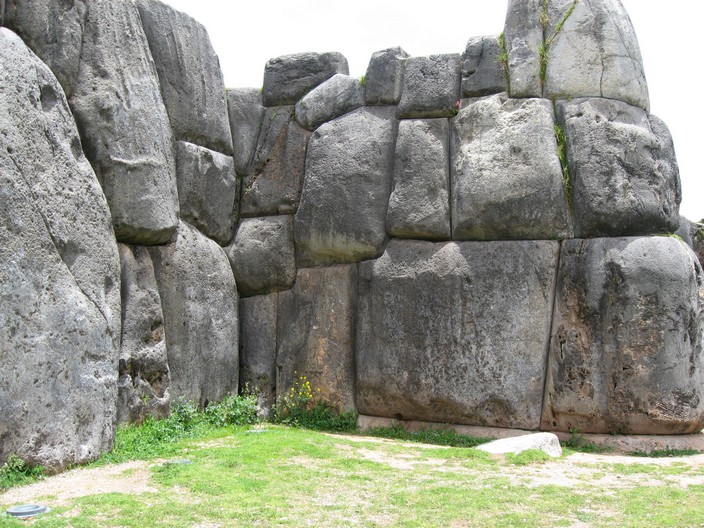
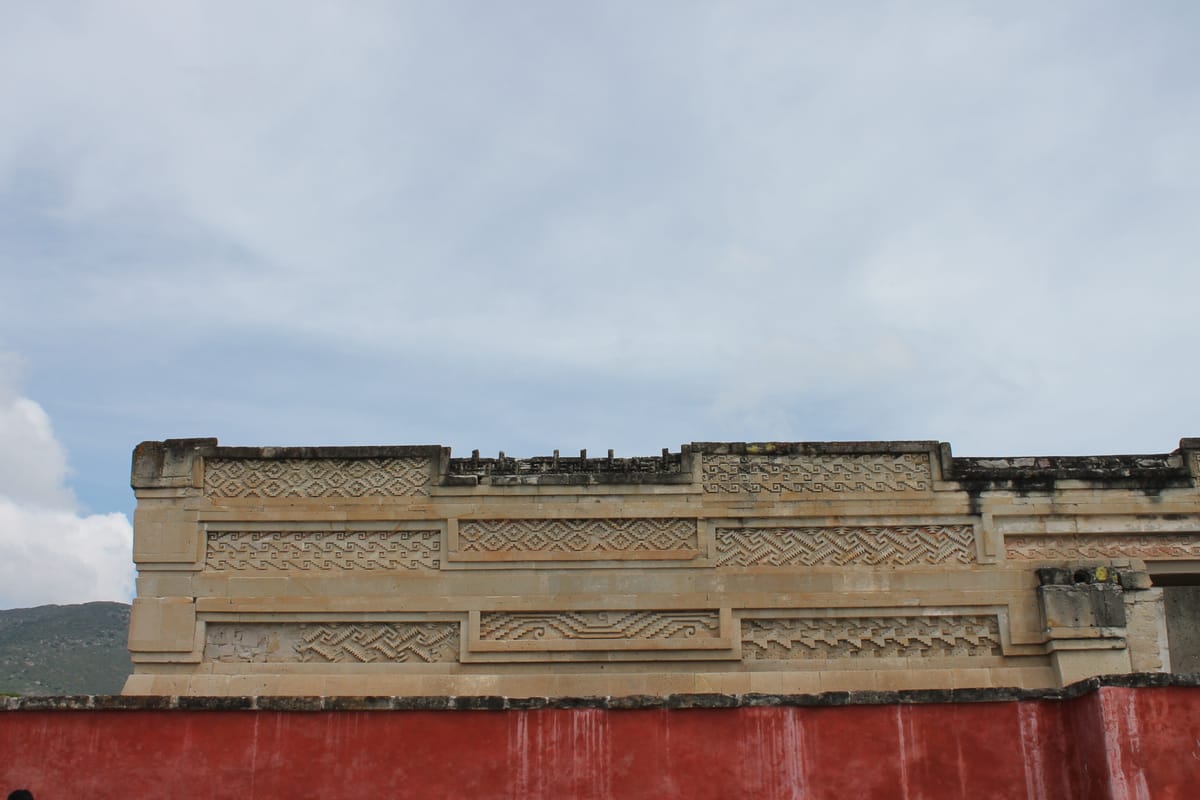
On a hill above Cusco there is a wall whose stones weigh more than a hundred tonnes each, fitted along curving seams so tightly that a knife blade still will not go in. Nothing holds them but their own cut faces. Four thousand kilometres north, in a valley in Oaxaca, there is a wall built on exactly the same principle that looks nothing like it. Its stones fit in your palm. There are more than a hundred thousand of them, cut into step-frets and locked into panels that stand on nothing but the pressure of their neighbours. The same refusal, at opposite ends of the scale that stone comes in.
The Inca at Sacsayhuamán won by grinding. Blocks were pecked out with hammerstones and hauled on sledges by rope and muscle — no wheel, no iron, no draft animals — then set, lifted, adjusted and set again until each irregular face met its neighbour along a seam with no gap. Pedro Cieza de León was told twenty thousand people worked the site. The reward was seismic: those interlocking shapes rode out the earthquakes that flattened colonial buildings raised from their own looted stone. The Zapotec at Mitla won by planning. Master craftsmen laid out each design as a template, and teams of cutters shaped trachyte to it piece by piece, every fragment destined for one predetermined slot in a wall fully specified before a chisel touched it. No panel at Mitla repeats another exactly.
They never met, and neither learned it from the other; both traditions have deep local pedigrees, the Andean one running back through Wari and Tiwanaku, the Oaxacan one through nearby Yagul, where the fretwork first shows up rough and unresolved. What they shared was not a technique but a consequence. Mortar is a tolerance — it takes up the difference between the stone you wanted and the stone you got. Remove it and there is no difference left to absorb, at any size. Whether your block weighs a hundred tonnes or sits in one hand, the only currency left is patience. Then, within a single generation, the same Spaniards reached both: carting Sacsayhuamán’s finest blocks downhill into Cusco’s churches, planting a church on Mitla’s platform and copying its fretwork onto Oaxaca’s cathedral. Neither wall ever needed anything to hold it together. Both are still holding.
Read the full studies: SacsayhuamánThe Stone Mosaics of Mitla