Great Zimbabwe
Colonial-era authorities spent decades insisting Africans could not have built this city — so how, exactly, did a Shona state organize the labor, engineering skill, and long-distance trade needed to raise 800,000-plus mortarless granite blocks into walls eleven metres high, and why, after roughly two centuries at the height of its power, was the city abandoned?
Why this rating?
- Construction difficulty
- 3/5
- Method uncertainty
- 2/5
- Capability gap
- 2/5
- Open questions
- 3/5
The dry-stone technique relies on locally abundant, naturally exfoliating granite and is architecturally well understood, so the achievement — while substantial for a five-century, mortar-free building program — sits comfortably within the capacity of the organized, wealthy Shona state that built it; the real open questions are narrower ones about labor mobilization, the Conical Tower's function, and the causes of 15th-century decline, not whether the builders were capable.
Overview
Great Zimbabwe is the largest surviving complex of pre-colonial stone architecture in sub-Saharan Africa: a sprawling city of dry-stone granite ruins spread across roughly 7 square kilometres near modern Masvingo, in southeastern Zimbabwe. Settled from around 1000 CE, it grew into the capital of the Kingdom of Zimbabwe from the 13th century and remained a major political and commercial center until the 15th or 16th century, at its height home to an estimated 10,000-20,000 people. It was built and inhabited by the ancestral Shona, the Bantu-speaking people who remain the majority population of Zimbabwe today, and it gives the modern country its name: “zimbabwe” is a Shona term for a house or court built of stone. The site’s most striking feature is that its massive curved walls — some standing 11 metres high — were laid entirely without mortar, using tens of thousands of precisely shaped granite blocks fitted together by weight and friction alone. Long before Europeans arrived in the region, Great Zimbabwe sat at the center of a gold- and ivory-trading network stretching to the Swahili coast and, from there, across the Indian Ocean — and for much of the 20th century, colonial authorities went to considerable lengths to deny that an African society had built it at all. Today it is a UNESCO World Heritage Site (inscribed in 1986, reference #364) and Zimbabwe’s most important national monument, and the stylized soapstone Zimbabwe Bird found among its ruins appears on the national flag and coat of arms.
The Structure
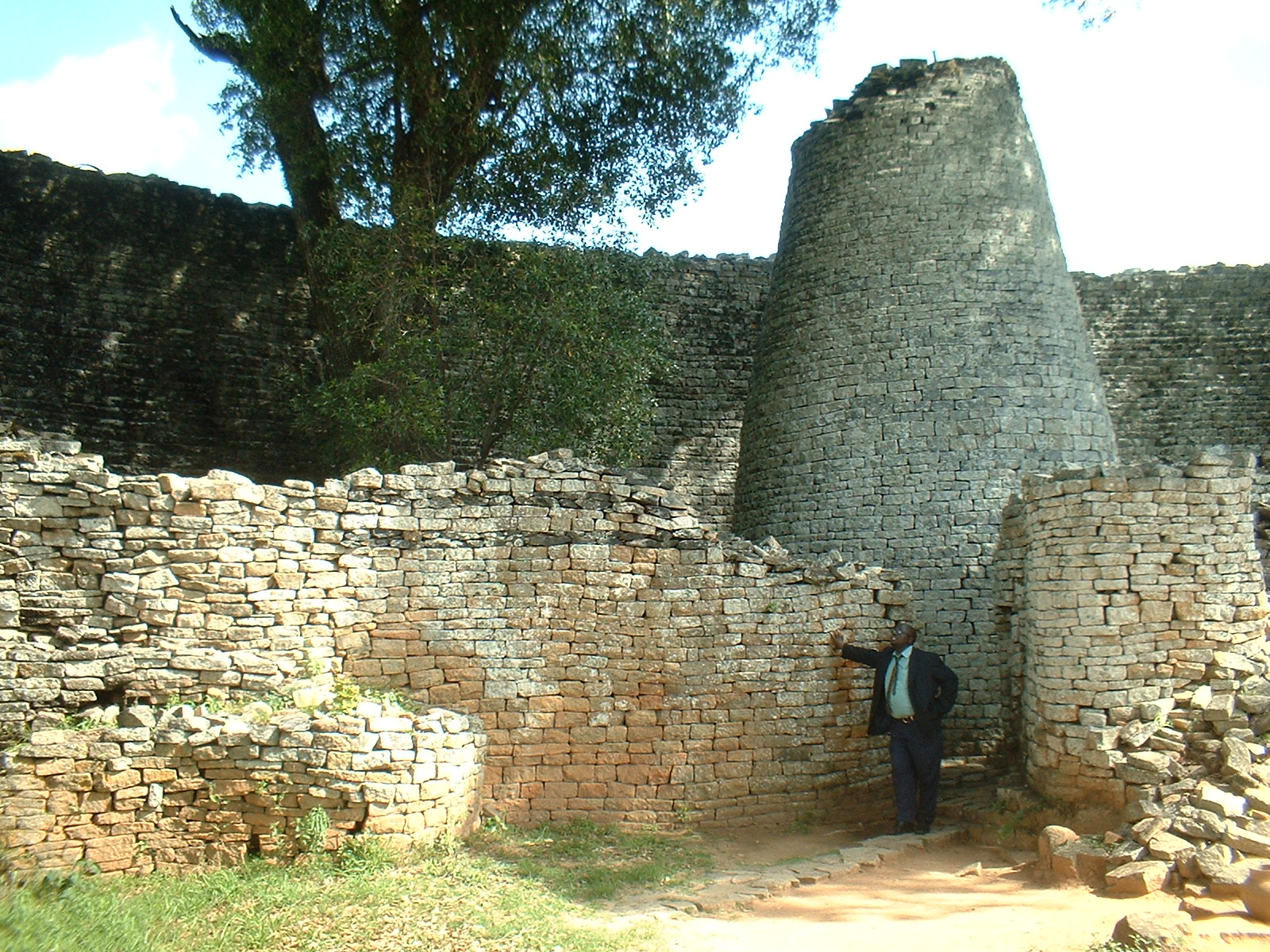
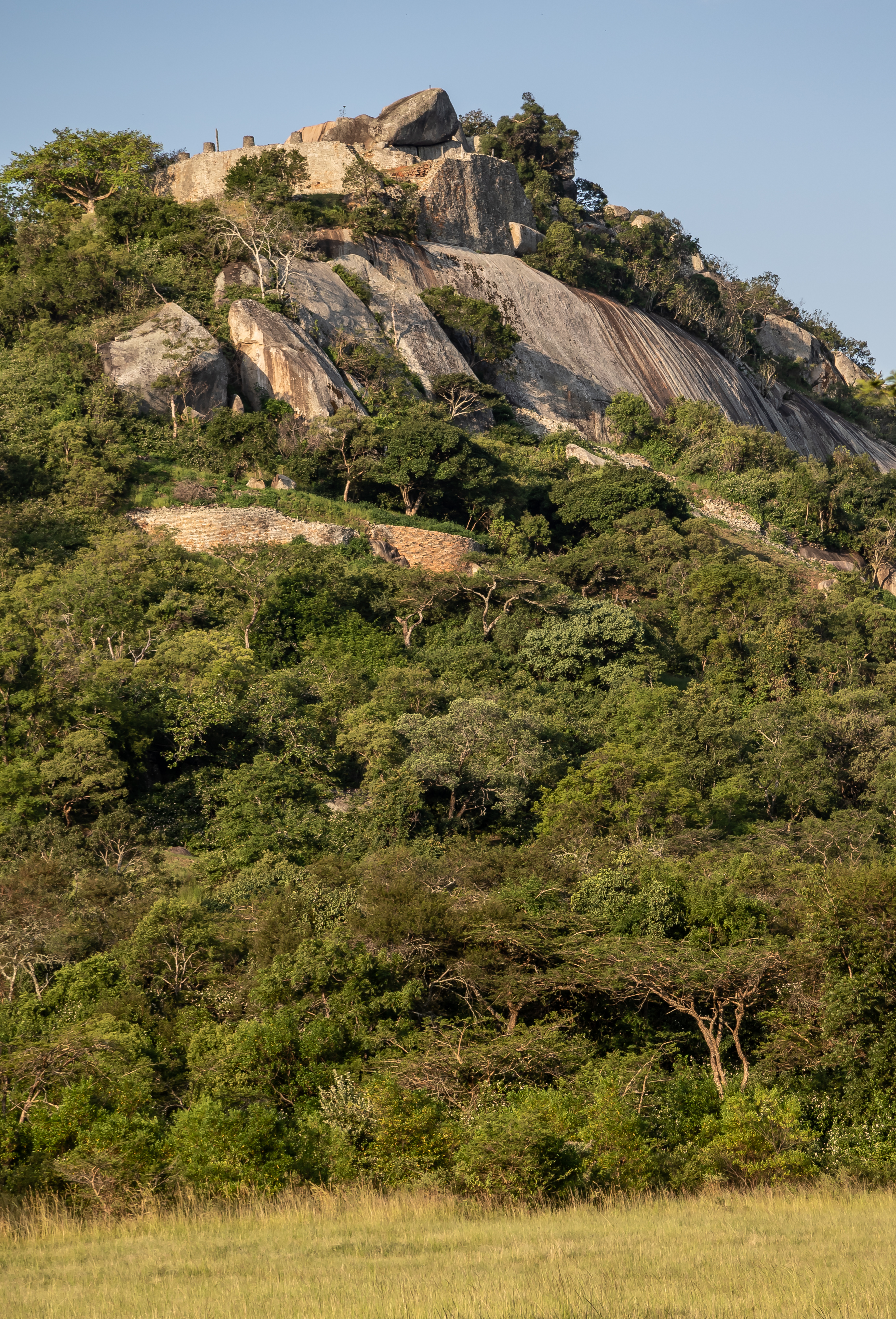
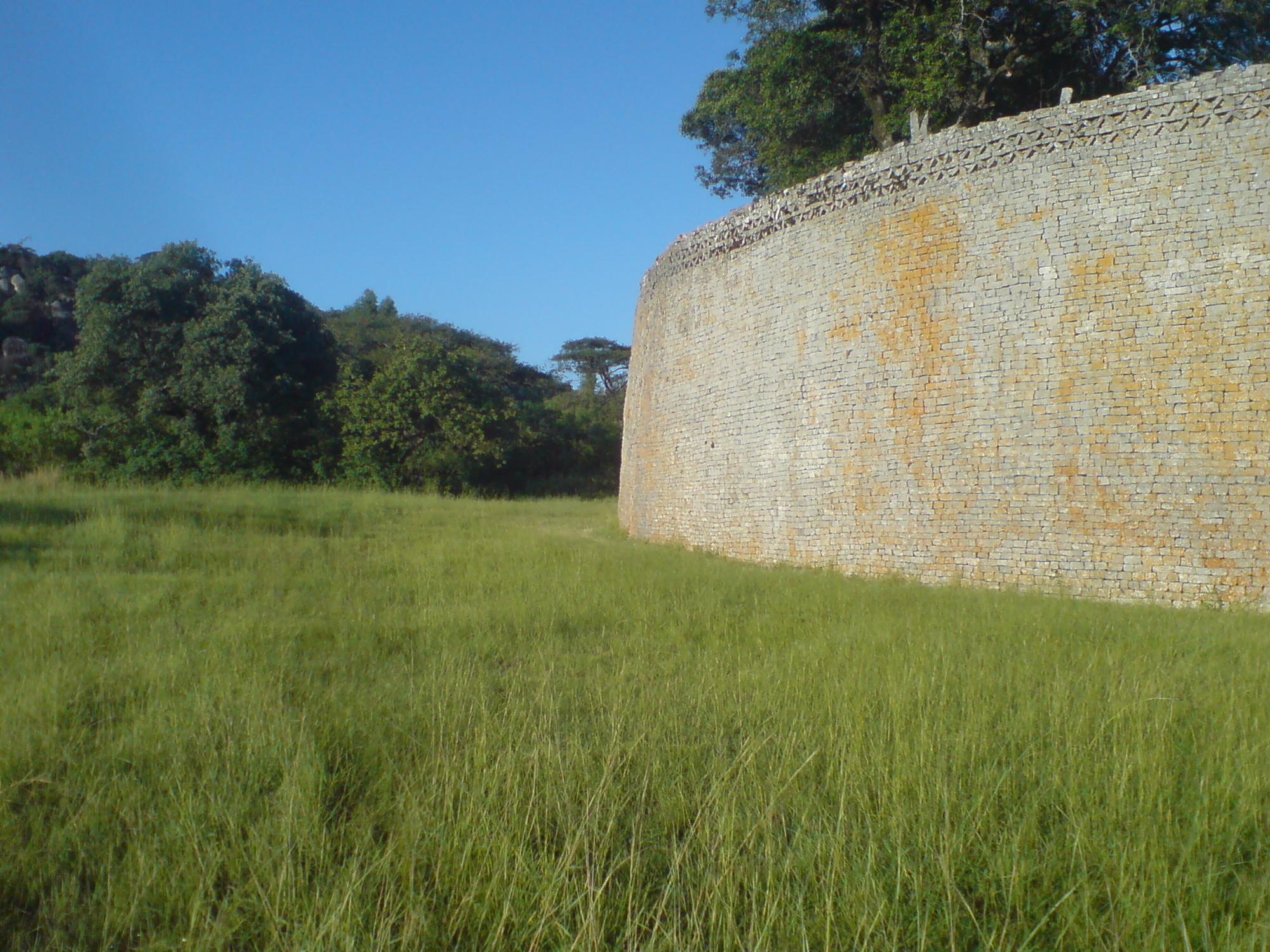
The ruins fall into three main groupings, built up over several centuries. The Hill Complex, occupying a granite kopje (outcrop) roughly 80 metres above the surrounding plain, is the oldest section, with stonework dating from at least the 11th-12th century; it likely served as a royal or ritual precinct, its walls threading between natural boulders to enclose a series of chambers and courtyards. Below it spreads the Valley Complex, a lower-lying area of house platforms and enclosures — the residential heart of a city whose ordinary dwellings were built of daga (packed earth/clay) rather than stone, meaning the stone ruins that survive represent only the elite and ceremonial core of a much larger settlement. The most famous structure is the Great Enclosure, built mainly in the 13th-14th centuries: a vast elliptical wall roughly 250 metres in circumference, up to 5.5 metres thick and as much as 11 metres high in places, curving around an inner space that includes a second, concentric passage wall and a series of stone platforms. Rising within the enclosure is the Conical Tower, a solid, tapering drum of stone about 5-5.5 metres across at its base and roughly 9-10 metres tall — built with no internal chamber or stairway, its form and purpose still debated by archaeologists (a granary-like monument to royal grain wealth and stored power is the leading interpretation).
Great Zimbabwe’s wealth rested on trade. Excavations across the site have recovered gold ornaments and smelting debris, worked ivory, iron tools, and copper ingots alongside imported Persian and Near Eastern glazed pottery, glass beads, and fragments of Chinese Ming-dynasty porcelain — physical evidence that the city was linked, via intermediary Swahili coast ports such as Kilwa and Sofala roughly 400 kilometres away, into the broader medieval Indian Ocean trading world. Among the most celebrated finds are eight soapstone birds, carved atop tall monoliths and generally identified with the bateleur eagle, a figure of spiritual and political significance in Shona tradition; one of these carvings, the Zimbabwe Bird, was adopted as the national emblem of independent Zimbabwe.
How Was It Built?
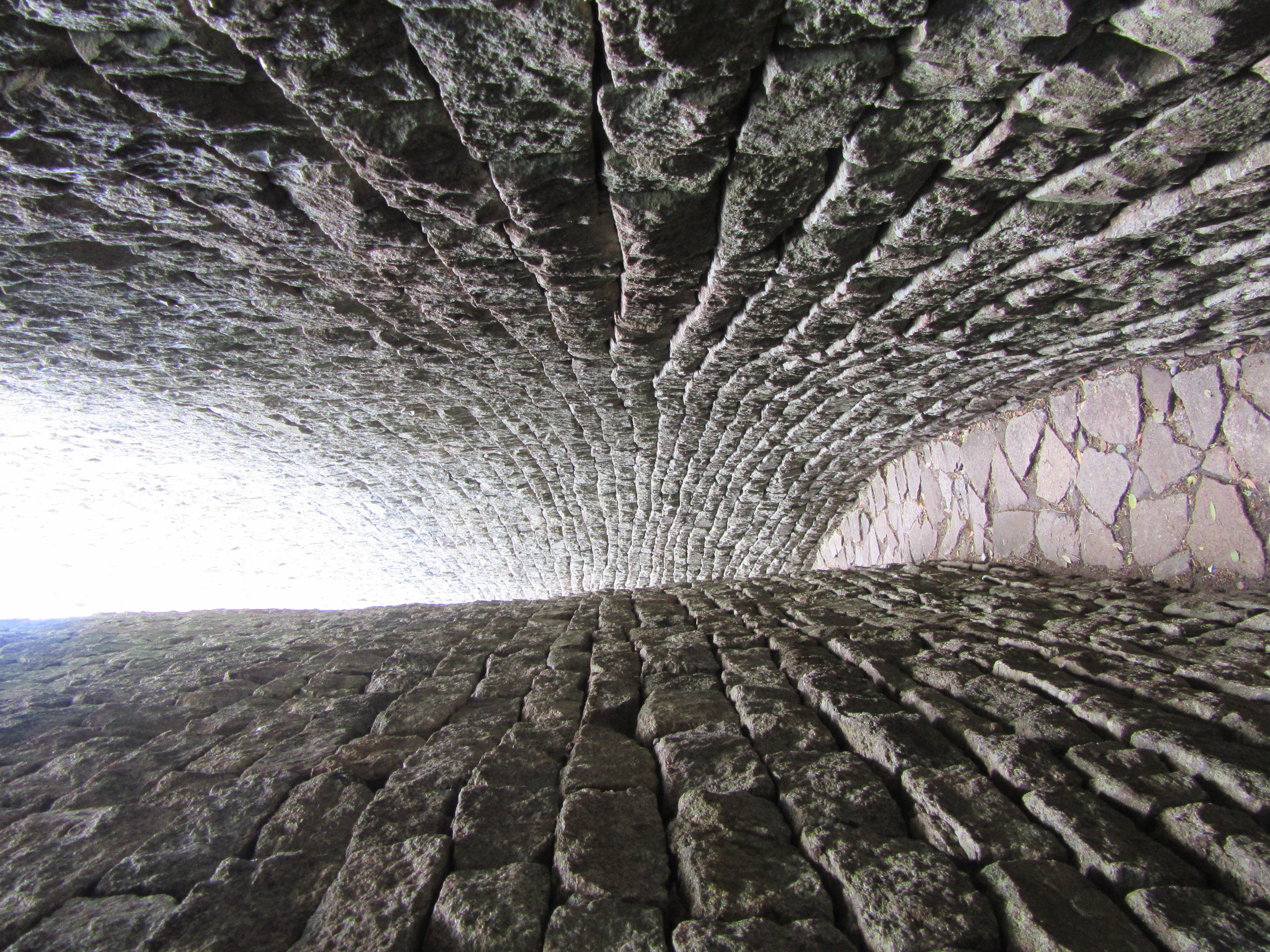
Great Zimbabwe’s builders exploited a locally abundant resource: granite that naturally exfoliates into flat, tabular slabs when exposed by weathering, requiring no iron tools or explosives to quarry into workable building stone. Masons split and dressed these slabs into roughly rectangular blocks and laid them in level courses, relying on the sheer mass, careful coursing, and slightly inward-battered profile of the walls — rather than mortar or binding material — to hold the structures together and let them flex rather than crack over centuries of weathering. Estimates of the material involved run into the hundreds of thousands of blocks for the Great Enclosure alone. Raising and maintaining walls at this scale, across a site occupied and expanded for roughly five hundred years, required a stable, resourced state: organized labor for quarrying and hauling stone, skilled specialist masons capable of coursing the distinctive chevron and herringbone decorative patterns visible on parts of the Great Enclosure wall, and a ruling elite with the authority and surplus wealth (much of it from gold and cattle) to direct such projects over generations. No contemporary written building records survive from the Shona state itself, so much of this is inferred from archaeology and the comparative study of dry-stone building traditions elsewhere in the region, rather than from an explicit historical account of how the work was organized.
The Mainstream View
Modern archaeology treats the question of who built Great Zimbabwe as settled beyond serious dispute. Excavated pottery, iron and copper working, cattle-based economy, house forms, and burial customs all tie the site firmly to the ancestral Shona and to the broader Bantu-speaking farming societies that had occupied the Zimbabwean plateau for centuries beforehand; Great Zimbabwe is understood as the largest and most elaborate expression of a wider regional tradition of dry-stone building (zimbabwes) found at hundreds of smaller related sites across the region. Scholars date its main construction to the 11th through 15th centuries CE, with the Great Enclosure’s walls raised primarily in the 13th and 14th centuries during the kingdom’s peak, when it controlled access to regional goldfields and dominated trade routes to the coast. Its decline, beginning in the 15th century, is generally attributed to some combination of exhausted local resources (including firewood and soil fertility for a large concentrated population), overpopulation, drought or climatic shifts, and the redirection of gold trade toward rival states such as the emerging Mutapa state to the north — though scholars continue to debate the relative weight of each factor. What is not in scholarly doubt is authorship: this was an accomplishment of indigenous Southern African civilization, achieved through organized labor, technical skill, and a wealthy, well-governed state — not evidence of any outside builders.
The Open Case
The genuine open questions about Great Zimbabwe concern method and history, not identity. Exactly how labor was organized and mobilized to move and shape hundreds of thousands of granite blocks over generations — whether through tribute obligations, seasonal corvée labor, specialist guilds of masons, or some combination — is not directly recorded and remains a matter of archaeological inference. The precise function of the Conical Tower, with no door, stair, or internal chamber, is still debated, as is the full division of ritual, political, and residential space across the Hill Complex, Great Enclosure, and Valley Complex. And the relative causes of the city’s 15th-century decline — ecological strain, drought, political fragmentation, or the pull of shifting gold and ivory trade routes — remain an active research question rather than a closed case. These are the legitimate mysteries. What is not legitimately in question is who built Great Zimbabwe: for decades, colonial-era writers and Rhodesian settler authorities promoted theories crediting the ruins to Phoenicians, Arabs, the biblical Queen of Sheba, or a vanished “white race,” and colonial administrations went so far as to suppress archaeologists’ findings that contradicted this narrative. Careful excavation through the 20th century — notably by David Randall-MacIver in 1905-06 and Gertrude Caton-Thompson in 1929, whose stratigraphy, pottery, and material culture analysis found the site conclusively African in origin and construction — dismantled those theories decisively, and later research has only reinforced the same conclusion. Great Zimbabwe is correctly wondered at for its scale, its engineering, and the sophistication of the state that built it; it should never be wondered at as evidence that its own people could not have done so.
Sources
Connected findings
- One Rock Cut Square, One Rock Grown Hexagonal — Same Wall — In Zimbabwe and Micronesia, two peoples with nothing in common raised mortarless stone cities from opposite ends of geometry.
On screen
- The Walls You Build for Gold — Two strategy games let you raise Great Zimbabwe yourself — and one of them still hands you the Queen of Sheba on the way out.
Gallery