The Walls You Build for Gold
Two strategy games let you raise Great Zimbabwe yourself — and one of them still hands you the Queen of Sheba on the way out.
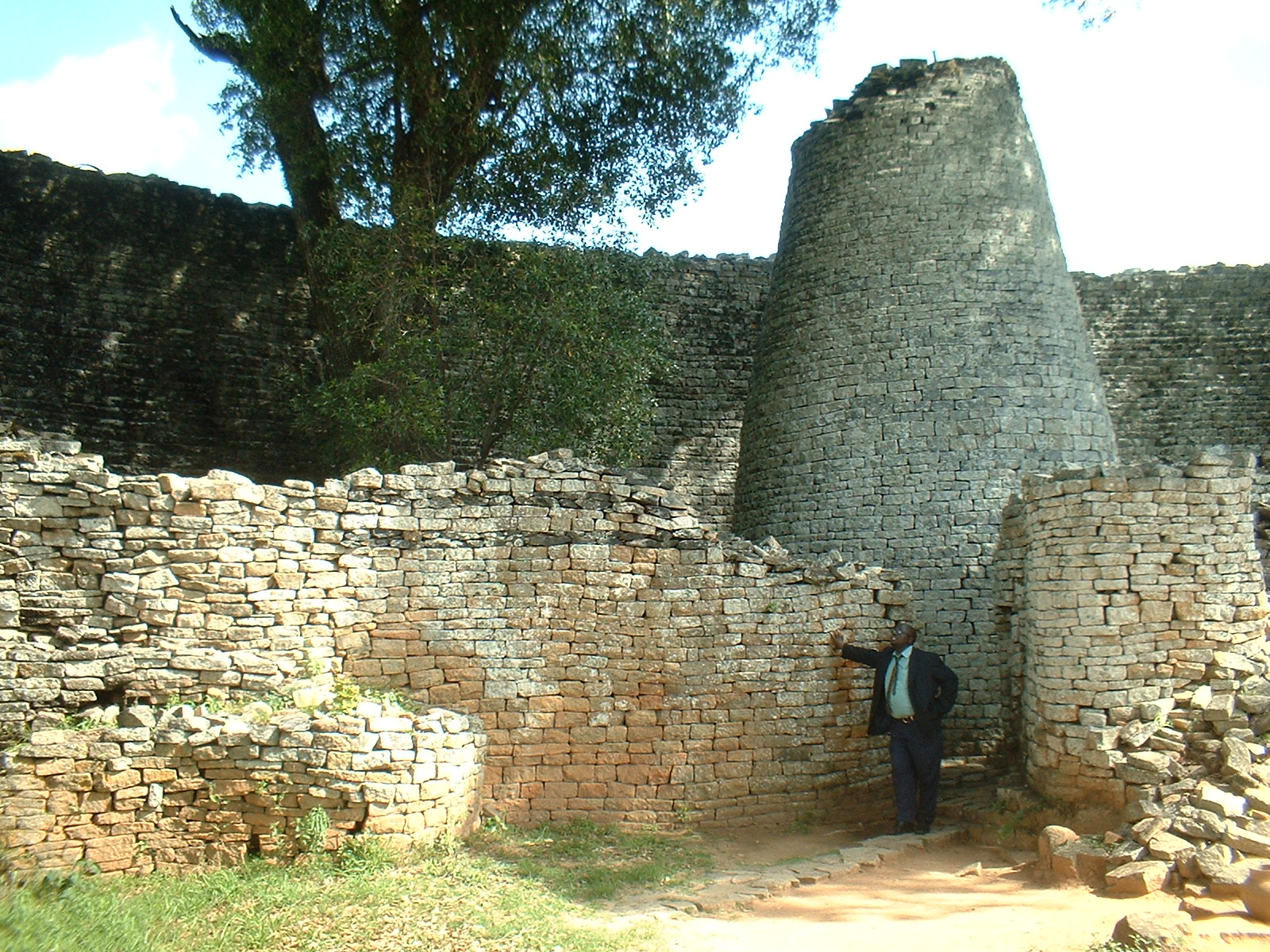
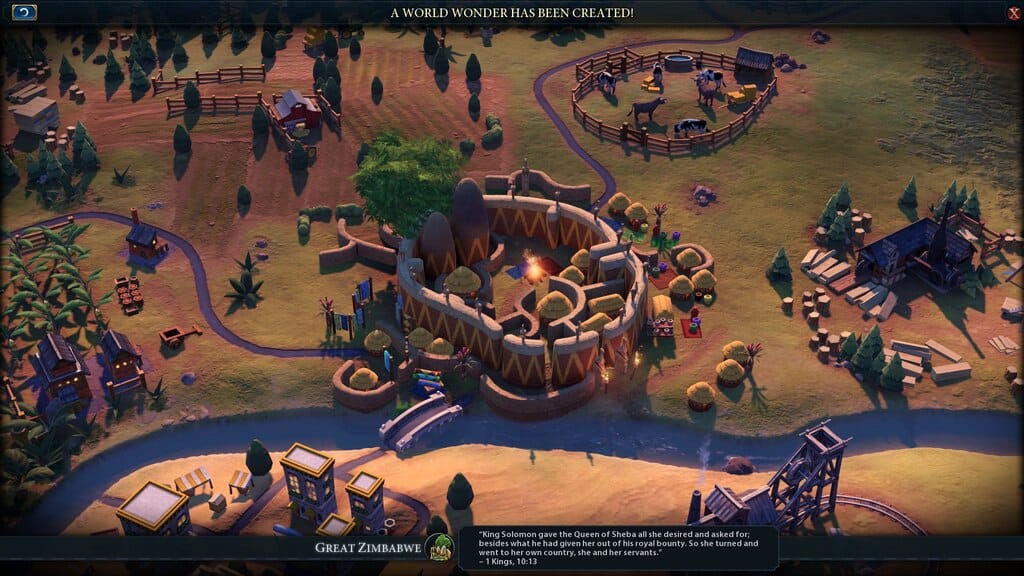
Civilization VI puts Great Zimbabwe in the Renaissance era, behind the Banking technology, and then attaches a condition most wonders never get: it has to be built beside a Commercial Hub with a Market and beside cattle. That second requirement is the game quietly doing its homework. The Shona state that raised these walls ran on herds as much as on gold — cattle were wealth, tribute and political capital — and Civ VI’s version pays out accordingly, adding a trade route to the city and stacking gold onto every trade run for the bonus resources sitting within three tiles. Nine hundred and twenty production later, a miniature of the Great Enclosure rises on the map: coursed granite, the chevron banding from the real outer wall, the conical tower standing solid in the middle of it, and a cow pen right up against the gate.
Then the game finishes the job and shows its seams. The completion card reads: “King Solomon gave the Queen of Sheba all she desired and asked for; besides what he had given her out of his royal bounty.” — 1 Kings, 10:13. That is the exact legend colonial administrators leaned on for decades to argue that Africans could not have built this place. What makes it stranger is that the wonder’s own Civilopedia entry opens by naming that legend and knocking it down — “According to one set of legends, Great Zimbabwe was the palace complex of the Queen of Sheba… In point of boring fact, it was the capital city… of the Kingdom of Zimbabwe” — and even quotes the Portuguese officer Vicente Pegado, writing in 1531, on “great walls, made of chiseled stone fitted without mortar,” which is the part of this site that should genuinely stop you. Firaxis wrote the debunking, then picked the myth for the victory screen. (The entry also calls the setting a jungle. It is granite hill country and open savanna, which is precisely why there was so much naturally split building stone lying around.)
Humankind takes the site earlier and makes it communal. Amplitude added Great Zimbabwe as a Medieval-era Cultural Wonder in February 2022, a free reward that shipped to anyone who claimed it, and in keeping with the game’s design it is a shared project — several cities pitching production into one build rather than a single capital hoarding the glory, which is a closer fit to five centuries of accumulated construction than a lone production queue is. Finish it and you get stability, fame, and money that scales with how many different resources your empire has its hands on: a trading city, rewarded for trading. The encyclopedia entry calls it “a colossal fortress-city… as elegant as it is impregnable,” which is the one word to argue with — archaeologists generally read the Great Enclosure’s walls as screening and display rather than defence, prestige architecture for an elite rather than a rampart anyone expected to hold.
Between them the two games land the same verdict from opposite ends of the tech tree: Great Zimbabwe was an economy. Cattle, gold, beads out of the Indian Ocean and porcelain from Ming China, all funnelling through a walled capital of somewhere between ten and twenty thousand people. That is the accurate part, and both games commit to it. What neither can queue up is the labour — the generations of masons splitting exfoliated granite into courses and setting eleven metres of wall without a drop of mortar, batter and friction doing the work that a binding agent does everywhere else. You can build it in a hundred turns. It took them five hundred years.
Read the full study: Great Zimbabwe