The Temples That Keep Time
In Odisha and in Yucatán, two peoples who never met each built not a temple aligned to the sun, but a temple that reads it — a building you can tell the time by.
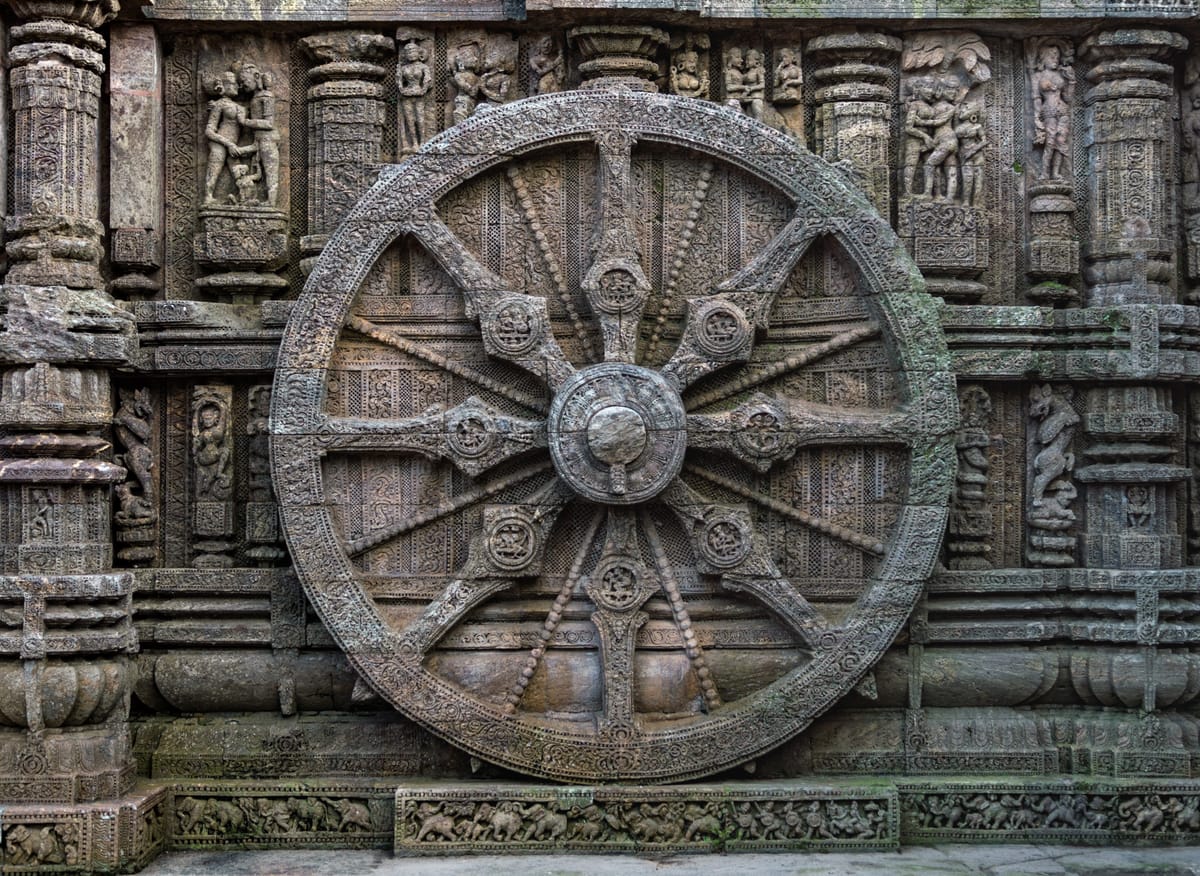
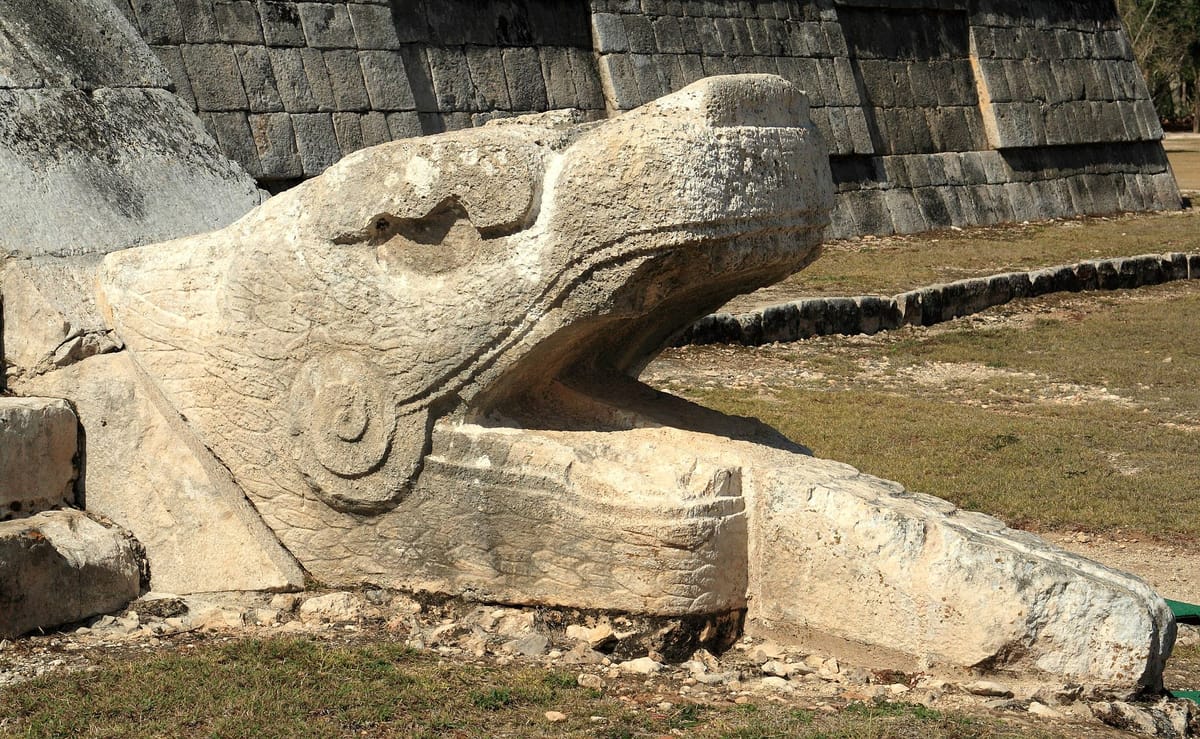
Picture a stone wheel nearly three metres across, one of twenty-four ranked along the base of a temple on the Odisha coast, carved so finely that a raised pin at its hub throws a shadow you can lay your finger on and read the hour from. The whole building around it is a chariot — seven straining horses, a base of wheels — dragging the sun god Surya across the sky, and it faces east so the first light of dawn strikes it head-on. Now picture a pyramid on the far side of the planet, in the flat scrub of the Yucatán, its four staircases climbing ninety-one steps each. Add the platform at the top and every stair counts out three hundred and sixty-five: one step for every day the sun takes to come back around. Two buildings, and neither is merely pointed at the sky. Each one is built to read it.
The instruments work in different registers. Konark keeps time by the day. Its wheels are read as gnomons — the spoke and its shadow marking the passage of the hours, a sundial the size of a cartwheel repeated two dozen times down the plinth, and pilgrims are still shown how to tell the time from one. (How precise those readings truly are is argued over; the popular claim that they run “to the minute” outpaces the evidence, but the wheels genuinely cast a legible, moving shadow.) El Castillo keeps time by the year. Its arithmetic is the calendar — 4 × 91 + 1 = 365 — and its showpiece is a single hinge of the year: on the afternoons around the equinoxes, the setting sun catches the pyramid’s stepped northwest corner and stacks a row of bright triangles down the balustrade, so that a serpent of light appears to ripple downward to the carved stone snake-head waiting at the base. (Even here the honest account is careful: archaeoastronomers agree the geometry throws a real shadow effect, while some, at recent conferences, argue the vivid “descending serpent” has been dramatized well beyond what the stone reliably does.) One temple measures the hour; the other measures the return of the seasons.
And here is the strange part. Konark rose around 1250, on the Bay of Bengal, under a Hindu dynasty of Kalinga. El Castillo was built two to four centuries earlier, by the Maya, across an ocean neither people knew held anything on the other side. No trader, no missionary, no drifting idea carried the notion from Odisha to the Yucatán or back. Two civilizations, each staring up at the same sun from opposite hemispheres, arrived at the same audacious conclusion entirely alone: that the highest thing you could do for a temple was not to decorate it with the sky but to make it keep the sky — to build a machine of stone whose moving parts are shadows, and whose ticking is the turning of the world. Stand at either one at the right hour and the building tells you something true about where you are in the day, or the year. The shadow crosses the wheel; the serpent comes down the stair. Nobody wound them, and they have not stopped.
Read the full studies: Konark Sun TempleEl Castillo (Temple of Kukulcán), Chichén Itzá
Sources
- UNESCO World Heritage Centre — Sun Temple, Konârak
- Encyclopaedia Britannica — Konark Sun Temple
- Wikipedia — Konark Sun Temple
- UNESCO World Heritage Centre — Pre-Hispanic City of Chichen-Itza
- Wikipedia — El Castillo, Chichen Itza
- Encyclopaedia Britannica — Chichén Itzá
- Yucatán Magazine — Equinox 'serpent' at Kukulkan debunked at archaeology conference