Konark Sun Temple
How did thirteenth-century Eastern Ganga builders raise a roughly 70-metre stone tower on the sandy Odisha coast — binding colossal slabs with forged wrought-iron beams and topping it with an enormous crowning stone — and why did that great sanctuary tower collapse while the porch beside it still stands?
Why this rating?
- Construction difficulty
- 4/5
- Method uncertainty
- 3/5
- Capability gap
- 2/5
- Open questions
- 3/5
Raising a roughly 70-metre tower on unstable coastal sand, binding oversized stone slabs with forged iron beams and hauling khondalite and chlorite from distant quarries was a genuinely hard, large-scale engineering campaign, so construction difficulty is high; but the Eastern Ganga state was a well-documented, demonstrably capable medieval civilization with ample labour, elephants, ramps and iron-working, so no exotic capability is required. What is really open is the fine detail: whether the great sanctuary tower was ever fully completed, exactly how it was raised, and above all why it collapsed while the adjacent hall survived — that failure, and the lost superstructure, leave more unresolved than at a still-intact temple, even as the sensational lodestone legend has no physical support.
Overview
Near the shore of the Bay of Bengal, in the small town of Konark in Odisha, stands the wreck of one of the most extravagant ideas in the history of Indian architecture. In the middle of the thirteenth century, Narasimhadeva I of the Eastern Ganga dynasty ordered the building of a temple to Surya, the sun god — and rather than a conventional shrine, his architects conceived the entire building as Surya’s chariot, a colossal ceremonial vehicle carved in stone and frozen mid-journey across the sky. Along its base run twenty-four enormous wheels; at the front, teams of straining stone horses appear to haul the whole mass forward. At its heart once rose a sanctuary tower said to have climbed some 70 metres, one of the tallest temples ever raised in India. That tower has since fallen, and what survives today is chiefly the great pyramid-roofed hall in front of it, together with the wheels, the horses and a dense skin of some of the finest sculpture in medieval India. European sailors, navigating by the dark bulk of the ruin on the coast, called it the “Black Pagoda.” It was inscribed as a UNESCO World Heritage Site in 1984 and appears on India’s ten-rupee note. Its fame rests on a double wonder: the sheer daring of building a mountain-sized chariot in stone, and the still-argued question of why its highest tower came down.
The Structure
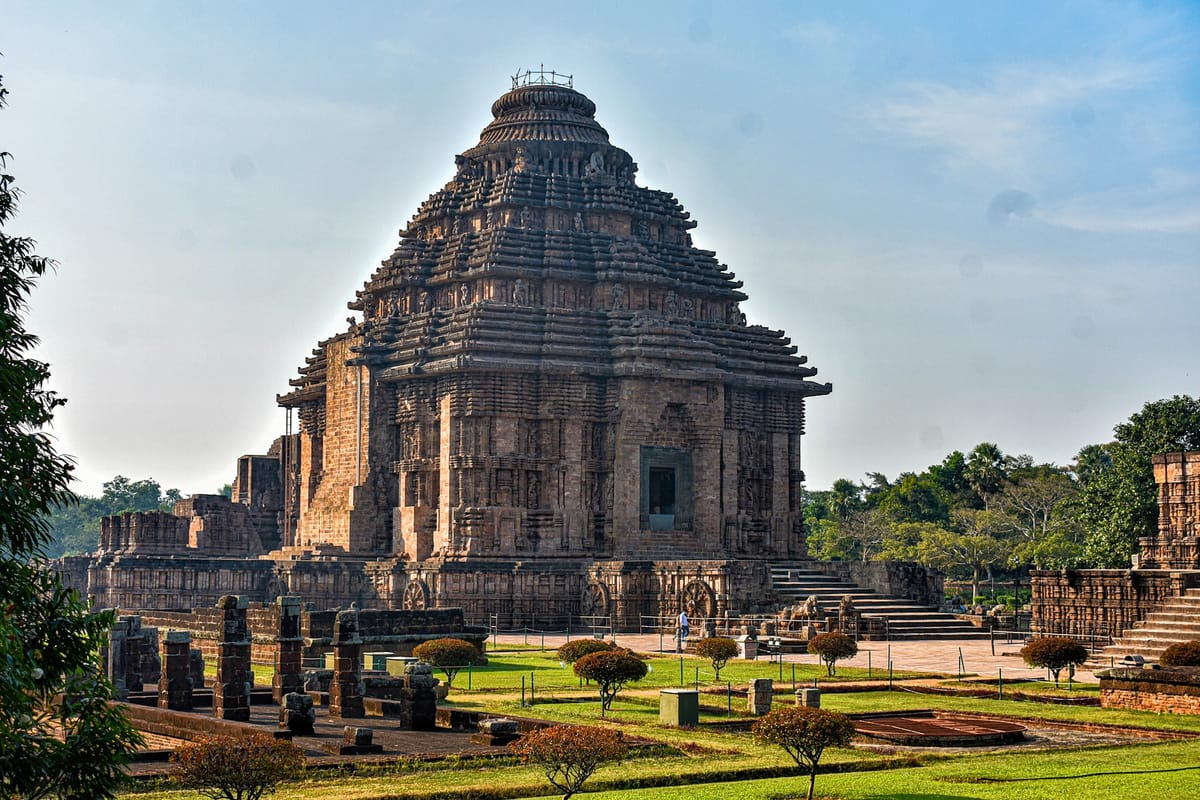
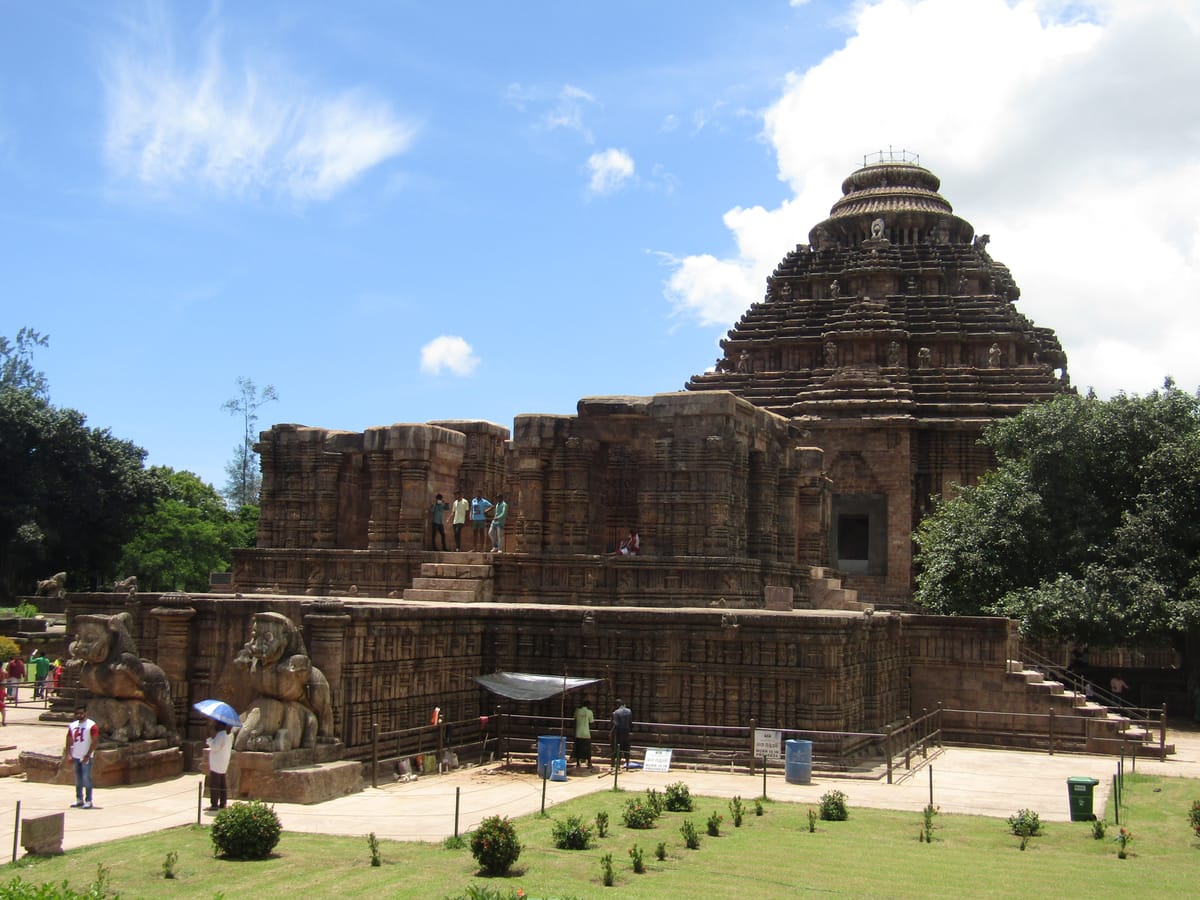
Konark was built to the classic Kalinga (Odishan) temple plan, but scaled up and reimagined as a chariot. The complex is aligned so that the temple faces east, toward the rising sun. The two main elements sit on a shared, richly carved platform: the deul or rekha — the tall curvilinear sanctuary tower over the sanctum, now collapsed — and, immediately in front of it, the jagamohana, the pyramid-roofed audience hall that is the tallest surviving part of the temple today, on the order of 30 metres high. A short distance to the east stands a separate pillared nata mandira, the hall of dance. The sanctuary tower is generally reconstructed as having risen to roughly 70 metres, which would have made it among the very tallest temple towers in India; because it no longer exists, that height is an informed estimate rather than a measured fact.
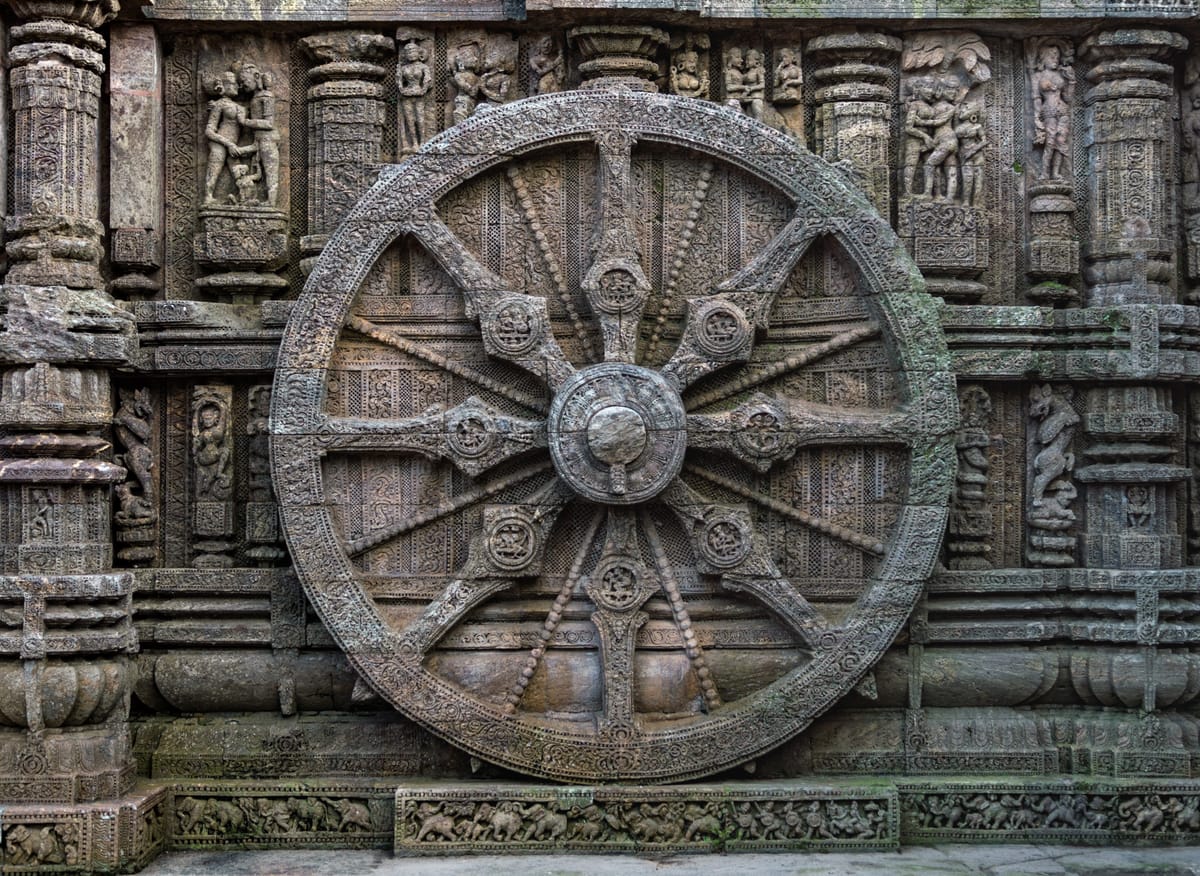
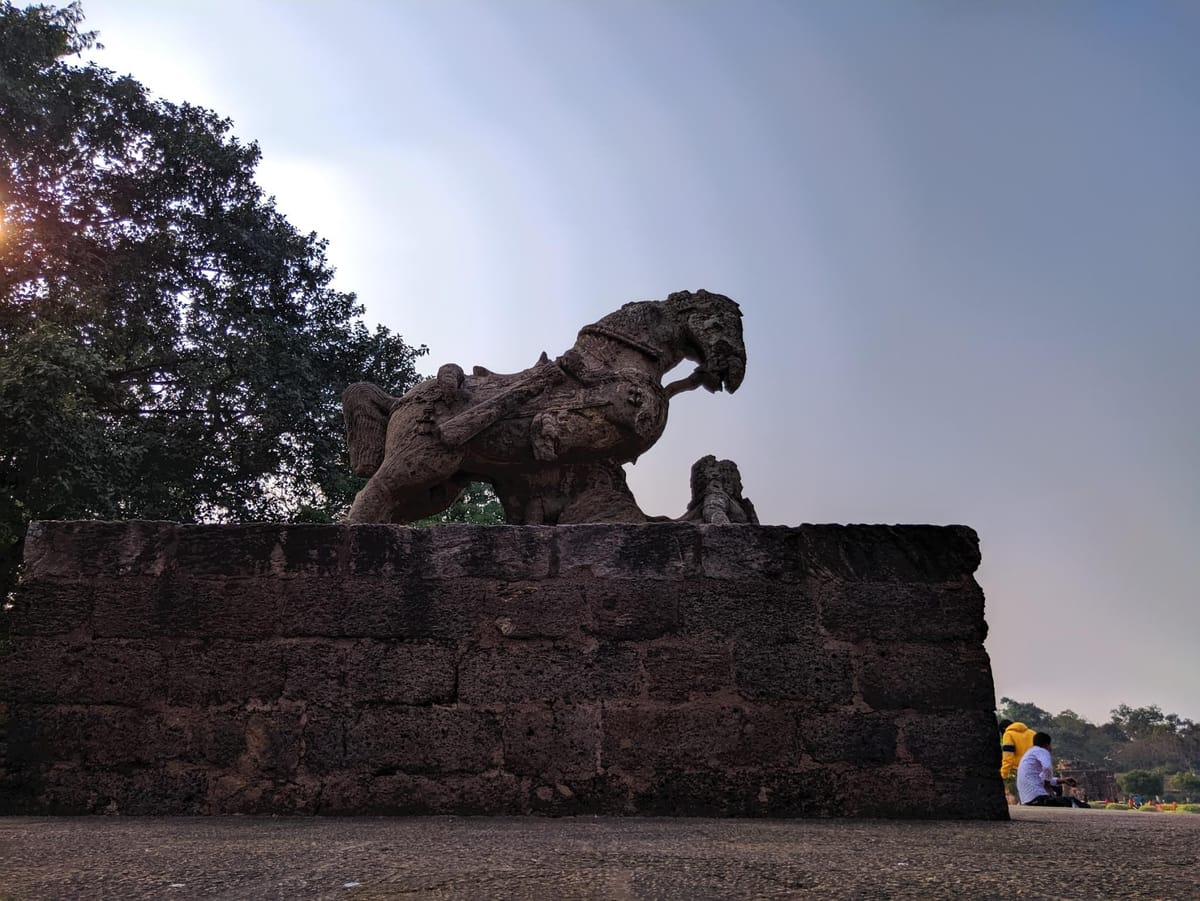
The chariot conceit is carried through in stone. Along the base of the platform are set twenty-four great wheels, each close to three metres in diameter, carved as ornate spoked discs with beaded rims and medallions — twelve pairs, popularly read as the twelve months, and each wheel commonly interpreted as a functioning sundial whose shadow can be used to tell the time of day. Seven massive horses, several now badly damaged, are shown pulling the temple forward. The whole building is sheathed in sculpture: deities, musicians, dancers, animals, scenes of court and daily life, and the frankly erotic figures that Konark shares with other temples of its age.
The materials are as deliberate as the design. The bulk of the structure is khondalite, a hard local metamorphic stone chosen for durability but prone to weathering; the platform and foundations make heavy use of laterite; and the finest carving, along with door frames and key sculptures, is worked in dark, fine-grained chlorite. Much of this stone is not local to the immediate site and had to be brought from distant quarries, transported — the standard reconstruction holds — along rivers and water channels toward the coast before being dressed and set. Tradition and later accounts hold that the temple was raised by an enormous workforce, often given as some 1,200 artisans, over a campaign of roughly twelve years.
How Was It Built?
The Eastern Ganga builders faced two problems at once: raising a very tall, top-heavy tower, and doing it on soft coastal ground near the sea. The stone itself had to be quarried elsewhere, moved to Konark, cut into precisely fitted ashlar blocks, and assembled largely by interlocking dressed masonry. To move and lift it, the builders would have drawn on exactly the tools a medieval Indian state is known to have commanded: large organised labour gangs, timber sledges and rollers, levers, ropes, earthen ramps, and trained elephants — some of the temple’s own carvings even depict lifting and construction scenes.
Konark’s most distinctive engineering signature, though, is iron. To span wide openings and to tie its heaviest stones together, the builders used wrought-iron beams and iron clamps and dowels set between blocks — a structural use of metal at a scale unusual for the period. Metallurgical study of the surviving beams shows that they were not cast in one piece but forged from shorter segments, on the order of a foot or so long, welded together into long members; the iron is notably corrosion- resistant, having survived centuries of salt coastal air far better than one might expect. These beams helped carry the loads over the temple’s broad interior spaces and reinforced the upper structure.
The foundation was engineered for the coast. Investigations describe a deep, layered stone foundation carried down many metres, with the load spread outward at an angle so that the enormous weight of the tower would bear on as much of the soft ground as possible — a recognisably sound response to building heavy masonry on sand. None of these techniques is beyond a capable thirteenth-century state; what is striking is the ambition of combining them to raise a 70-metre tower right at the water’s edge.
The Mainstream View
To historians and archaeologists, Konark is not an unsolved mystery in the way popular legend suggests, but a spectacular and largely explicable achievement of a wealthy, sophisticated medieval kingdom. The builder, patron dynasty and rough date are well established: the temple was raised by Narasimhadeva I of the Eastern Ganga dynasty around the middle of the thirteenth century, and it belongs securely to the mature tradition of Kalinga temple architecture, of which the great temples of nearby Bhubaneswar and Puri are close relatives. The chariot form, the sun symbolism, the wheels-as-months and the horses are read as a coherent, intentional theological programme, not an enigma. The engineering — moving stone by water, lifting it with ramps, rollers, levers and elephants, tying it with iron — is regarded as impressive but consistent with what the period could do. UNESCO and the Archaeological Survey of India frame Konark as a masterpiece of Odishan art and engineering, and modern technical reviews of its construction treat the foundation design and iron reinforcement as evidence of genuine skill rather than of anything inexplicable.
Crucially, the mainstream view firmly separates the real temple from its folklore. The famous story of a giant 52-tonne lodestone at the summit — said to have held an iron idol of the sun god floating in mid-air, and to have dragged passing ships off course before being removed — is treated as legend. No such magnet has ever been found, no floating idol is documented, and the physics of the tale does not hold up; it is a colourful tradition, not a record of how the temple worked.
The Open Case
What genuinely remains open at Konark is unusual, and more substantial than at an intact temple: the building’s most ambitious part is simply gone. The great sanctuary tower collapsed at some point before the nineteenth century, and there is no settled agreement on when it fell or why. Explanations put forward over the years include structural failure of a too-tall, top-heavy tower on yielding sandy ground; foundation subsidence; damage from cyclones and centuries of neglect once the temple was abandoned; the removal of key load-bearing stones; and deliberate destruction. Some scholars have even questioned whether the tower was ever fully completed, or whether it began to fail during or soon after construction. Because it no longer stands, its true height, its exact form, and the precise mechanism of its downfall are all matters of reconstruction rather than record. By the twentieth century the surviving jagamohana was itself judged so unstable that its interior was deliberately filled with sand and sealed to keep it from collapsing too — a striking measure that is itself a monument to how precarious the building had become.
Smaller questions cluster around the same theme. The structural role the wrought-iron beams played in the standing tower — how much they carried, and whether their placement contributed to or delayed the collapse — cannot be fully read from the ruin. The exact quarry sources for the stone, the water routes by which it travelled, and the real size of the workforce are informed inferences rather than documented facts. And the popular retellings that surround Konark — the levitating idol, the ship-wrecking magnet, the sundials accurate “to the minute” — mix real, remarkable features of the temple with embellishments that the evidence does not support. The honest position is that Konark is a solved marvel with a genuinely unsolved centre: we understand who built the sun god’s chariot, and roughly how, but not exactly how they raised its highest tower into the coastal sky — nor why that tower, alone among its parts, came back down.
Sources
- UNESCO World Heritage Centre — Sun Temple, Konârak
- Encyclopaedia Britannica — Konark Sun Temple
- Wikipedia — Konark Sun Temple
- PMC / journal review — The Konark Temple's Construction: A Critical Review of the Historical, Cultural, and Scientific Evidence
- Archaeological Survey of India — Sun Temple, Konârak (1984)
- World History Encyclopedia — Konarak Sun Temple
Connected findings
- The Temples That Keep Time — In Odisha and in Yucatán, two peoples who never met each built not a temple aligned to the sun, but a temple that reads it — a building you can tell the time by.
- india
- odisha
- eastern-ganga-dynasty
- narasimhadeva-i
- surya
- sun-temple
- hindu-temple
- khondalite
- iron-beams
- chariot
- unesco-world-heritage
- medieval-engineering
Gallery