Nobody Gave the Order
A monument is supposed to need a monarch — surplus to feed the workers, a hierarchy to marshal them, a ruler who can command. Two peoples an ocean and an age apart moved earth by the millions of cubic yards, basket by basket, and left no palace, no throne, no trace of the coercion the textbooks demanded.
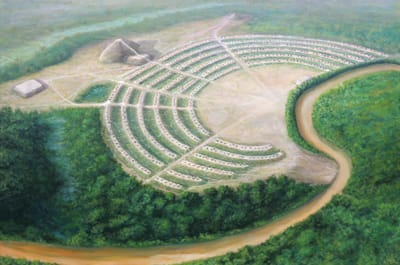
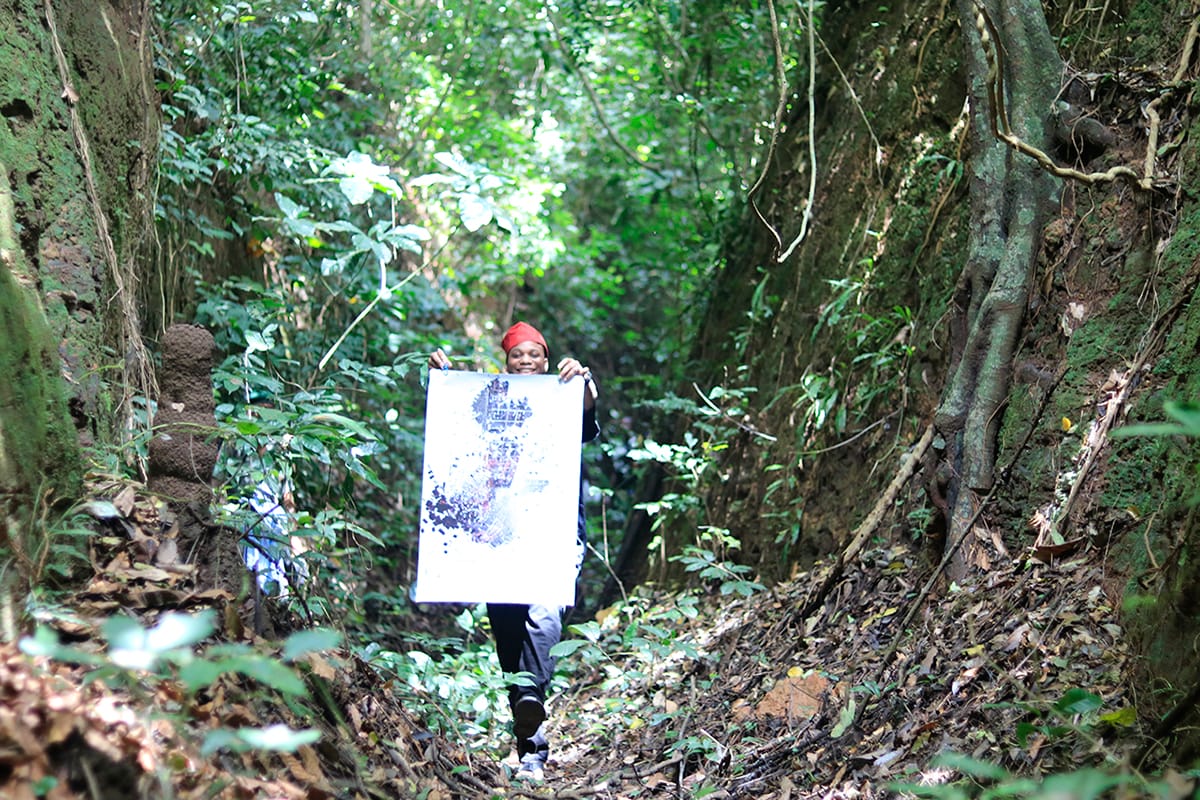
Stand in northeast Louisiana and the land rises in long curving welts — six nested, C-shaped ridges wrapped around an open plaza, and behind them Mound A, a flat-topped hill of packed earth seventy feet high. Stand in the rainforest southwest of Ijebu-Ode, in Nigeria, and the ground drops instead of climbs: a green-walled trench plunges away beneath your feet, its smooth, near-vertical sides falling as much as twenty metres to the floor, running on and on through the trees for something like a hundred miles. One monument heaped the earth up; the other cut it down. Both are among the largest things their makers ever built, and both were shaped entirely by hand.
Do the arithmetic and the two sites begin to rhyme. Poverty Point’s builders moved on the order of a million cubic yards of soil — perhaps 750,000 cubic metres — into their ridges and mounds between roughly 1700 and 1100 BCE, carrying it in woven baskets on their backs, one fifty-pound load at a time, tens of millions of loads in all. Mound A alone, its unweathered internal layering suggests, went up in a single sustained push of maybe ninety days, the coordinated work of thousands of people at once. Sungbo’s Eredo is larger still: an estimated three and a half million cubic metres of earth, dug out and heaped along one continuous line, which the archaeologist who first mapped it reckoned was more soil than went into the Great Pyramid of Giza. Neither people had a wheel to roll it, a cart to hold it, or a draft animal to pull it. Every basket was lifted by a human arm.
Monuments like these are supposed to come with a monarch attached. The textbook logic ran that shifting earth by the million cubic yards required a state — farming to feed the workers, a hierarchy to organise them, a ruler with the power to command. Yet Poverty Point’s builders were mobile hunter-gatherer-fishers who grew no crops and left no palace, no royal grave, no trace of hereditary kings; the machinery behind Mound A remains, three thousand years on, unexplained. And the Eredo, for all its scale, guards the same silence: who mobilised the labour, under what authority, and how it was sustained is simply not recorded — no throne survives to claim it. The two works were raised some nine thousand kilometres apart, and the better part of two thousand years apart in time — by some datings more than three — by peoples who never shared a rope or a word. This is not one idea travelling the world. It is the same discovery made twice, alone: that enough hands, willing and organised, can move a whole landscape without a crown to command them. Picture the two crews at their work, an ocean and an age between them and unaware of each other forever — one line of people carrying baskets up a growing mound in the Louisiana heat, another passing baskets up out of a deepening trench in the Nigerian green — the same patient human chain, moving the same stubborn earth, for reasons that in both places have outlasted every name we ever had for who was in charge.
Read the full studies: Poverty PointSungbo's Eredo
Sources
- UNESCO World Heritage Centre — Monumental Earthworks of Poverty Point
- National Park Service — Poverty Point
- Archaeology Magazine — Archaic Engineers Worked on a Deadline (Mound A construction)
- Wikipedia — Poverty Point
- Wikipedia — Sungbo's Eredo
- HeritageDaily — Sungbo's Eredo: The "Queen of Sheba's Embankment"
- P. J. Darling — "Sungbo's Eredo, Southern Nigeria", Nyame Akuma No. 49 (June 1998)
- William & Mary News — LiDAR project maps world's largest earthen enclosure (Dec 2024)