Poverty Point
How did a mobile hunter-gatherer society with no farming, no metal tools, no wheel, no draft animals, and no sign of kings or a coercive state organize enough people to move roughly a million cubic yards of earth, basket by basket, into the largest earthworks in North America — raising its greatest mound in under three months — and what was the whole complex for?
Why this rating?
- Construction difficulty
- 3/5
- Method uncertainty
- 2/5
- Capability gap
- 3/5
- Open questions
- 4/5
The earthmoving is vast — roughly a million cubic yards moved by hand — but the physical method (digging and hauling soil in baskets, piling it in stages) is well understood and not technically exotic. What genuinely upends expectations is the social capability: monumental construction on this scale, plus the near-90-day raising of Mound A, was long assumed to require farming, cities, and coercive rulers, and Poverty Point had none of them. The purpose of the complex, how a mobile hunter-gatherer society mobilized the labor, and why it was eventually abandoned all remain open.
Overview
Poverty Point is a set of monumental earthworks on Macon Ridge in West Carroll Parish, northeastern Louisiana, overlooking Bayou Macon near the small town of Epps. Built between roughly 1700 and 1100 BCE, during what archaeologists call the Late Archaic period, it is the largest and most elaborate earthwork complex of its age in North America — a landscape of long curving ridges and tall mounds laid out with evident planning across several hundred acres. What makes it remarkable is not only its size but its authorship: the people who built it were hunter-gatherer-fishers, not farmers. They grew no crops, kept no domestic animals for labor, had no metal, no wheel, and left no trace of kings, palaces, or a standing army. By the assumptions that governed archaeology for much of the twentieth century, a society like that should not have been able to build something like this at all. Poverty Point did, and it did so while pulling in exotic stone and minerals from as far as 700 miles away. It was inscribed as a UNESCO World Heritage Site in 2014 — the first in Louisiana — and it is administered today as a Louisiana State Historic Site. The name is modern and incidental: it comes from a nineteenth-century plantation that once occupied the land, long after the original builders were gone.
The Structure
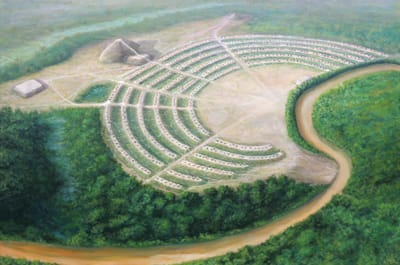
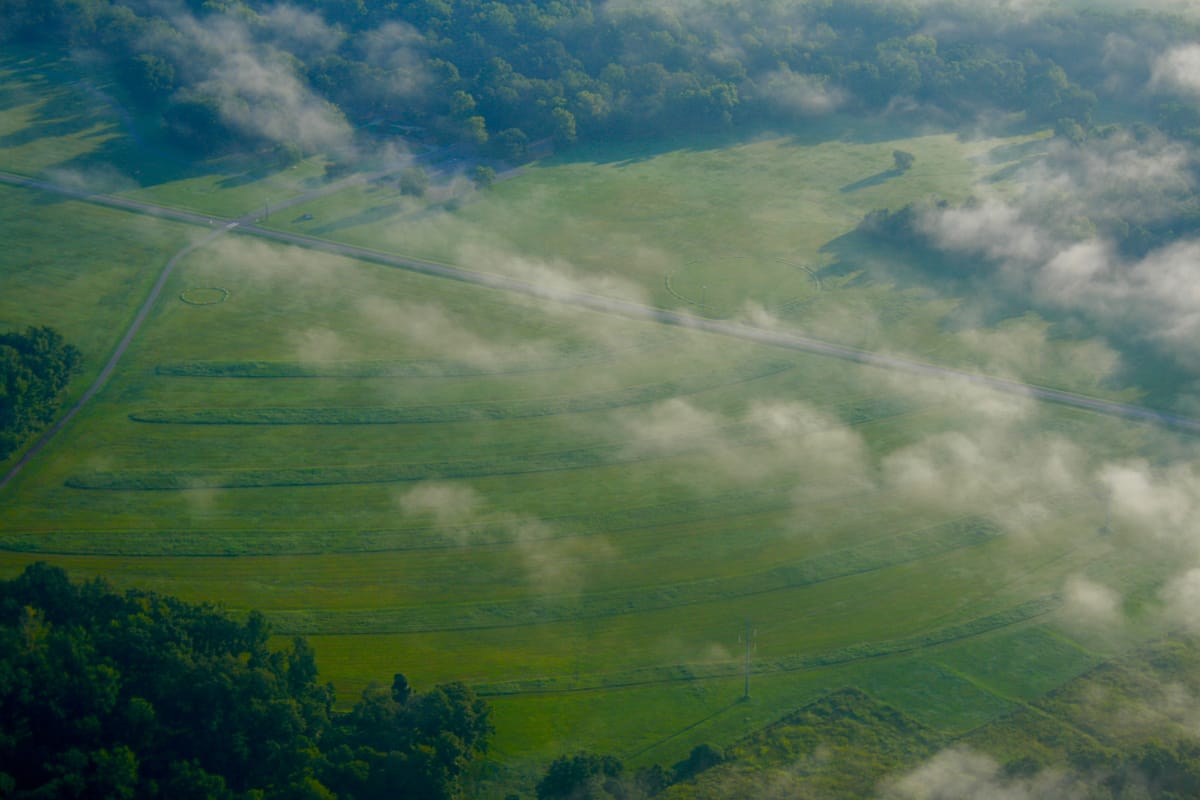
The heart of the site is a plaza — a flat, open expanse of roughly 43 acres (about 17 hectares) — wrapped on its western side by six nested, C-shaped earthen ridges, opening toward Bayou Macon to the east. The ridges are set in concentric arcs; the outermost is roughly 1.14 kilometers (about three-quarters of a mile) across, so that the whole ridge system, if the arcs were completed into circles, would enclose an area comparable to a small town. In the plaza itself, geophysical survey and excavation have found the postholes of large timber circles — rings of upright posts, sometimes compared to a wooden version of a henge — suggesting the open ground was a deliberate, used space, not merely empty.
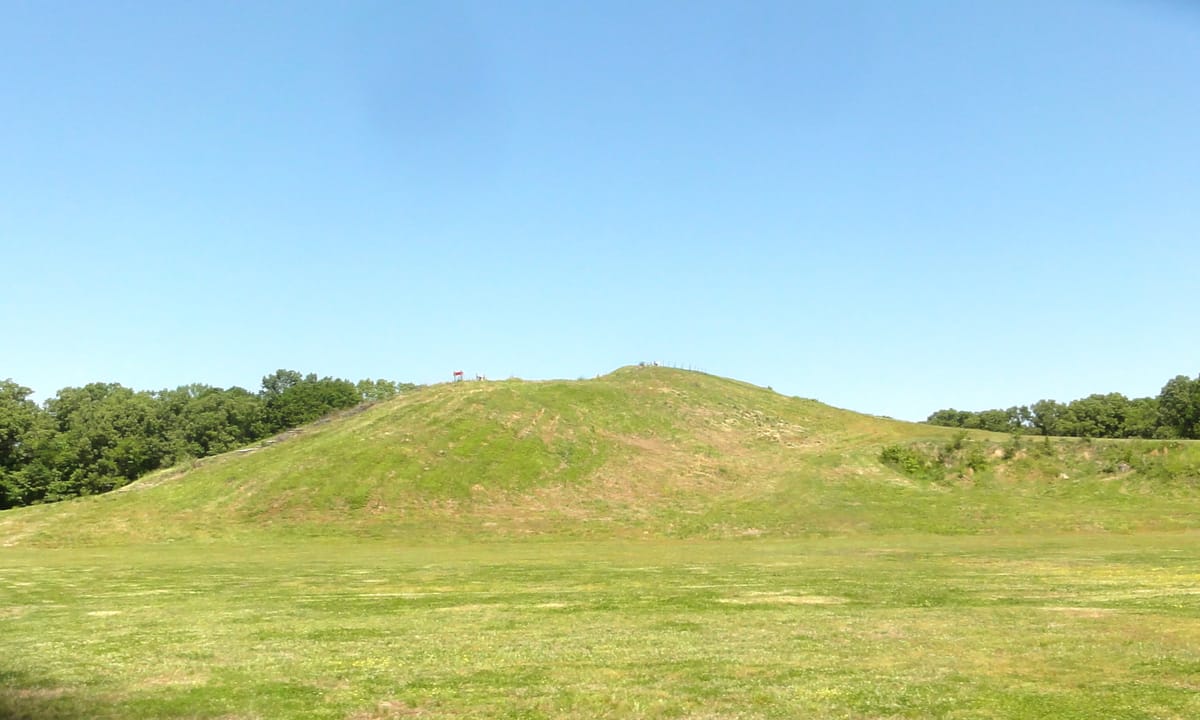
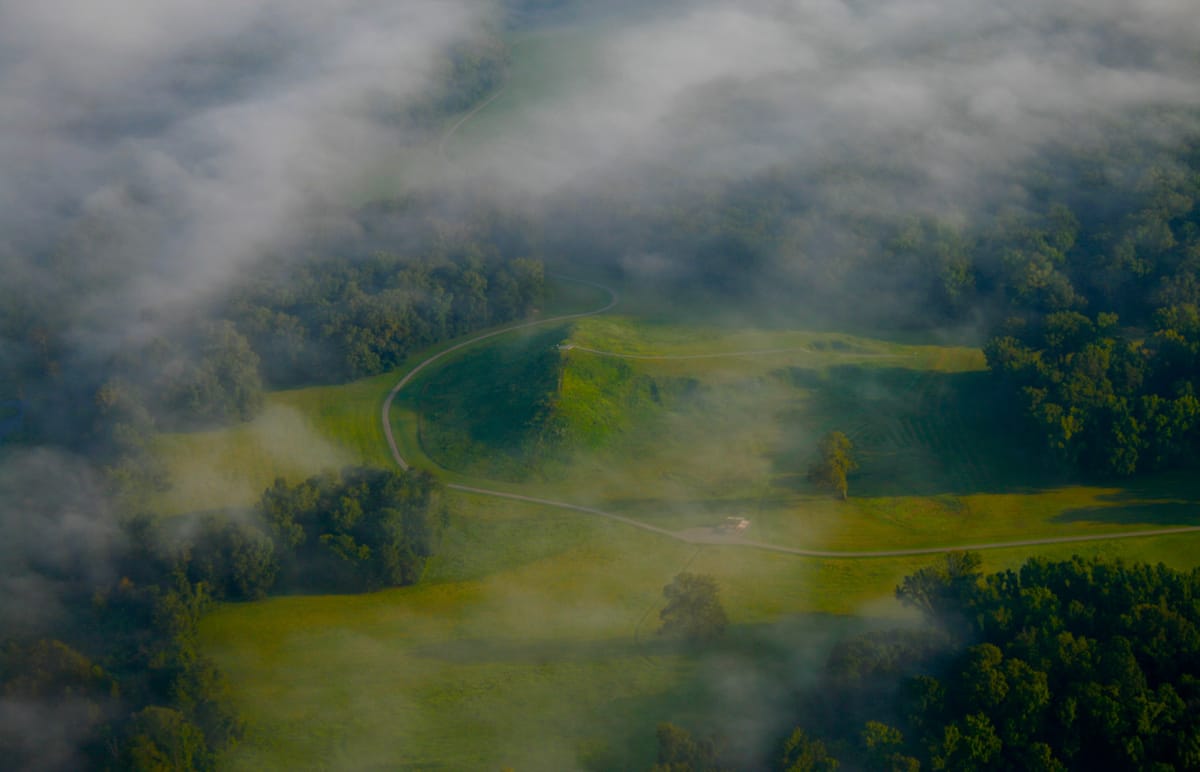
Around and beyond the ridges stand the mounds. Five of them belong to the main Late Archaic construction: the largest, Mound A, rises about 22 meters (72 feet) high on a base measuring roughly 215 by 200 meters (about 705 by 660 feet), and is often described as bird- or T-shaped. A sixth mound at the site, Mound F, was added around 700 CE — some 1,800 years after the main complex was finished — by a later and unrelated group of people, a reminder that the location kept its significance long after its builders had dispersed. The full extent of Poverty Point occupation stretches for around three miles (five kilometers) along the bayou, but the planned core of ridges and mounds is the part that reads, unmistakably, as architecture.
How Was It Built?
Every ridge and every mound at Poverty Point was raised by hand. The builders had no wheeled carts, no draft animals, and no metal tools; they dug soil from borrow areas with implements of wood, stone, and cane, and carried it to the growing earthworks in woven baskets on their backs. Estimates of the total earth moved for the main earthworks run to around 750,000 cubic meters — on the order of a million cubic yards — with some researchers arguing that when landscape preparation and later modification are included, the figure could be roughly double that. Put in human terms, it represents something like tens of millions of individual basket-loads of dirt, each weighing perhaps fifty pounds, carried one at a time.
The most striking single discovery concerns Mound A. Careful study of its internal layering found essentially no evidence of the erosion, weathering, or soil-surface development that would form if the mound had been built up slowly over generations, with rain and time acting between stages. Instead the fill looks continuous — as if the mound went up in a single sustained push. Researchers concluded it was raised in a matter of months, quite possibly fewer than 90 days, a feat that would have required thousands of people (one estimate puts it at around 3,000 laborers) working in coordination, all of whom had to be fed, housed, and organized for the duration. For a society without agricultural surplus to draw on, feeding a workforce that large, even briefly, is itself a logistical puzzle.
The Mainstream View
Archaeologists are in firm agreement about who built Poverty Point and, in broad terms, how: it is the work of Indigenous North Americans of the Late Archaic period, and it was built by human hands moving earth in baskets. There is no serious scholarly dispute on either point, and this study takes no part in “lost race” or extraterrestrial speculation — historically, such claims were used to deny Native American peoples credit for their own monuments, and the material evidence at Poverty Point ties it firmly to an Indigenous cultural tradition of the Lower Mississippi Valley.
What the mainstream view has had to revise is not the identity of the builders but the assumptions about what kind of society they were. Poverty Point was long a genuine anomaly, because the prevailing model held that monumental architecture required a settled, agricultural population governed by a centralized elite that could command labor. Poverty Point’s builders were mobile hunter-gatherer-fishers with a diet drawn from fishing, hunting, and wild plants, and excavation has turned up no palaces, no royal burials, and no clear signs of the entrenched social hierarchy that the old model expected. The site instead points to a large, cooperative undertaking by a society that was socially sophisticated without being a state — and it sat at the center of a far-reaching exchange network, importing soapstone (steatite), galena, copper, and several kinds of chert from sources hundreds of miles away in the Ozarks, the Appalachians, and the Ohio and Tennessee valleys. That combination — monumental building and long-distance trade without agriculture or kings — is now taken seriously as evidence that complex, coordinated Indigenous societies existed far earlier, and in less “expected” forms, than mid-century archaeology assumed.
The Open Case
The mystery of Poverty Point is not who built it or by what physical means; both are reasonably well established. What remains genuinely open is the human machinery behind it, and its purpose. How a mobile, non-agricultural society mobilized, fed, and directed a labor force large enough to raise Mound A in under three months — through kinship obligation, shared belief, seasonal gatherings, feasting, some mix of these, or a form of social organization we have not fully reconstructed — is inferred from indirect evidence and remains debated. So does the fundamental question of what the place was: a permanent settlement, a seasonal trade and gathering center, a ceremonial and religious complex, a pilgrimage destination, or some combination that shifted over its centuries of use. The exotic stone flowing in from a thousand-mile radius, the deliberate geometry of the ridges, the timber post circles in the plaza — each hints at meaning, but none delivers a caption.
There is also the question of endings. The great construction effort wound down after around 1100 BCE, and the reasons the builders eventually dispersed are not clearly understood. None of this requires anything more exotic than people, baskets, and organization. The wonder of Poverty Point is precisely that: that a society we once assumed lacked the capacity for monuments left one of the largest earthworks on the continent, built at a pace that still surprises the archaeologists who measure it — and that so much of why they did it remains, three thousand years on, an open case.
Sources
Connected findings
- Nobody Gave the Order — A monument is supposed to need a monarch — surplus to feed the workers, a hierarchy to marshal them, a ruler who can command. Two peoples an ocean and an age apart moved earth by the millions of cubic yards, basket by basket, and left no palace, no throne, no trace of the coercion the textbooks demanded.
Gallery