Terracotta Army
How did Qin-dynasty workshops mass-produce roughly 8,000 life-sized clay soldiers — each with an individual face — some 2,200 years ago, using a modular assembly line of moulded torsos, heads and limbs that were then hand-finished, kiln-fired and painted to guard an emperor's still-unopened tomb?
Why this rating?
- Construction difficulty
- 4/5
- Method uncertainty
- 2/5
- Capability gap
- 2/5
- Open questions
- 3/5
Turning out roughly 8,000 individualized life-sized figures — on top of an enormous underground mausoleum — was a staggering feat of organization and skilled labour, which keeps construction difficulty high. But the method is well understood: the figures were built from moulded, hand-finished modular parts, luted together, kiln-fired and painted by state workshops whose foremen even stamped their names into the clay, so both method uncertainty and any capability gap are low. Nothing about the army demands unknown technology — the once-popular idea that the Qin invented an anti-rust chromium coating for the bronze weapons was disproved in 2019. The residual wonder lies less in the soldiers than in the sealed tomb mound beside them, which has never been opened and whose contents remain genuinely unknown.
Overview
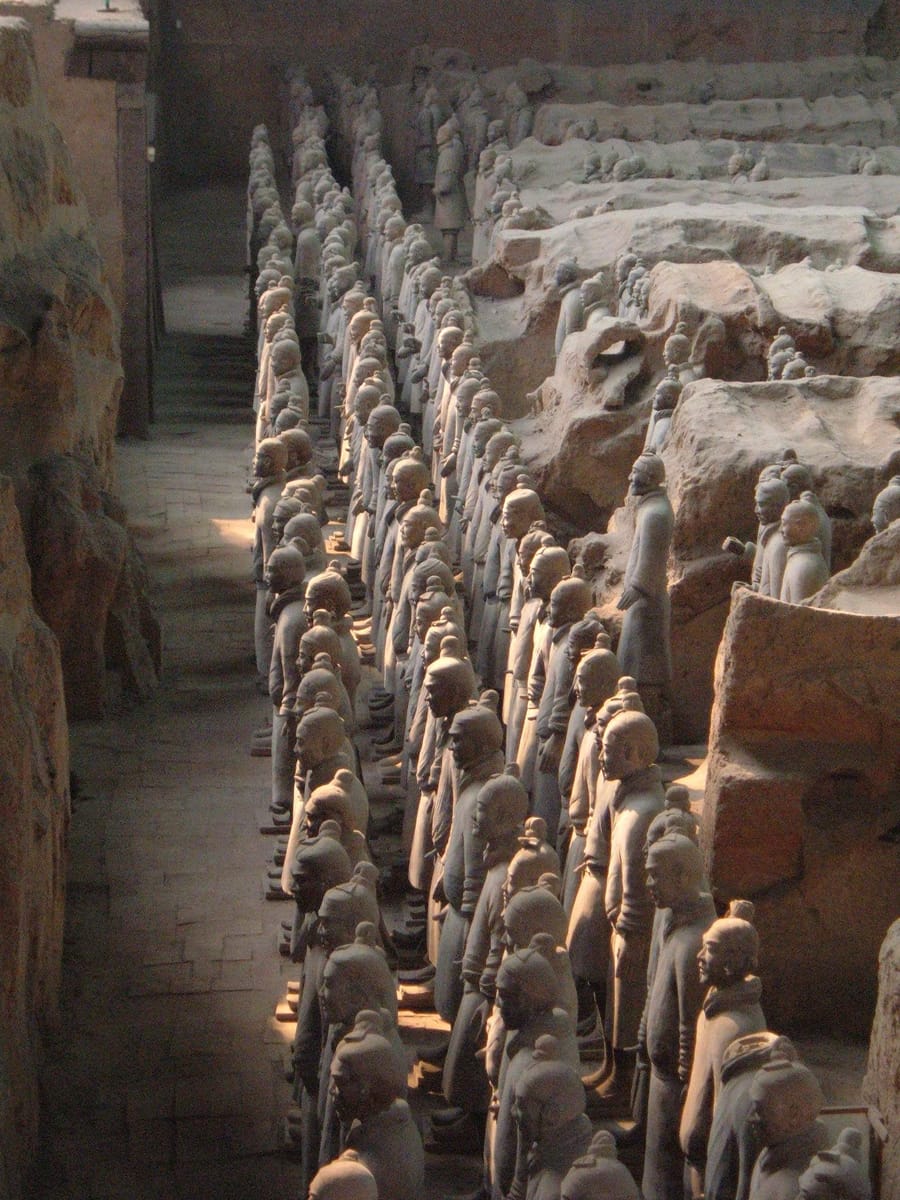
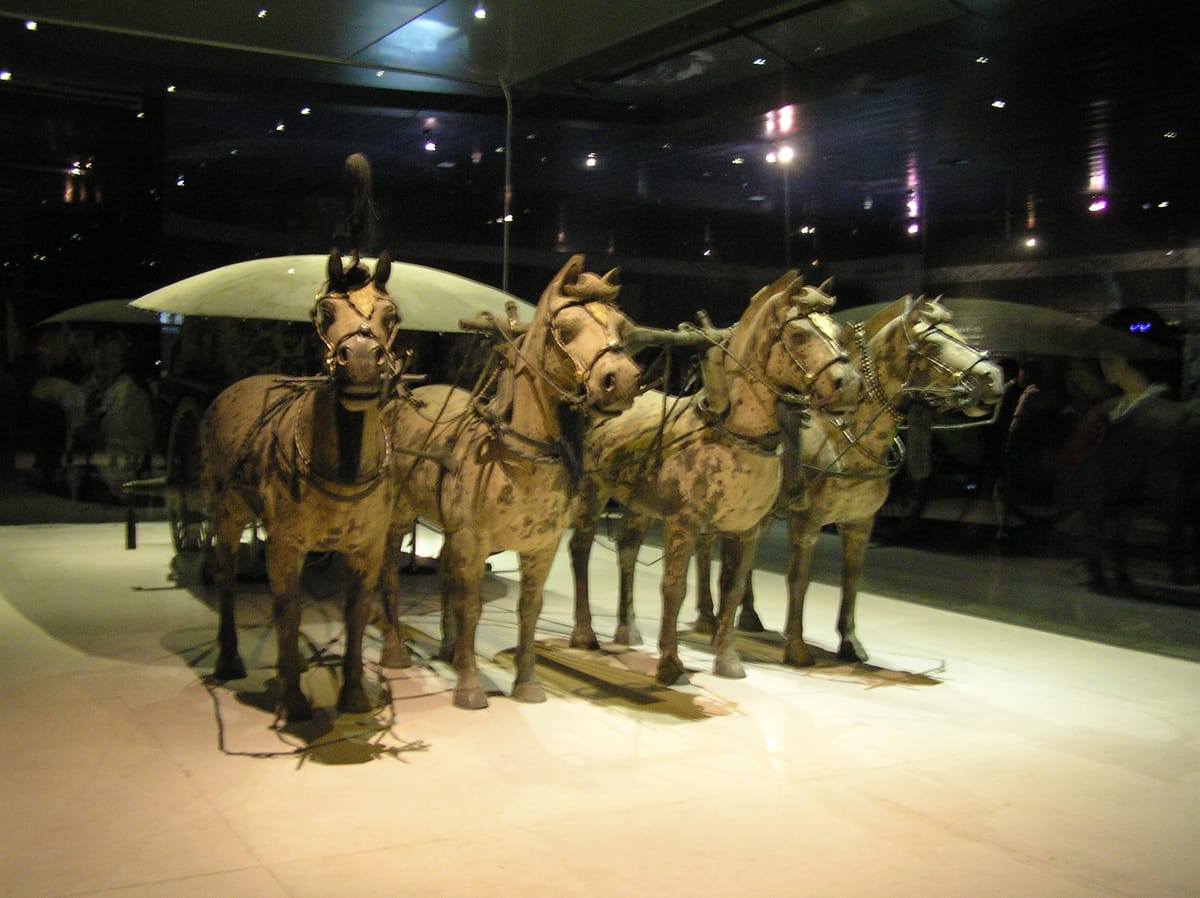
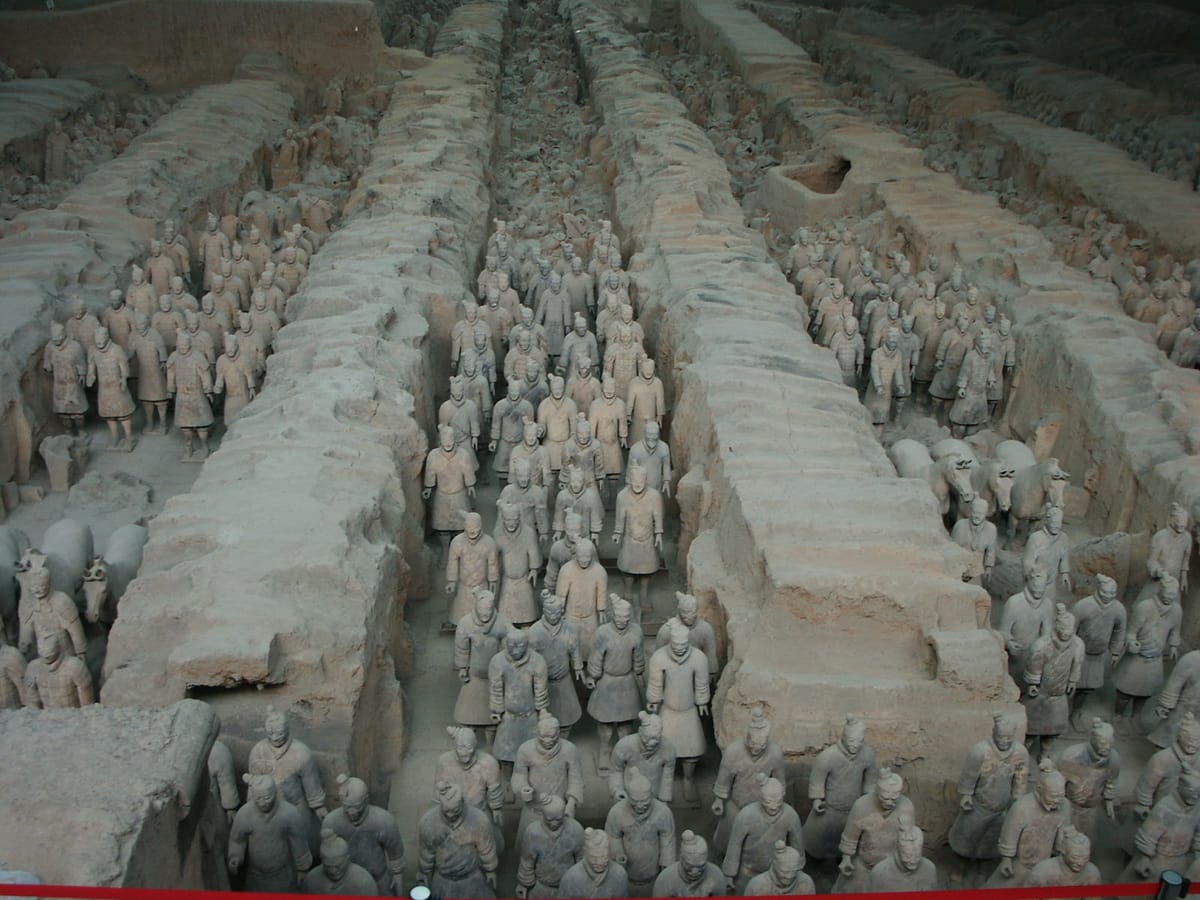
In the flat farmland of Lintong, on the eastern edge of Xi’an in Shaanxi Province, a buried army has stood in the dark for more than two thousand years. It is the Terracotta Army: an estimated 8,000 life-sized clay soldiers, together with some 130 wooden chariots, more than 600 horses, and figures of officials, acrobats and musicians, all arranged in pits to guard the tomb of Qin Shi Huang, the ruler who in 221 BCE conquered the warring Chinese states and made himself the first emperor of a unified China. Work on his vast mausoleum complex began around 246 BCE, when he came to the throne of Qin as a boy, and continued for decades; the emperor died in 210 BCE and the project wound down soon after. The army was not a monument meant to be seen — it was sealed underground as a spirit guard for the afterlife, and it was forgotten so completely that when farmers digging a well in March 1974 struck fragments of a clay figure, they had no idea what they had found. What they had found was one of the largest archaeological discoveries of the twentieth century. A reader who has never seen a photograph can picture the essentials plainly: rank upon rank of clay men, each the size of a real person and each with a slightly different face, standing in formation in long earthen trenches, facing the enemies of an emperor who has been dead for twenty-two centuries.
The Structure
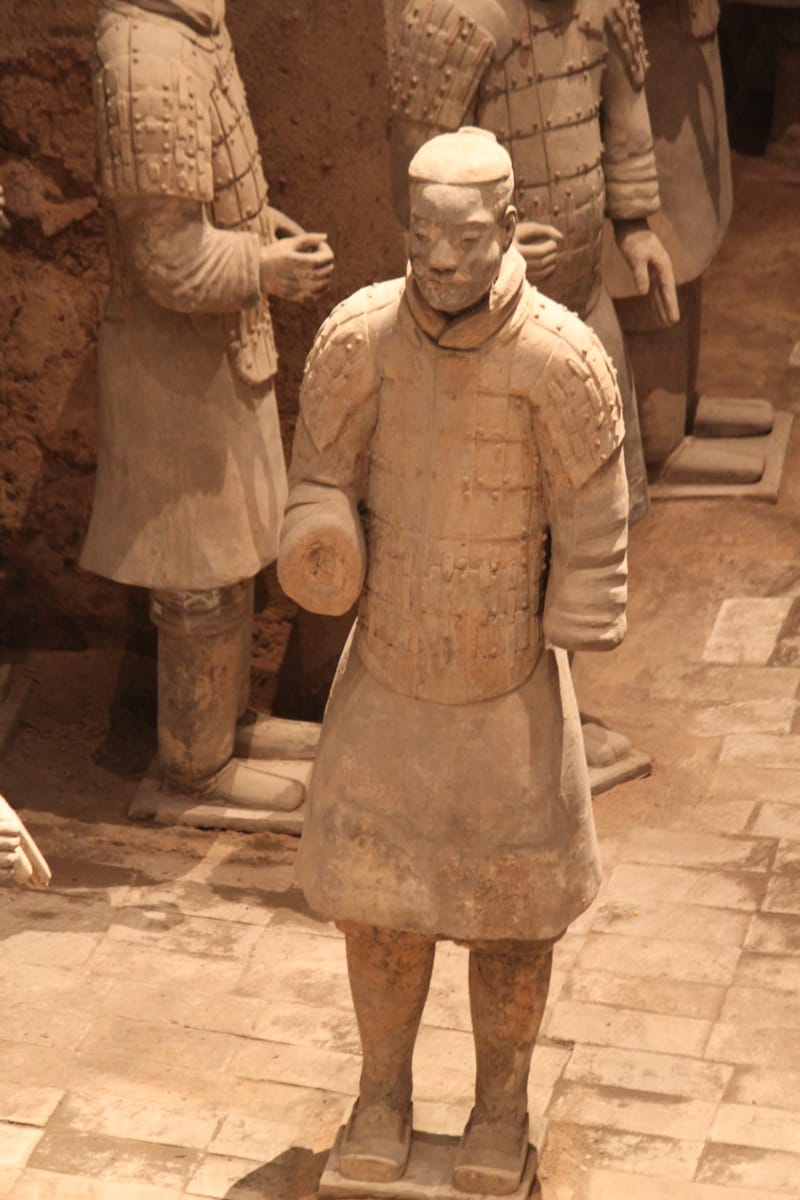
The soldiers occupy three main pits, dug a short distance northeast of the emperor’s tomb mound. Pit 1 is by far the largest — a rectangular hall roughly the length of two football fields, holding the main infantry force in eleven parallel corridors, thousands of foot soldiers arranged in battle order. Pit 2 is more varied, mixing cavalry, kneeling and standing archers, and chariot units; Pit 3, the smallest, appears to be the command post, with a cluster of higher-ranking officers. The figures average around 1.8 metres tall and stand a touch taller than that once you include their bases, with generals and officers deliberately made the tallest of all; a single warrior can weigh a couple of hundred kilograms of fired clay. Their variety is what stuns visitors. Faces differ from one figure to the next — different noses, eyes, moustaches, hairstyles and expressions — as do armour, rank and posture, so that the effect is of thousands of distinct individuals rather than identical toy soldiers. They did not always look as they do now. Every figure was originally brightly painted over a lacquer ground, in reds, greens, blues, purples and other colours, so the buried army was once a riot of colour rather than the muted grey clay we see today. Many of the soldiers once held real bronze weapons — swords, spears, crossbow triggers and thousands of arrowheads — a genuine arsenal buried with the clay ranks. Beyond the pits lies the thing they were made to protect: the enormous earthen tomb mound of Qin Shi Huang himself, which to this day has never been excavated.
How Was It Built?
The genius of the Terracotta Army is not any single figure but the production system that made so many of them possible. The workshops used what amounts to an early assembly line. The bodies were built from separately made parts — feet and legs, a hollow coil-built torso, arms and hands, and a head — which were produced in quantity, some of them with the help of moulds, and then joined together with wet clay slip in a process conservators call luting. Heads in particular were formed from a limited set of moulds, perhaps eight or ten basic types, and then individualized by hand: craftsmen added or reshaped ears, noses, moustaches, hair and expressions, and pressed on details, so that a small kit of standard parts could yield an apparently endless variety of faces. This is mass production and customization at the same time — standardized enough to be fast, hand-finished enough to look unique. The assembled figures were then fired in kilns; estimates of the firing temperature have generally centred on somewhere around 950–1,000°C, though more recent analyses of some samples suggest lower peak temperatures, and firing a hollow figure nearly two metres tall in one piece was itself a demanding technical achievement. Archaeologists have found the remains of kilns near the site to support this on-location manufacture. After firing came the lacquer coating and the paint. The organization behind all this was rigorously bureaucratic: many figures and weapons carry stamped or inscribed marks naming workshops and the foremen responsible, an early quality-control system that let the state hold individual supervisors accountable for what their teams produced. Sima Qian, the Han-dynasty historian writing about a century later, records that around 700,000 conscripted labourers were assigned to the emperor’s mausoleum project as a whole — a figure that, whatever its precise accuracy, conveys the scale of state power thrown at building an underworld for one man.
The Mainstream View
Among historians and archaeologists there is very little mystery about who made the Terracotta Army, when, why, or broadly how. It was the funerary guard for Qin Shi Huang, produced by imperial workshops during the late third century BCE, and the essentials are supported both by the physical evidence in the pits and by early written history. The modular, moulded-and-hand-finished production method is not a matter of speculation — it can be read directly off the figures themselves, in the seams where parts were joined, the repeated basic head types, and above all the workshop and foreman inscriptions that name the people responsible. The bronze weapons, the pigments, the kiln technology and the coil-built construction all sit comfortably within the known capabilities of Qin-dynasty China, a centralized state famous precisely for standardization, mass mobilization of labour, and administrative control. Scholarly attention has largely moved on to finer questions — how many distinct workshops were involved, how the labour was organized, exactly how the pigments and lacquer were made and applied, and how the whole complex relates to Qin ideas about death and the afterlife. The site was inscribed as a UNESCO World Heritage Site, the “Mausoleum of the First Qin Emperor,” in 1987. In short, the specialists’ consensus is that the Terracotta Army is an extraordinary achievement of organization and craft, not an unexplained one.
The Open Case
The real open questions at Lintong are of two kinds, and neither points to lost technology. The first is preservation. When the painted figures are exposed to Xi’an’s dry air, the ancient lacquer layer beneath the paint curls and flakes within a short time of excavation, taking the colour with it, so much of what has been dug up has lost its original paint almost on contact — which is one reason the great majority of the mausoleum’s estimated thousands of figures remain deliberately unexcavated, left in the ground until conservation methods improve. A related puzzle once looked more dramatic than it turned out to be: for decades the remarkably good condition of some buried bronze weapons was attributed to an “impossibly” advanced anti-rust treatment, a chromium coating supposedly invented two thousand years ahead of its time. A 2019 study led by University College London and the site museum tested hundreds of weapons and concluded the opposite — the surface chromium is contamination that leached from the nearby lacquer after burial, and the weapons’ survival owes far more to the fine, alkaline, low-organic local soil than to any ancient super-technology. It is a useful cautionary tale about reading modern wizardry into ancient craft. The second open question is the biggest of all, and it is a genuine one: the emperor’s own burial chamber, under its great mound a short distance from the army, has never been opened. Sima Qian described it as a subterranean palace containing models of the empire with its rivers and seas rendered in flowing mercury, and modern surveys have indeed detected strikingly high mercury concentrations in the mound’s soil, lending his account unexpected support. What actually lies sealed inside — and whether excavating it could ever be done without destroying it — remains, for now, one of archaeology’s most tantalizing unanswered questions.
Sources
- Wikipedia — Terracotta Army
- UNESCO World Heritage Centre — Mausoleum of the First Qin Emperor
- The Metropolitan Museum of Art — The Terracotta Warriors and the Age of Empires
- Scientific Reports (Nature) — Surface chromium on Terracotta Army bronze weapons is neither an ancient anti-rust treatment nor the reason for their good preservation
- UCL News — Scientists shed light on preservation mystery of Terracotta Army weapons
- Smithsonian Magazine — What You Need to Know About China's Terra-Cotta Warriors and the First Qin Emperor
On screen
- The Army You Can Build — In Civilization, the emperor's buried guard becomes a building you queue up like any other.
- china
- qin-dynasty
- terracotta
- mass-production
- funerary
- sculpture
- bronze-weapons
- shaanxi
- xian
- unesco-world-heritage
Gallery