Newgrange
How did a farming community without writing, metal tools, or (as far as the evidence shows) any recorded mathematics engineer a 19-meter passage to funnel winter-solstice sunrise into a chamber with such precision, and what did the tomb mean to the people who built and used it?
Why this rating?
- Construction difficulty
- 3/5
- Method uncertainty
- 2/5
- Capability gap
- 3/5
- Open questions
- 3/5
Long-distance stone transport, corbelled-roof engineering, and the winter-solstice light effect are all well documented archaeologically, leaving open mainly how precisely the alignment was engineered versus achieved through patient observation, and the tomb's social meaning and primary purpose.
Overview
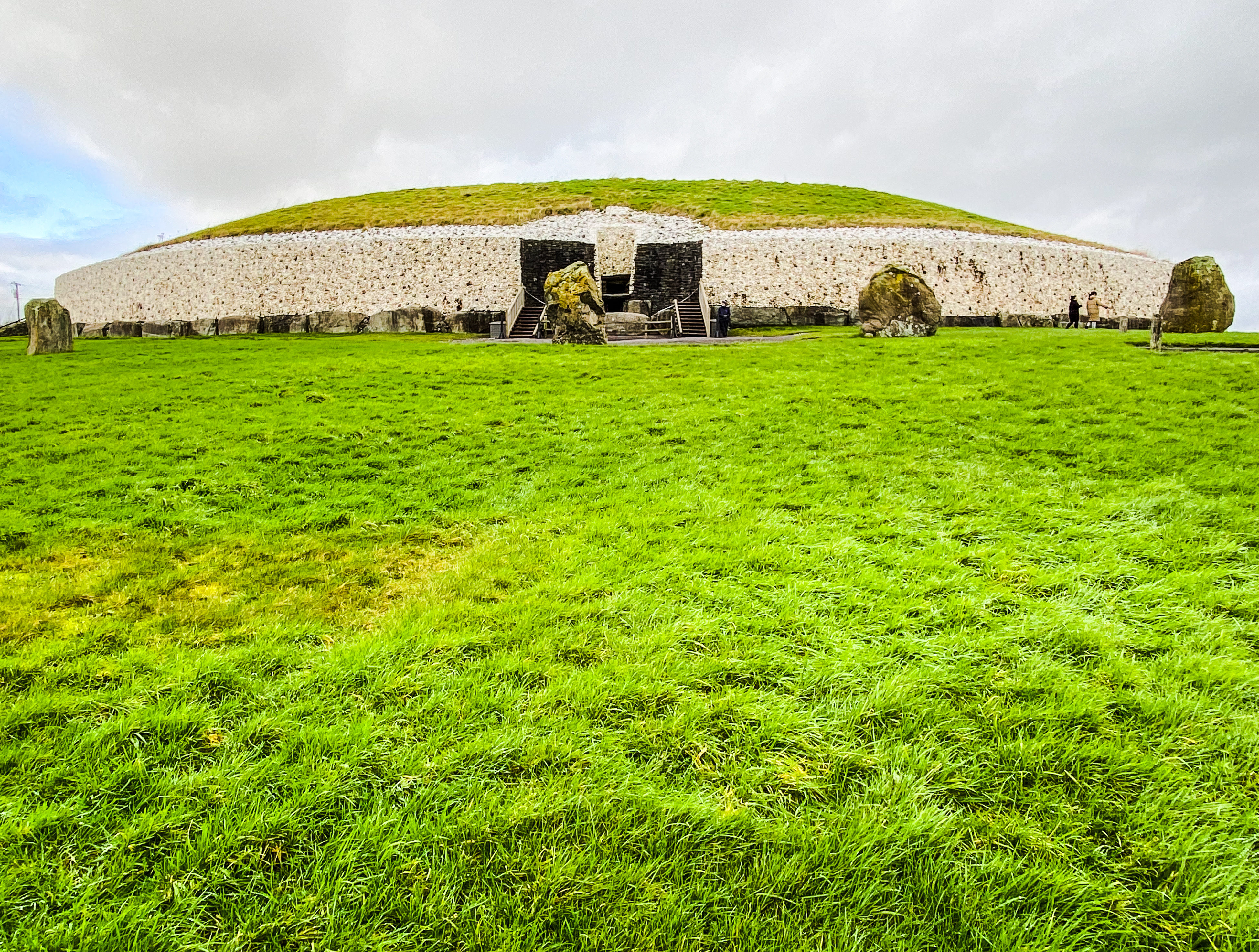
Newgrange (Irish: Sí an Bhrú) is a Neolithic passage tomb standing on a low ridge above a bend of the River Boyne in County Meath, Ireland, about 8 kilometers west of Drogheda. It is the largest and best-known monument in the Brú na Bóinne Archaeological Ensemble, which also includes the passage tombs of Knowth and Dowth and dozens of smaller satellite monuments, inscribed together as a UNESCO World Heritage Site in 1993. Radiocarbon dating places its construction at roughly 3200 BCE, making Newgrange older than Stonehenge and older than the Great Pyramid of Giza. Beneath a great grass-covered mound edged with a kerb of carved stones lies a stone passage leading to a cross-shaped inner chamber. Newgrange is famous above all for a precise piece of engineering: a specially built opening called the roof-box, positioned so that for a few mornings around the winter solstice, a beam of sunrise light travels the length of the passage and floods the chamber, an effect first documented in modern times by archaeologist Michael J. O’Kelly on 21 December 1967.
The Structure
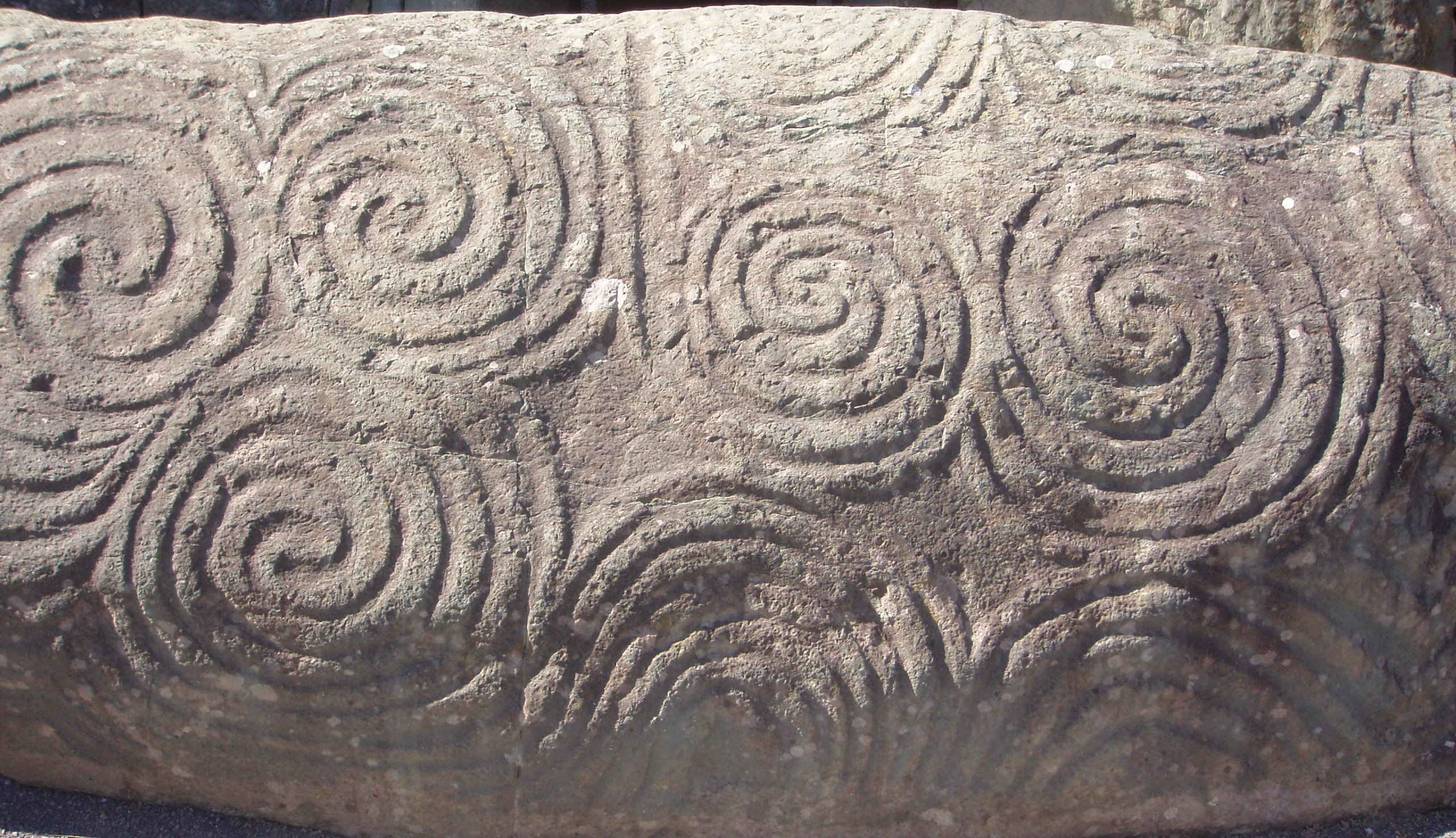
The mound is roughly 85 meters across and about 12-13 meters high, covering close to an acre (4,500 square meters) and estimated to contain around 200,000 tonnes of layered earth and stone. Around its base runs a kerb of engraved stones — commonly counted at 97 — of which the most celebrated is Kerbstone K1, the entrance stone: a slab about 3 meters long and 1.2 meters high, weighing an estimated 5 tonnes, covered edge to edge with a carved triple spiral (triskele) and other curvilinear motifs, and ranked among the finest examples of megalithic art in Europe. Kerbstone K52, directly opposite at the rear of the mound, carries similarly dense carving. The front of the mound is faced with a dramatic wall of bright white quartz cobbles studded with rounded granite stones — a reconstruction (discussed below) based on quartz recovered in excavation.
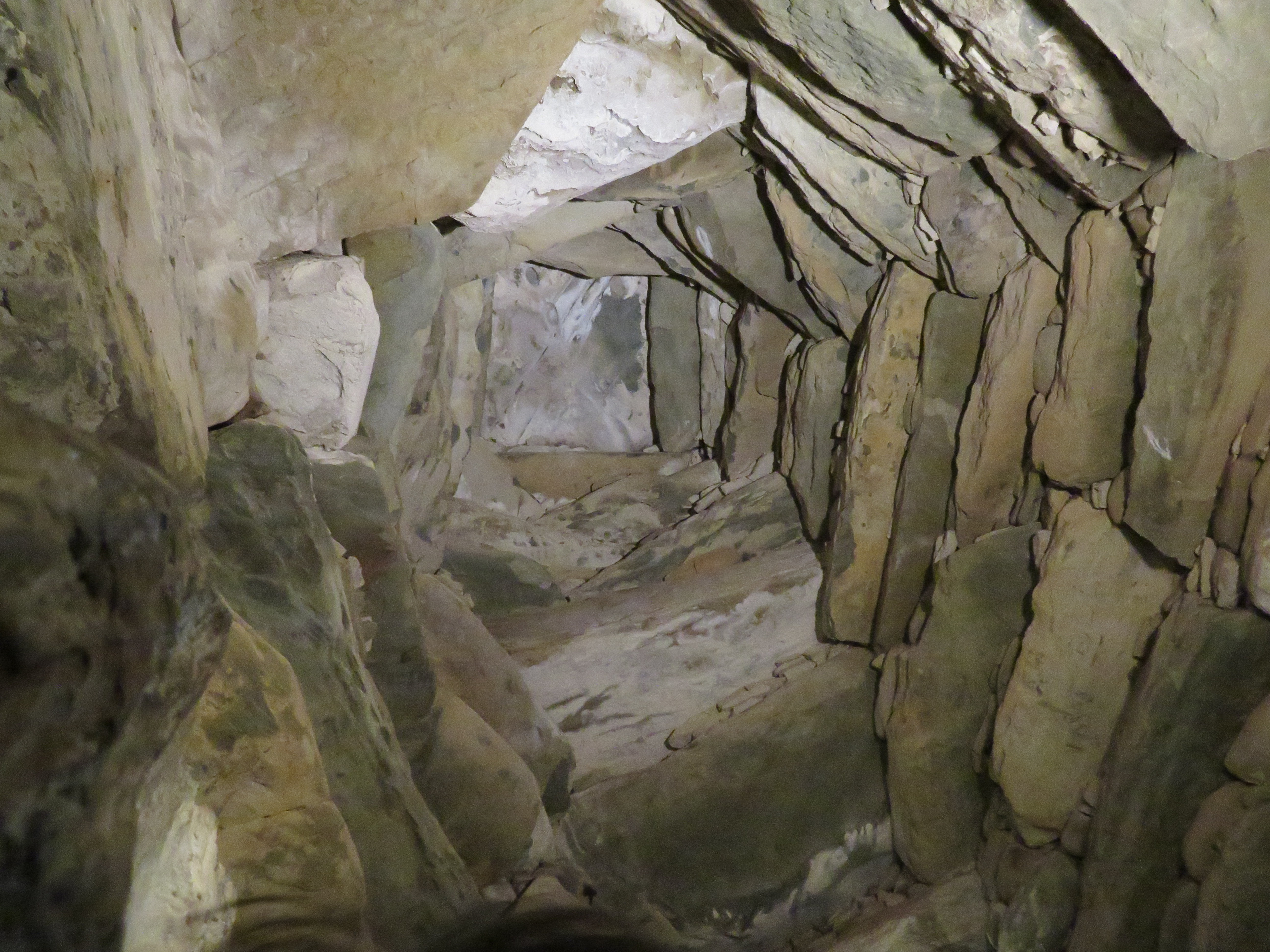
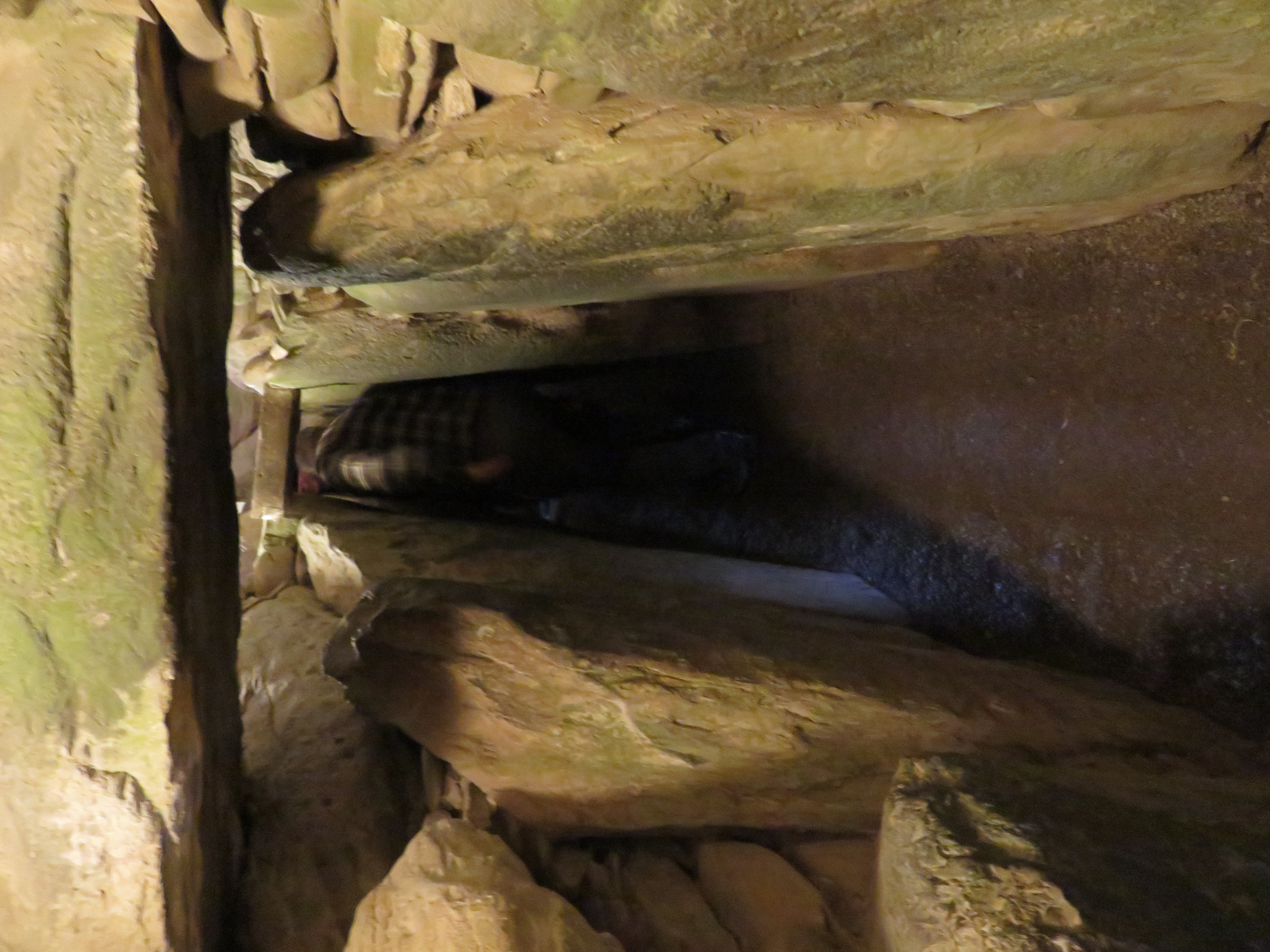
A passage roughly 19 meters long, lined with standing stone slabs called orthostats (22 on the west side, 21 on the east), leads from the entrance about a third of the way into the mound to a cruciform central chamber with three recesses. The chamber is roofed with a corbelled vault — overlapping horizontal courses of stone that narrow toward the top — that has stayed watertight for over five thousand years without mortar. The recesses hold large carved stone basins, likely receptacles for human remains: excavation found deposits of burnt and unburnt bone from at least a small number of individuals, along with a handful of grave goods (bone pins, pendants, beads, and carved stone “marbles”). Whether the tomb was built primarily to hold the dead, mark ancestry, track the calendar, or serve some combination of these purposes is still debated (see “The Open Case,” below). Outside the mound, an incomplete ring of freestanding stones — the “Great Circle” — survives with about 12 of an estimated original 35-38 stones still standing.
How Was It Built?
Analysis of the stone shows Neolithic builders drawing on a wide and logistically demanding supply network. Local greywacke, quarried or gathered from nearby river terraces, forms most of the passage, chamber orthostats, and kerbstones. The white quartz cobbles fronting the mound came from the Wicklow Mountains, roughly 50 kilometers to the south; dark granodiorite cobbles came from the Mourne Mountains about the same distance to the north; other stone was sourced from the Cooley Mountains and the Carlingford Lough shore. None of the stones show tool marks consistent with quarrying — they appear to have been selected from natural outcrops and river deposits and hauled, most likely by a combination of land transport (wooden rollers or sledges) and rafting along the coast and up the Boyne. Estimates of the labor involved vary widely: the geographer Frank Mitchell suggested the mound itself could have been raised in as little as five years by a large workforce, while excavator Michael J. O’Kelly’s team argued the full project, including quarrying, transport, carving, and construction, took at minimum several decades. The corbelled roof was built by carefully overlapping stone courses so that each course leans slightly inward and outward-sloping joints shed water — a design so effective that the chamber has remained essentially dry for five millennia.
The Mainstream View
Mainstream archaeology treats Newgrange as the achievement of local Neolithic farming communities living in the Boyne Valley in the fourth millennium BCE — people who had already established settled agriculture, pottery, and stone tool traditions capable of quarrying, transporting, and precisely dressing large stones without metal. The most thorough excavation, led by University College Cork archaeologist Michael J. O’Kelly between 1962 and 1975, uncovered the roof-box, documented the megalithic art, and reconstructed the collapsed quartz façade — a restoration using a modern concrete retaining wall that has itself drawn criticism from later scholars as overly assertive, though a 2017 reassessment by archaeologists Geraldine Stout and Muiris O’Sullivan-aligned researchers Robert Hensey and Elizabeth Twohig judged a bright, prominently displayed quartz front consistent with the effort of moving the stone 50 kilometers in the first place. O’Kelly’s team also confirmed, by placing an observer in the chamber before dawn on 21 December 1967, that the roof-box precisely admits a beam of sunrise light that travels the passage and reaches into the chamber, an event that recurs for several mornings around the winter solstice each year (weather permitting) and now draws tens of thousands of entrants to Ireland’s Office of Public Works lottery for a small number of places inside the chamber on those mornings. Archaeologists broadly read Newgrange as a tomb bound up with a wider Neolithic “cult of the dead” and ancestor veneration, likely built and used by farming communities across multiple generations, with the astronomical alignment either intentional from the outset or elaborated as the monument’s significance grew.
The Open Case
What remains genuinely unresolved is not whether the solstice alignment is real — it has been observed and photographed for decades and is documented in excavation records predating O’Kelly’s famous 1967 observation — but how confidently to read intention and precision into it, and what the tomb meant to the people who built it. Calculations correcting for the slow drift of Earth’s axis (precession) suggest that 5,000 years ago the first light of the solstice sunrise would have struck precisely at sunrise and reached the chamber’s back wall, rather than arriving a few minutes late and lighting the middle of the chamber as it does today — a level of fit that some archaeoastronomers consider too exact to be accidental, while others caution that a builder watching the sun’s position shift over years near the solstice, without any need for abstract astronomical theory, could achieve the same result by patient observation and trial adjustment alone. Similar but less precise solar alignments have since been identified at nearby Dowth and at other passage tombs, raising the question of whether Newgrange represents a uniquely refined achievement or one data point in a broader, still poorly understood Neolithic tradition of solar-aligned architecture. The tomb’s social meaning is equally open: a 2020 DNA study of one individual buried in the chamber revealed his parents were first-degree relatives, which some researchers read as evidence of a hereditary elite akin to later royal dynasties, while other archaeologists argue Neolithic Irish society was probably too fluid and small in scale to support a rigid ruling class, and that the finding may reflect an isolated ritual or symbolic practice rather than dynastic succession. And the tomb’s primary purpose — burial site, astronomical instrument, ceremonial gathering place, territorial marker, or some fusion of all four across different periods of its use — has no settled answer. What can be said without overreach is that Newgrange required people without writing, metal tools, or draft animals to organize long-distance stone transport, precise structural engineering, and an alignment accurate to within a matter of minutes of sunrise, sustained across construction that certainly took years and plausibly took decades. Whether that reflects an unrecognized sophistication in Neolithic astronomical practice, a slower process of empirical trial and correction, or a mix of both is the genuinely open question — not a case for anything beyond the reach of the people who are known to have built it.
Sources
Connected findings
- The Arch Everyone Invented — Step stone inward, course by course, and you get a roof. Neolithic Ireland found it, Bronze Age Sardinia found it, the Classic Maya found it — and all three stopped dead at the same five metres, because none of them ever cut the one wedge-shaped stone that breaks the ceiling.
- The Tunnels Built for the Sun — In Ireland and in Egypt, two peoples who never met each built a corridor whose only job was to let the sun in — on a few chosen days a year, and no others.
On screen
- The Tomb You Break Into — Assassin's Creed Valhalla names the place outright: Boyne Tombs, now known as Newgrange.
Gallery