Nan Madol
With no draft animals, no metal tools, and no wheel, how did a Pacific island society quarry, move, and stack tens of thousands of multi-tonne basalt columns across open reef water to build a city of nearly 100 artificial islets — and why, after roughly four centuries as the seat of Saudeleur power, was it abandoned?
Why this rating?
- Construction difficulty
- 4/5
- Method uncertainty
- 4/5
- Capability gap
- 4/5
- Open questions
- 4/5
Quarrying and rafting tens of thousands of multi-tonne basalt columns across open reef water to build a reef-flat city, with no comprehensive record of column weights or transport logistics and no written account of the process, leaves the physical how substantially reconstructed rather than documented, alongside unresolved questions about labor organization and the city's abandonment.

Overview
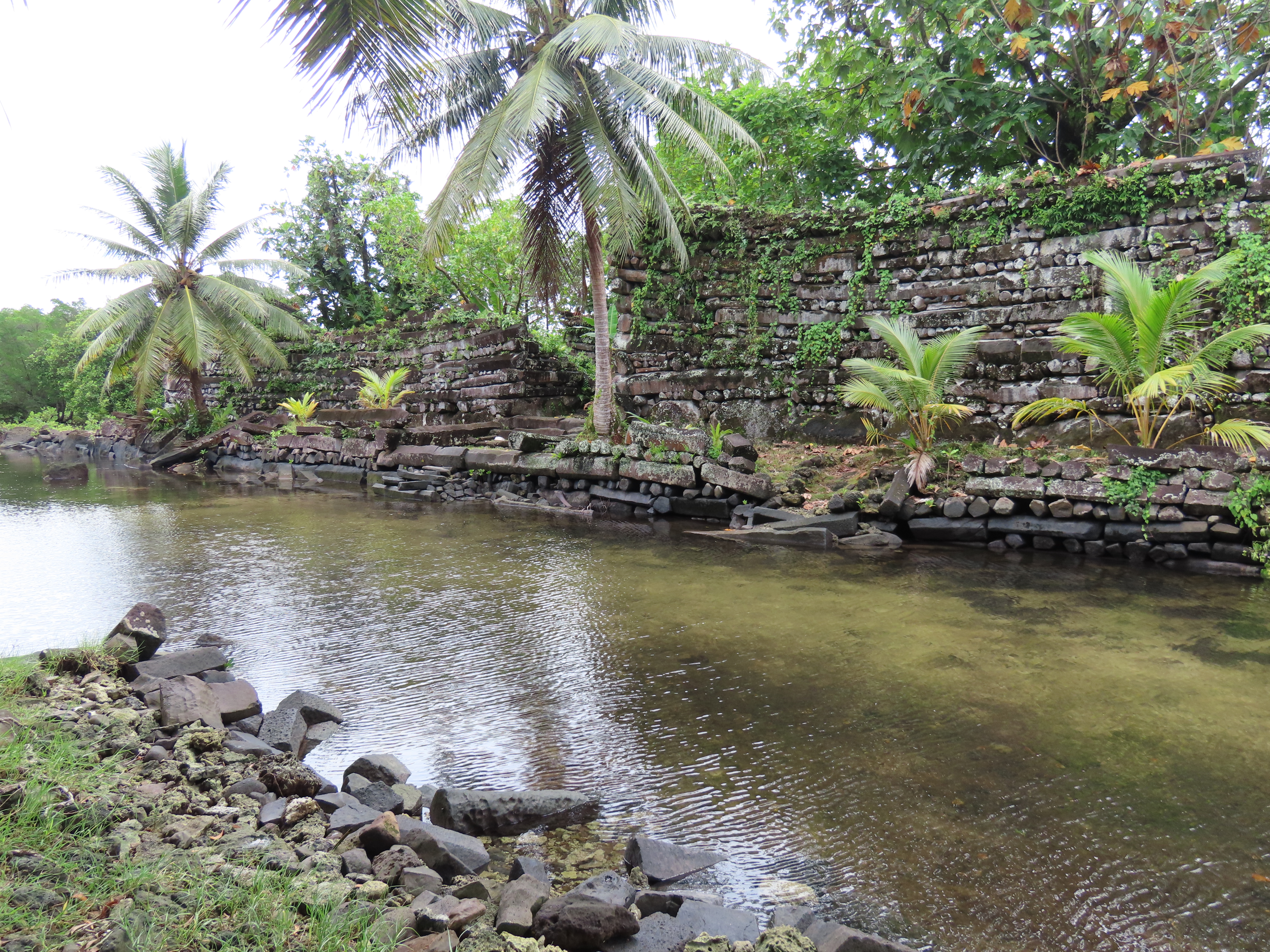
Nan Madol is a ruined ceremonial and political city built on a coral reef flat off Temwen Island, on the southeastern coast of Pohnpei in the Federated States of Micronesia. It consists of roughly 92 artificial islets — figures in the literature range from about 92 to nearly 100 — packed into a core area of only about 1.5 by 0.5 kilometres and threaded by a network of tidal canals, which is how the site earned its popular nickname, the “Venice of the Pacific.” The name Nan Madol itself is generally translated as “within the intervals” or “the spaces between,” referring to those canals. For roughly four centuries, Nan Madol served as the capital of the Saudeleur dynasty, the rulers who first unified Pohnpei’s chiefdoms under a single tribute-based political system. Human activity at the site dates back to around the 1st century CE, with the first artificial islets raised by around 900 CE, but the city’s defining feature — massive walls and platforms built from stacked, naturally hexagonal columns of basalt — belongs to a later, monumental phase of construction that began around 1180 CE and continued for the next two to three centuries. Unlike most Pacific island societies, the Saudeleurs built in enduring stone rather than wood and thatch, and left behind one of the largest and most unusual archaeological complexes in Oceania. Nan Madol was inscribed as a UNESCO World Heritage Site in 2016 — the first in Micronesia — and was simultaneously placed on the List of World Heritage in Danger, threatened by mangrove overgrowth, canal siltation, and rising seas.
The Structure
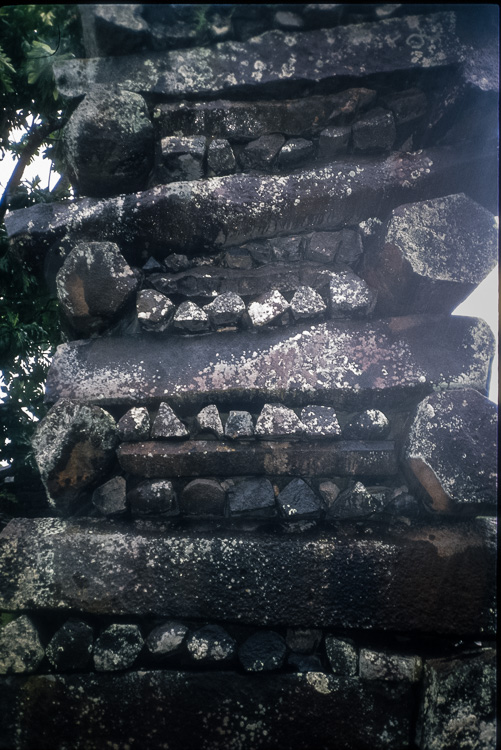
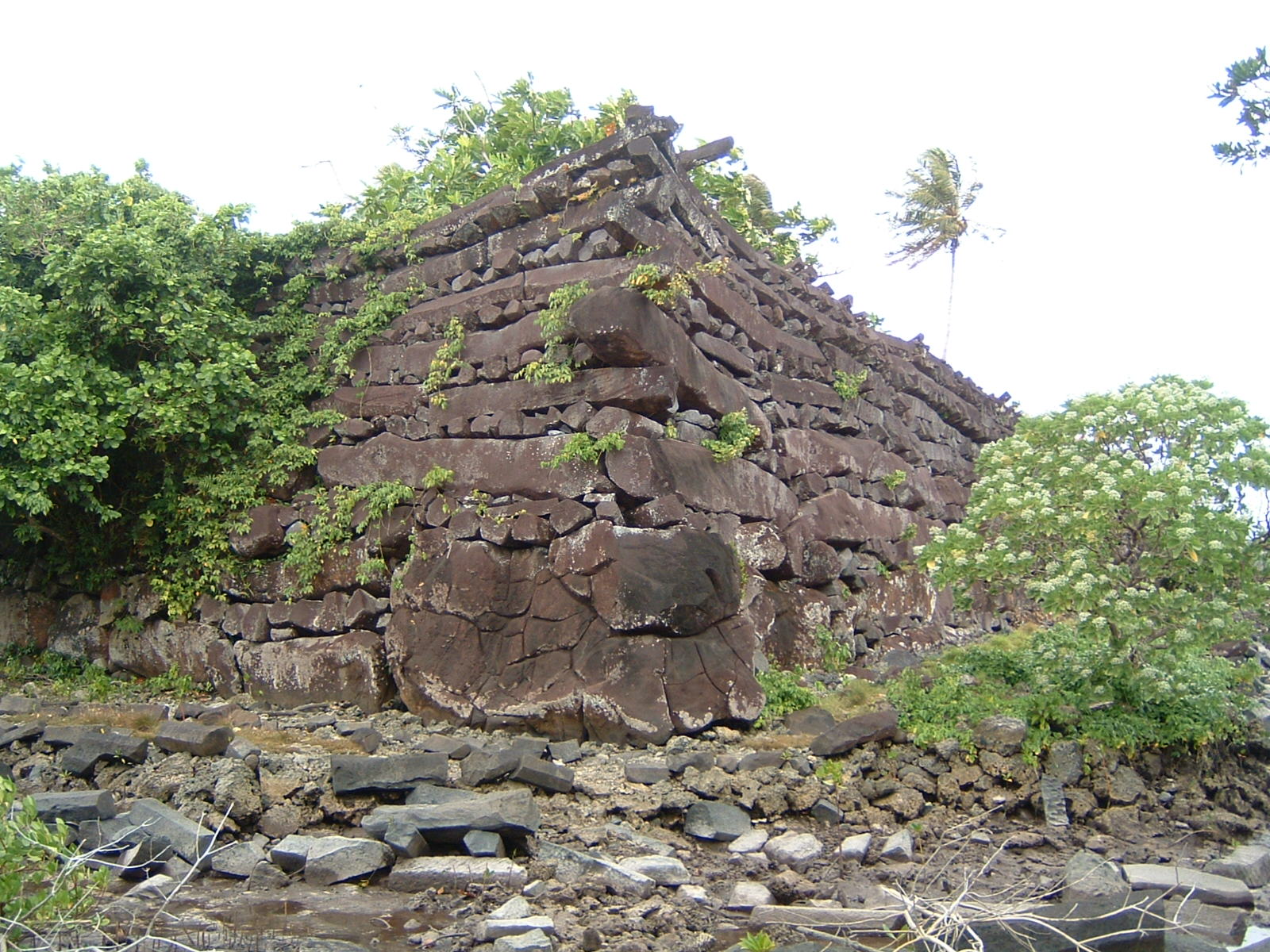
Nan Madol’s islets were built up from a foundation of coral rubble fill, faced and retained by massive walls of columnar basalt — a volcanic rock that fractures naturally into long, prismatic, often hexagonal “logs” as it cools. Builders stacked these columns in crisscross, alternating courses, sometimes described as a “header-and-stretcher” or log-cabin-like technique, without any mortar or binding material; the columns’ own weight and interlocking placement hold the walls together. Some retaining walls still stand more than 7 metres high. The site divides into two main sectors: Madol Powe, a mortuary and ceremonial district of about 58 islets in the northeast, and a residential/administrative sector to the southwest where Saudeleur chiefs, priests, and their retainers lived and governed. The most celebrated structure is Nan Douwas (also spelled Nandauwas), a royal mortuary islet whose double-walled enclosure — with outer walls reported at roughly 5.5 to 7.5 metres high — held the tombs of Saudeleur rulers and was clearly the ceremonial heart of the complex. Other islets served as chiefly residences, mortuary compounds for lesser nobility, a coconut-oil preparation area, and a distribution point (first called Peiniot, later Usennamw) where tribute food gathered from Pohnpei’s districts was received on behalf of the Saudeleur. Archaeologists estimate the Saudeleur polity governed a population in the tens of thousands, and Nan Madol’s scale — a purpose-built stone capital raised on a reef flat rather than on the main island itself — is without real parallel elsewhere in Remote Oceania.
How Was It Built?
The basalt used throughout Nan Madol was not locally available on the reef flat; it was quarried from volcanic outcrops elsewhere on Pohnpei, most often cited as the Sokehs area on the far side of the island, then transported to the building site. Individual columns are commonly reported as weighing anywhere from roughly one to several tonnes, with some accounts describing exceptionally large pieces weighing considerably more — the range varies between sources, and no comprehensive survey has published a definitive weight distribution for every column used. Once on site, columns were laid in alternating crisscross courses to raise walls and platforms, with a rubble-and-coral core filling the interior of each islet. None of this was achieved with draft animals, wheeled transport, iron tools, or pulley systems — none of which existed in pre-contact Pohnpei. The prevailing archaeological inference is that columns were moved from the quarry to the coast and then floated or rafted — lashed to canoes or wooden rafts — across open water and canals, likely timed to exploit high tides to reduce the effective weight and friction of moving such loads, before being levered, dragged, and stacked into place using log rollers, ramps, and coordinated human labor. Given the volume of material moved over multiple centuries, construction on this scale required a large, organized workforce and a political structure capable of directing and provisioning it — consistent with the tribute-based authority the Saudeleur dynasty is known to have exercised over Pohnpei’s districts.
The Mainstream View
Archaeologists and historians are not in doubt about who built Nan Madol: it is a Pohnpeian achievement, built and used by the ancestors of today’s Pohnpeian people, under the political authority of the Saudeleur dynasty. Pohnpeian oral tradition credits the site’s founding to twin sorcerers, Olisihpa and Olosohpa, who arrived from a legendary homeland to build an altar to the god of agriculture; in the tradition, Olosohpa became the first Saudeleur ruler. Archaeological evidence — settlement sequences, radiocarbon dates, local basalt sourcing, and continuity with Pohnpeian material culture — corroborates a purely indigenous origin and chronology, situating monumental construction from around 1180 CE through the Saudeleur period, which is generally dated to roughly 1200-1628 CE (accounts of the exact end date vary). The dynasty’s centralized, tribute-collecting form of rule is the accepted explanation for how such an enormous, sustained construction effort — spanning generations — could be organized and provisioned without writing, metal tools, or draft animals: through the mobilization of communal labor under a stratified political system with the authority to direct it. The Saudeleur period ended, per oral tradition, with the invasion of the culture-hero Isokelekel, after which Pohnpei fragmented into the smaller chiefdoms (nahnmwarki) that persist on the island today, and Nan Madol was gradually abandoned as a seat of power.
The Open Case
What remains genuinely unresolved about Nan Madol is not who built it, but exactly how, in practical, physical detail. No contemporary written or pictorial record documents the logistics of quarrying, transport, or construction, so archaeologists must reconstruct the process from the physical remains themselves, from comparative Pacific building traditions, and from oral history recorded long after the fact. The precise transport method for the heaviest basalt columns — how many people were needed per raft or canoe load, how loads were coordinated across open reef water and narrow tidal canals, and how variable the true range of column weights actually was — is still debated, as is the fine detail of how labor was mobilized and organized across Pohnpei’s districts over the two to three centuries of monumental building. The relative causes of Nan Madol’s eventual abandonment are also unsettled: oral tradition points to Isokelekel’s conquest and the collapse of centralized Saudeleur rule, but researchers have also proposed population decline, changing subsistence patterns, and environmental pressures as contributing factors, without full consensus on their relative weight. These are legitimate open questions of maritime logistics, labor organization, and historical causation — genuine mysteries of engineering and society, not evidence of anything beyond human ingenuity. Local tradition and archaeology agree that Nan Madol is a Pohnpeian accomplishment; what invites wonder is the sheer scale of coordinated effort a small island society mustered to build it, and how fragile that achievement has proven against rising seas and a UNESCO danger listing today.
Sources
- UNESCO World Heritage Centre — Nan Madol: Ceremonial Centre of Eastern Micronesia
- Wikipedia — Nan Madol
- UN News — UNESCO adds four new sites to World Heritage List (2016)
- IARII (International Archaeological Research Institute) — Monumental Architecture of Nan Madol
- World Heritage Site — Nan Madol Travel Guide
Connected findings
- One Rock Cut Square, One Rock Grown Hexagonal — Same Wall — In Zimbabwe and Micronesia, two peoples with nothing in common raised mortarless stone cities from opposite ends of geometry.
- megalithic-architecture
- oceania
- micronesia
- pohnpei
- saudeleur-dynasty
- basalt
- artificial-islands
- unesco-world-heritage
- world-heritage-in-danger
Gallery