Dolmen of Menga
How did a Neolithic community without metal tools, draft animals, or the wheel quarry, transport, and raise a roofing stone weighing on the order of 150 tonnes, and why did they orient the whole monument toward a mountain rather than the sun?
Why this rating?
- Construction difficulty
- 5/5
- Method uncertainty
- 3/5
- Capability gap
- 4/5
- Open questions
- 3/5
A 150-180 tonne capstone raised with no metal tools, draft animals, or wheels is unmatched by any other documented Neolithic construction, and while the 2023-2024 studies identified the quarry and a deliberate load-bearing design, the exact lifting sequence is still inferred rather than observed, and the monument's mountain-facing orientation and deep well remain unexplained.
Overview
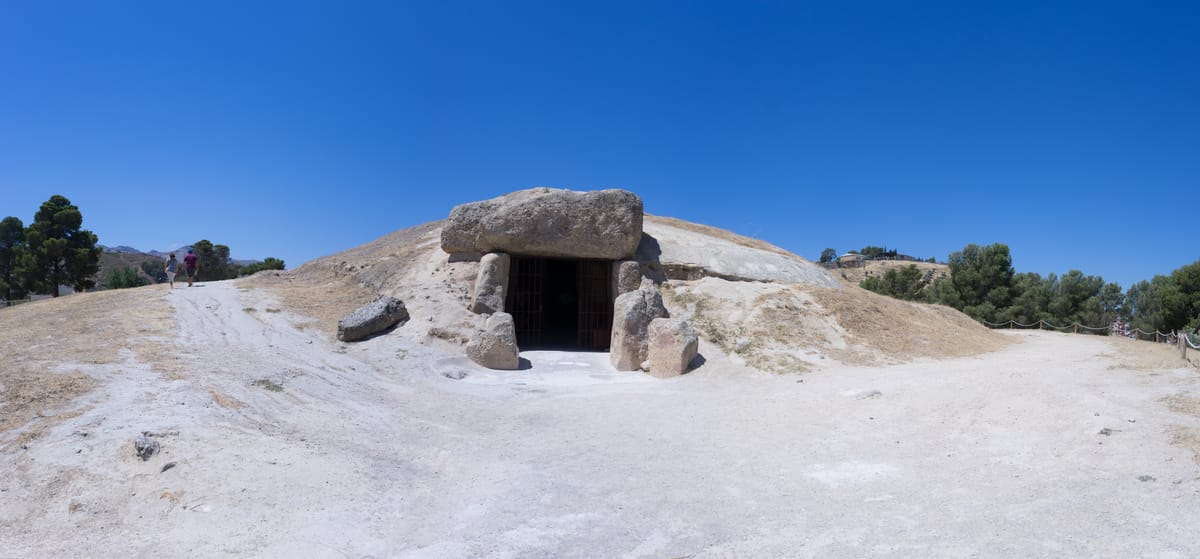
The Dolmen of Menga is a Neolithic megalithic burial monument on the edge of Antequera, in Málaga province, Andalusia, southern Spain. Built roughly between 3800 and 3600 BCE, it is one of the oldest and largest megalithic structures in Europe: a long stone-lined passage and chamber, roofed by five colossal capstones and originally covered by an earthen mound (tumulus) that today rises as a grass-covered hill. Menga predates Stonehenge’s sarsen circle by well over a thousand years and is far heavier in its individual stones than any element of that better-known monument. Together with the nearby Dolmen of Viera and the Tholos of El Romeral, it forms the Antequera Dolmens Site, inscribed as a UNESCO World Heritage Site in 2016 in recognition of what UNESCO describes as one of the most important works of European megalithic architecture. Excavations since the 19th century recovered the disturbed remains of several hundred individuals from the chamber, confirming its use as a collective tomb, likely reused over a long span of time and periodically reopened for later burials.
The Structure
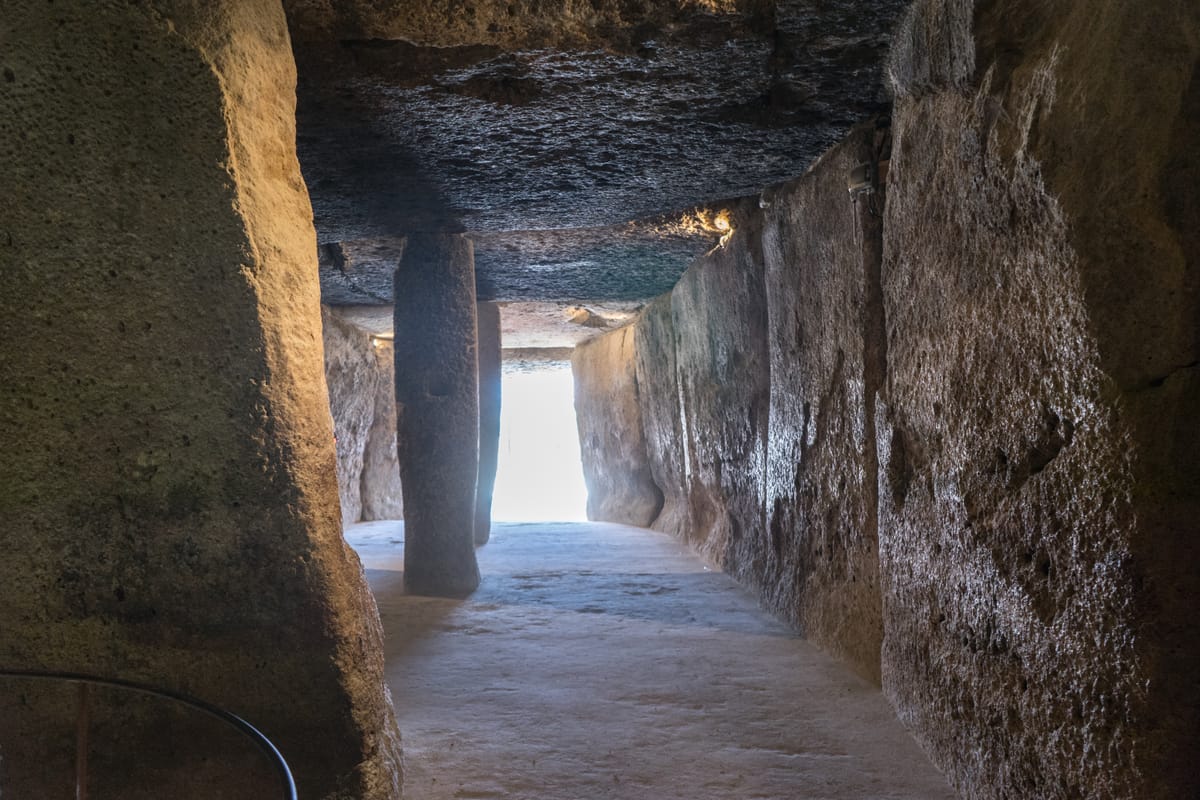
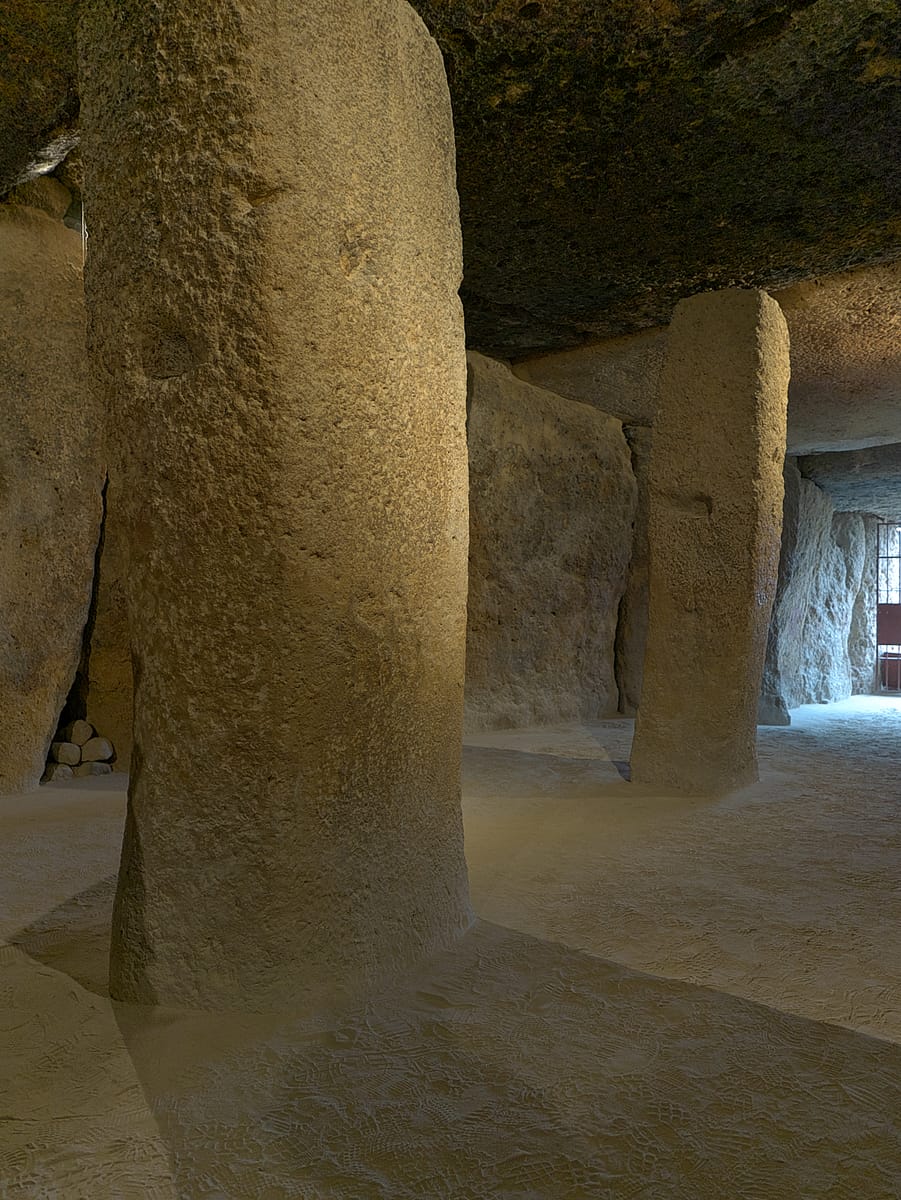
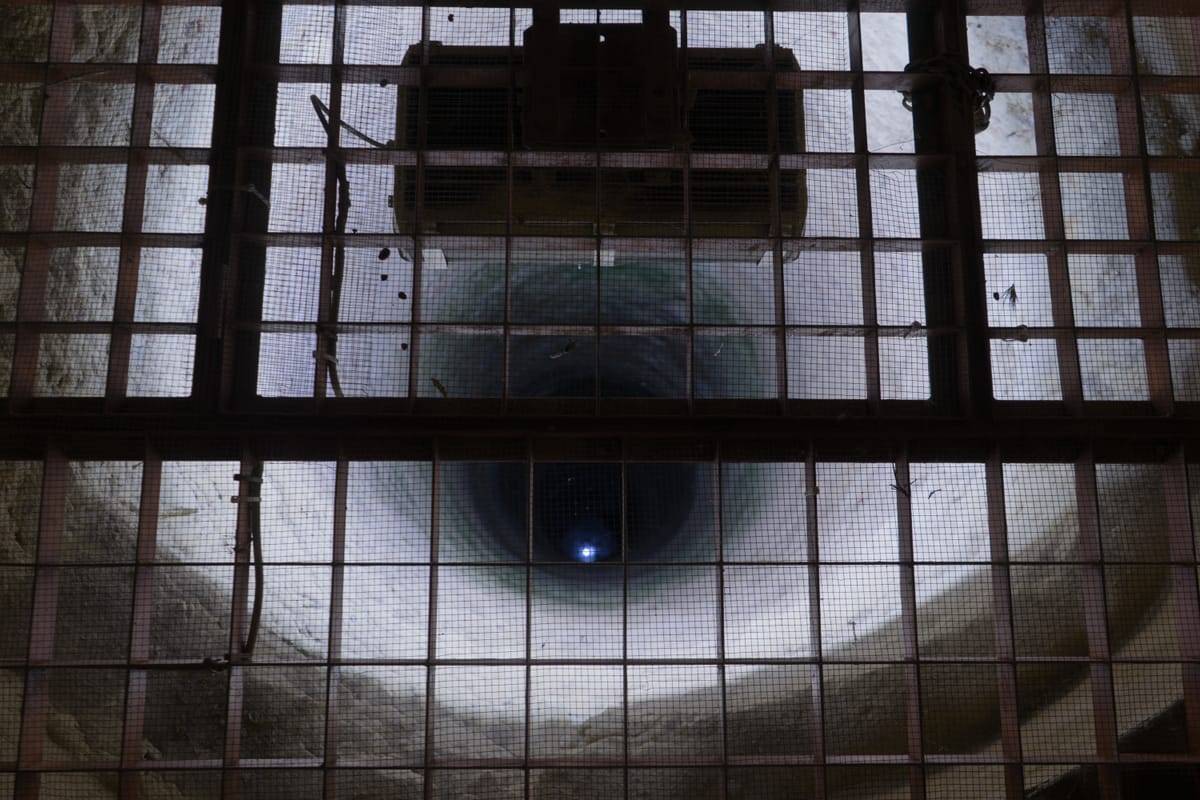
Menga’s chamber and passage run about 27.5 meters from the entrance to the rear wall, roughly 6 meters wide, and up to 3.5 meters high. The walls are formed from 32 huge upright stones (orthostats) of local stone, and the roof is made of just five capstones, the largest of which is estimated to weigh on the order of 150 tonnes, with some estimates running as high as 180 tonnes. To help carry that immense load, the builders did something found at no other dolmen of this scale: they placed three massive freestanding pillars along the central axis of the chamber, positioned precisely under the joints between the capstones, to share the roof’s weight with the side walls. Near the back of the chamber, aligned with those pillars, excavators uncovered a well cut directly into the sandstone bedrock — about 1.5 meters across and some 19.5 meters deep, reaching down to the water table. Unlike almost every other Iberian dolmen, whose passage faces sunrise, Menga’s axis points northeast toward a distinctive nearby mountain, the Peña de los Enamorados, whose silhouette from certain angles resembles a reclining human figure and which itself bears Neolithic rock art. That deliberate orientation toward a landmark rather than a celestial event is, so far as archaeologists have found, unique among the megalithic monuments of continental Europe.
How Was It Built?
Petrographic and stratigraphic analysis published by José Antonio Lozano Rodríguez and colleagues in 2023 traced Menga’s stones to a quarry roughly a kilometer away, at Cerro de la Cruz, where geologists identified the natural tectonic fractures the builders exploited to split enormous slabs of calcarenite (a soft, sandstone-like limestone) out of the bedrock. Moving stones of that mass and fragility without cracking them was, the researchers argued, itself a major engineering achievement, likely requiring graded, leveled trackways, wooden sledges, ropes, and large coordinated labor gangs, with scaffolding and levers used to raise and seat the capstones once the stones reached the site. A follow-up study by the same team, published in Science Advances in 2024, went further, arguing that the builders applied what the authors call “early science”: the orthostats were deliberately tilted slightly inward, giving the chamber a trapezoidal cross-section that reduces the span the roof has to bridge and channels the capstones’ weight down through the walls and the three internal pillars; contact surfaces between stones were dressed and fitted with what the team characterizes as millimetric precision; and the whole assembly functioned as a kind of self-stabilizing structural system, with counterweighting and interlocking joints designed to keep multi-hundred-ton loads from shearing apart over centuries. Once the roof was in place, the entire structure was buried under an artificial mound of packed earth and stone, which also served to brace the megaliths from outside.
The Mainstream View
Archaeologists agree that Menga was built and used by Neolithic farming communities settled in the fertile Guadalhorce valley around Antequera, a society that, on current evidence, had no metal tools, no draft animals harnessed for heavy haulage, and no wheeled transport. The mainstream explanation for its construction rests on the 2023-2024 Lozano Rodríguez research program: sophisticated but low-technology methods — quarrying along natural stone fractures, sledges and greased or wetted trackways, ramps, levers, and very large, well-organized labor forces — are considered sufficient to explain how the stones were moved and raised, without requiring tools or techniques beyond what is otherwise attested for the European Neolithic. The tomb’s scale and the coordination it demanded are read as evidence of an unusually complex, hierarchical, or at least highly cooperative society for its time and place, one capable of mobilizing labor across what was likely a period of years. The collective burial of hundreds of people over an extended period fits the wider pattern of megalithic tomb use across Atlantic and Mediterranean Europe, where such monuments served as durable, visible markers of ancestry, territory, and community identity as much as places of interment.
The Open Case
What remains genuinely open is not whether Menga is real, or roughly how old it is — both are well established by decades of excavation, radiocarbon dating, and the 2023-2024 geological and structural studies — but the precise mechanics and motives behind choices that still strain reconstruction. No Neolithic society anywhere is otherwise documented moving and lifting single stones approaching 150 tonnes with the routine confidence Menga’s builders show, and the exact sequence of ramps, counterweights, and manpower needed to seat five capstones that size, without a documented failure, is inferred rather than directly observed. Why the builders chose to align the monument with the Peña de los Enamorados rather than the sun, breaking with the overwhelming regional pattern of solar-oriented tombs, is unresolved: was the mountain itself sacred, a marker tied to the dead, or an orientation whose meaning is now lost? The purpose of the 19.5-meter well is likewise debated — proposals range from a practical water source, to a ritual feature symbolically connecting the tomb to the earth and the water table below, to a combination of both, but no proposal is settled fact. None of this requires appeal to anything beyond Neolithic ingenuity operating at the outer edge of what has been documented for its era; it is the specificity of Menga’s engineering, and the deliberateness of its unusual choices, that keeps researchers returning to the site.
Sources
- UNESCO World Heritage Centre — Antequera Dolmens Site
- Wikipedia — Dolmen of Menga
- Wikipedia — Antequera Dolmens Site
- Lozano Rodríguez et al., Scientific Reports (2023) — The provenance of the stones in the Menga dolmen reveals one of the greatest engineering feats of the Neolithic
- Lozano Rodríguez et al., Science Advances (2024) — Early science and colossal stone engineering in Menga, a Neolithic dolmen (Antequera, Spain)
Gallery