Leshan Giant Buddha
How did Tang-dynasty workers carve a coherent, 71-metre seated Buddha directly into a river cliff over some ninety years and three generations, and engineer a hidden drainage system that has kept the soft sandstone standing for more than 1,200 years?
Why this rating?
- Construction difficulty
- 4/5
- Method uncertainty
- 2/5
- Capability gap
- 2/5
- Open questions
- 2/5
Carving a coherent 71-metre figure into a live river cliff over ninety years was an enormous organizational and sculptural feat, but the method — direct relief carving of relatively soft red sandstone with Tang-era iron tools, plus a documented internal drainage system — is well understood and squarely within Tang China's known capabilities, so the genuine wonder lies in the scale, the millennium of survival, and the ingenuity of the hidden drainage rather than in any technological mystery.
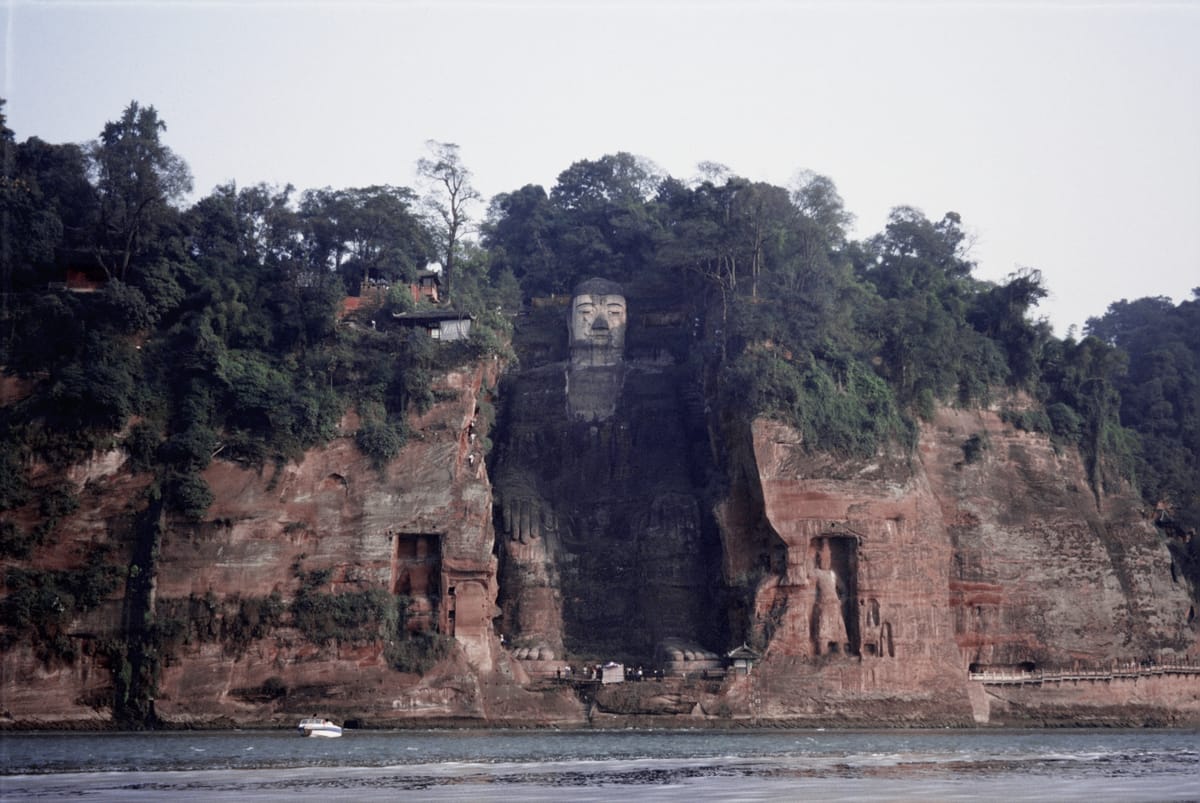
Overview
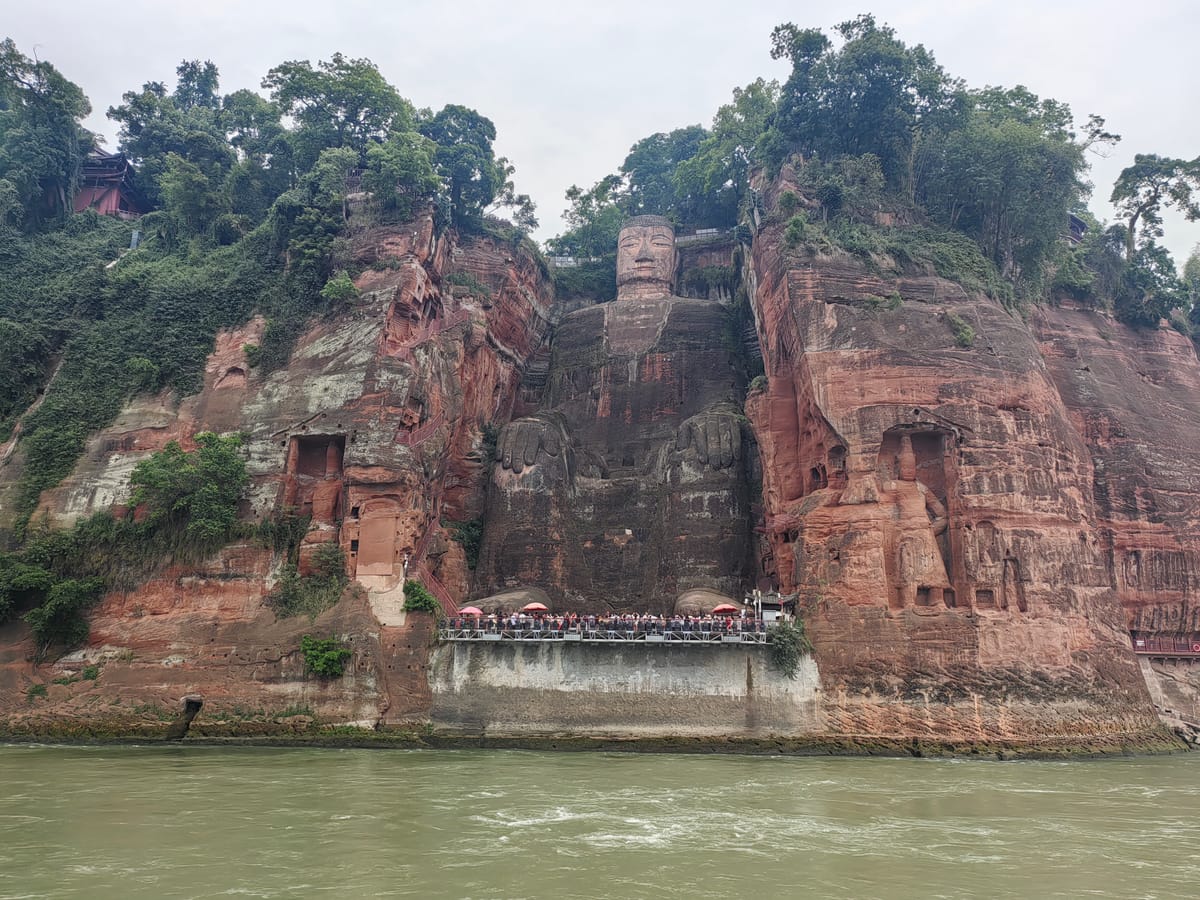
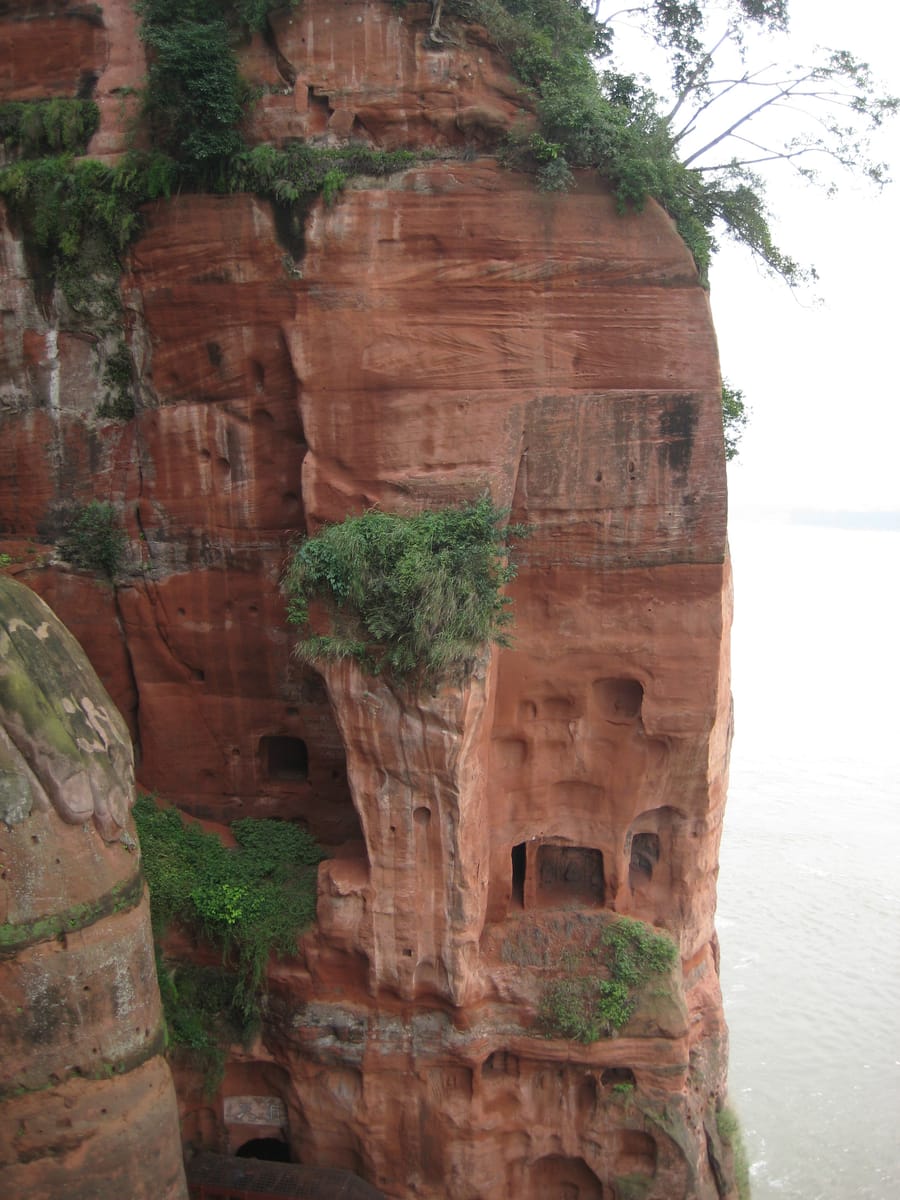
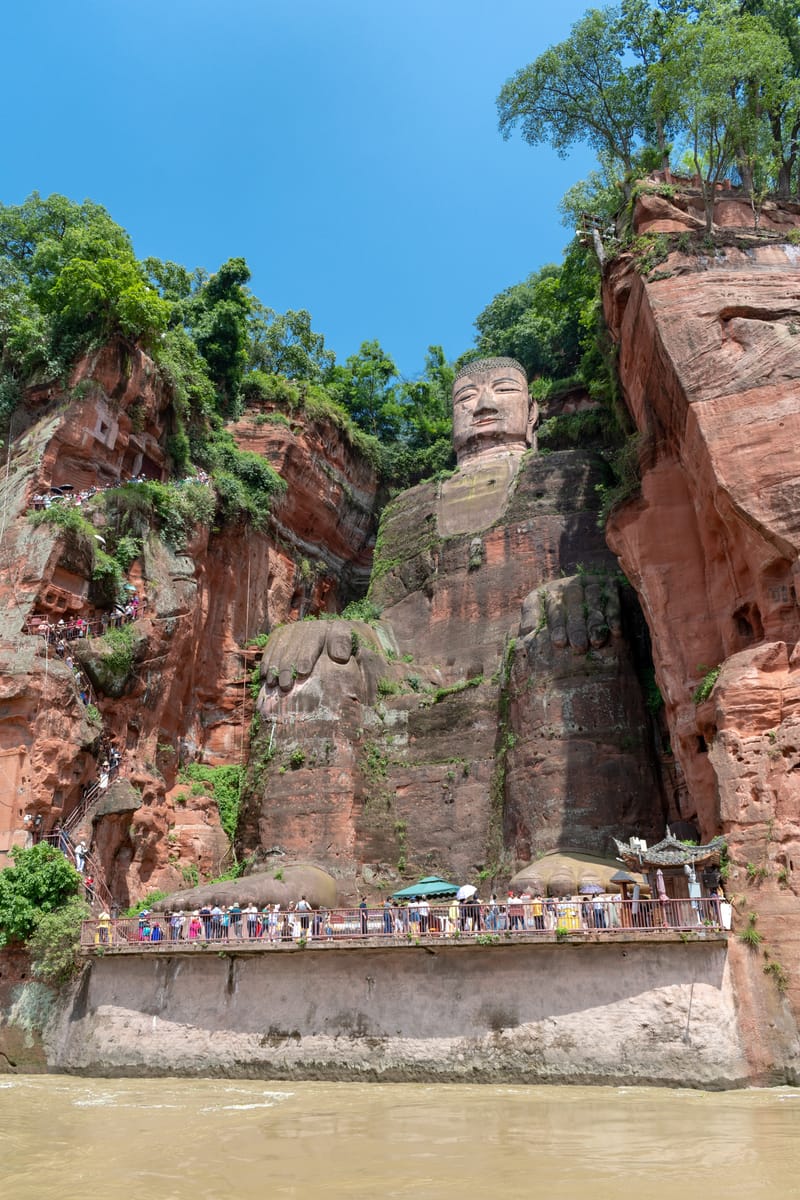
At the eastern edge of the city of Leshan in Sichuan, China, a seated Buddha 71 metres tall is carved directly into a red sandstone cliff overlooking the point where three rivers — the Min, the Dadu, and the Qingyi — come crashing together. It is the largest pre-modern stone Buddha in the world, and by most reckonings the tallest stone statue of any kind surviving from the ancient or medieval world. The figure depicts Maitreya, the Buddha of the future who Buddhist tradition holds will one day appear on Earth to renew the teaching, and it sits in a calm, formal posture with hands resting on its knees and eyes half-closed toward the water below. Work began in 713 CE, early in China’s Tang dynasty, and dragged on across roughly ninety years and three generations of workers before it was finished around 803 CE. Since 1996 the Buddha has been protected as part of the UNESCO World Heritage Site “Mount Emei Scenic Area, including Leshan Giant Buddha Scenic Area,” recognized for both its natural setting and its cultural significance. A reader who has never heard of it can picture the essentials plainly: a single colossal Buddha, hewn out of a cliff by hand, still gazing over a busy river confluence more than twelve centuries after the first chisel struck.
The Structure
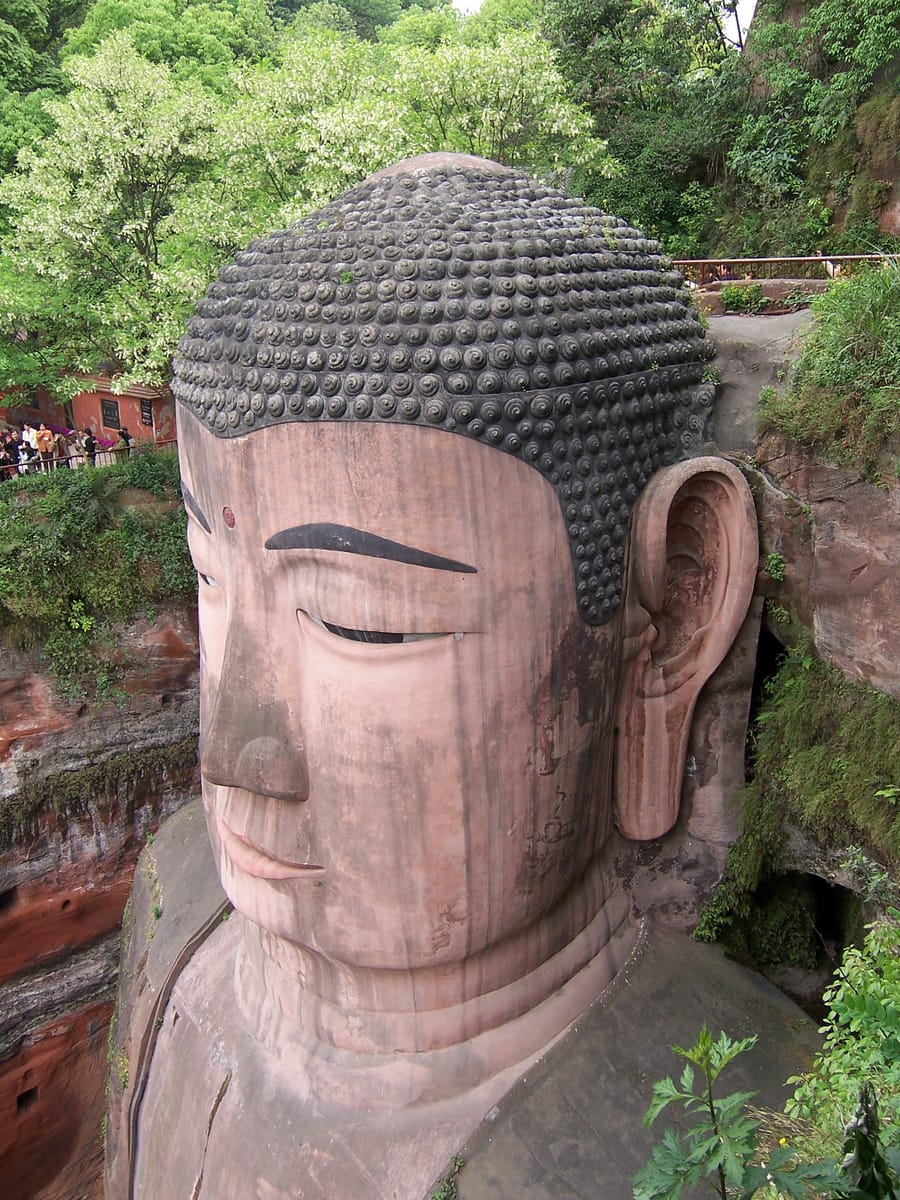
The statue was the idea of a Buddhist monk named Hai Tong (also written Haitong), who lived on Mount Lingyun and was disturbed by how many boats and lives were lost each year in the violent, fast-moving waters at the river junction below. He conceived of carving a giant Maitreya into the cliff, believing the Buddha’s presence would calm the currents and protect the boatmen — and, in a practical sense he may or may not have intended, the enormous quantity of rock chiselled off the cliff and dumped into the river during construction did alter the flow and reduce its ferocity. The figure’s dimensions are staggering: its shoulders span about 28 metres, its head alone is nearly 15 metres tall, each ear is roughly 7 metres long, the nose about 5.6 metres, and the fingers more than 8 metres each; visitors standing on the toe are dwarfed by it. The head is crowned with 1,021 individually carved coils of hair. The whole work is cut from the Cretaceous red bed sandstone of the cliff itself, a relatively soft and workable stone — an advantage for the carvers, but also a liability, since it weathers readily in Sichuan’s damp, rainy climate. For centuries the Buddha was sheltered by a huge multi-storey timber pavilion built against the cliff, which was later destroyed, leaving the figure exposed to the elements as it appears today. A legend attached to Hai Tong records that when local officials tried to divert the funds he had raised for the project, he declared he would sooner gouge out his own eyes than surrender the money — and, the story goes, did exactly that to prove his resolve.
How Was It Built?
The Buddha was made by direct relief carving: rather than assembling or transporting stone, workers simply removed everything that was not the Buddha, cutting the figure out of the living cliff from the top down. This is essentially the same rock-cut tradition seen across Buddhist Asia in cave temples and cliff shrines, executed here at colossal scale. Tang-dynasty masons worked the soft sandstone with iron tools — chisels, picks, and hammers — which bite into this kind of stone far more readily than the copper-and-abrasive methods needed for granite elsewhere in the ancient world, which is a large part of why a project this size was feasible by hand at all. The most admired piece of engineering is not the carving but the concealed drainage system built into the finished figure. A network of hidden gutters and channels is worked through the coiled hair, along the collar, across the back and chest, and behind the ears, designed to catch rainwater and carry it away from the most vulnerable surfaces before it can soak in and erode them. This internal plumbing, cut more than twelve hundred years ago, still functions and is credited as a major reason the soft-stone statue has survived so long in such a wet climate. Construction was anything but continuous. Hai Tong began in 713 and had progressed only as far as the Buddha’s head and shoulders when he died; the project then stalled for years until his disciples resumed it with backing from a local official, Zhangchou Jianqiong, reaching roughly the knees before work halted again when that patron was recalled to the capital. It was finally the regional military governor Wei Gao who funded the last push, and the Buddha was completed around 803 CE — some ninety years after it was begun.
The Mainstream View
Historians and archaeologists regard the Leshan Giant Buddha as a well-documented monument whose origin, purpose, dating, and construction method are essentially settled. The core narrative — Hai Tong’s initiative in 713, the long interrupted campaign across three generations of patrons, and the completion under Wei Gao around 803 — is supported by Chinese historical records and inscriptions, not merely by legend, and the roughly ninety-year span fits comfortably with the scale of the work and its repeated funding crises. The identification of the figure as Maitreya, its dimensions, its red sandstone material, and the presence of the internal drainage system are all directly observable and non-controversial. The carving technique fits squarely within the broader East Asian tradition of rock-cut Buddhist sculpture, and the choice of a soft, iron-workable sandstone cliff is exactly what made a hand-carved colossus of this size practical. In short, there is no serious dispute about who built the Leshan Buddha, when, why, or broadly how. What impresses specialists is not any puzzle of lost technique but the sheer ambition and sustained organization required to finish it, and the sophistication of the drainage engineering that has allowed a fragile-stone statue to endure for more than a millennium in a punishing climate.
The Open Case
Because the big questions are settled, the genuine open questions at Leshan are narrower and more technical — and they are questions of conservation and detail rather than mystery. Chief among them is the ongoing battle against weathering itself: the same soft sandstone that made the Buddha possible to carve makes it perpetually vulnerable, and despite the ancient drainage system the figure suffers from erosion, cracking, biological growth, and blackening, prompting repeated modern surveys and restoration campaigns whose long-term effectiveness is still being worked out. The full extent and original design of the internal drainage network is not completely mapped, and researchers continue to study how much of the statue’s survival is owed to that Tang engineering versus later interventions and the vanished protective pavilion that once covered it. There are also unresolved details about the statue’s original appearance — how it was painted or gilded, and exactly how the great timber shelter was constructed and when it was lost. None of this points to anything beyond the capabilities of Tang-dynasty China, which was one of the most technically and administratively advanced societies of its age. The lasting wonder of Leshan is not that we cannot explain it, but that a project so vast, carved by hand into crumbling rock and repeatedly abandoned for lack of money, was ever finished at all — and that its builders had the foresight to hide inside it the drainage that would keep it standing for the next twelve hundred years.
Sources
- Wikipedia — Leshan Giant Buddha
- UNESCO World Heritage Centre — Mount Emei Scenic Area, including Leshan Giant Buddha Scenic Area
- UNESCO / IUCN World Heritage Outlook — Mount Emei Scenic Area, including Leshan Giant Buddha Scenic Area
- Ancient Origins — The Leshan Giant Buddha: Largest Stone Buddha in the World
- China Discovery — Leshan Giant Buddha History and Facts
- Buddhistdoor Global — Leshan Buddha Undergoes 'Physical' Examination and Repairs
Connected findings
- Soft Enough to Carve, Soft Enough to Lose — A Neolithic underworld beneath a Maltese suburb and a 71-metre Buddha in a Sichuan cliff were both made possible by picking weak stone. Both are now being taken apart by the weather for exactly the same reason.
- china
- tang-dynasty
- buddhist
- rock-cut
- sandstone
- maitreya
- colossal-statue
- sichuan
- unesco-world-heritage
- drainage-engineering
Gallery