Ishibutai Kofun
How did seventh-century builders drag some thirty granite blocks three kilometres from a mountainside and set a 77-tonne ceiling stone almost five metres in the air with nothing but timber, rope, and muscle — and why was the earth mound that hid all of it stripped away?
Why this rating?
- Construction difficulty
- 4/5
- Method uncertainty
- 3/5
- Capability gap
- 2/5
- Open questions
- 4/5
Hauling roughly 2,300 tonnes of granite three kilometres and seating a 77-tonne capstone nearly five metres up is a genuine feat, though a wealthy seventh-century state with iron tools, timber sledges, and organised labour is a plausible builder, so the capability gap is small. What stays open is the specifics: no record or excavated ramp shows how the capstones were actually raised, the occupant is inferred rather than proven, and there is no settled explanation for why the covering mound is entirely gone.
Overview
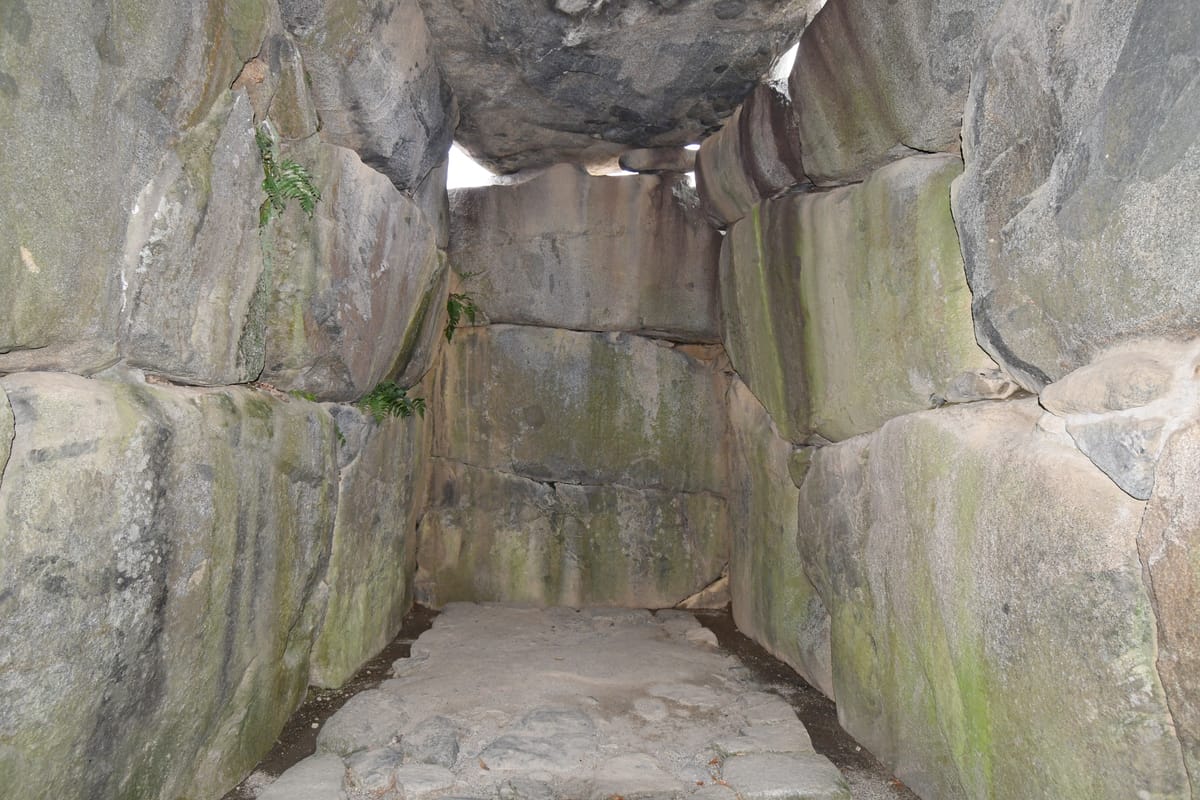
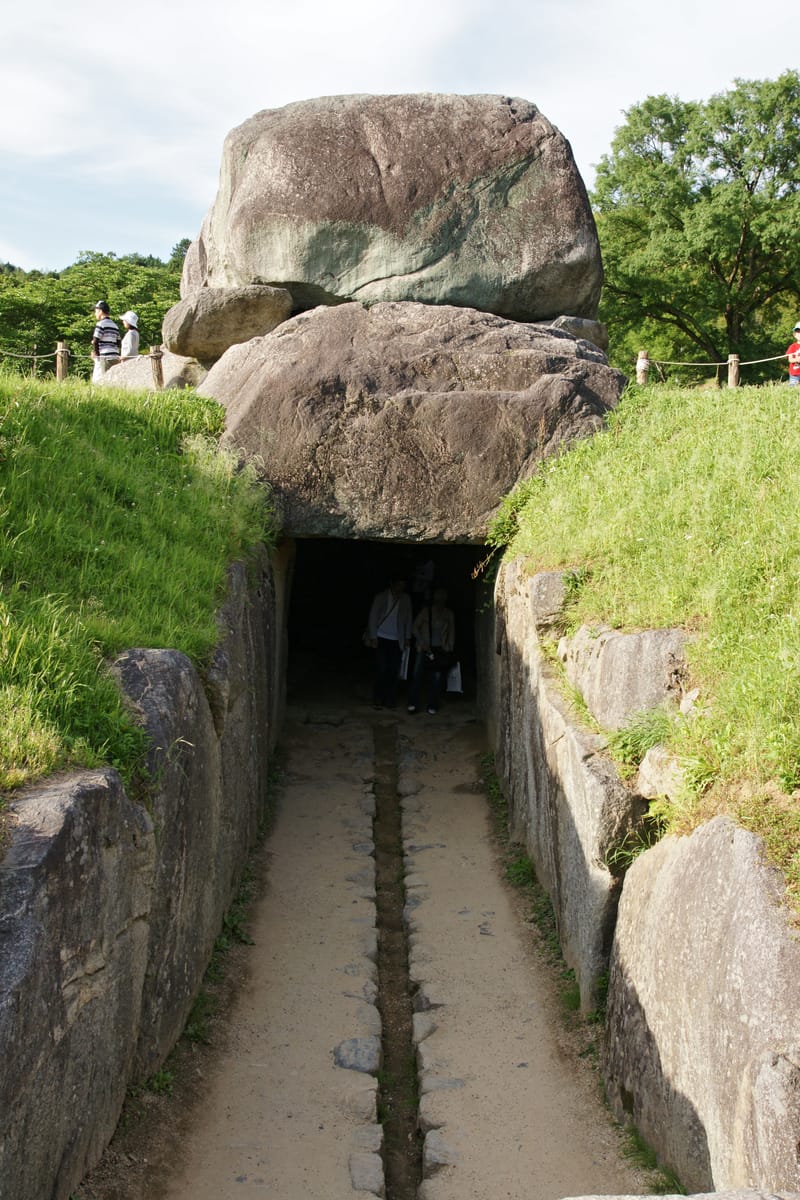
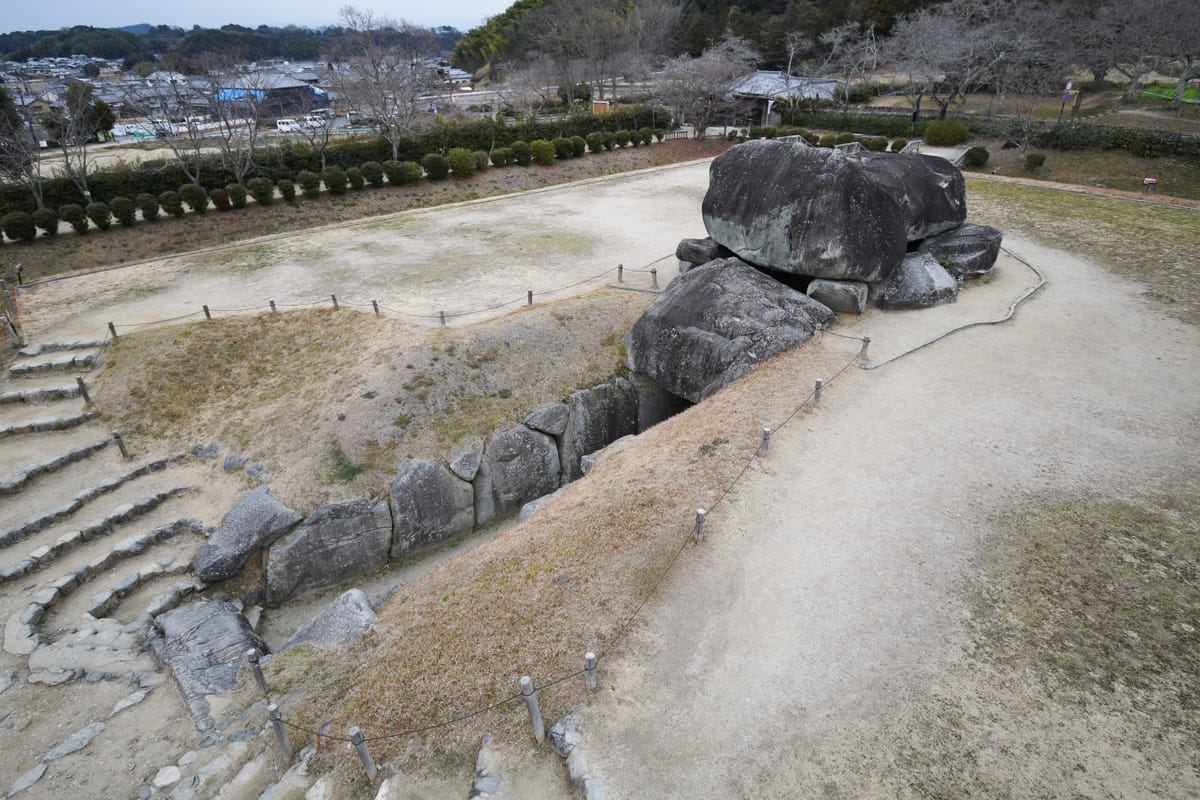
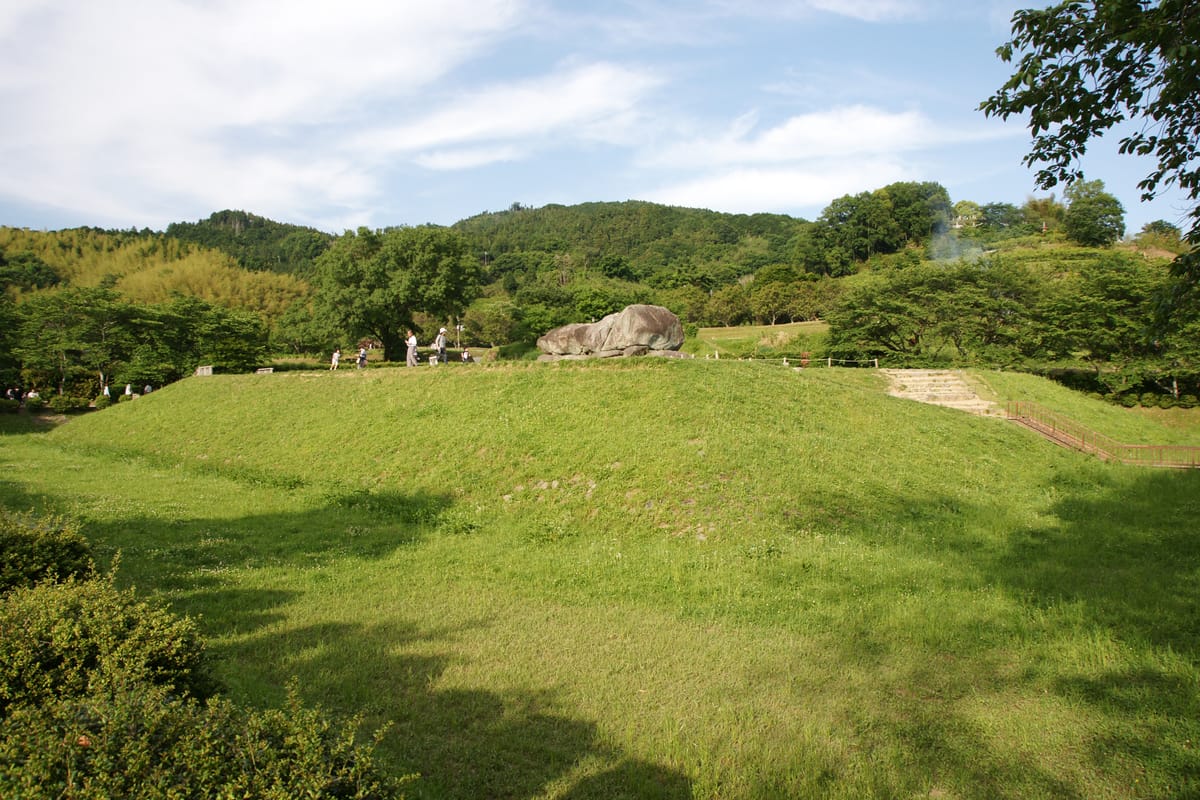
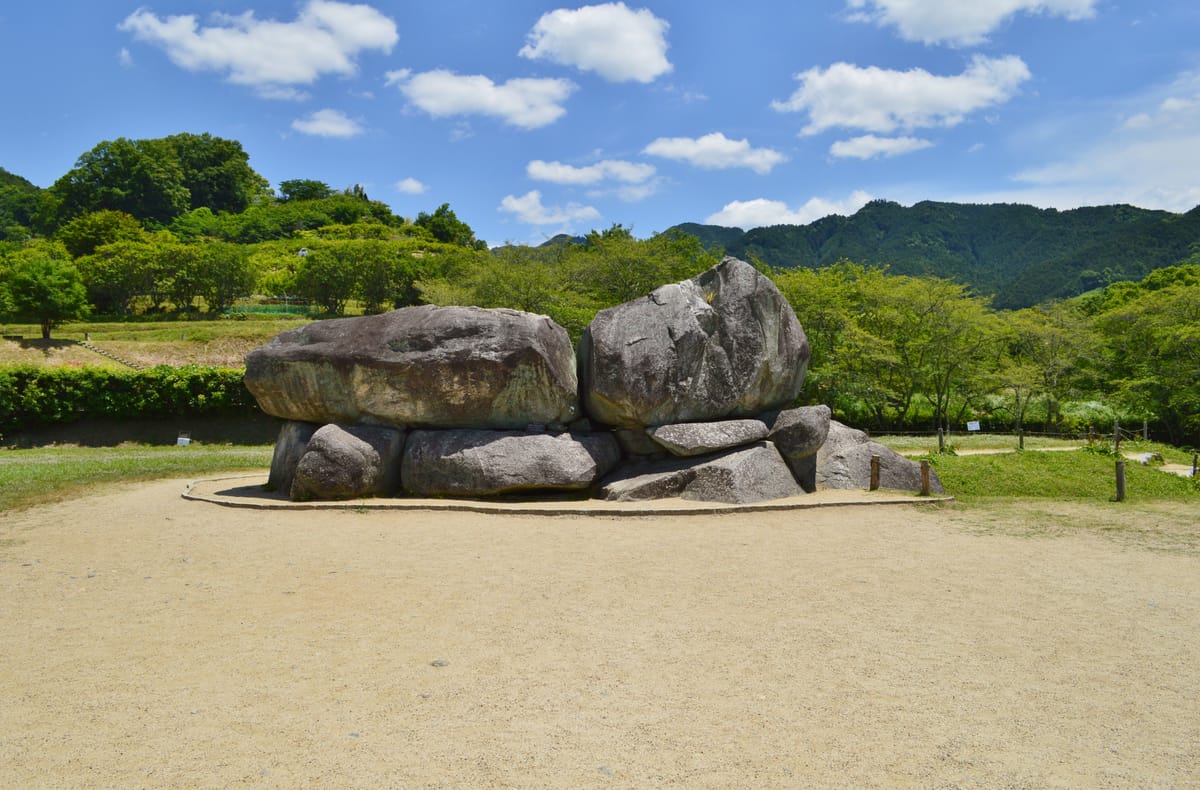
Ishibutai Kofun sits in a shallow valley in the village of Asuka, Nara Prefecture, in the old heartland of the Japanese state. It is a kofun — a mounded tomb of the kind built across Japan between roughly the third and seventh centuries CE — but it looks like nothing else in the country, because the mound is missing. What remains is the bare skeleton: a chamber built from about thirty granite megaliths weighing an estimated 2,300 tonnes in total, roofed by two enormous ceiling stones of roughly 64 and 77 tonnes. Stripped of the earth that once buried it, the structure reads as a flat-topped rock platform, and the name it has carried for centuries — ishibutai, “stone stage” — comes from exactly that impression.
It is one of the largest stone burial chambers in Japan and is built from the heaviest individual stones known in any Japanese tomb. It has been a nationally designated Special Historic Site since 1954, and in July 2026 it was inscribed on the UNESCO World Heritage List as one of the nineteen component sites of “Asuka-Fujiwara,” the archaeological landscape of Japan’s earliest capitals. Almost every account identifies the person buried here as Soga no Umako, the statesman who dominated the Yamato court in the late sixth and early seventh centuries — but no inscription, and almost no grave goods, survive to confirm it.
The Structure
The tomb dates to the early seventh century CE, at the very end of the kofun-building tradition and the start of the Asuka period, when Buddhism, continental writing, and a centralised court were reshaping Japan. Excavation showed that the builders levelled and destroyed at least seven smaller sixth-century burial chambers to clear the ground — a blunt statement of precedence by whoever commissioned it.
The chamber itself (the genshitsu, or main burial room) is about 7.7 metres long, 3.5 metres wide, and 4.7 metres high, entered through a horizontal passage (sendō) some 11 metres long, giving a stone structure roughly 19 metres end to end. The passage floor carries a carefully cut drainage channel running down its centre, an engineering detail that says the builders expected water and planned for it. The walls are granite blocks laid without mortar, leaning slightly inward as they rise, so the side walls corbel in toward the roof and shorten the span the ceiling stones have to cross. Two capstones close it: the northern one at roughly 64 tonnes, the southern one at roughly 77 tonnes.
All of this once stood inside a mound. The 1933 and 1935 excavations led by the archaeologist Kōsaku Hamada recovered the ground plan: a square platform about 50 metres on each side, ringed by a moat and an outer embankment that brought the whole precinct to some 80 metres across. That square footprint has been restored and is what visitors walk around today. What the mound looked like above the platform is genuinely unresolved — a two-tiered square mound, a round dome on a square base (jōen-kahō-fun), and an octagonal upper stage have all been proposed, and the evidence does not decide between them, because the mound’s earth is simply gone.
Inside, the tomb had been thoroughly robbed long before modern archaeology arrived. Excavators found broken fragments of a tuff sarcophagus, scraps of gilt and bronze fittings, and pottery sherds — enough to confirm a burial of high status, not enough to name anyone.
How Was It Built?
The granite came from the flank of Mount Tōnomine, roughly three kilometres away, and was brought down the valley of the Fuyuno River. That distance is short by megalithic standards; the difficulty is the mass. A 77-tonne block is heavier than a loaded semi-trailer several times over, and it had to travel over soft valley ground and then be lifted nearly five metres.
There is no contemporary description of how it was done, but seventh-century Japan is not a technological blank. The Yamato state had iron tools, organised corvée labour, and — crucially — a documented stone-moving machine. In March 1978, excavators working the moat of the Mitsuzuka Kofun in Fujiidera, Osaka, pulled two wooden sledges out of the mud, the larger 8.8 metres long, each carved from the natural fork of a red oak so that the split of the trunk formed the sledge’s two runners. A lever pole 6.2 metres long and 20 centimetres thick came up with them. These are shura — the sledges tradition says were used to drag megaliths for kofun construction — and their survival turned a folk term into an excavated artefact. Reconstructions have since been used in public stone-hauling experiments.
The standard reconstruction for Ishibutai therefore runs: split the granite along natural joints on the mountain, load each block onto a shura, and drag it on rollers over a prepared, wetted or greased track with large gangs on ropes and levers. At the site, build the chamber walls first, then raise an earth ramp against them and haul each capstone up the slope on the same sledges until it can be levered into its seat — after which the ramp material simply becomes part of the mound that buries the whole thing. It is an elegant idea, because the mound and the lifting machine become the same pile of dirt. It is also, at Ishibutai, entirely inferred: the mound is gone, so no ramp survives to be excavated.
The Mainstream View
Japanese archaeology treats Ishibutai as an impressive but explicable monument. The dating to the early seventh century rests on the tomb’s architecture, the pottery recovered, and its stratigraphic relationship to the sixth-century graves it destroyed. The attribution to Soga no Umako rests on a reading of the Nihon Shoki, which records the death of the Great Minister in 626 and his burial at a place called Momohara — a location that fits this valley, in a district whose place name, Shimanoshō, preserves Umako’s court nickname “the Minister of the Island,” after the famous island-and-pond garden at his residence. The historian Sadakichi Kita made this identification early in the twentieth century and it has held ever since, though it is an inference from geography and text, not proof. It is not unanimous: the Nara University archaeologist Masayoshi Mizuno has argued from the stone types and construction chronology that the tomb belongs instead to Umako’s father, Soga no Iname.
On construction, the consensus is that nothing here exceeds what a wealthy, centralised seventh-century polity could organise. Iron tools, timber sledges, rollers, levers, ropes, earthen ramps, and a large conscripted workforce are sufficient in principle, and the same court was simultaneously building Asuka-dera, Japan’s first full-scale Buddhist temple, with continental architects. Ishibutai is read less as a technical puzzle than as a political monument: the last, largest gesture of the mounded-tomb tradition, raised by a family at the height of its power just before the tradition — and the family — ended.
For the missing mound, the most-repeated explanation is also Kita’s. Twenty years after Umako’s death his descendants overreached; in 645 the coup remembered as the Isshi Incident destroyed the Soga, and the clan was branded as traitors retroactively. On this reading the mound was deliberately stripped and the tomb opened as posthumous punishment. Others argue for something duller: centuries of erosion and farmers quarrying convenient earth from an unprotected hill.
The Open Case
The stones are not a mystery in the sense of being unexplainable — they are a mystery in the sense that no one has ever watched it done, and the evidence that would settle it was carted away.
Every element of the standard reconstruction is attested somewhere in kofun-period Japan, but not here. The shura sledges come from a different tomb, sixty kilometres west. The earthen ramp is a reasonable proposal that cannot be tested, because the mound that would have contained it no longer exists. No tools, no work records, no unfinished blocks abandoned on the route from Mount Tōnomine have been recovered. The gap between “this was possible” and “this is how it happened” is, at Ishibutai, unusually wide — and it is the price of the very thing that makes the site extraordinary to look at. The tomb is visible precisely because the archaeology of its construction was destroyed.
The occupant is likewise a strong inference resting on a single line in a chronicle written a century after the fact. The original silhouette of the mound remains undetermined between three competing reconstructions. And the reason the mound is gone at all — vandalism as political vengeance, or simply time and the plough — has no decisive evidence on either side, only a story that fits too neatly to fully trust.
What is left is the thing itself: two slabs of mountain, one of them 77 tonnes, resting exactly where somebody in the early 600s decided they should rest, above a chamber swept empty by robbers, on a platform whose covering hill somebody else decided should not remain. Stand in the passage with the capstones overhead and the question is not whether people could have done this. It is how, and at what cost, and who was determined enough to insist on it.
Sources
- Wikipedia — Ishibutai Kofun
- Asuka Historical National Government Park — Ishibutai Kofun (石舞台古墳)
- Nara Prefecture Official Tourism — Ishibutai Kofun
- Japanese Wiki Corpus — Ishibutai-kofun Tumulus
- Wikipedia — Asuka-Fujiwara (UNESCO World Heritage inscription, 2026)
- Wikipedia (Japanese) — 石舞台古墳
- Wikipedia (Japanese) — 修羅 (そり), the wooden sledges excavated at Mitsuzuka Kofun
- Japan Guide — Ishibutai Tomb, Asuka
Gallery