Dholavira
How did a Bronze Age community with only hand tools survive for well over a millennium on a parched salt-desert island by engineering one of the world's earliest city-scale water systems - and why, after all that ingenuity, was Dholavira eventually abandoned?
Why this rating?
- Construction difficulty
- 3/5
- Method uncertainty
- 2/5
- Capability gap
- 1/5
- Open questions
- 3/5
The construction methods - dressed-stone masonry, rock-cut reservoirs, and gravity-fed drains - are well understood and squarely within known Harappan capability, so there is no real gap between the builders and the result. The genuine open questions lie elsewhere: the ten-symbol signboard and the rest of the Indus script remain undeciphered, the precise chronology is still debated, and exactly why so ingenious a water system ultimately failed is unresolved.
Overview
Dholavira is a ruined city of the Harappan, or Indus Valley, Civilization, sitting on Khadir Bet
- an island of higher ground surrounded by the seasonally flooded salt flats of the Great Rann of Kutch, in Gujarat, western India. Occupied from roughly 3000 BCE to about 1450 BCE, it is one of the five largest Harappan sites and the most prominent Indus Valley site within India’s modern borders. What makes Dholavira extraordinary is where it was built: on a hot, saline island with no perennial river and almost no natural fresh water, in a landscape that receives only a brief, erratic monsoon. The Harappans answered that hostile setting with engineering. They ringed and threaded their city with an interconnected system of reservoirs, dams, channels and drains designed to capture the runoff of two seasonal streams and a few weeks of rain, and to hold it through the long dry year. Nearly a third of the walled city was given over to storing water. In 2021, UNESCO inscribed the site on the World Heritage List as “Dholavira: A Harappan City,” recognising it as one of the earliest and most complete examples of urban-scale water management anywhere in the ancient world.
The Structure
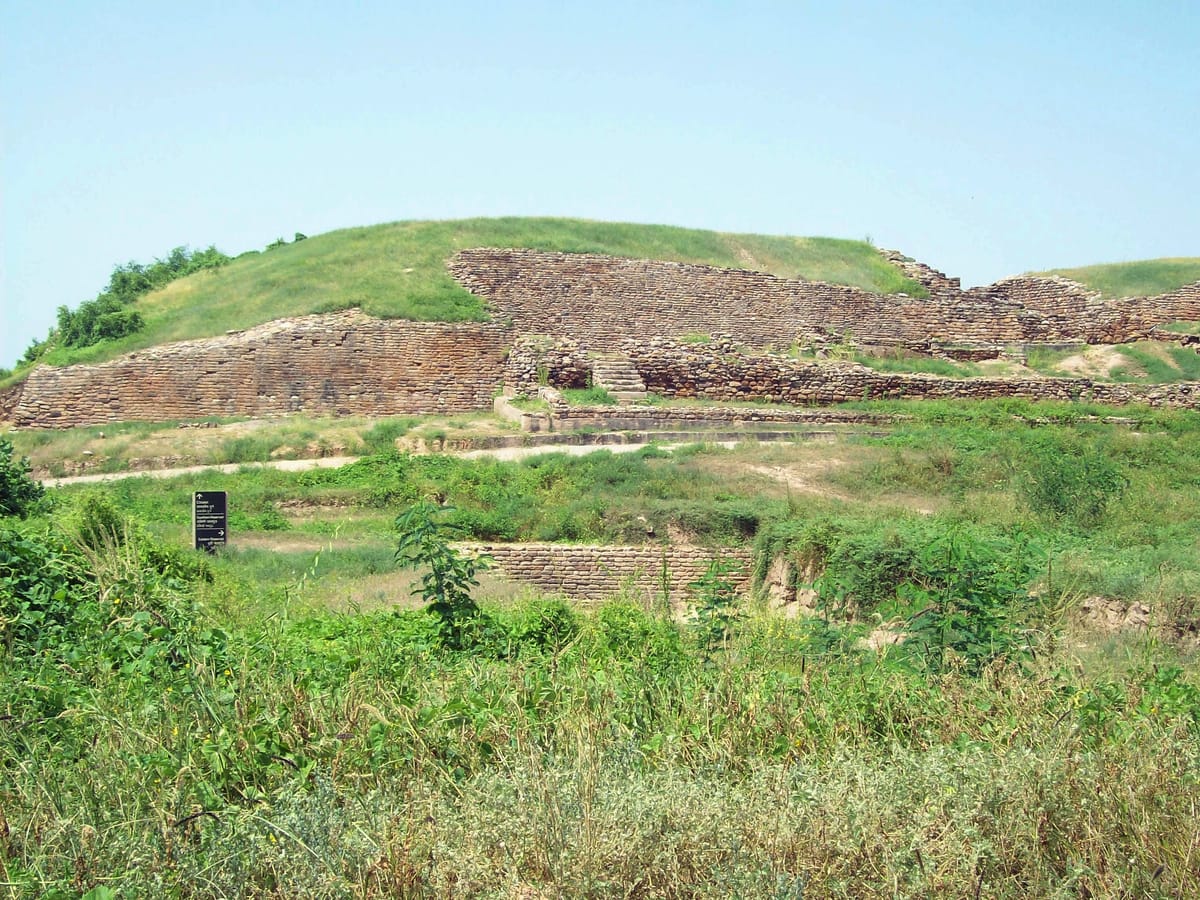
The site covers about 47 hectares in total, with the walled city proper occupying roughly 22 hectares in a fortified rectangle measuring some 771 by 617 metres. Like other Indus cities, Dholavira was carefully planned, but it differs from famous Harappan centres such as Harappa and Mohenjo-daro in one striking respect: where those cities were built largely of standardised fired and mud brick, Dholavira was built substantially of stone - quarried, dressed and laid as masonry - because good building stone was close at hand on the island. The city is divided into three nested parts: a heavily fortified upper “citadel” (itself split into a “castle” and an adjacent “bailey” where officials seem to have lived), a “middle town,” and a “lower town,” all enclosed and subdivided by massive double ramparts and gateways.
Near the northern gate of the citadel, excavators found what has become one of Dholavira’s signature discoveries: the so-called Dholavira Signboard, a row of ten large symbols in the still-undeciphered Indus script. Each sign, made of inlaid pieces of a white gypsum-like mineral, stands roughly 37 centimetres high, and the whole inscription ran about three metres across what is thought to have been a wooden board mounted above the gateway. It is one of the longest single Indus-script sequences ever found - an ancient signpost whose meaning is completely lost, because no one has yet been able to read the Indus script.
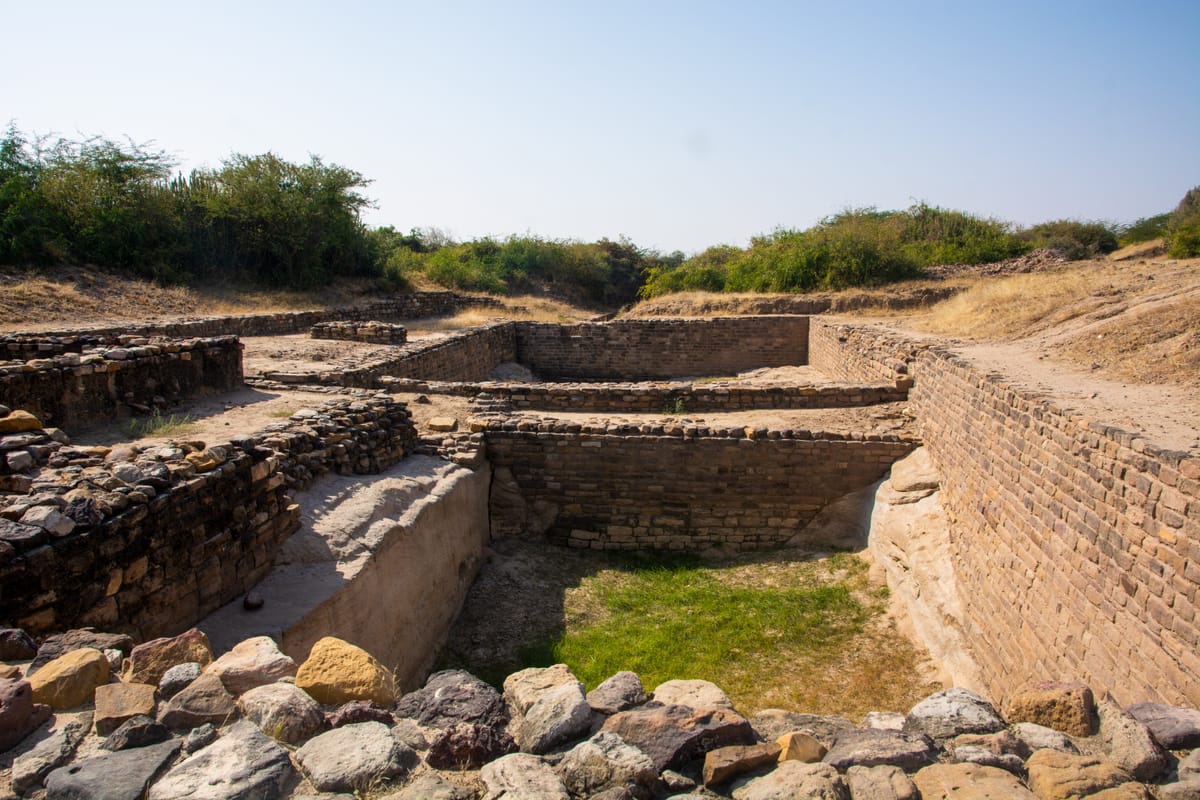
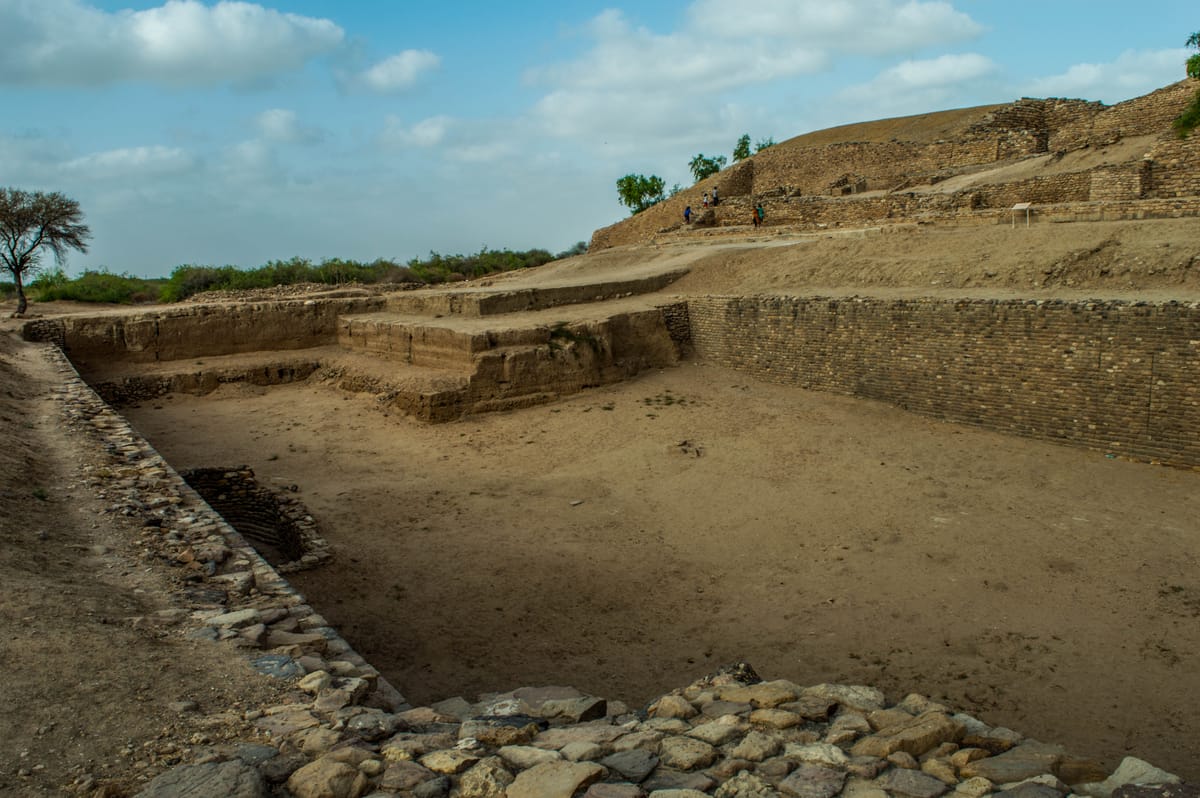
But the defining structures at Dholavira are its waterworks. Archaeologists have identified sixteen or more reservoirs woven into and around the city, some cut vertically down through the bedrock and others built up in stone masonry, together accounting for a remarkable share of the settlement’s footprint. The largest reservoirs are on the order of 80 metres long, 12 metres wide and more than 7 metres deep. A monumental rectangular tank exposed in later excavations measures about 73 metres long, 29 metres wide and 10 metres deep - reported to be several times the volume of the celebrated Great Bath of Mohenjo-daro. Storm-water drains, some large enough to walk through, fed this network through a system of slopes, steps, cascades and manholes. The total live storage across the reservoir network has been estimated at well over 250,000 cubic metres - an artificial water reserve on a scale that would not be matched in the region for millennia.
How Was It Built?
Dholavira’s water system worked by catching and taming the two seasonal streams that flank the island, the Mansar to the north and the Manhar to the south, along with direct monsoon runoff. The Harappans threw a series of dams and check-dams across these streams - archaeological evidence points to several on the Manhar and at least a couple on the Mansar, a feature essentially unique to Dholavira among Indus sites. These barriers slowed the brief, violent monsoon floods, allowed silt to settle, and diverted the water through stone-cut and masonry channels, engineered with deliberate gradients, into a cascade of smaller tanks and then the great reservoirs. Routing the flow through successive tanks reduced its speed and its load of sediment before it reached the main stores, and stone-lined drains carried surplus and waste water away. Groundwater was tapped as well, through wells connected by troughs to the tank system.
None of this required any tool or technique beyond those the Harappans are known to have possessed: stone quarrying and dressing, coursed masonry, rock cutting, controlled excavation, and an evidently sophisticated command of gradients and drainage. What it required in abundance was planning, organisation and labour - to move an enormous volume of stone and earth, to lay out an entire city and its reservoirs as a single integrated hydraulic scheme, and to maintain that scheme against silting, evaporation and structural stress across many centuries and multiple rebuilds. The city passed through seven distinct occupation stages, including at least one episode of near-abandonment and reoccupation, so what stands today is the accumulated work of dozens of generations adapting and repairing the same basic system.
The Mainstream View
To archaeologists, Dholavira is not a puzzle of how so much as a superb, well-documented example of what a Bronze Age society could achieve through organisation and accumulated engineering knowledge. The site was noted in the 1960s and excavated systematically by the Archaeological Survey of India from 1989-90 under R.S. Bisht, in campaigns running to 2005, and it sits firmly within the broader, richly studied Harappan world of planned cities, standardised weights, drainage and long-distance trade. Its stone architecture is explained by local geology; its water system by the obvious necessity of survival on a dry island; its layout by the same planning instincts visible across Indus urbanism. The reservoirs, dams and drains are read as a rational, incremental response to a harsh environment by skilled builders
- impressive in scale and foresight, but the product of human ingenuity operating with entirely plausible Bronze Age means. There is no serious scholarly suggestion of anything beyond that.
The Open Case
What genuinely remains open at Dholavira is less about the engineering than about the people and the ending. The Indus script - including the ten bold characters of the northern signboard - has never been deciphered, so the city’s own words are silent: we cannot read what that great signpost announced, who ruled here, or what they called the place. The precise chronology is still debated, with the earliest occupation pushed by some researchers back toward 3500 BCE. And the deepest question is the most human one: a community clever enough to build one of the world’s first city-scale water systems, and to keep it running for over a thousand years, was in the end defeated. As the monsoon weakened and the region grew more arid in the second millennium BCE, and as the wider Indus world de-urbanised, Dholavira declined and was ultimately left to the salt and the wind. Exactly how the collapse unfolded on the ground - drought, dwindling trade, the slow failure of the reservoirs, or some combination - is still being pieced together. The wonder of Dholavira is not that it demands a supernatural explanation; it plainly does not. It is that ordinary people, with hand tools and stone, out-engineered a desert for fifteen centuries - and that even so ingenious a solution eventually met a limit it could not overcome.
Sources
Connected findings
- Engineering the Drought — Two desert civilizations faced the same enemy — too little water, arriving all at once — and built entire societies around opposite answers: one hoarded every drop behind stone, the other flung the floods across the sand.
Gallery