Neither of These Is a Dome
One is a spiral staircase of stone dressed smooth into a curve. The other cracked apart early and has been standing as a ring of leaning wedges ever since. Between them they held the record for the largest roofed room on earth for close to three thousand years.
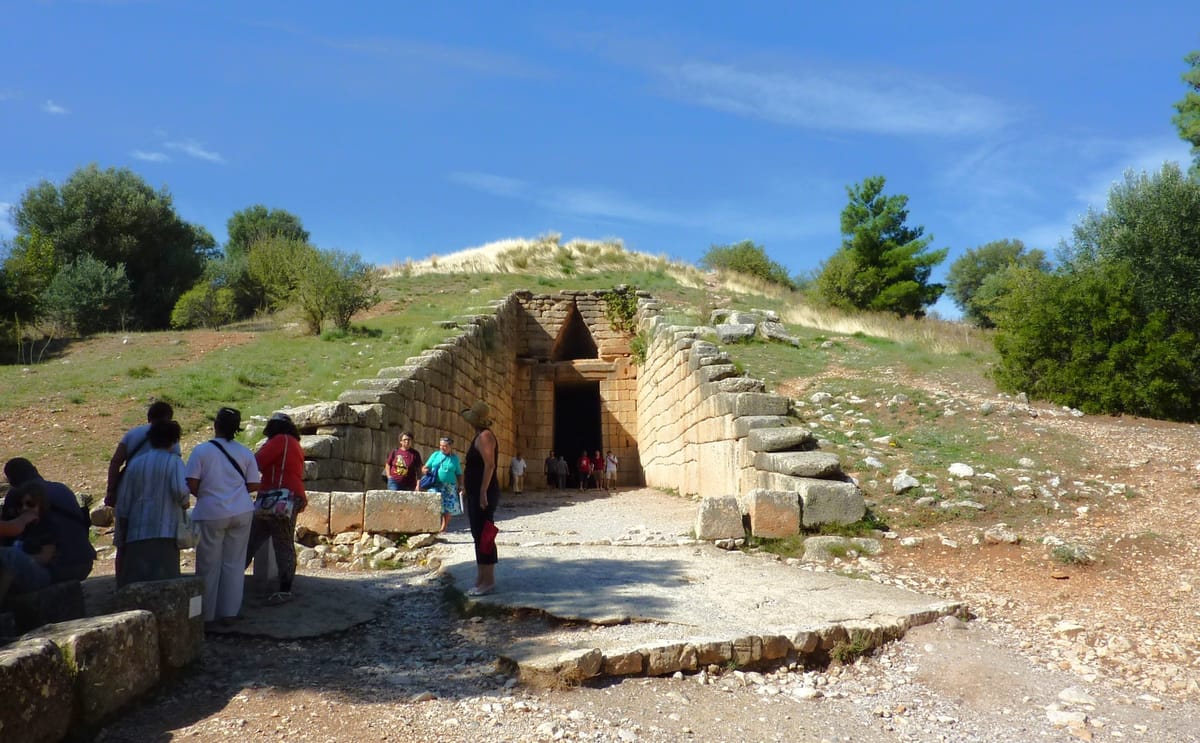
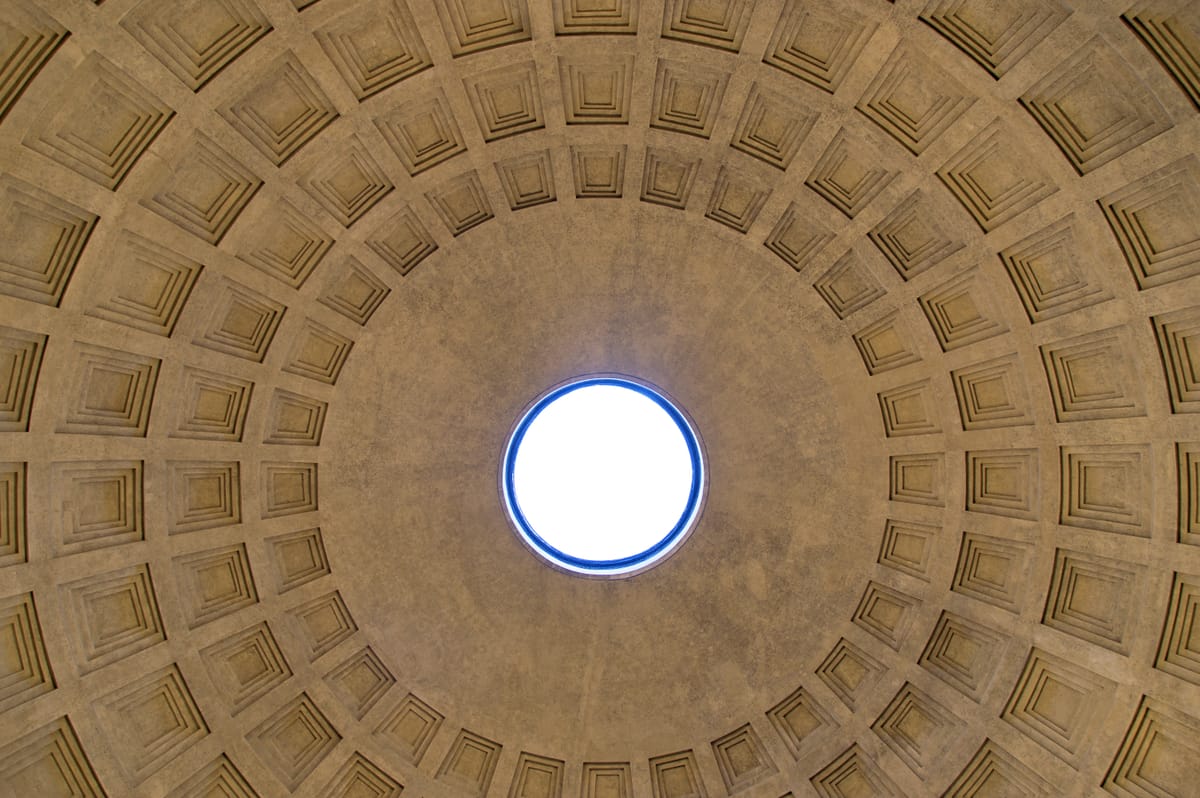
Stand at the bottom of the Treasury of Atreus and look straight up. Thirty-three rings of dressed stone close overhead, 13 metres above the floor, over a room 14.5 metres across. It was finished around 1250 BCE, and nothing on earth roofed a wider or taller space in stone for the next thousand years and more. Now stand under the oculus of the Pantheon. There are 43.3 metres of unreinforced concrete over your head, an 8.8-metre hole open to the weather at the top, and rain falling through it onto a floor drilled with drains. Nineteen centuries later, no one has built a bigger dome out of concrete alone.
Mycenae got there without the one component that is supposed to make it possible. There is no keystone in the Treasury of Atreus, no wedge, no true arch — just each ring laid a little further in than the ring beneath. That trick stalls at about five metres almost everywhere it has been invented. The Mycenaeans cleared three times that by building the chamber inside a pit quarried out of a hillside and backfilling behind it, so the hill presses inward and holds every cantilevered block down: compression, borrowed from a landscape. Only once the capstone was set did they dress the inner faces smooth. Rome changed the material instead. The Pantheon’s builders graded their aggregate as they climbed — heavy travertine at the springing, broken terracotta through the middle, pumice at the crown — thinned the shell from 6.4 metres to 1.2, cut 140 coffers out of its underside, and piled external step-rings onto the haunches to hold the spread.
Neither is the thing it looks like. The curve above you at Mycenae is not a curve; it is a staircase, trimmed. The hemisphere above you in Rome is not intact; it cracked early, the splits running up to roughly 54 degrees, and it has stood ever since as an array of wedge-shaped arches leaning on one another. Both buildings survive by being secretly something other than they appear. And neither tells you the truth on the label — the Treasury of Atreus is not a treasury and has no connection to Atreus, while the Pantheon carries Agrippa’s name in metre-high bronze across a building raised long after Agrippa’s burned down. The largest roofed room on earth, twice over, and both times nobody signed it.
Read the full studies: The Treasury of AtreusThe Pantheon
Sources
- Wikipedia — Treasury of Atreus
- Wikipedia — Pantheon, Rome
- Wikipedia — List of largest domes (record-holder chronology)
- Mark & Hutchinson, "On the Structure of the Roman Pantheon", The Art Bulletin (1986)
- Como, "On the origin of the cracks in the dome of the Pantheon in Rome", Engineering Failure Analysis (2018)
- UNESCO World Heritage Centre — Archaeological Sites of Mycenae and Tiryns