The Unfinished Obelisk of Aswan
How did New Kingdom quarrymen, using nothing harder than dolerite hammerstones, set out to free a single 1,090-tonne granite monolith from solid bedrock — and what does the crack that stopped them reveal about the limits, and the method, of ancient hard-stone quarrying?
Why this rating?
- Construction difficulty
- 4/5
- Method uncertainty
- 3/5
- Capability gap
- 3/5
- Open questions
- 3/5
Freeing a single 1,090-tonne granite monolith from bedrock using only stone hammers was a task at the very edge of New Kingdom capability, and the obelisk's own crack shows the builders found that edge. Engelbach's study of the site and comparative evidence establish the pounding-and-trenching extraction method fairly securely, but exactly how the Egyptians would have detached, moved, and raised a piece this size — beyond anything they ever actually erected — remains genuinely reconstructed rather than directly observed.
Overview
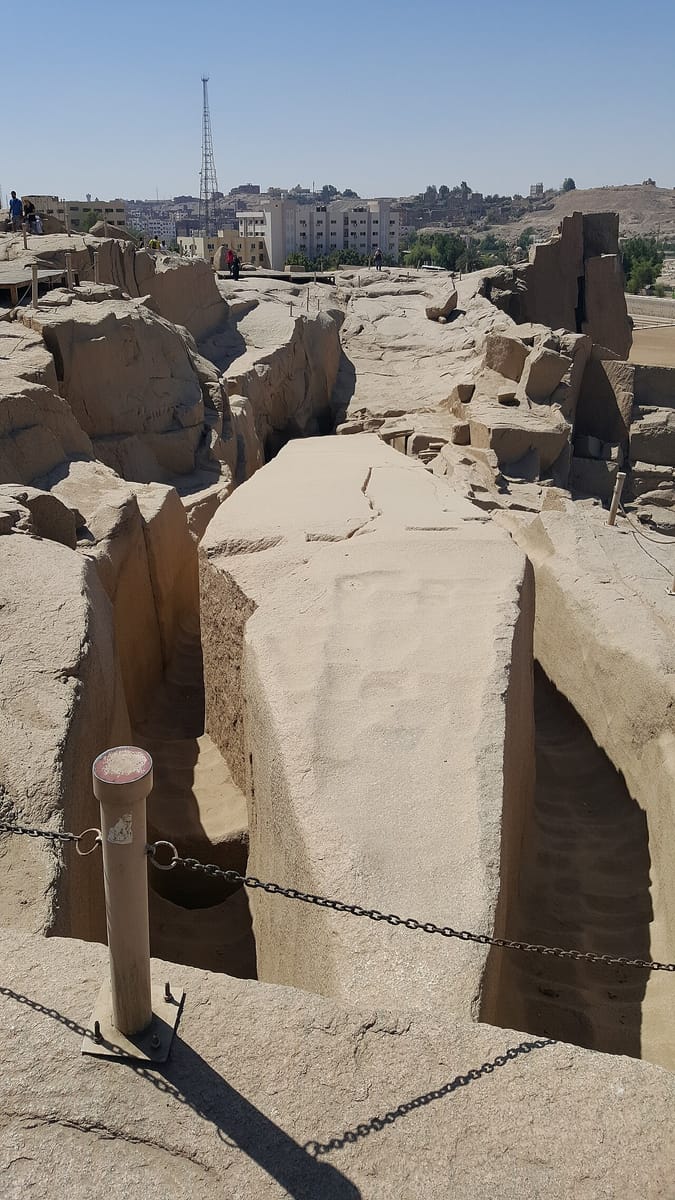
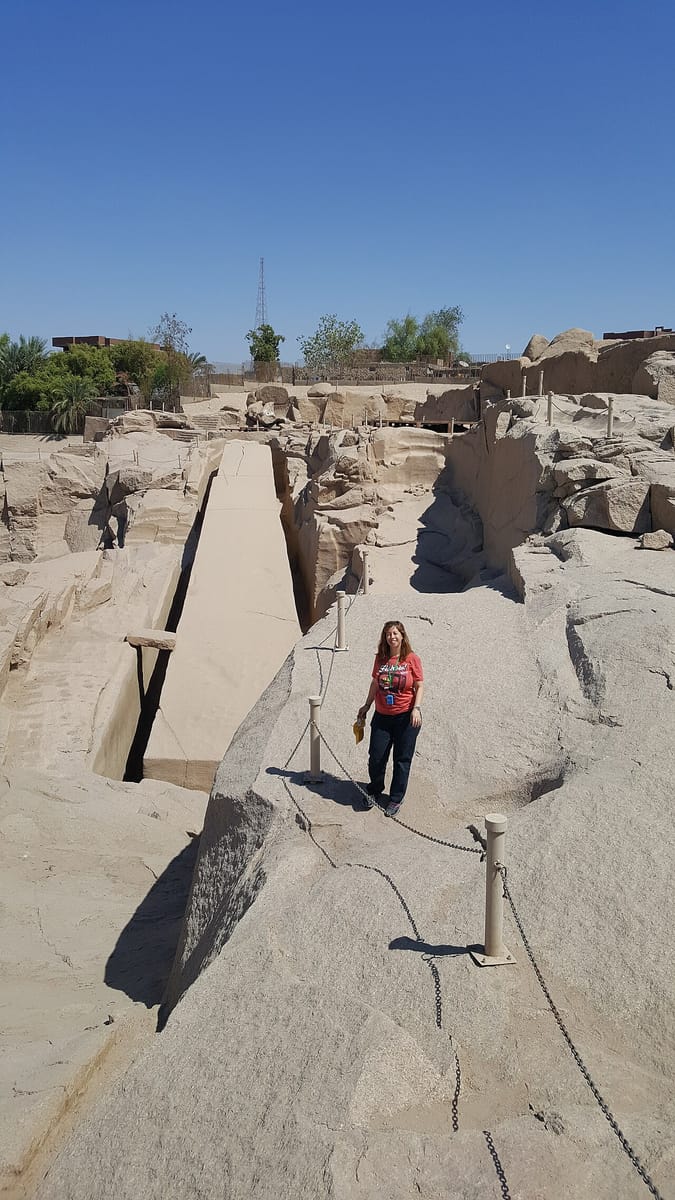
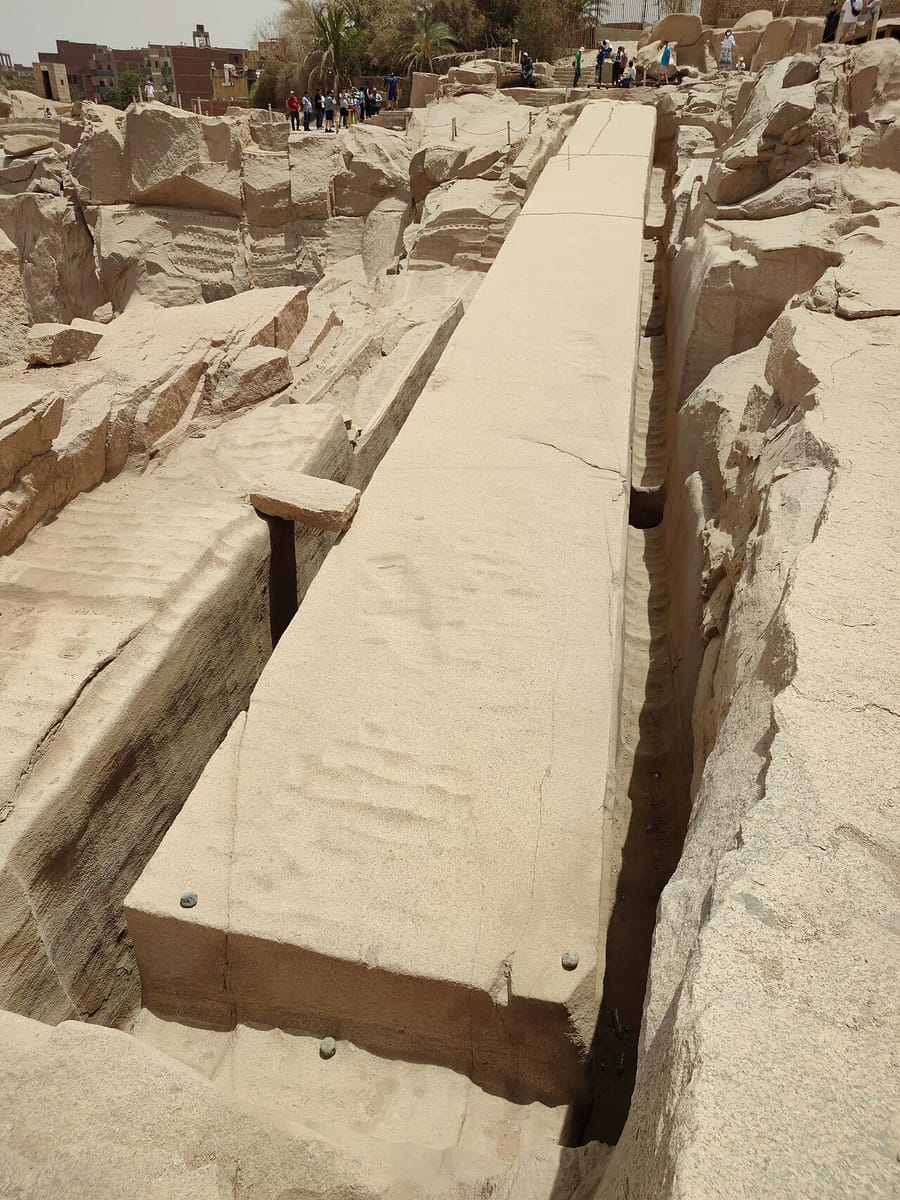
In the granite hills just north of the modern city of Aswan, in southern Egypt, lies one of the most instructive failures in the history of engineering: a single obelisk, still three-quarters attached to the bedrock it was cut from, that was never finished, never freed, and never moved an inch from where ancient quarrymen began working it more than 3,400 years ago. Had it been completed, the Unfinished Obelisk would have stood approximately 42 meters (137 feet) tall and weighed an estimated 1,090 tonnes — making it, by a wide margin, the largest obelisk ancient Egypt ever attempted, larger than any obelisk that was ever actually raised anywhere in the ancient world. Instead, cracks appeared in the granite partway through quarrying, and the project was abandoned where it lay. That abandonment is precisely what makes the site so valuable: because the obelisk was never finished, smoothed, or removed, it preserves — frozen mid-process — the physical evidence of how New Kingdom Egyptians extracted and shaped hard stone, evidence that finished, polished monuments elsewhere in Egypt do not offer.
The Structure
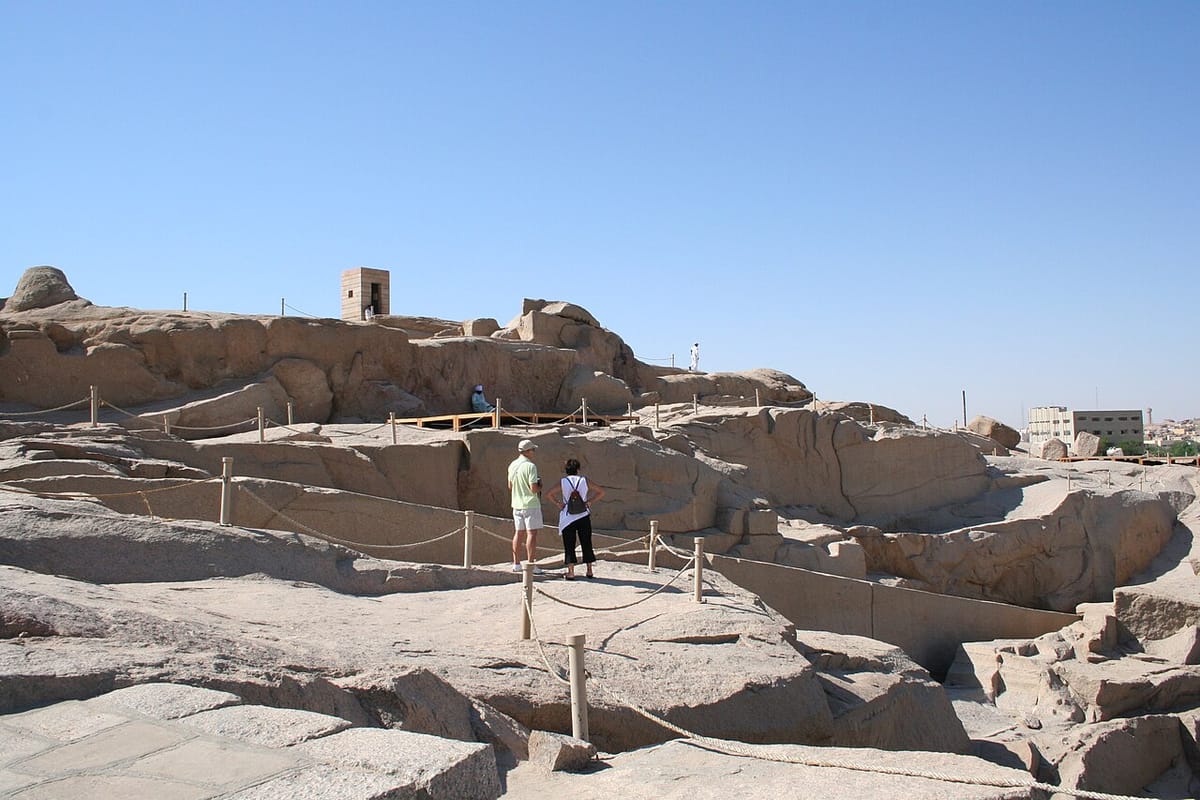
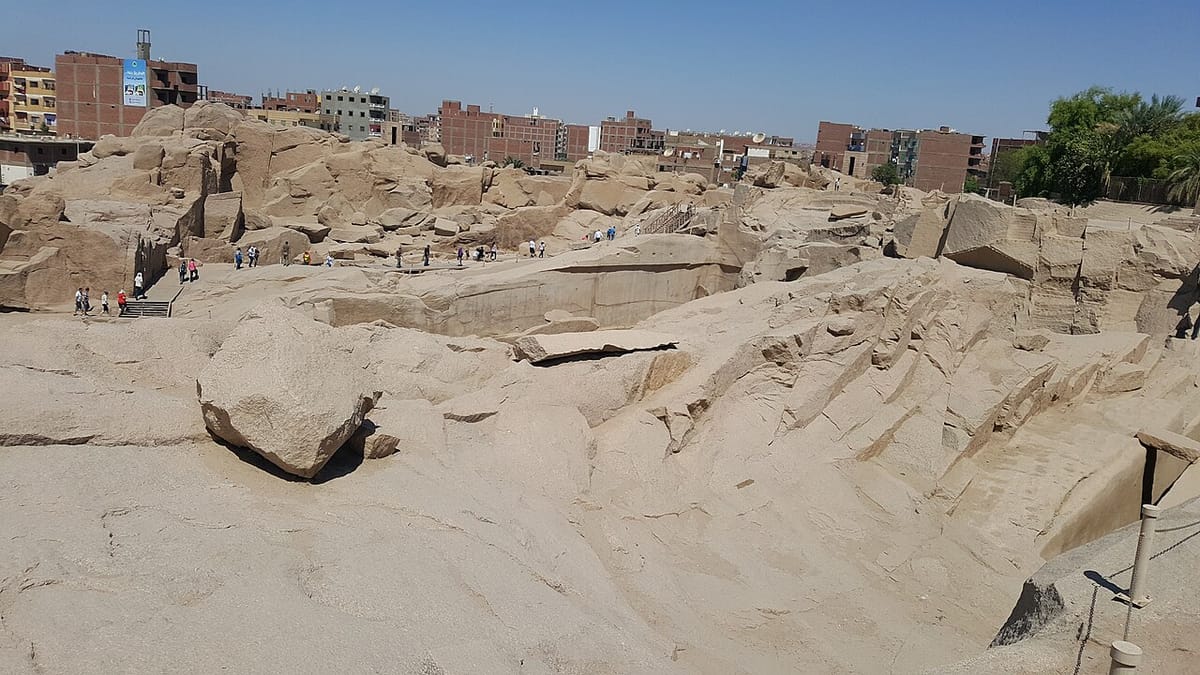
The Unfinished Obelisk lies in Aswan’s northern stone quarries, on the east bank of the Nile, an area that supplied granite (the ancient Egyptians called it “red stone of Elephantine,” and later Greek and Roman writers used the term “syenite,” after Syene, the Greek name for Aswan) to major building projects throughout pharaonic history, including obelisks, colossal statues, sarcophagi, and monumental shrines found as far away as the pyramid complexes of Giza and the temples of Karnak. Quarrying at Aswan was a continuous industry across three thousand years, and the surrounding rock still bears extensive traces of ancient extraction work — cut trenches, detached blocks, and worked faces — alongside the operations that continue there today. Egyptologists generally date the Unfinished Obelisk to the 15th century BCE, during the New Kingdom, and most closely associate it with Hatshepsut, one of the few women to rule Egypt as pharaoh in her own right (reigned c. 1479–1458 BCE). Hatshepsut is known to have commissioned multiple obelisks at the Karnak temple complex, including a pair to mark her sixteenth regnal year; ancient sources and modern reconstructions suggest that during work on that later pair, one obelisk cracked during quarrying, and the Unfinished Obelisk is generally identified either as that failed piece or as an attempt to replace it — though, as with much about the site, the exact attribution is not settled with certainty from inscriptions and rests instead on circumstantial and stylistic evidence. If finished, the obelisk would have dwarfed every obelisk Egypt actually completed: for comparison, the largest ancient Egyptian obelisk successfully quarried, transported, and erected — now known as the Lateran Obelisk, originally raised at Karnak under Thutmose III and Thutmose IV and later moved to Rome — stands about 32 meters tall and weighs around 413 tonnes. At nearly 42 meters and roughly 1,090 tonnes, the Unfinished Obelisk would have been close to one-third larger again. The site was studied in detail by the engineer and Egyptologist Reginald Engelbach in 1922, whose survey remains the foundation of modern understanding of the quarry, and it is preserved today as an open-air archaeological site near Aswan.
How Was It Built?
Ancient Egyptian granite quarrying did not rely on metal cutting tools capable of biting into hard igneous rock the way iron chisels can cut sandstone or limestone; granite is far too hard for the copper and bronze tools available in the Bronze Age New Kingdom to shape directly. Instead, mainstream Egyptology holds that quarry workers relied primarily on percussion: rounded, fist-sized to melon-sized balls of dolerite — a very hard, dense igneous rock even tougher than the granite being worked — were swung and pounded by hand against the stone, repeatedly, to pulverize and grind the granite away a small amount at a time. Using these hammerstones, sometimes for what must have amounted to armies of workers over months, quarrymen pounded out narrow trenches along the intended outline of a block, gradually deepening the cut into the bedrock while leaving the block itself standing proud in the middle, still connected to the rock below. At the Unfinished Obelisk, this trenching process is visible in extraordinary, almost complete detail: the obelisk’s four sides were cut free along their length, workers leaving a channel roughly a meter wide and several meters deep running the full 42-meter span, while the bottom face remained joined to the surrounding bedrock, exactly the stage at which extraction would have moved to undercutting and detaching the block. Ochre-colored guidelines marking planned cuts, and individual dimples and scars from hammerstone blows, are still visible across the worked surfaces. Once freed, comparably sized (if smaller) obelisks are understood to have been moved on wooden sledges and rollers to the Nile, loaded onto purpose-built barges — a Hatshepsut-era relief at Deir el-Bahari depicts one such barge carrying a pair of her obelisks — and floated downriver to their final sites, where they were raised upright using ramps, levers, and sand-filled pits from which sand was gradually removed to lower the obelisk’s base into position under controlled, ropes-assisted descent. The Unfinished Obelisk itself never reached any of these later stages; the whole visible site is, in effect, a single freeze-frame of stage one.
The Mainstream View
Egyptologists are confident about the broad outline of what happened at the Unfinished Obelisk and why. The stone was undoubtedly a New Kingdom granite obelisk under active quarrying; the pounding-and-trenching method used to shape it is well attested both here and at other Aswan quarry faces, and is consistent with the hammerstones (dolerite pounders) that have been recovered at Egyptian granite quarry sites, including thousands documented in the region. Cracks — probably following pre-existing flaws or fault lines within the granite itself, invisible until deep cutting exposed them — are the accepted, non-controversial explanation for the project’s abandonment; ancient Egyptian quarrymen had no way to detect such internal flaws in advance, and granite of this scale inevitably contains some. The likely link to Hatshepsut’s building program at Karnak, while not proven by an inscription naming her specifically at this obelisk, fits comfortably with her documented obelisk-building activity and the site’s New Kingdom dating on stylistic and archaeological grounds. None of this is seriously disputed among specialists; Engelbach’s 1922 study established the working framework that later archaeologists have refined but not overturned.
The Open Case
What remains genuinely open is not whether Egyptians quarried this obelisk by hand — they plainly did — but exactly how they intended to finish the job, and what that implies about the outer edge of what New Kingdom engineering could actually achieve. Scholars broadly agree on the pounding-and-trenching extraction method visible here, but the final, most delicate step — undercutting and separating a 1,090-tonne slab from the bedrock beneath it without shattering it — was never demonstrated at this scale by any completed obelisk, and exactly how workers proposed to lever, wedge, or otherwise detach a piece this size, cleanly enough to move it, is reconstructed from analogy with smaller, completed obelisks rather than observed directly. The same is true further downstream: no ancient Egyptian obelisk anywhere close to this size was ever successfully transported or raised, so the sledge, barge, and sand-pit methods well attested for the roughly 300–450-tonne obelisks Egypt did complete are, at this hypothetical scale, extrapolations rather than proven capability. In that sense the Unfinished Obelisk marks a real boundary: evidence strongly suggests it snapped somewhere near the actual limit of what Bronze Age quarrying, haulage, and engineering could reliably deliver, and the crack that stopped the work may be the most honest data point we have about where that limit lay. That is a genuinely unresolved engineering question, worth sitting with on its own terms — not because the answer requires anything beyond human ingenuity, but because the ancient Egyptians themselves, on this occasion, ran directly into the edge of it.
Sources
- Wikipedia — Unfinished Obelisk
- Wikipedia — Aswan
- Wikipedia — Hatshepsut
- Wikipedia — Obelisk
- Wikipedia — Ancient Egyptian technology
- Digital Applications in Archaeology and Cultural Heritage — The Problems of the Obelisk Revisited (Marcis & Frastia, 2023)
- Internet Archive — Engelbach, The Problem of the Obelisks (1923)
- Egyptian Ministry of Tourism & Antiquities — The Unfinished Obelisk
- Smithsonian Magazine — A NOVA Crew Strains, and Chants, to Solve the Obelisk Mystery
- PBS NOVA — Secrets of Lost Empires: Pharaoh's Obelisk
- World History Encyclopedia — Egyptian Obelisk
Connected findings
- The Stones Too Big to Move — Three civilizations, twenty-nine centuries apart, each pushed stone-moving to its exact breaking point — and left the proof lying exactly where it failed.
Gallery