Temple of Seti I at Abydos
How did a temple that produced some of the most exquisitely precise painted relief carving in all of Egypt also become the birthplace of the world's most famous 'out-of-place artifact' — and what is really written on the eroded ceiling beam that so many mistake for a helicopter?
Why this rating?
- Construction difficulty
- 2/5
- Method uncertainty
- 1/5
- Capability gap
- 1/5
- Open questions
- 2/5
This is a low-mystery, well-understood site: the limestone temple and its raised-relief carving are ordinary, if superbly executed, New Kingdom practice, and the famous 'helicopter' is essentially solved — a palimpsest of Seti I's titulary re-cut by Ramesses II, with the plaster infill lost to erosion, not an anomaly. The only mildly open thread is the Osireion's austere, cyclopean red-granite construction and its dating relative to the delicate temple in front of it.
Overview
The Great Temple of Abydos, better known as the Temple of Seti I, is one of the finest surviving monuments of Egypt’s New Kingdom. It was begun in the 13th century BCE by Seti I, the second pharaoh of the 19th Dynasty, and left unfinished at his death around 1279 BCE; his son and successor, Ramesses II, then completed and altered the building, adding his own decoration and inscriptions throughout. The temple sits at Abydos, in the desert margin west of the Nile in what is today the Sohag Governorate of Upper Egypt — and Abydos itself is among the oldest and most sacred places in all of Egyptian history. It was the burial ground of Egypt’s earliest kings, whose First Dynasty tombs lie at the desert site of Umm el-Qa’ab nearby, and above all it was the great cult center of Osiris, the god of death, resurrection, and the afterlife. By the New Kingdom, Abydos had become one of the holiest pilgrimage destinations in Egypt, a place every pious Egyptian hoped to visit, or at least to be symbolically carried past, on the journey to the west.
Seti I’s temple was a mortuary and cult temple woven into this sacred landscape. It honored the principal gods of the Egyptian state and, unusually, the Osirian mysteries specific to Abydos, while also serving the cult of the deified king himself. What makes the building extraordinary is less its scale — it is large but not colossal — than its quality: the relief carving on its walls is widely regarded as among the most beautiful ever produced in Egypt, and the temple preserves a carved list of royal ancestors that remains one of the most important documents for reconstructing the sequence of Egyptian pharaohs. To modern popular culture, however, the temple is known for something else entirely — a single eroded ceiling relief that fringe writers have promoted as evidence of ancient flying machines. Both the genuine wonder and the manufactured one belong to the same walls, and this study takes them in turn.
The Structure
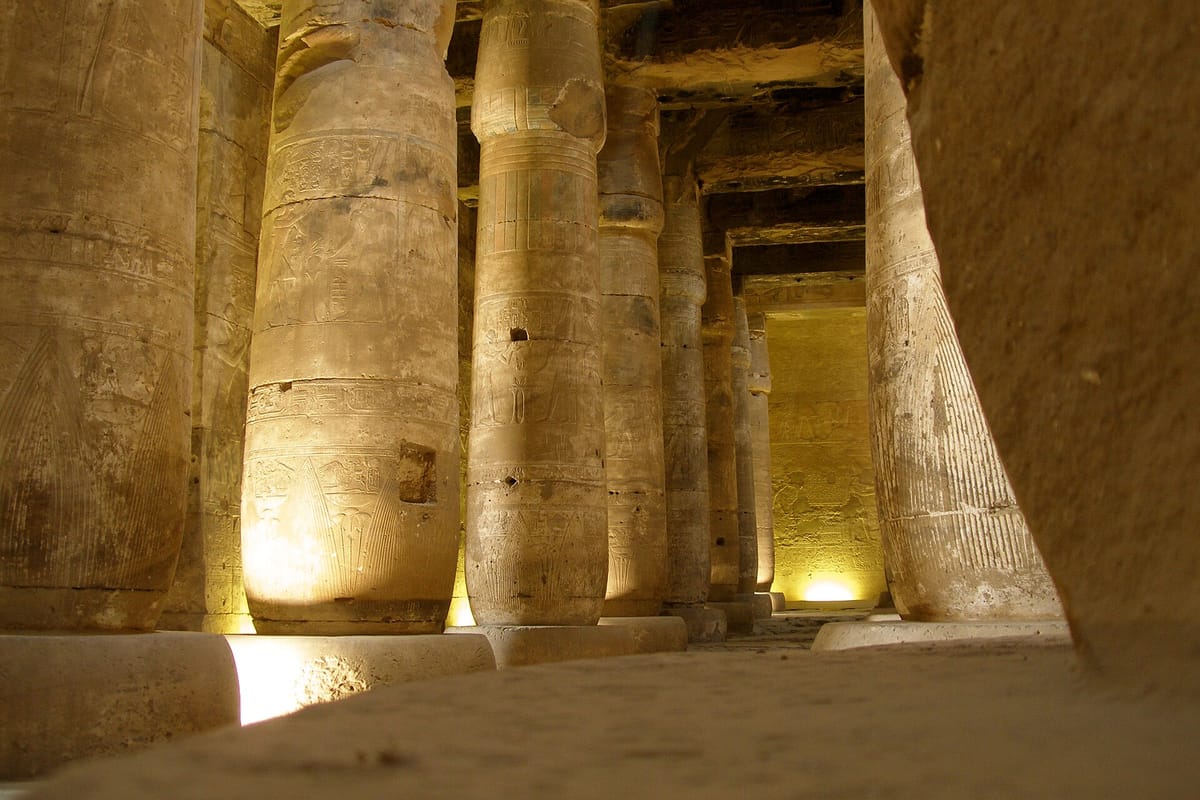
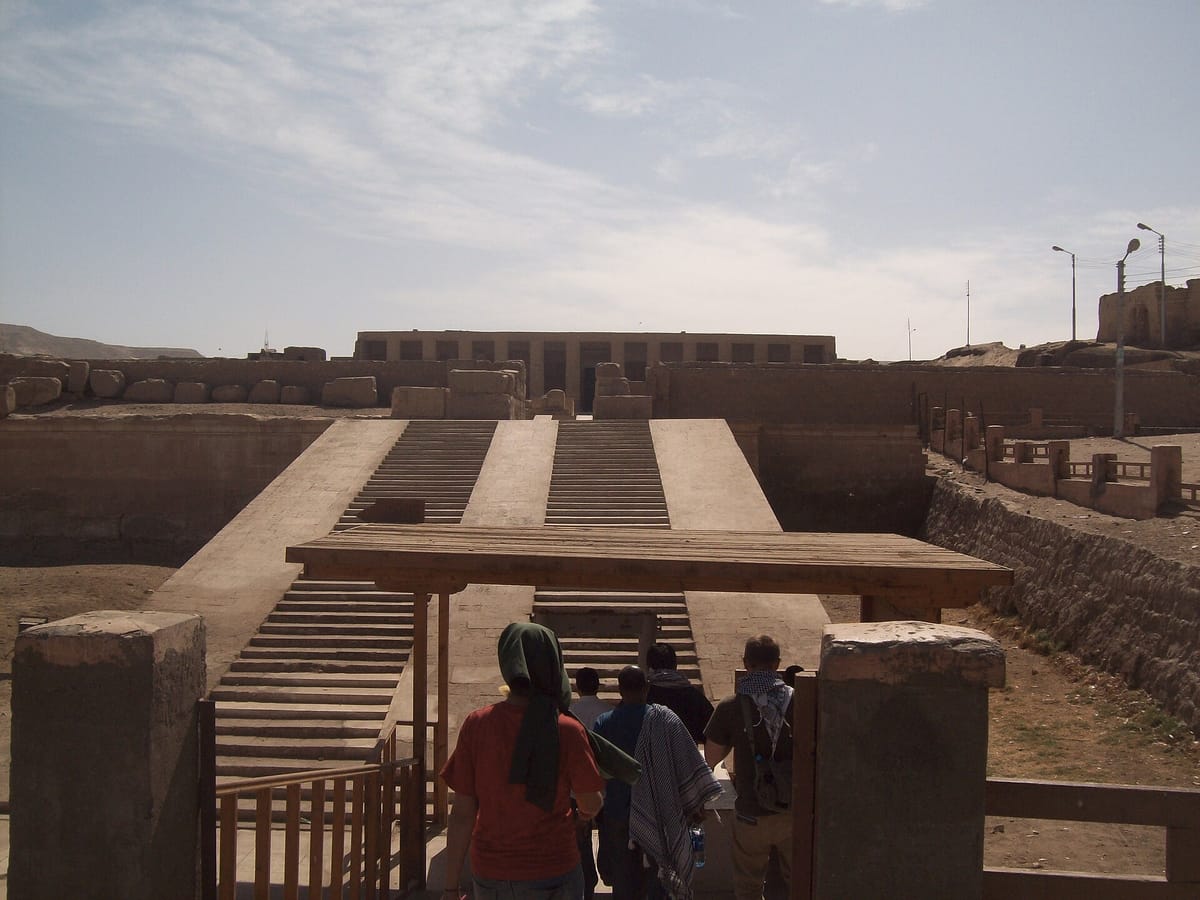
The temple is built to an unusual L-shaped plan rather than the straightforward rectangular, axial layout of most Egyptian temples. A visitor entered through a now largely ruined forecourt and pylon built by Ramesses II, crossed two successive courts, and passed into two great hypostyle (columned) halls set one behind the other — together carrying on the order of three dozen columns, with the outer first hall completed and decorated by Ramesses II and the inner second hall preserving the finer work begun under Seti I. Beyond the second hypostyle hall, instead of the single sanctuary a typical temple would have, the wall opens into a rank of seven sanctuaries side by side — a rare and striking arrangement. Each was a barque chapel, roofed with a distinctive false (corbelled) vault of overlapping stone, and each was dedicated to a different deity: from one end, the shrines honor Horus, Isis, and Osiris — the Abydene family triad — together with the great state gods Amun-Ra of Thebes, Re-Horakhty of Heliopolis, and Ptah of Memphis, and finally a seventh chapel dedicated to the deified Seti I himself. Six of the seven had doorways leading deeper into the temple; the Osiris chapel opened into a further complex of halls and shrines at the heart of the Osirian cult.
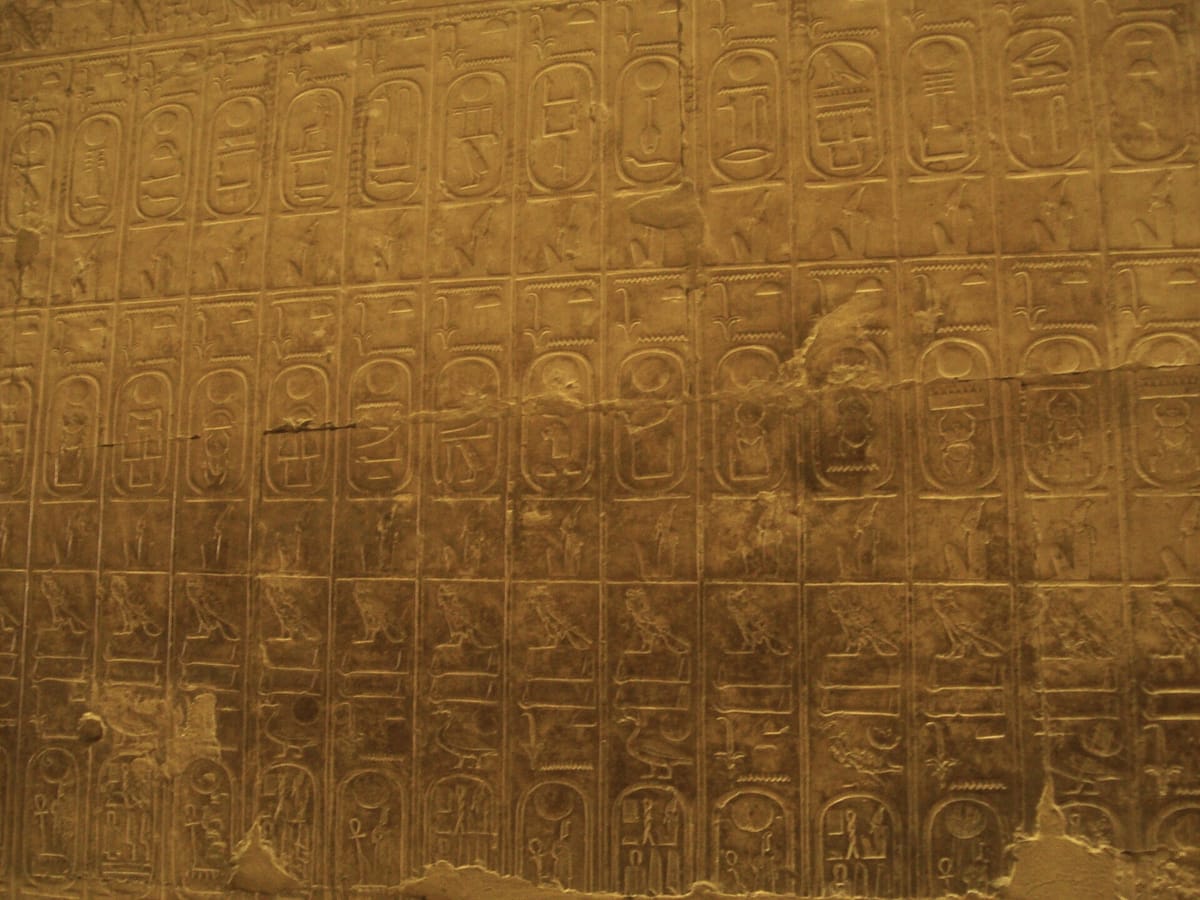
From the long arm of the L, a corridor known as the Gallery of the Kings (or Gallery of the Ancestors) branches off, and it is here that the temple preserves the celebrated Abydos King List. Carved in low relief under Ramesses II, the list shows Seti I, accompanied by the young prince Ramesses wearing the sidelock of youth, making offerings to their royal predecessors. It records the cartouches of 76 pharaohs, arranged in two rows of names above a third row that simply repeats Seti’s own titulary. Crucially, the list is a curated, not a comprehensive, record: it silently omits rulers judged illegitimate or unwelcome, including the female pharaohs Hatshepsut and Sobekneferu, the “heretic” Amarna kings — Akhenaten, Smenkhkare, Neferneferuaten, Tutankhamun, and Ay, all effaced as a kind of official forgetting — and the foreign Hyksos of the Second Intermediate Period. Despite these deliberate gaps, the list remains one of the single most valuable sources for Egyptian chronology, and for several obscure kings of the Seventh and Eighth Dynasties it is essentially the only record of their names that survives.
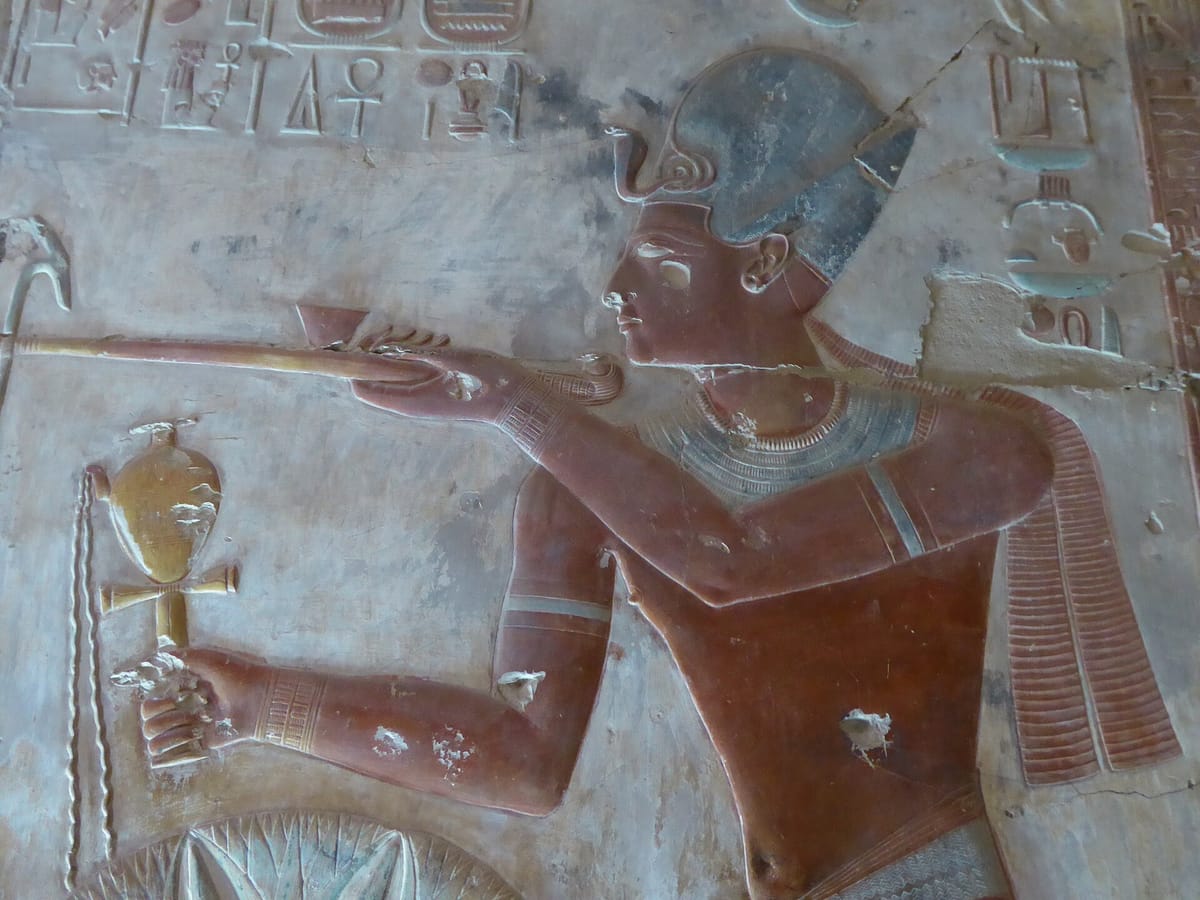
The temple’s true glory, though, is its raised relief. Rather than the quicker sunk relief that Ramesses II favored in his later work — where the outline is simply cut down into the stone surface — the finest carving here, associated with Seti I, is true raised (bas) relief, in which the sculptors cut away the entire background so that the figures and hieroglyphs stand slightly proud of the wall. The result, executed in fine white limestone, is astonishingly delicate: the modeling of muscles, the fine pleating of translucent linen garments, the strands of wigs, and the subtle curves of faces are rendered with a softness and precision that mark a high point of New Kingdom temple art. In many areas the original painted color survives, giving a rare sense of how vivid these interiors once were. The temple was built largely of limestone with some sandstone elements, the sandstone probably quarried at Gebel Silsila upstream.
Directly behind the temple lies a very different structure: the Osireion, a subterranean cenotaph understood as a symbolic tomb of Osiris. In deliberate contrast to the temple’s delicate limestone, the Osireion is built of enormous, austere blocks — a central hall whose roof was carried on massive red granite pillars and architraves, surrounding a stone “island” set within a water channel. Cut down to the level of the local water table, it evokes the primeval mound rising from the waters of creation, the mythic setting of Osiris’s resurrection. Roughly 57 by 13 meters in its hall, and approached by a long stone-lined passage inscribed with funerary texts, it was discovered by Flinders Petrie and Margaret Murray in 1902–1903 and further excavated by the Egypt Exploration Society. Its decoration was completed under Seti’s grandson Merenptah; today, rising groundwater keeps much of it flooded.
How Was It Built?
The main temple is, in engineering terms, a thoroughly conventional New Kingdom stone temple, and nothing about its construction lies beyond the well-documented capabilities of 19th Dynasty Egypt. Limestone was quarried, dressed, and laid up in courses to form walls, columns, and roofing slabs; the columns of the hypostyle halls were assembled from stacked drums; and the whole was roofed with stone beams and slabs spanning between closely spaced supports — the standard Egyptian solution to roofing in a civilization without the true arch for monumental spans. The seven chapels’ false vaults were built by corbelling overlapping blocks inward and then carving the underside into a smooth curve, a technique attested elsewhere in the period.
The relief decoration followed the ordinary Egyptian workshop sequence, simply carried out to an exceptional standard. Draftsmen laid out scenes over a grid of guide-lines, sculptors then cut the raised relief by chiseling away the background around the drawn figures using copper and bronze tools with stone abrasives, and painters finished the surfaces with mineral pigments over a thin plaster or wash. The extraordinary quality at Abydos reflects the resources of a powerful early-Ramesside court and the skill of its craftsmen, not any unusual method — and the visible shift from Seti’s fine raised relief to Ramesses II’s faster sunk relief in the outer, later-finished parts of the temple is itself a clear illustration of ordinary changes in royal taste and workshop economy.
The Osireion is the one part of the complex whose building stands somewhat apart. Its cyclopean red granite pillars and huge blocks recall the massive, plain masonry of much earlier royal monuments more than the refined limestone temple in front of it, and moving and setting granite members of that size — granite being far harder than limestone and quarried at Aswan, hundreds of kilometers upstream — was a major undertaking, though one Egyptians had performed for obelisks and colossi since the Old Kingdom. Cutting the structure down to the water table and managing groundwater during construction added a further practical challenge. The techniques involved are known, but the Osireion’s deliberate archaism of style is a genuine and interesting contrast to the temple.
The Mainstream View
Egyptologists regard the Temple of Seti I as a well-understood monument. Its date, its builders, its religious function, and its construction all sit comfortably within the richly documented history of the early 19th Dynasty. The building was begun by Seti I and completed by Ramesses II, whose cartouches, added scenes, and change from raised to sunk relief are visible throughout; the seven chapels and the Osirian complex fit the temple’s role at the cult center of Osiris; and the King List is understood as a piece of royal ideology — a curated genealogy that legitimized Seti and Ramesses by linking them to a filtered line of “true” ancestors. None of this is in dispute.
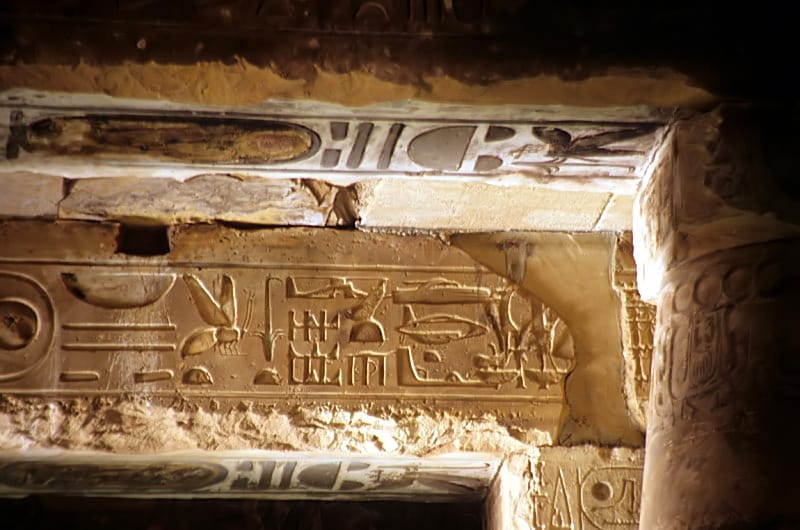
That same settled understanding fully explains the temple’s most famous “mystery,” the so-called helicopter hieroglyphs. On an architrave in the first hypostyle hall, an eroded band of carving contains shapes that, to a modern eye primed by machines, can be read as a helicopter, a submarine, or a jet aircraft — and ancient-astronaut writers have promoted the relief as an out-of-place artifact showing lost technology. The real explanation is a palimpsest, and it is understood in detail. The architrave originally carried one of Seti I’s royal titles, which included the epithet about repulsing or subduing the “nine bows” (the traditional enemies of Egypt). When Ramesses II completed the temple, he had his father’s titulary re-carved into his own — a completely routine act of royal self-assertion — with the older signs filled in with plaster and new hieroglyphs cut over them, or the new titles simply carved across the old. Over roughly three thousand years, the plaster infill weathered and fell away, leaving both the earlier Seti inscription and the later Ramesses inscription partially visible at once, superimposed. The famous “helicopter” is precisely this overlap: a bow sign from Seti’s titulary combined with arm signs from Ramesses’s re-carved version, read together by a pattern-seeking brain as a machine. This is a textbook case of pareidolia — the same faculty that finds faces in clouds — layered on top of an ordinary ancient re-carving. The palimpsest reading is the unanimous view of Egyptologists and has been laid out explicitly in the scholarly literature, including Joshua Roberson’s aptly titled 2016 study “Anatomy of a Palimpsest: The Not-so-Strange Case of the ‘Abydos Helicopter’” and Peter Brand’s recent work on Ramesses II. There is no anomaly here to explain; there is a well-documented editing of stone by a son over his father’s name.
The Open Case
Honesty requires stating plainly that the “helicopter” is not a genuine open question. It is not an unexplained artifact, a lost technology, or a coincidence still awaiting an answer — it is a resolved case. The overlapping signs are identifiable, the historical practice of re-carving a predecessor’s titles is well attested across Egyptian monuments, and the loss of plaster infill over millennia is exactly what one would expect. The ancient-astronaut and “out-of-place artifact” readings fail on every count: they ignore the visible second inscription, treat weathering damage as intentional design, mistranslate or simply disregard the surrounding hieroglyphic text that reads as ordinary royal titulary, and depend entirely on modern pattern-recognition to see aircraft where the ancient carvers wrote names. To present this as a mystery would be to manufacture one.
The temple as a whole is likewise a low-mystery site. Its architecture and its celebrated relief work are superb but entirely explicable New Kingdom craft, and its history is anchored by abundant inscriptions. The one thread that remains legitimately, if modestly, open is the Osireion. Its deliberately archaic, cyclopean red-granite construction stands in such marked stylistic contrast to the delicate temple in front of it that earlier observers sometimes wondered whether it was a far older structure that Seti I had incorporated or imitated. The modern consensus, grounded in Seti I’s own cartouches found in the building — including an inscription naming him as “beneficial to Osiris” — and its integration with the temple’s Osirian cult, firmly dates the Osireion to Seti’s reign, with decoration finished under Merenptah. What stays a fair subject of scholarly discussion is narrower and more interesting: why its builders chose such a stark, massive, archaizing style, how precisely its granite elements were quarried, transported, and set at the water-table level, and how its symbolism of the primeval mound shaped those choices. These are ordinary questions of art history and construction detail, not signs of anything beyond the reach of New Kingdom Egypt — and they are a far more honest place to direct a sense of wonder than the eroded ceiling beam that made the temple internet-famous.
Sources
- Wikipedia — Temple of Seti I (Abydos)
- Wikipedia — Helicopter hieroglyphs
- Wikipedia — Abydos King List
- Wikipedia — Osireion
- American Research Center in Egypt (ARCE) — The Temple of Seti I in Abydos
- Madain Project — Temple of Seti I (Abydos)
- Ancient Origins — Helicopter Hieroglyphs? Debunking the 'Mystery' of the Abydos Carvings
- abydos
- seti-i
- ramesses-ii
- egypt
- new-kingdom
- osiris
- king-list
- raised-relief
- helicopter-hieroglyphs
- palimpsest
- osireion
- pareidolia
Gallery