Ta Keo
Why did the Khmer state abandon its own state temple mid-construction, leaving a five-tier sandstone pyramid permanently bare — and what does that unfinished shell reveal about how an Angkorian temple-mountain was actually assembled, block by block, before the carving ever began?
Why this rating?
- Construction difficulty
- 3/5
- Method uncertainty
- 2/5
- Capability gap
- 2/5
- Open questions
- 4/5
Building a 20+ meter, all-sandstone stepped pyramid was a serious engineering step up for its era, but the quarrying, block-cutting, and stacking techniques are well understood from comparable, better-documented Angkorian sites. The real puzzle at Ta Keo is not how it was built but why it stopped: the lightning-omen inscription and the likelier explanation of Jayavarman V's death and a succession crisis remain genuinely unresolved and actively debated.
Overview
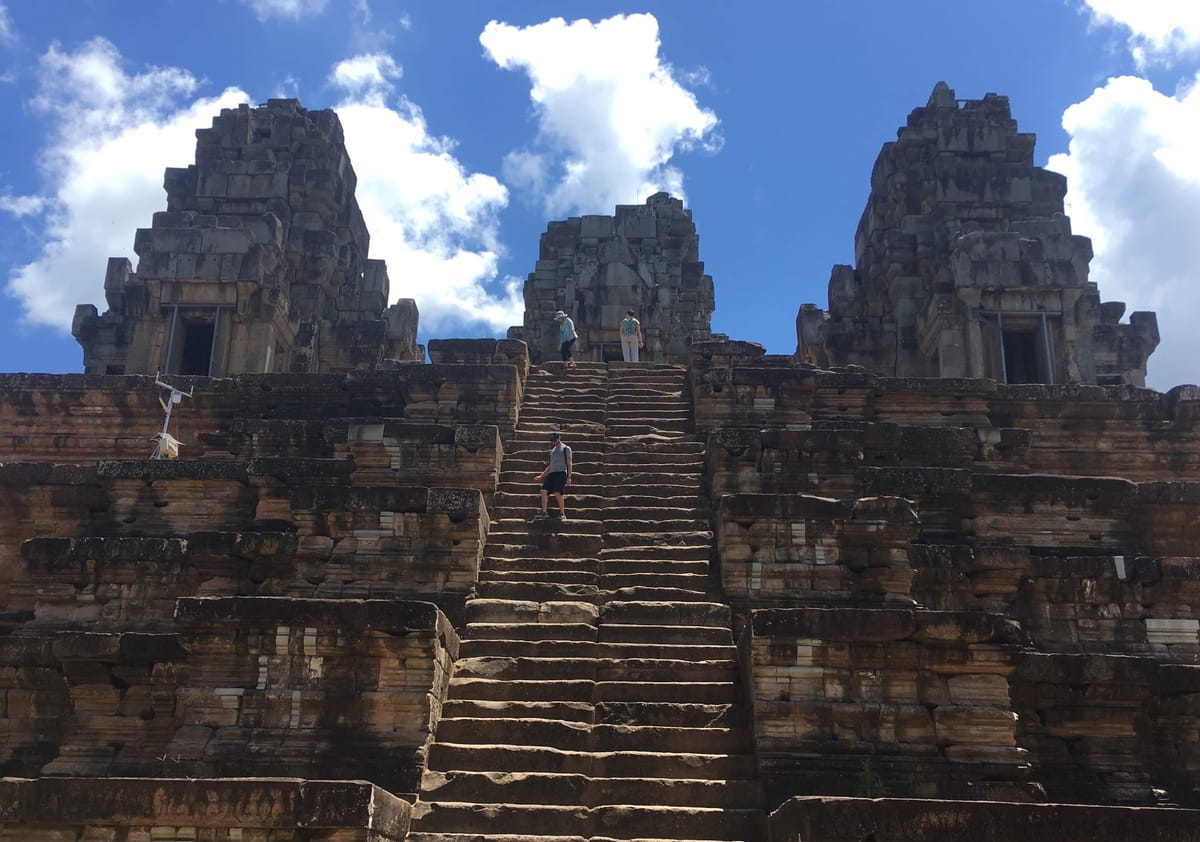
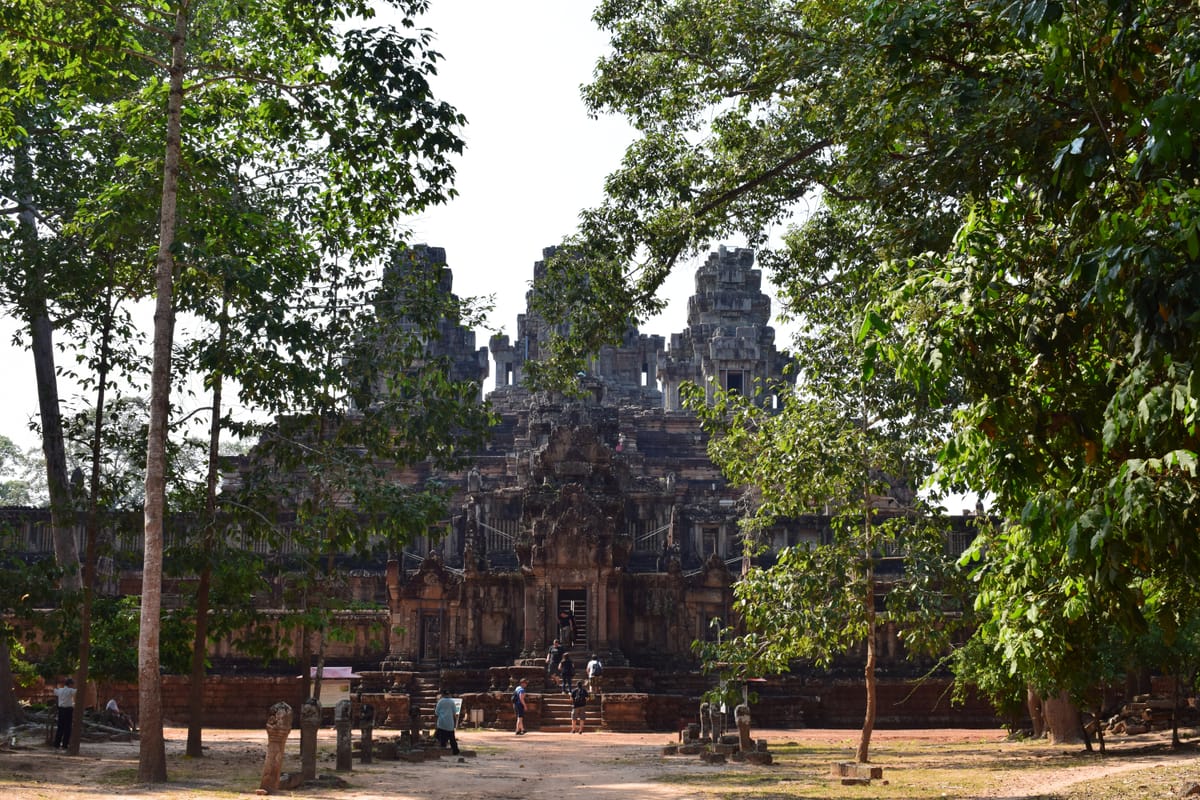
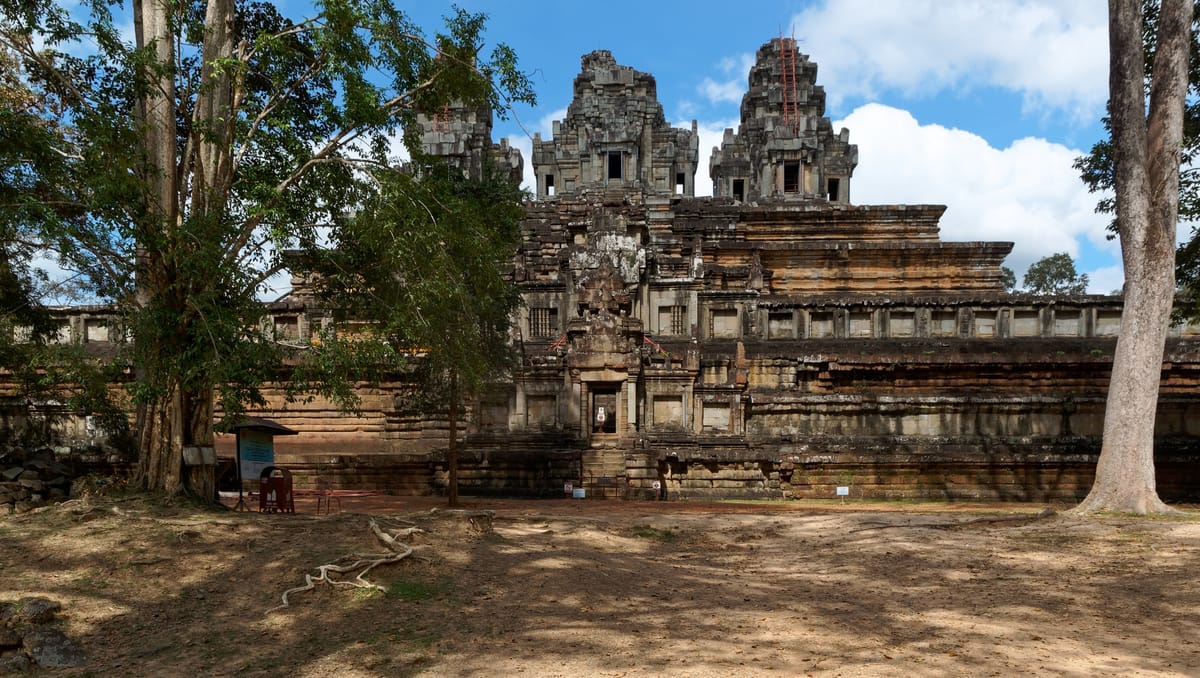
Ta Keo is a state temple of the Khmer Empire standing within the Angkor Archaeological Park in Siem Reap Province, Cambodia, just east of the walled city of Angkor Thom. Commissioned around 975 CE by King Jayavarman V, it takes the form of a temple-mountain: a five-tiered sandstone pyramid rising in stepped terraces to a summit crowned by five towers arranged in a quincunx, one at the center and one at each corner. What sets Ta Keo apart from its famous neighbors is not what it has but what it lacks — construction was abandoned before the temple’s surfaces were ever carved, so almost the entire structure survives as bare, massively stacked sandstone blocks rather than the dense mythological relief work seen at Angkor Wat or the Bayon. That accident of history makes Ta Keo an unusually direct, almost cutaway view of Khmer temple engineering: the stonework that elsewhere lies hidden beneath centuries of carving is here left fully exposed. Ta Keo is included within the “Angkor” UNESCO World Heritage property, inscribed in 1992.
The Structure
Jayavarman V began Ta Keo as his personal state temple around 975 CE, reportedly at about seventeen years old, continuing a family tradition of temple-building — his father, Rajendravarman II, had built the nearby Pre Rup. Scholars generally place the temple’s dedication around the year 1000, in the Khleang architectural style associated with Jayavarman V’s reign. Ta Keo was conceived, like other Angkorian state temples, as an earthly stand-in for Mount Meru, the mythical mountain home of the Hindu gods, dedicated to Shiva. Its footprint is defined by an outer enclosure wall roughly 120 by 100 meters, built of sandstone on a laterite base, originally surrounded by a moat about 255 by 195 meters (now largely silted in and overgrown). A causeway some 500 meters long once led from the temple’s eastern entrance to a landing stage on the East Baray, Angkor’s great Yashodharapura-era reservoir, linking Ta Keo into the wider Angkorian water network. The pyramid itself rises in five levels to about 21-22 meters, with the first two tiers forming the base of two enclosed courtyards — one ringed by a plain wall, the other by a gallery, itself an early example of a feature (the surrounding gallery) that would become standard at later Angkorian temples. The upper three tiers are steep and narrow, climbing to the summit platform where the central sanctuary tower reaches roughly 45 meters above the base. Ta Keo is notable as one of the first Khmer temples built entirely of sandstone rather than the brick-and-sandstone or laterite-and-sandstone combinations common before and after it, a technical step that architectural historians treat as a milestone in Khmer monumental construction.
How Was It Built?
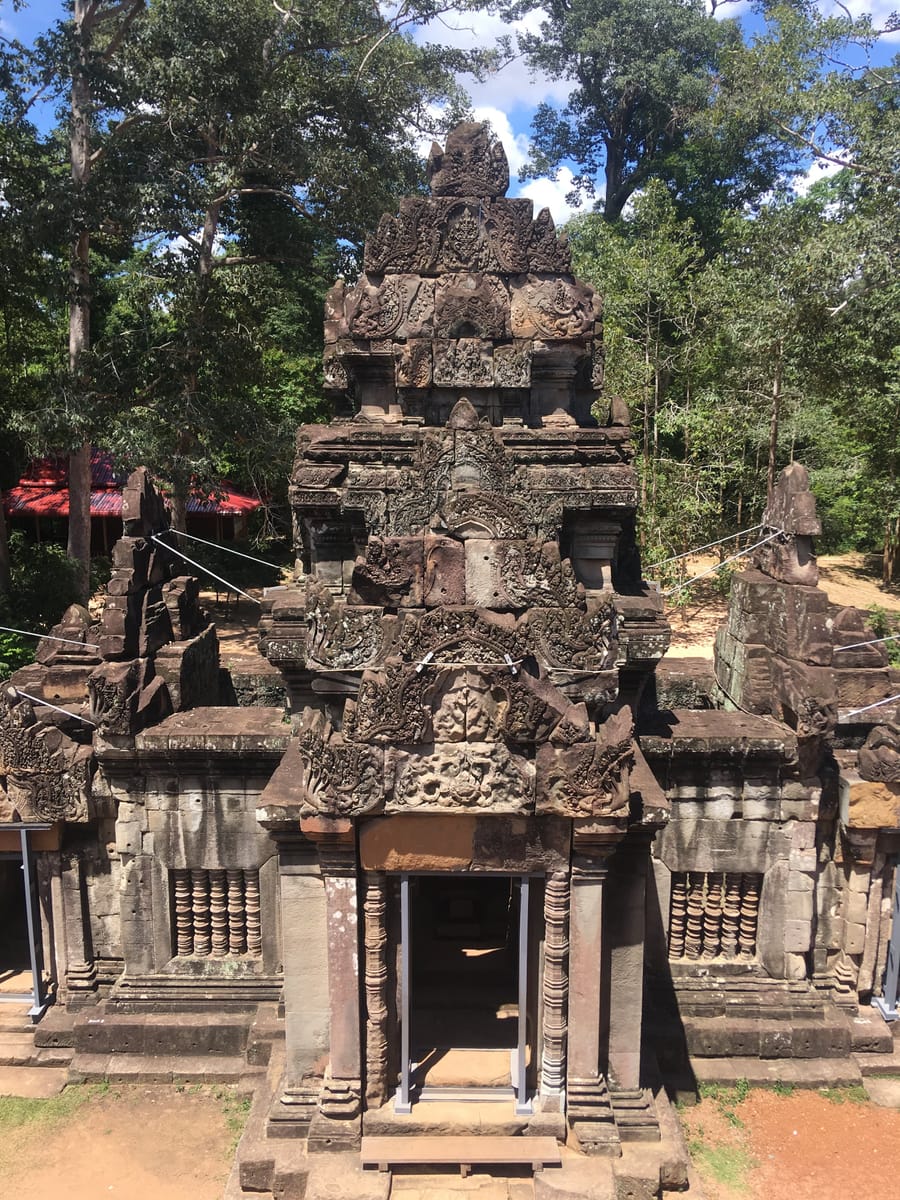
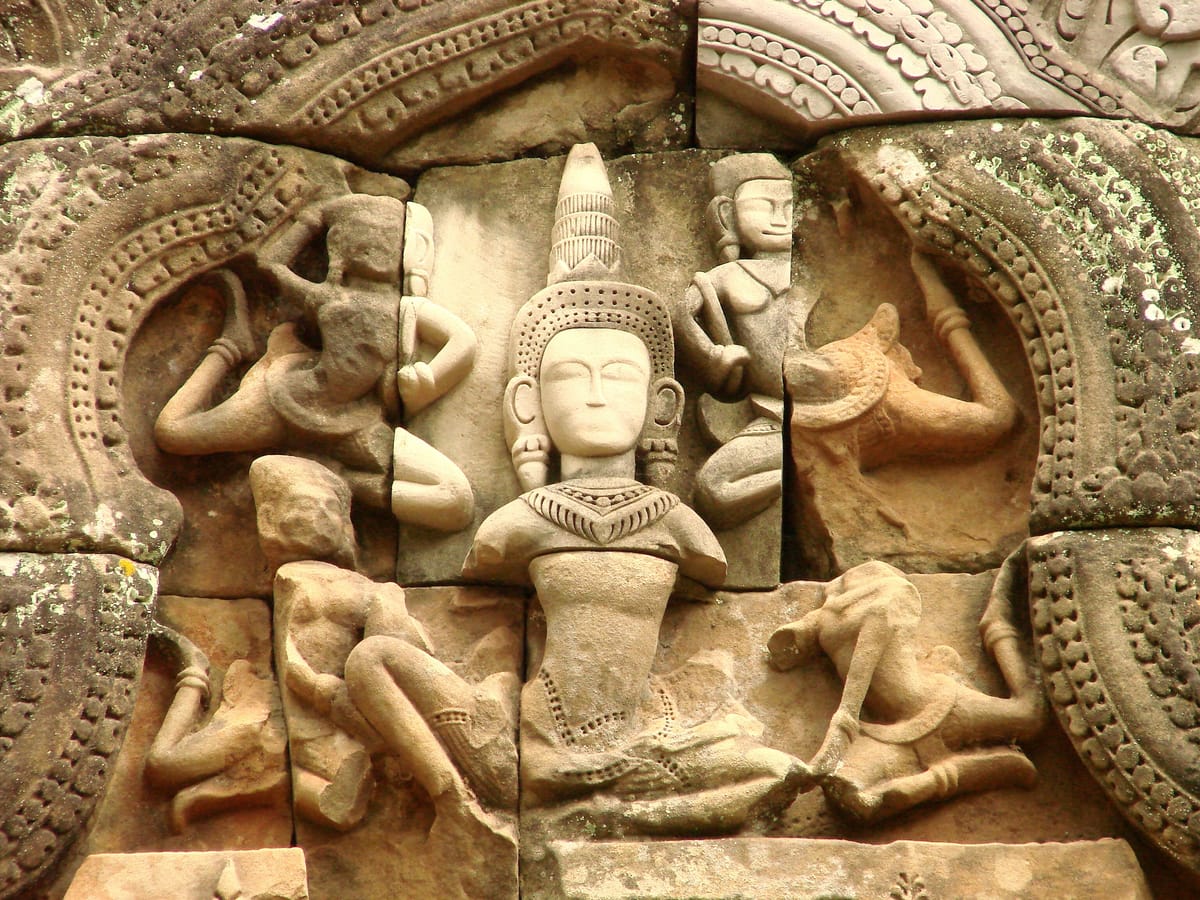
Builders quarried and dressed large sandstone blocks, then stacked and fitted them without mortar into the temple’s terraces, walls, and towers, using laterite — a porous, iron-rich stone that hardens on exposure to air — for the foundations and other elements requiring a firm base. Because work stopped before decoration began, the raw assembly method is unusually visible at Ta Keo: courses of large, carefully squared blocks are stacked in clean horizontal runs, their joints and dressing marks exposed rather than smoothed away or hidden beneath carved relief, giving the temple what visitors and scholars alike describe as a stark, almost brutalist massiveness compared with the ornamented surfaces of later Angkorian monuments. The normal Angkorian building sequence, inferred in large part from sites like Ta Keo where it was interrupted, involved rough-shaping stone at the quarry, transporting and stacking blocks into the intended architectural form, and only then carving figures, floral motifs, and inscriptions directly into the assembled surfaces — decoration was therefore one of the last stages of construction, not something added before the stone was set in place. At Ta Keo, only a few damaged carvings of floral and figural motifs on the eastern face of the central tower and on some of the gate structures (gopura) show where that final carving phase had just begun before it was cut short. Raising a stepped pyramid of this height and mass with sandstone alone, rather than mixing in lighter brick as earlier Khmer temples had, required moving substantially more stone than earlier state temples and reflects the growing scale of Angkorian construction projects under Jayavarman V and his successors.
The Mainstream View
Historians and archaeologists agree, based on inscriptions, architectural style, and comparison with securely dated Khmer monuments, that Ta Keo was commissioned by Jayavarman V as his state temple in the late 10th century and left unfinished. What is not disputed is the basic sequence of events: work proceeded far enough to complete the temple’s structural mass — its terraces, galleries, enclosure wall, and towers — before the intended surface carving was more than barely begun. Ta Keo’s significance in mainstream scholarship rests less on any mystery of technique and more on what its raw, undecorated state reveals about ordinary Khmer building practice: because so little decoration was ever added, Ta Keo has become a reference point for understanding how Angkorian masons sequenced quarrying, transport, assembly, and carving, information partly obscured at more completed temples where the finished decoration is all a visitor normally sees. Its role as the first (or among the first) major Khmer monuments built entirely in sandstone is likewise treated as an established technical milestone, part of a broader trajectory of Khmer builders shifting away from brick toward increasingly ambitious all-stone construction that would culminate a century and a half later in Angkor Wat.
The Open Case
The genuine open question at Ta Keo is not how the Khmer built it — the stacking, quarrying, and finishing methods are consistent with well-documented Angkorian practice — but why they stopped. A contemporary or near-contemporary inscription, attributed to a high priest named Yogisvarapandita, records that lightning struck the unfinished building, an event read as an evil omen that halted work outright. Whether that account reflects an actual physical strike, a natural disaster later reinterpreted as portentous, or simply the kind of omen literature Khmer inscriptions regularly used to explain political events, is not something scholars can settle from the text alone. Most historians instead favor a more mundane explanation: Jayavarman V’s death (his reign is generally dated to have ended around 1000-1001) triggered succession conflicts that disrupted state patronage of his temple project, and construction was never resumed by his successors, who had their own state temples to build. The two explanations are not necessarily exclusive — a lightning strike could have been folded into the propaganda of a succession dispute after the fact — and neither can be fully verified against the other from the surviving evidence. What is not in question is that this was a stoppage of labor and patronage, not a failure of engineering: every unfinished surface at Ta Keo shows competent, in-progress Khmer stonework, not a structure that collapsed or exceeded its builders’ abilities. The wonder Ta Keo offers is not a puzzle of lost technique but a genuinely open historical question — a frozen moment in an otherwise well-understood building process, whose final interruption still has no single, fully corroborated cause.
Sources
- khmer-empire
- cambodia
- temple-mountain
- hindu-temple
- unfinished-monument
- unesco-world-heritage
- medieval
- sandstone
Gallery