Silbury Hill
Why did Neolithic communities commit an estimated four million hours of labor to raising the largest artificial mound in prehistoric Europe when centuries of tunneling have found no burial, chamber, or treasure inside it?
Why this rating?
- Construction difficulty
- 3/5
- Method uncertainty
- 2/5
- Capability gap
- 2/5
- Open questions
- 5/5
The staged chalk-and-revetment construction sequence is well reconstructed from excavation and required only labor-intensive Neolithic earthmoving, not unresolved technique, but despite an estimated four million labor-hours and over two centuries of digging, no burial or function has ever been found, leaving Britain's largest prehistoric mound's purpose entirely open.
Overview
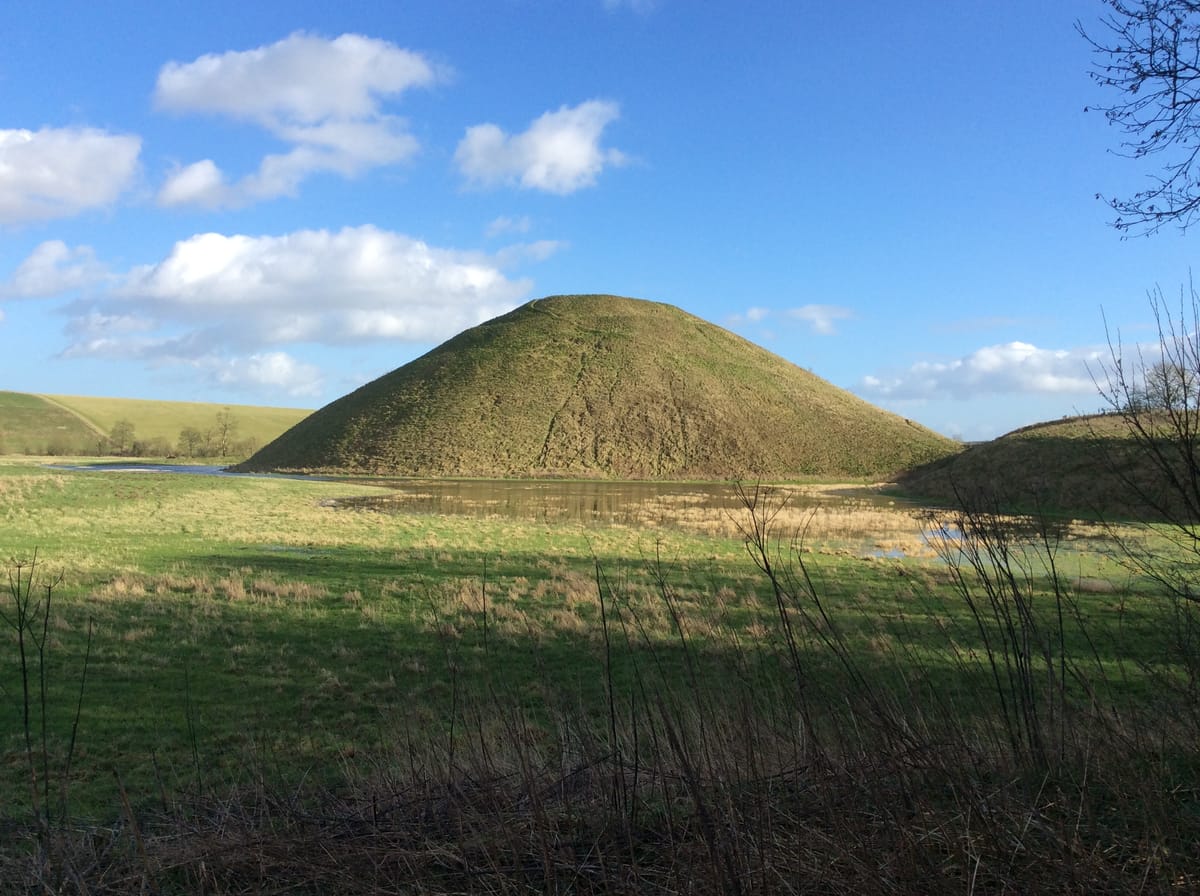
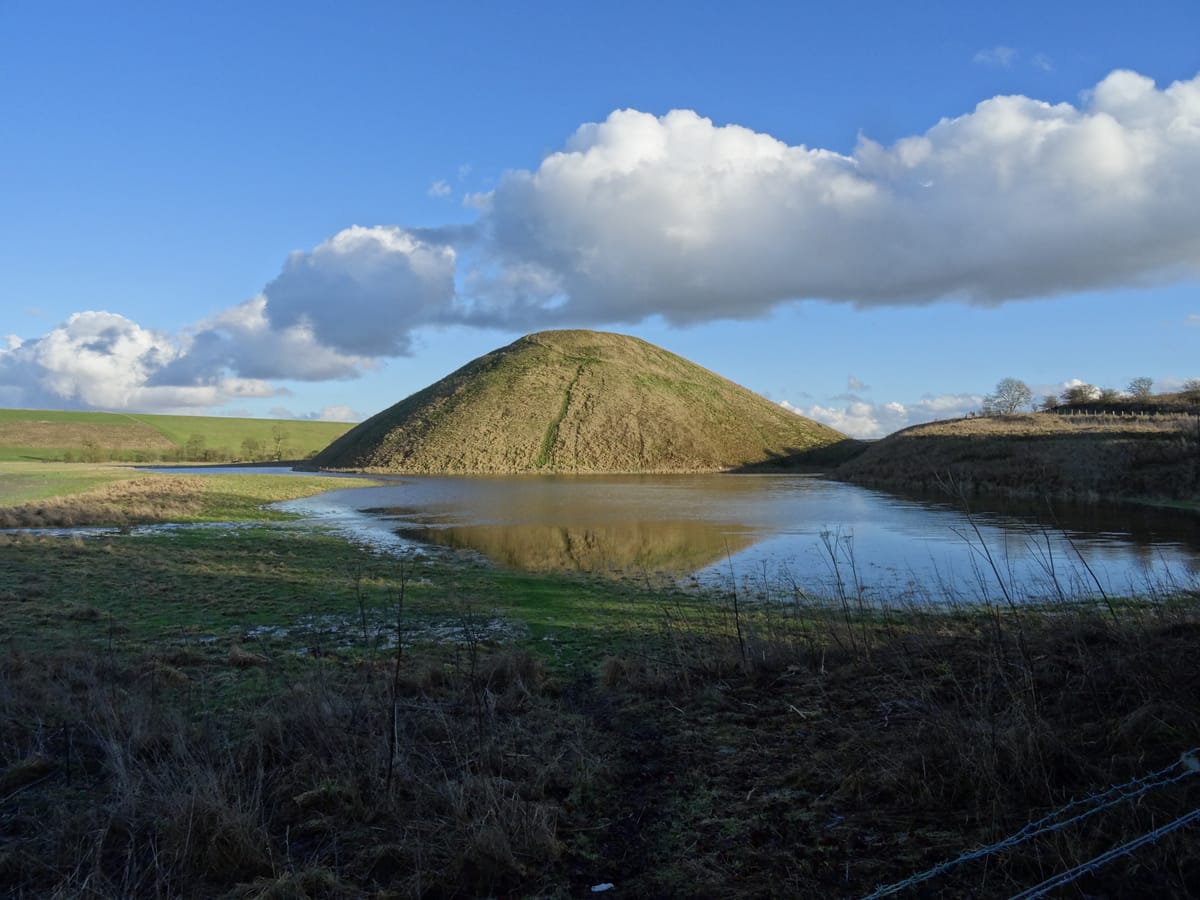
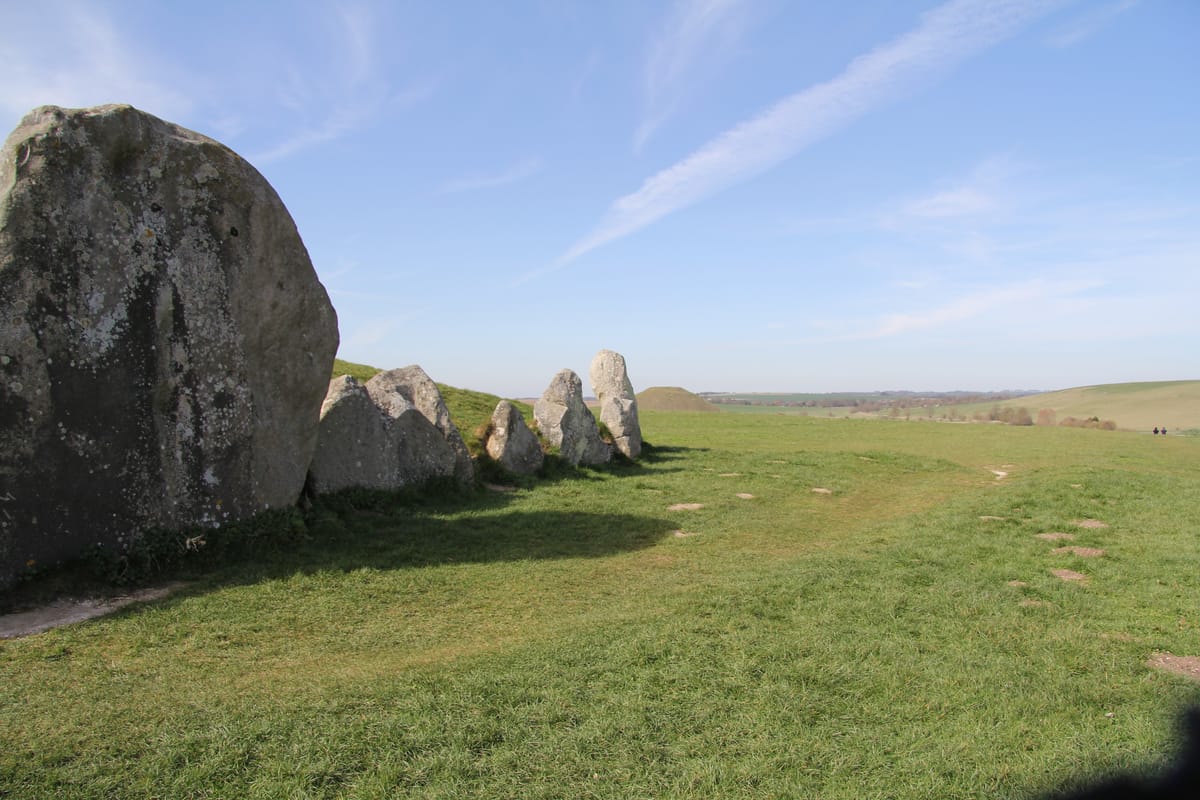
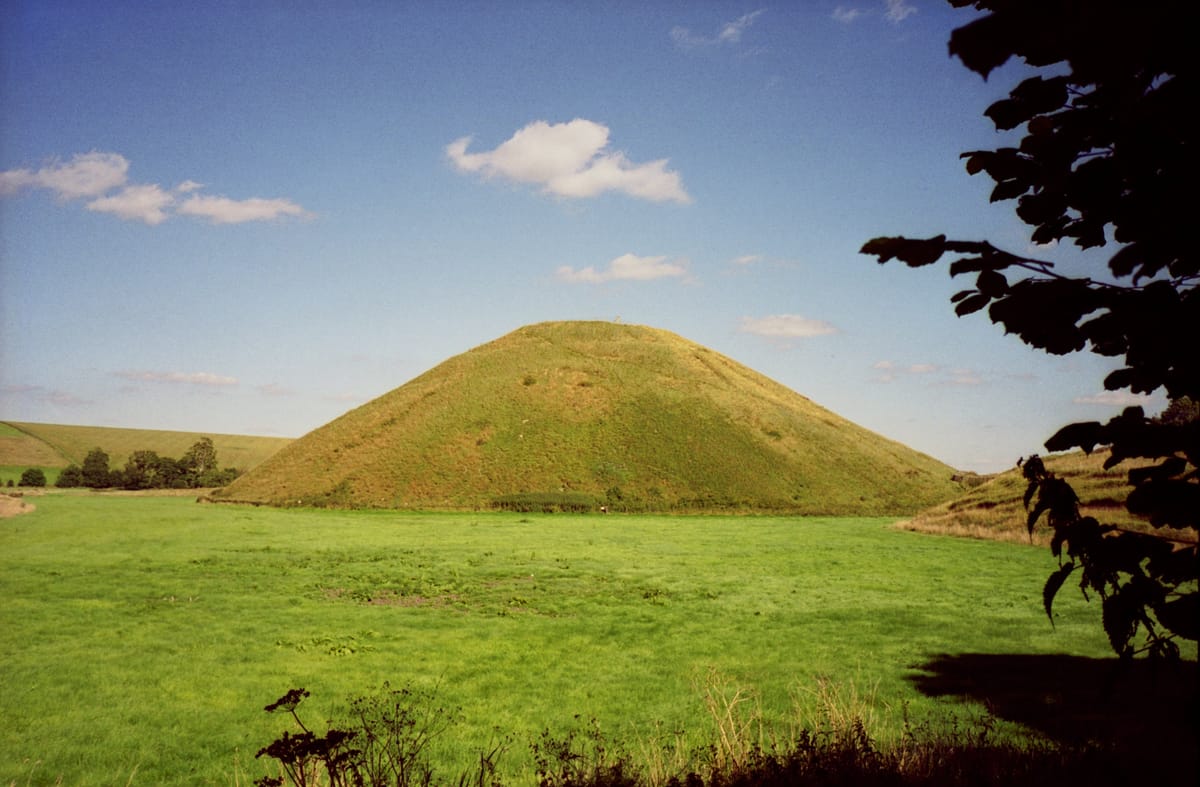
A few kilometers from the great stone circle at Avebury, in the chalk downland of Wiltshire, England, rises a man-made hill unlike anything else in prehistoric Europe. Silbury Hill stands about 30 meters (roughly 100 feet) high with a circular base some 160 meters across — comparable in footprint and bulk to some of the smaller Egyptian pyramids, though built entirely of chalk, earth, and turf rather than dressed stone. It is the largest artificial mound known to have been built by prehistoric people anywhere on the continent. Raised in stages during the Late Neolithic, around 2470 to 2350 BCE, it contains an estimated 500,000 tonnes of material and, according to English Heritage’s own working estimate, represents something on the order of four million hours of human labor. Silbury Hill is not a burial mound in the ordinary sense: despite its scale and despite more than two centuries of digging aimed at finding one, no burial, chamber, or grave goods have ever been recovered from inside it. It forms part of the Avebury section of the “Stonehenge, Avebury and Associated Sites” UNESCO World Heritage property, inscribed in 1986, and sits within a dense concentration of Neolithic monuments that includes the Avebury henge and stone circle, the West Kennet Long Barrow, West Kennet Avenue, and the Sanctuary.
The Structure
Silbury Hill is a stepped, roughly conical mound covering about two hectares, encircled by a large ditch (originally about 100 meters across at its widest phase) that was fed by groundwater and springs and, in its early life, likely held water for at least part of the year — a moat around an artificial island. The summit is flattened, around 30 meters across, and the sides show a shallow spiral or stepped terracing that may have served as a construction ramp, a means of preventing slippage, or both; its original purpose is not settled. Radiocarbon dating of antler tools and other organic material recovered during excavation places the bulk of construction in a fairly narrow window, roughly 2470 to 2350 BCE, making Silbury Hill contemporary with the main building phases at nearby Avebury and with the final stages of Stonehenge, some 30 kilometers to the south. It sits low in the Kennet valley rather than on a hilltop, an unusual siting for a monument of this visibility, and near the point where the River Kennet and a smaller tributary, the Winterbourne, meet — a detail some archaeologists think was deliberate, tying the mound to water and to the surrounding ceremonial landscape rather than to any single settlement or elite residence.
How Was It Built?
Modern understanding of Silbury Hill’s construction comes chiefly from Richard Atkinson’s 1968–70 tunnel excavation (broadcast on the BBC) and from the more recent conservation-driven survey and excavation of 2000–2008, both of which built on earlier antiquarian digs. Excavators identified several successive building campaigns rather than one continuous effort. The earliest phase was a small gravel mound less than a meter high, possibly using material dredged from the River Kennet, encircled by a ring of stakes. This was progressively enlarged: a phase of packed mud, turf, and organic material brought the mound to roughly 35 meters across and 5 meters high, surrounded by a substantial ditch; a final major phase added chalk quarried from an enlarged surrounding ditch, raising the structure to its present height in a series of chalk “steps” retained internally by walls of chalk blocks that acted as a kind of skeleton, holding each layer in place while the next was added on top. This stepped, internally revetted construction — closer to a layered engineering structure than a simple heap of spoil — is what has kept Silbury Hill essentially stable for over four thousand years, even as its later, unrevetted upper layers have proven more prone to slumping and tunnel collapse. The tools recovered from the mound and ditch — antler picks, ox-scapula shovels, and baskets’ worth of chalk rubble — point to a labor-intensive process using entirely Neolithic technology: no metal tools, wheeled transport, or draft-animal haulage. Analysis of insect remains recovered by Atkinson (including gravedigger beetles and flying ants) suggested a late-summer start to at least one building phase, one of the few clues to the season, if not the exact sequence, of construction.
The Mainstream View
Archaeologists are confident about who built Silbury Hill and roughly when: it is a product of the same Late Neolithic communities responsible for the Avebury henge, stone circles, and long barrows in the surrounding landscape, built using well-understood earth-moving and revetment techniques over multiple campaigns across perhaps a century, most likely as a large communal or ceremonial undertaking rather than the tomb of a single ruler. This is well supported by radiocarbon dates from antler tools and other organic material recovered in secure archaeological contexts, by comparison with construction sequences seen at other Neolithic monuments in the region, and by the internal stepped-and-revetted structure exposed in excavation, which shows a coherent, staged engineering logic rather than one-off dumping. What is not resolved, and what mainstream archaeology is candid about, is why: proposals include an act of communal identity-building whose value lay largely in the process of construction itself rather than any finished function (a reading championed by researchers such as Jim Leary and David Field, who led the 2000s excavation), a monument of political or spiritual authority display, a marker tied to water, fertility, or seasonal ritual cycles (as argued by writers like Michael Dames), or a structure with symbolic ties to the sun, moon, or surrounding horizon. None of these has become a scholarly consensus.
The Open Case
The genuine mystery at Silbury Hill is not how it was built — the sequence of gravel core, mud and turf enlargement, and revetted chalk phases is reasonably well reconstructed from excavation — but what it was for. Digging into the mound has a long history: in 1776, the Duke of Northumberland’s men sank a vertical shaft from the summit to the base looking for a central burial chamber and found nothing; in 1849, the dean of Hereford, John Merewether, drove a horizontal tunnel toward the center and again found no grave, only decayed turf, moss, and other organic traces; Richard Atkinson’s 1968–70 tunnel, the most systematic investigation, likewise found no burial, no chamber, and no evidence the mound was ever intended to hold one. A serious crisis arrived in May 2000, when the 1776 shaft partially collapsed, opening a crater at the summit; the resulting 2000–2008 conservation project stabilized the old tunnels by backfilling them with hundreds of tonnes of chalk, while also giving archaeologists a last close look at the mound’s internal structure before it was sealed for good. That work confirmed the staged, revetted construction sequence but did not settle the question of purpose. What makes Silbury Hill stand as an open case is the sheer disproportion between the effort invested — an estimated four million hours of labor by Neolithic communities using only antler and bone tools — and the absence of any burial, artifact hoard, or structural function that would conventionally justify that effort. This is not a case for ancient aliens or lost technology: the builders were the Neolithic farming communities of the Avebury region, using methods that leave a clear, traceable archaeological signature. But even with the “how” reasonably well understood, English Heritage’s own assessment is blunt: “we do not know its purpose, or its meaning for the late Neolithic people who built it.” Silbury Hill’s relationship to the surrounding ceremonial landscape — Avebury, West Kennet Long Barrow, the Sanctuary — is clearly close, but the precise nature of that relationship, and the meaning the mound held for the people who built and repeatedly enlarged it, remain genuinely open questions.
Sources
Gallery