Rano Raraku
Why are roughly half of all the moai ever carved still standing in the quarry that made them — abandoned partway to somewhere else, or deliberately raised on the spot they were born?
Why this rating?
- Construction difficulty
- 4/5
- Method uncertainty
- 2/5
- Capability gap
- 3/5
- Open questions
- 4/5
Cutting figures up to 21 metres long out of a cliff face with basalt hand picks, then detaching and standing them, was punishing work at a scale sustained for centuries — but the quarry is unusually generous about method, preserving every stage from rough outline to finished statue, so how it was done is among the best-documented questions in Pacific archaeology. What stays open is why roughly half of all moai never left, whether the statues in the quarry were abandoned or deliberately installed, and why the carving stopped.
Overview
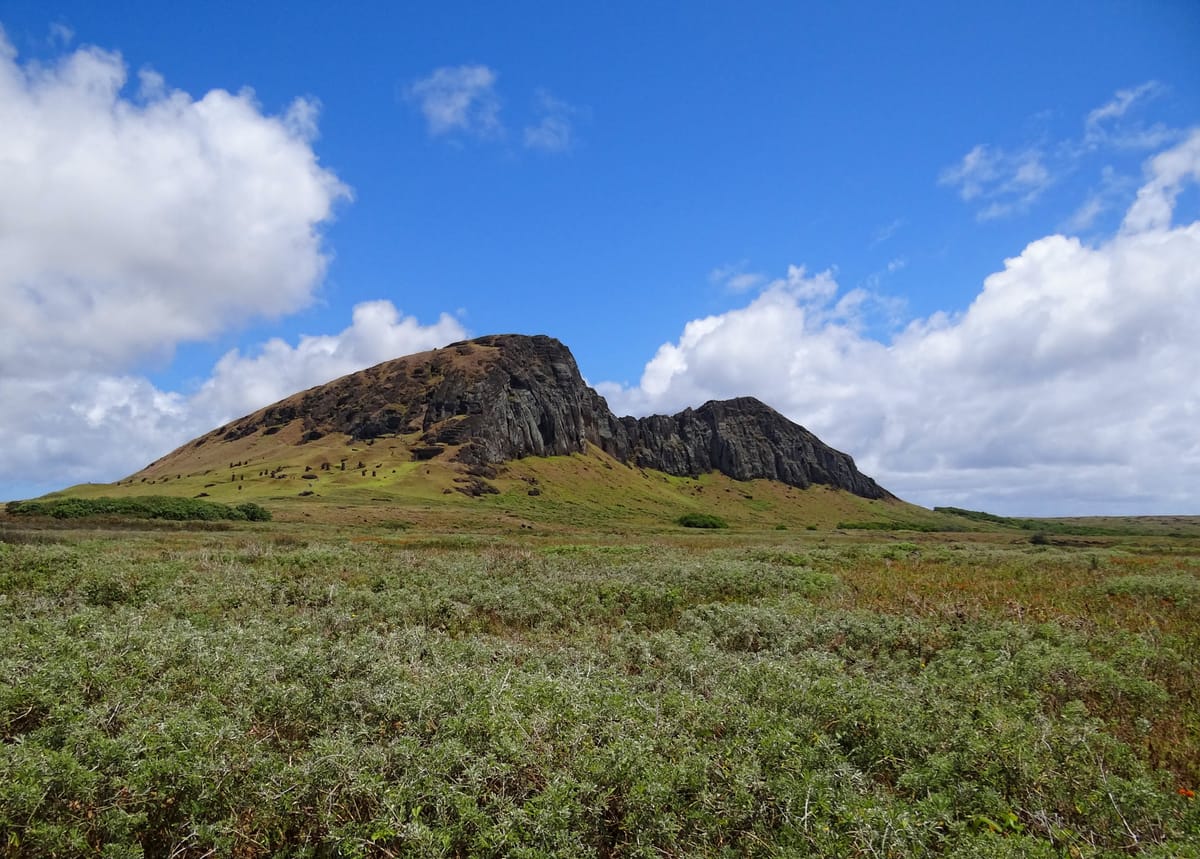
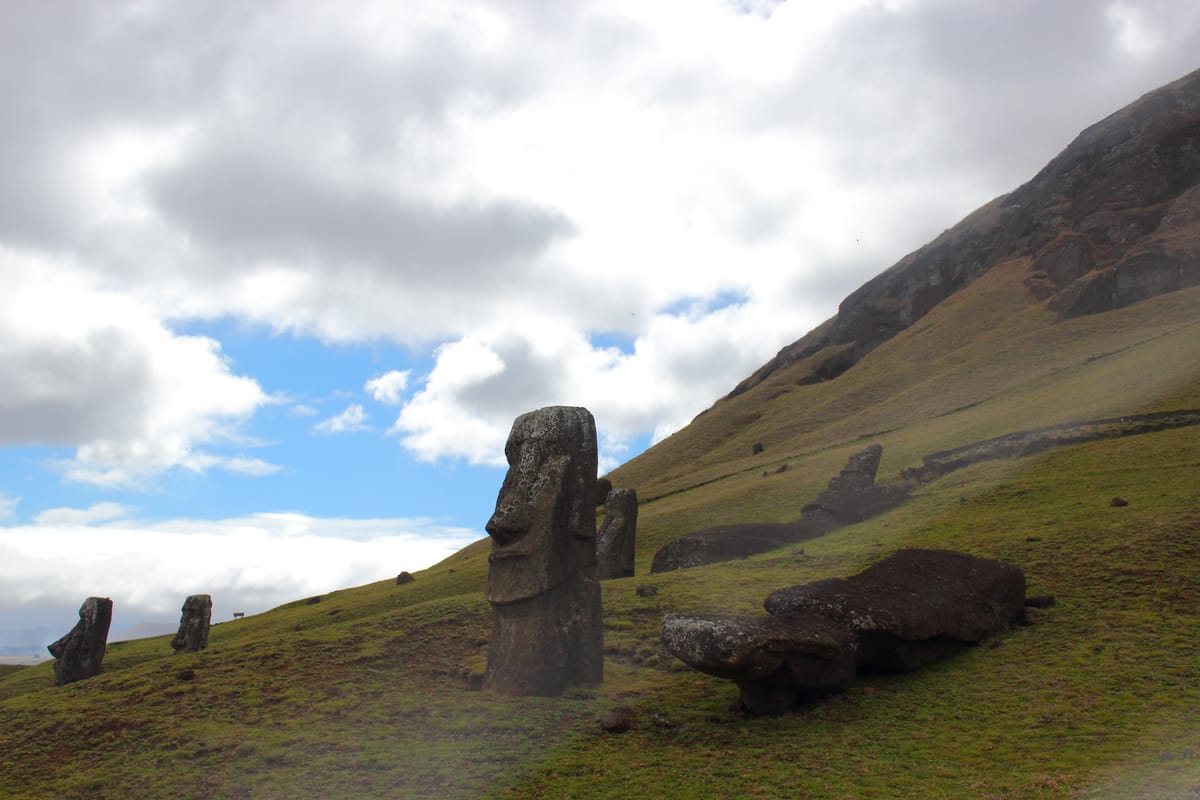
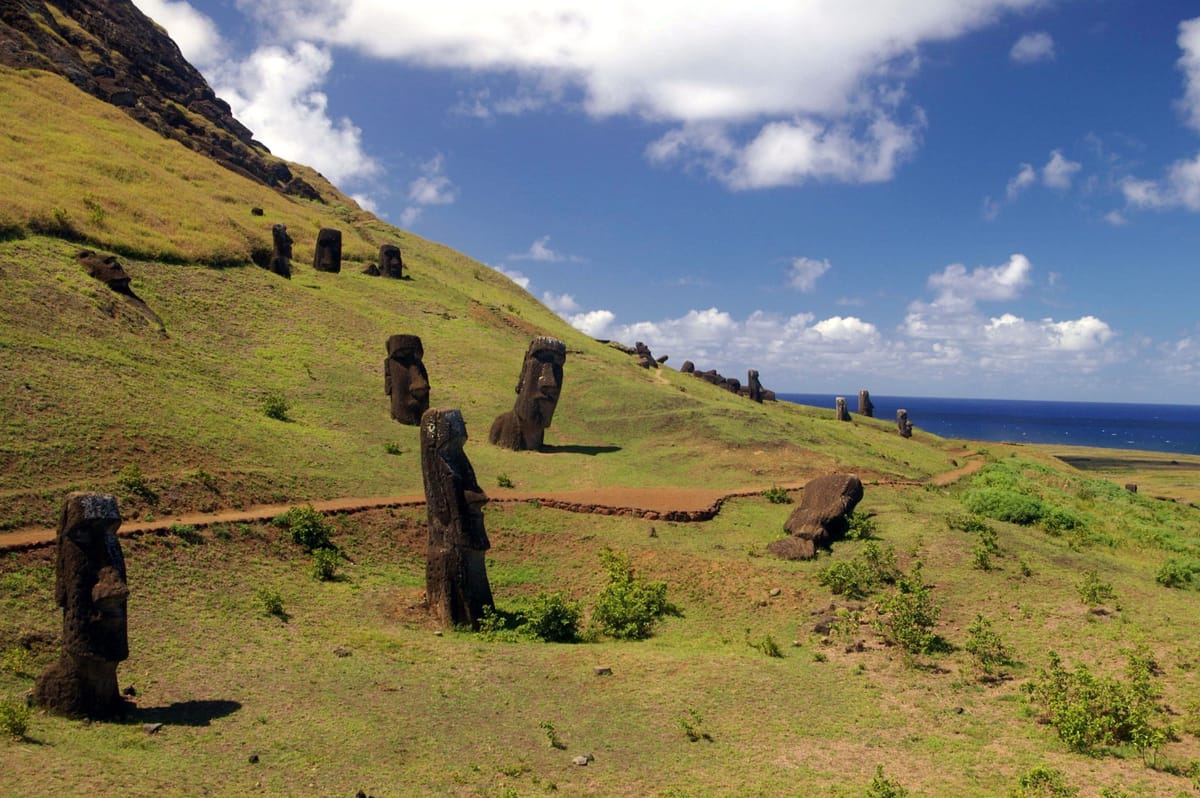
Rano Raraku is a volcanic crater on the eastern side of Rapa Nui (Easter Island), and it is the reason the island looks the way it does. Its rock — a consolidated volcanic ash called tuff, soft enough to cut with stone tools and firm enough to hold a face — supplied the material for roughly 95% of the island’s approximately 900 known moai, carved by the Rapa Nui people over some four to five centuries. What makes the crater remarkable is not that statues came from here but that so many of them never left: around 400 moai, close to half of every one ever made, are still on Rano Raraku’s inner and outer slopes. Some stand upright, buried to the chest or shoulders in accumulated sediment. Some lie flat on the grass. Others have never been separated from the mountain at all, still lying face-up in the rock face where a crew stopped work. The site sits within Rapa Nui National Park, inscribed by UNESCO as a World Heritage Site in 1995, and it is usually described as a quarry. That undersells it. A quarry is a place stone is taken from. Rano Raraku is a place where every stage of an entire monumental tradition was left standing in sequence, and then abandoned.
The Structure
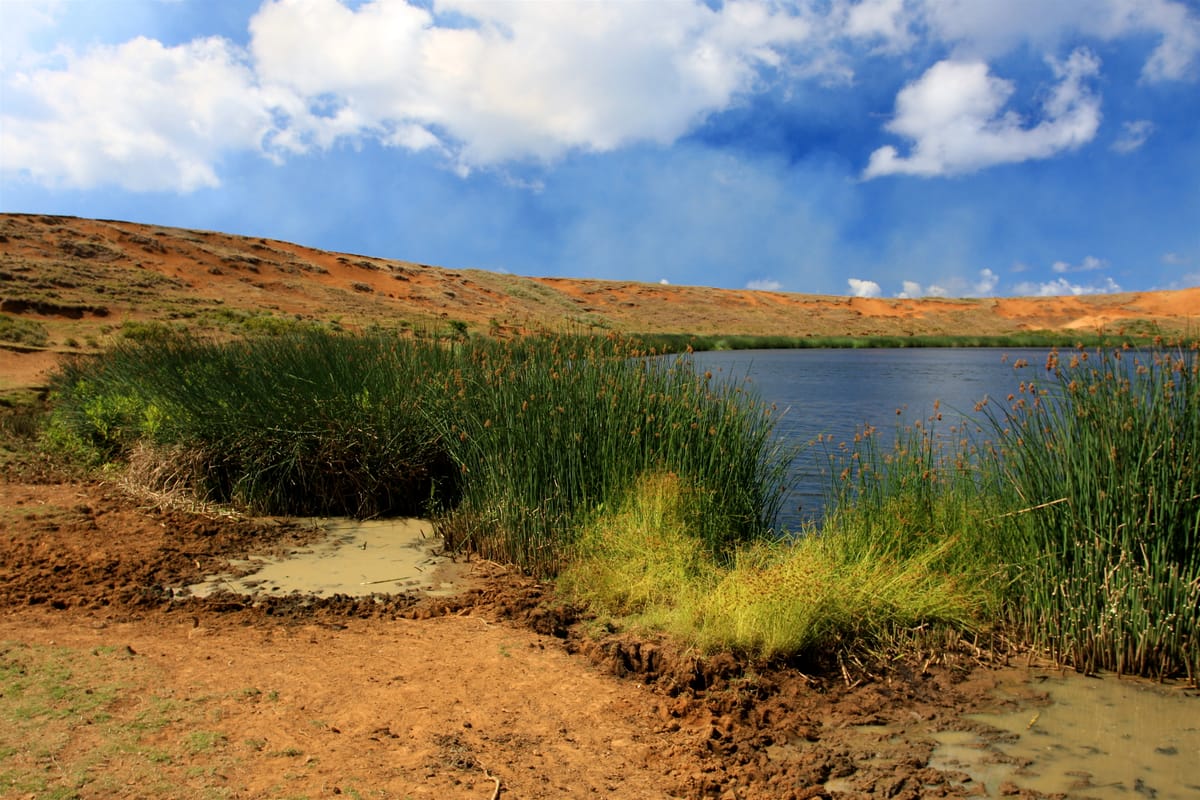
The crater is one of the island’s more forgiving landforms: steep on most sides, but low and gently sloping to the north and northwest, which is where the work happened and where the statues could be moved out. Inside it lies a freshwater lake, one of only three standing bodies of fresh water on Rapa Nui, ringed by totora reeds that islanders used for thatch and for swimming floats. Statues were cut on both the exterior flank and the interior crater wall, so the finished moai are distributed on both sides of the rim.
The largest of them never stood up. Known as El Gigante, it lies on its back in the quarry, roughly 21.6 metres long — nearly twice the height of any moai successfully erected — with weight estimates ranging from about 200 to 270 tonnes depending on how the volume is reckoned. For scale, an average moai stands about four metres and weighs twelve or thirteen tonnes; the heaviest ever actually raised on a platform, Paro, was around 82 tonnes. Trenches had already been cut along El Gigante’s sides to free it when work ended.
The moai still at Rano Raraku are also, oddly, the best-preserved on the island. They were never fitted with the hollowed eye sockets and red scoria topknots that the finished coastal statues received, and — crucially — they were not pulled down during the island’s later upheavals, when essentially every moai standing on a platform was toppled. What survives here is the tradition in progress rather than the tradition in ruins.
How Was It Built?
The method is legible because the quarry never cleaned up after itself. Carvers worked with toki, hand picks chipped from hard basalt, striking and abrading the softer tuff. A figure was laid out directly on the rock face and cut face-up, with the front and both sides worked to near-finish while the statue was still part of the mountain — held there by a narrow longitudinal ridge of stone running down its spine, a keel that kept it steady and stopped it dropping. Only at the very end was the keel cut through, freeing the moai.
What happened next explains the buried statues. Freed figures were eased down the slope into prepared pits, tipped upright, and packed around with soil and rubble so that carvers could reach the back and finish the surface on a statue that was now standing. Over the following centuries, runoff and erosion did the rest, filling those pits higher and higher until the bodies vanished and only heads and shoulders showed — which is why the popular image of Easter Island is a field of disembodied heads. They are not heads. Excavations by Jo Anne Van Tilburg’s Easter Island Statue Project, working in the quarry between 2010 and 2014, dug two of them out and found complete bodies underneath, their surfaces protected by the very burial that hid them, carrying carved detail including — on one statue, RR-001-156 — a dense set of petroglyph motifs found on only a handful of moai anywhere.
Not every stoppage was a mystery. Some unfinished statues were plainly given up when carvers cut into a hard inclusion in the tuff and the stone refused to cooperate.
The Mainstream View
Archaeologists treat Rano Raraku as a working quarry operated by the Rapa Nui themselves, with no gaps in the account that would require outside builders or unknown technology. The sequence from outline to detached statue is directly observable at the site, basalt toki have been recovered in quantity, and the half-finished figures let researchers reconstruct each step without guesswork. Dating places the main period of production at roughly 1250 to 1500 CE, with quarrying activity continuing in some form into approximately the early 1700s.
Recent work has complicated the “industrial site” picture in an interesting way. The 2019 study by Van Tilburg, Sarah Sherwood and colleagues in the Journal of Archaeological Science analysed soils inside the quarry and found them unusually fertile — a by-product of lapilli tuff weathering in place, continually refreshed by the quarrying itself — along with direct evidence of cultivation: sweet potato, taro, banana, paper mulberry and probably bottle gourd, from around the 14th century into the early 19th. The authors argue this makes Rano Raraku not merely a source of rock but a productive and probably sacred place, and propose that at least some statues standing in the quarry were deliberately installed there rather than stranded, in a setting the Rapa Nui associated with fertility and abundance. That interpretation is a serious proposal from the team that did the digging, not a settled consensus; the soil and crop evidence is solid, the meaning read from it is argued.
The Open Case
The open questions at Rano Raraku are not about capability. They are about intent, and they are unusually sharp because the evidence is so abundant.
The largest is simply this: why is half the corpus still here? The traditional reading is interruption — statues finished or nearly finished, queued for transport, and then overtaken by whatever ended the tradition. The competing reading, strengthened by the quarry’s cultivated soils, is that a substantial number were always meant to stand where they stand, and that the quarry was a destination in its own right. Both readings fit a slope covered in upright figures; they imply very different things about what the Rapa Nui thought they were doing.
El Gigante sharpens the same problem. At 21 metres and something like 200 tonnes, it is far beyond anything the island ever moved, and it is genuinely unclear whether its carvers were attempting a statue they had a plan to transport, making a deliberate showpiece to be left in the rock, or simply pushing to see where the limit was — and then finding it. No account survives to say.
And the ending is unresolved. Carving wound down sometime between the 1600s and the early 1700s, and the explanations on offer — internal conflict, the shift toward the Birdman religious system centred at Orongo, resource pressure, and later the catastrophic effects of European contact, introduced disease and 19th-century slave raiding — are plausible individually and hard to weigh against one another. None of this points anywhere exotic. The Rapa Nui built this, and the quarry they left behind is the most complete record of ancient monumental sculpture anywhere on Earth: a hillside where you can walk from a line scratched on rock, past a figure still joined to the mountain by its spine, to a finished ancestor standing in the grass. The instructions are all there. The last page is missing.
Sources
- Wikipedia — Rano Raraku
- UNESCO World Heritage Centre — Rapa Nui National Park
- Van Tilburg, Sherwood et al. — New excavations in Easter Island's statue quarry: soil fertility, site formation and chronology (Journal of Archaeological Science, 2019)
- UCLA Newsroom — Unearthing the mystery of the meaning of Easter Island's moai
- Easter Island Statue Project — Jo Anne Van Tilburg
- Easter Island Travel — Rano Raraku, the moai statue quarry
Gallery