The Qanats of Gonabad
How did Iron Age well-diggers, working by lamplight with hand picks and a rope windlass, sink a shaft roughly 300 metres into the desert and then drive a tunnel some 33 kilometres back to the surface — holding a gradient of a fraction of a percent the whole way, underground, with no way to see where they were going?
Why this rating?
- Construction difficulty
- 5/5
- Method uncertainty
- 3/5
- Capability gap
- 3/5
- Open questions
- 3/5
Driving a 33-kilometre gravity tunnel by hand from a mother well roughly 300 metres deep, holding a gradient of well under one percent underground for its entire length, is close to the practical ceiling of pre-modern excavation — and the shafts, spoil rings and flowing water are all still there to prove it was done. What keeps the mystery scores moderate rather than high is that qanat digging survives as a living craft with a written engineering manual behind it, so the method is broadly understood; what keeps them from being low is that the earliest description of that method was written some 1,500 years after Gonabad was cut, and the qanat's true date and build sequence rest on scattered pottery and legend rather than excavation.
Overview
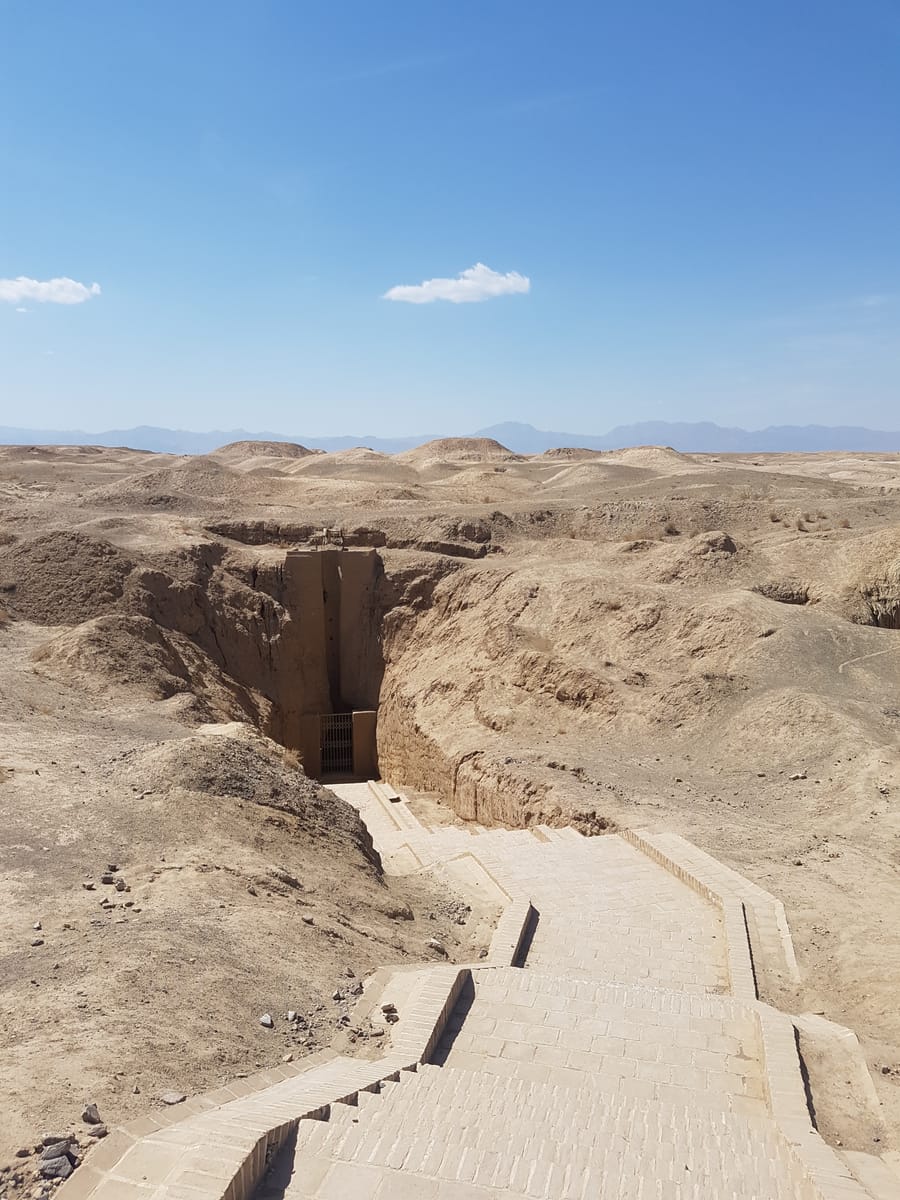
On the dusty plain outside Gonabad, in Iran’s northeastern province of Razavi Khorasan, the ground is pocked with hundreds of low circular craters running in a long, almost dead-straight line towards the mountains. From the air they look like the aftermath of a bombing run. They are, in fact, the tops of 427 hand-dug vertical shafts, and they mark the line of the Qasabeh qanat of Gonabad — an underground aqueduct roughly 33 kilometres (20.6 miles) long, cut through the alluvium of the desert by hand, at some point between about 700 and 500 BCE. A qanat works by tapping an aquifer high on an alluvial fan, near the mountains, and then leading that groundwater to a village far out on the arid plain through a gently sloping tunnel. There are no pumps and no moving parts anywhere in the system: water enters the tunnel through its upper, porous stretch and is carried the rest of the way by gravity, emerging into daylight at a point where the falling land surface finally meets the near-level tunnel. Gonabad’s is among the oldest, longest and deepest qanats known anywhere — its mother well, the shaft that first reached the water table, is usually given as around 300 metres (roughly 1,000 feet) deep, which is commonly cited as the deepest of any qanat. And it never stopped working. Two and a half thousand years after it was dug, the Qasabeh qanat still discharges on the order of 130 to 150 litres per second, watering farmland and supplying tens of thousands of people in the modern town above it. In 2016 UNESCO inscribed it, along with ten other Iranian systems, as “The Persian Qanat” — a World Heritage Site whose primary component, listed as Qasabeh Gonabad, is not a monument to be looked at but a machine that is still running.
The Structure
The Iranian plateau is one of the hardest places on Earth to farm. Rainfall is sparse and seasonal, surface streams die in summer, and evaporation in an open canal across a desert is punishing. The qanat is the answer that Iron Age Persians worked out, and it is an elegant one: put the whole canal underground, where nothing evaporates and nothing is lost to seepage, and feed it from the groundwater that collects beneath the gravel fans spilling out of the mountains. Because the flow of a qanat is governed by the level of the water table itself, it cannot draw the aquifer down the way a pumped well can — properly maintained, it is a self-limiting, effectively sustainable system that delivers water indefinitely. The technology is old: written records leave little doubt that ancient Iran was the birthplace of the qanat, and as early as the 8th century BCE the Assyrian king Sargon II recorded finding an underground water-tapping system during a campaign in the Persian highlands, a technique his son Sennacherib then applied to the irrigation works around Nineveh. Under Achaemenid rule the technique spread across an empire stretching from the Indus to the Nile, helped along by a striking piece of state policy: anyone who dug a new qanat, or restored an abandoned one, and brought groundwater to the surface to cultivate land had their tax obligation waived — and so did their heirs, for up to five generations. The Greek historian Polybius, writing later of the country at the foot of the Alborz, described exactly this landscape of hidden water: streams running down from everywhere, and people who had “transferred too much water from a long distance through some subterranean canals by spending much cost and labor.”
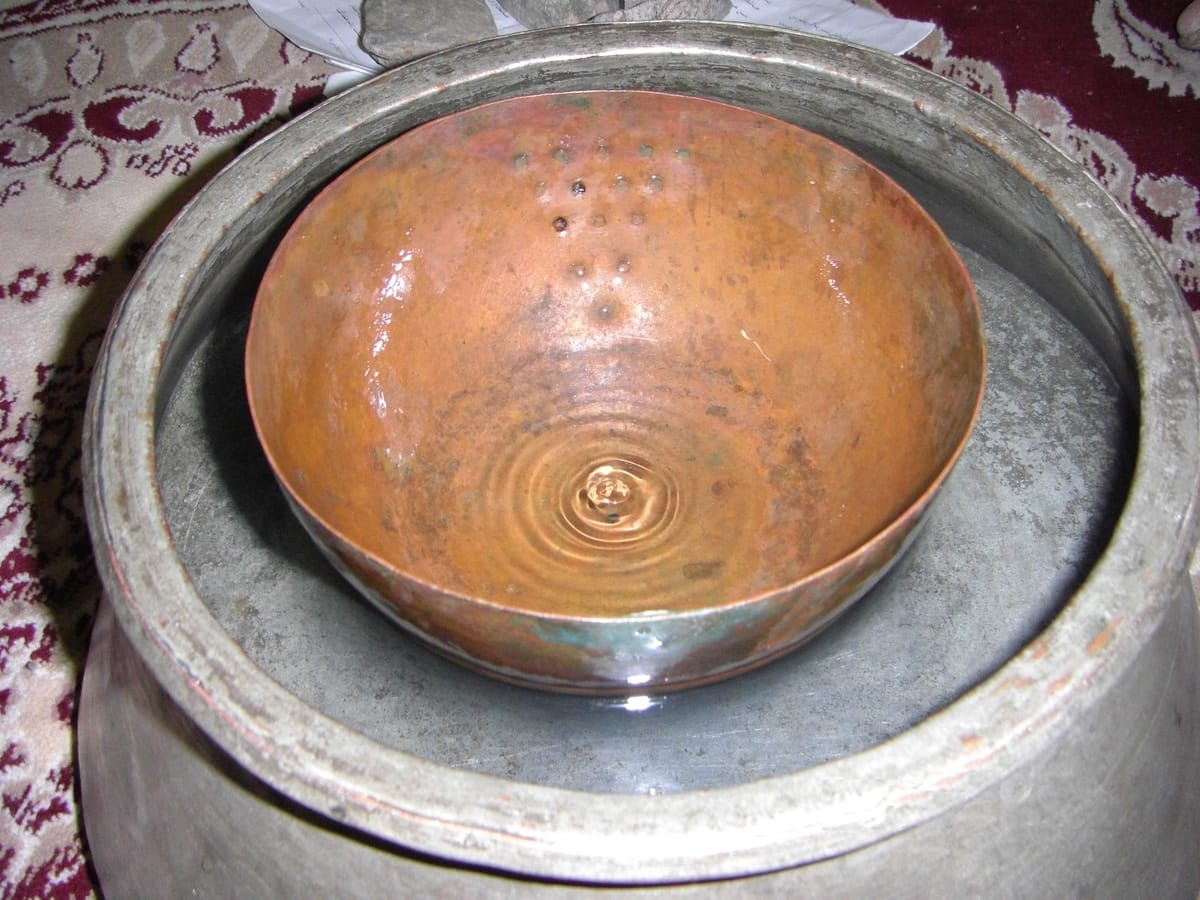
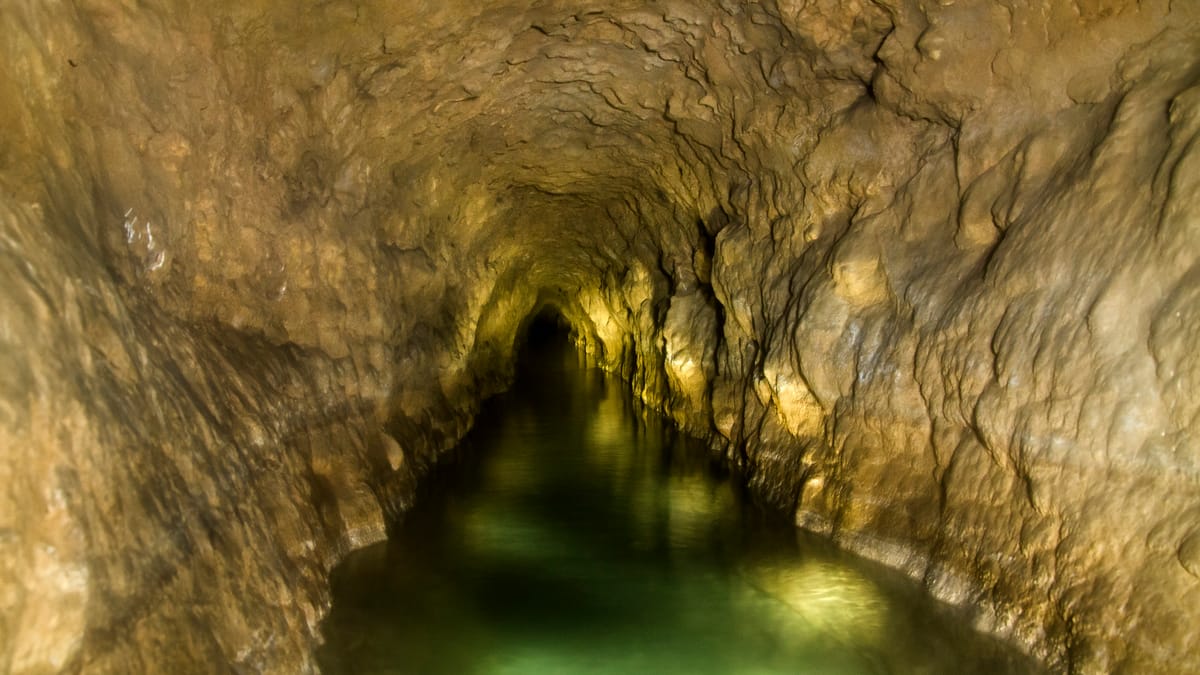
The Gonabad system is the extreme case of that investment. The Qasabeh qanat has two main branches and several subsidiary channels, drawing on a catchment of roughly 300 square kilometres, with a total tunnel length usually given as 33,113 metres and a shaft count of 427. Its tunnel is a bare hand-cut gallery, in most stretches barely wider than the shoulders of the man who dug it and only high enough to crouch or stand in — no masonry lining, no arch, just the compacted alluvium itself, which at Gonabad is firm and impermeable enough to hold its own shape and to lose almost nothing to leakage. Locally, the site is bound up with legend rather than with any king’s building inscription: it is known as the Kariz-e Kay Khosrow, the qanat of Kay Khosrow, the mythic Iranian ruler of the Shahnameh whose wars are set in this very region, and the 11th-century Persian traveller and poet Nasir Khusraw recorded that attribution as established fact in his own day. Modern writers have sometimes tried to rationalise the legend by reading Kay Khosrow as a memory of Cyrus the Great; archaeologically, the firmest handle on the date is the pottery recovered from the shafts, which points to the Achaemenid period. Around the water itself grew an entire social technology: shares of qanat flow were owned, inherited and traded, and the length of each shareholder’s turn was measured with a fenjaan, a pierced copper bowl floated in a larger vessel of water until it filled and sank — a sinking-bowl clock that in Iran is documented in use for timing qanat shares from around 500 BCE, and which at Gonabad and neighbouring Zibad remained the practical arbiter of who got water and for how long until mechanical clocks replaced it.
How Was It Built?
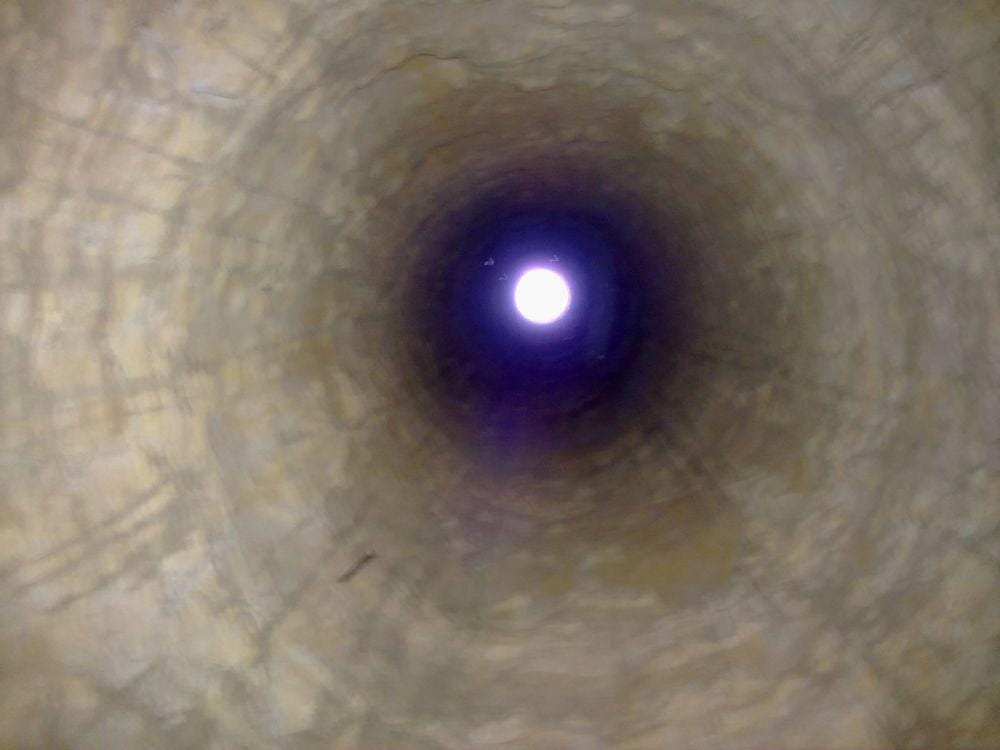
The sequence is deceptively simple to describe and brutal to execute. First the diggers — muqanni, a specialised and well-paid trade passed from father to son and organised into guilds in cities like Yazd, Kerman and Tehran — had to find the water. That meant reading the landscape at the point where the alluvial fan meets the foothills: deep-rooted vegetation, seasonal seeps, the grain of old watercourses. Then they sank trial shafts until one struck the water table. That shaft became the mother well, and at Gonabad it went down roughly 300 metres through gravel and silt — a hole about a metre across, excavated by a crew of three or four men, the spoil hauled to the surface bucket by bucket on a rope over a windlass turned at the top. The spoil was not carted away but tipped in a ring around the shaft mouth, which is why every shaft in the line is crowned by a small crater-like mound: it is waste, but it is also a deliberate lip that stops surface runoff from pouring down the shaft and silting the tunnel.
With the mother well down, the real work began, and it ran the other way. The tunnel was driven from the outlet end, far downslope, back towards the mother well, with a line of vertical shafts sunk from the surface ahead of the face at intervals of roughly 20 to 35 metres. Those shafts did three jobs at once: they gave the tunnellers air, they gave them a short vertical route to lift spoil instead of dragging it kilometres to the portal, and — critically — they gave them a fixed, surveyable point on the surface directly above the line they were supposed to be following. Digging proceeded between shaft bottoms, each new shaft acting as a target to hole through to, which is how a hand-dug tunnel tens of kilometres long stays straight without anyone ever seeing more than a few metres of it at a time. Gradient was the other half of the problem. Too steep and the water scours the unlined floor and collapses the tunnel; too shallow and it simply stops moving and silts up. Qanat galleries are therefore cut to a fall of roughly a tenth of a percent — commonly quoted as somewhere between 1:1000 and 1:1500, with the longest systems running very nearly level — and that slope was set and checked with the simplest possible instruments: strings, plumb lines and levels, measured shaft by shaft. Progress was measured in metres a day and fell away sharply with depth, from perhaps tens of metres a day in a shallow qanat to only a few metres a day once the shafts ran deep, so a system on Gonabad’s scale represents not a season’s work but years or decades of it. It was also lethal work: misreading the soil meant a roof fall, and a roof fall in a one-metre gallery hundreds of metres from the nearest shaft bottom killed the crew.
The best window onto the technique is a book written long after Gonabad was finished. Around 1017 CE the Persian mathematician and engineer Abu Bakr Muhammad al-Karaji wrote Inbat al-miyah al-khafiya, “The Extraction of Hidden Waters” — arguably the oldest surviving textbook of hydrology and hydrogeology, and a working manual for qanat construction. It covers how to find and judge groundwater, how to classify soils, how to line and protect a gallery, how to dredge and maintain it, and — most revealingly — it describes and illustrates the levelling and sighting instruments Karaji designed for setting a tunnel’s grade, complete with geometric proofs of why they work. What makes Karaji so useful is that the practices he set down in the 11th century are recognisably the same practices still used by qanat crews today, a thousand years later. The craft is astonishingly conservative. The uncomfortable corollary is that it is also, for most of its history, entirely unwritten.
The Mainstream View
Historians and hydrologists do not regard the Gonabad qanat as inexplicable, and neither should a reader. The consensus is that it is a very large, very early, and very well-preserved example of an indigenous Iranian technology whose principles are thoroughly understood: an underground gravity conduit tapping an alluvial aquifer, built with hand tools, a windlass, string and plumb line by a professional trade of tunnellers, in a state that actively subsidised such work through generational tax exemption. Its date is placed in the range of roughly 700 to 500 BCE — the late Iron Age into the Achaemenid period — on the combined evidence of pottery recovered from the shafts, the well-attested Achaemenid expansion of qanat building, and the antiquity of the settlement the qanat sustains. Its extraordinary dimensions are read not as anomalies but as consequences of local geology and need: Gonabad sits far out on a dry plain, so the tunnel had to be long; the aquifer under its fan lies very deep, so the mother well had to be deep; the surrounding alluvium is firm and nearly watertight, which is precisely why an unlined gallery of that length survives and why the discharge has stayed unusually stable for centuries. The scale is a measure of how much water was worth, not evidence of unknown technique. Modern hydrogeological work on the Gonabad plain treats the qanat as what it is — a functioning piece of infrastructure — and studies of its hydrograph over recent decades show its discharge declining in step with groundwater drawdown caused by modern pumped wells, which is to say the greatest threat this 2,500-year-old system has ever faced is the twentieth-century borehole, not the passage of time.
The Open Case
What stays open at Gonabad is not whether people could dig it — they plainly did, and their descendants still dredge it — but how exactly, and exactly when. The oldest surviving account of how to build a qanat, Karaji’s manual, was written around 1,500 years after Gonabad was cut; everything we say about how these particular diggers found their line, set their fall, and coordinated 427 shafts over 33 kilometres is reasoning backwards from a later, living craft to an Iron Age one, and there is no Achaemenid text, plan or inscription from Gonabad itself to check it against. The dating rests on pottery from the shafts and on the general context of Achaemenid qanat expansion, not on excavation of the tunnel’s construction horizons, and the attribution to a legendary king is folklore recorded a millennium and a half after the fact; even the basic figures shift between sources, with the widely repeated 33,113 metres and 427 shafts and 300-metre mother well sitting alongside other published claims of a system some 45 kilometres long and a main well past 360 metres. Nor is it settled whether a qanat like this was conceived and driven as a single vast project or grew by accretion, branch after branch, generation after generation, with later crews extending, deepening and rejoining what earlier ones left — a question that matters, because the two answers describe two completely different kinds of society. Even the ancestry of the technique is contested: the mainstream view places the qanat’s invention on the Iranian plateau in the early first millennium BCE, but the earliest hard reference is Sargon II’s Assyrian account of finding the method in the highlands of what is now northwestern Iran, and a minority argument points instead to southeastern Arabia as an independent or earlier origin. And then there is the thing that no amount of documentation would make ordinary. Somewhere out on that plain, a crew of three or four men went down a hole roughly a metre wide, dropped it the height of the Eiffel Tower into the dark, and then — working by lamplight in a gallery they could not stand upright in, breathing air delivered down a shaft behind them, guided by nothing but a string, a plumb bob and the next disc of daylight ahead — cut their way back to the surface for 33 kilometres, missing their grade by no more than a fraction of a percent over the entire distance. They got it right. The water has been running ever since.
Sources
- Wikipedia — Qanats of Ghasabeh
- UNESCO World Heritage List — The Persian Qanat (ref. 1506)
- Wikipedia — Qanat
- WaterHistory.org — Qanats (background, construction and diffusion)
- World History Encyclopedia — Qanat
- Hydrology and Earth System Sciences — The millennium-old hydrogeology textbook 'The Extraction of Hidden Waters' by Abubakr Mohammad Karaji
- Journal of Hydrogeology (Univ. of Tabriz) — Hydrogeological Assessment of the Gonabad Plain Qanats
- achaemenid-empire
- iran
- qanat
- underground-aqueduct
- water-engineering
- irrigation
- tunnelling
- iron-age
- unesco-world-heritage
- persian-engineering
Gallery