Pyramids of Meroë
A powerful, literate African kingdom raised nearly 200 steep-sided pyramids in the Nubian desert over six centuries — so why does this vast royal necropolis remain so little known next to Egypt's, and what does it really take to understand how the Kushites built, and why they built, on this scale?
Why this rating?
- Construction difficulty
- 2/5
- Method uncertainty
- 3/5
- Capability gap
- 2/5
- Open questions
- 3/5
Kushite builders raised smaller, steep-sided sandstone pyramids using ramps and lever devices well within demonstrated Iron Age capability, and the overall construction sequence is well attested even without a surviving Kushite engineering text. The larger open questions are philological and historical rather than structural: the Meroitic language remains only partly deciphered, leaving much of the Kushites' own record of their kings and building projects still unread.
Overview
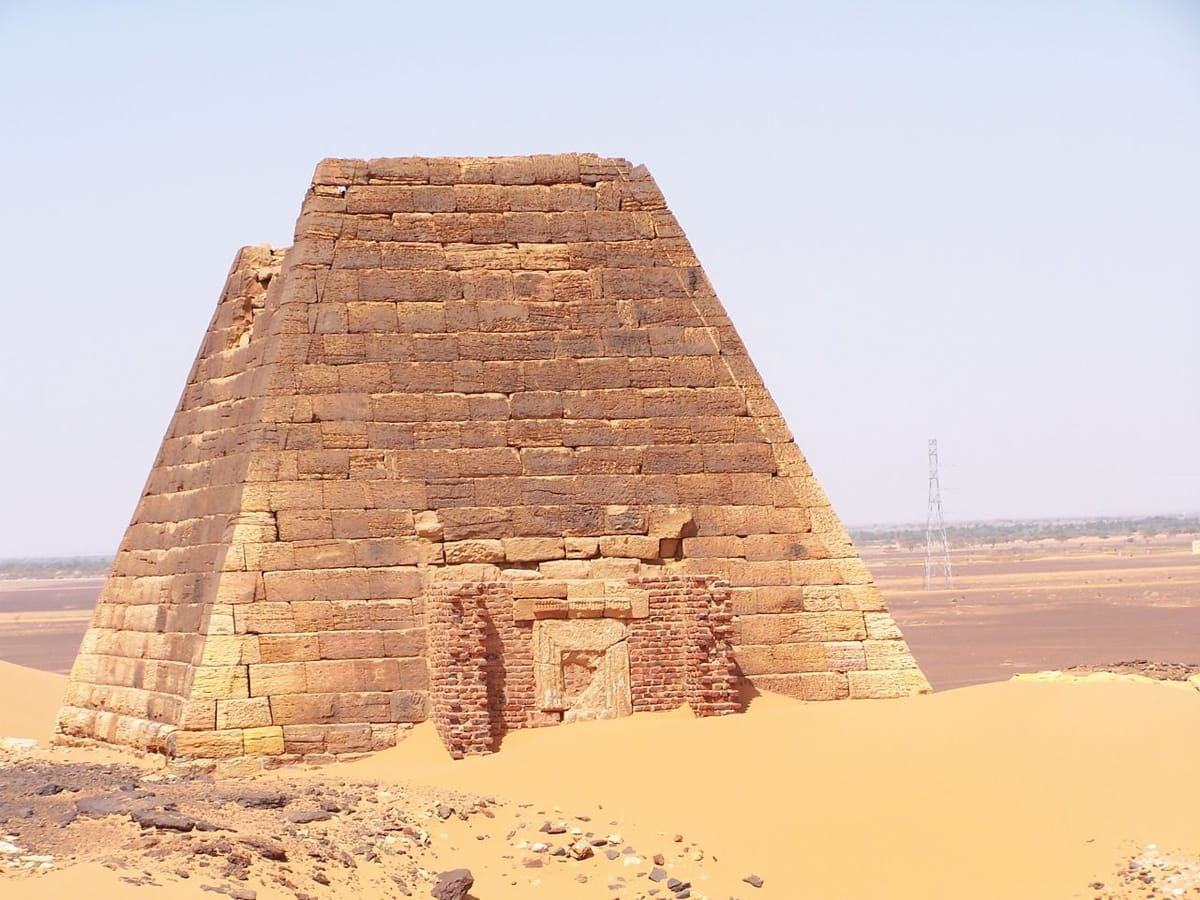
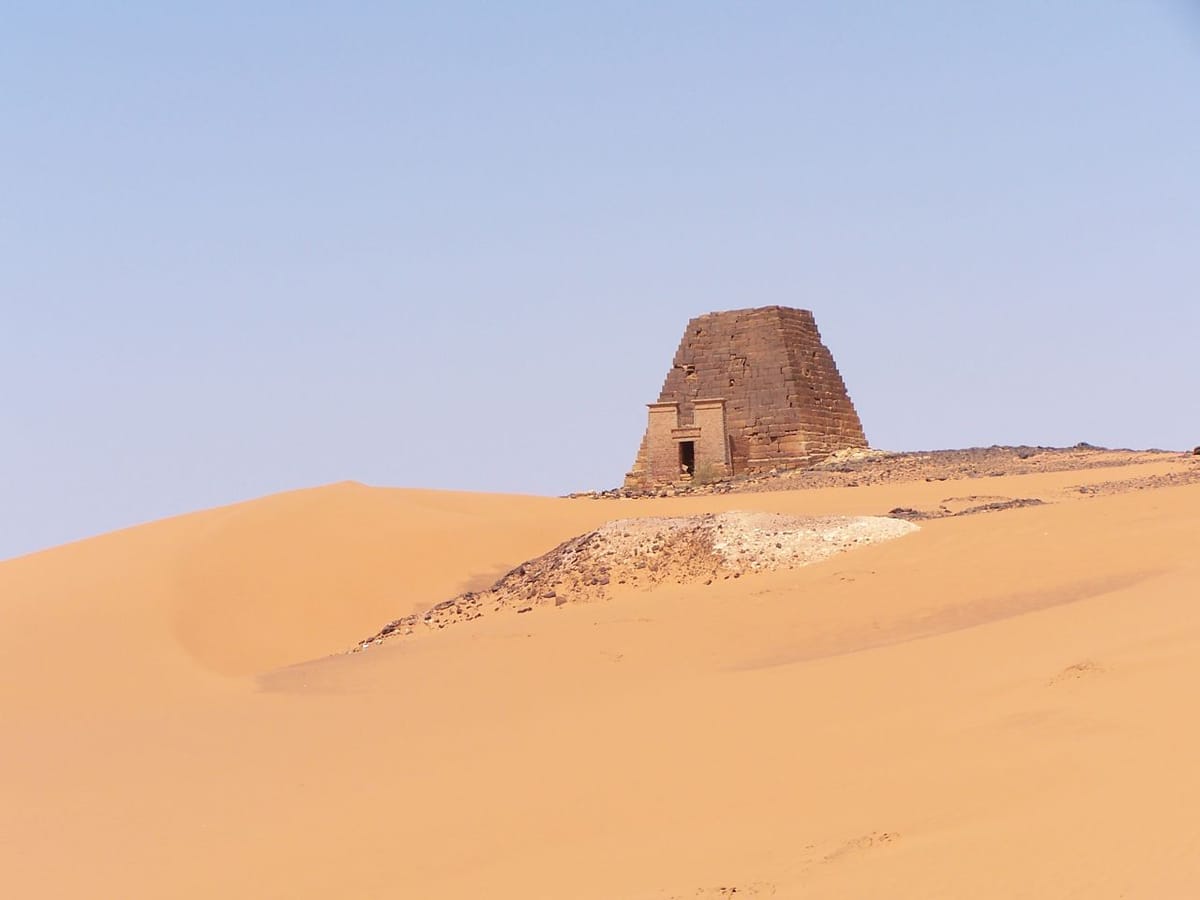
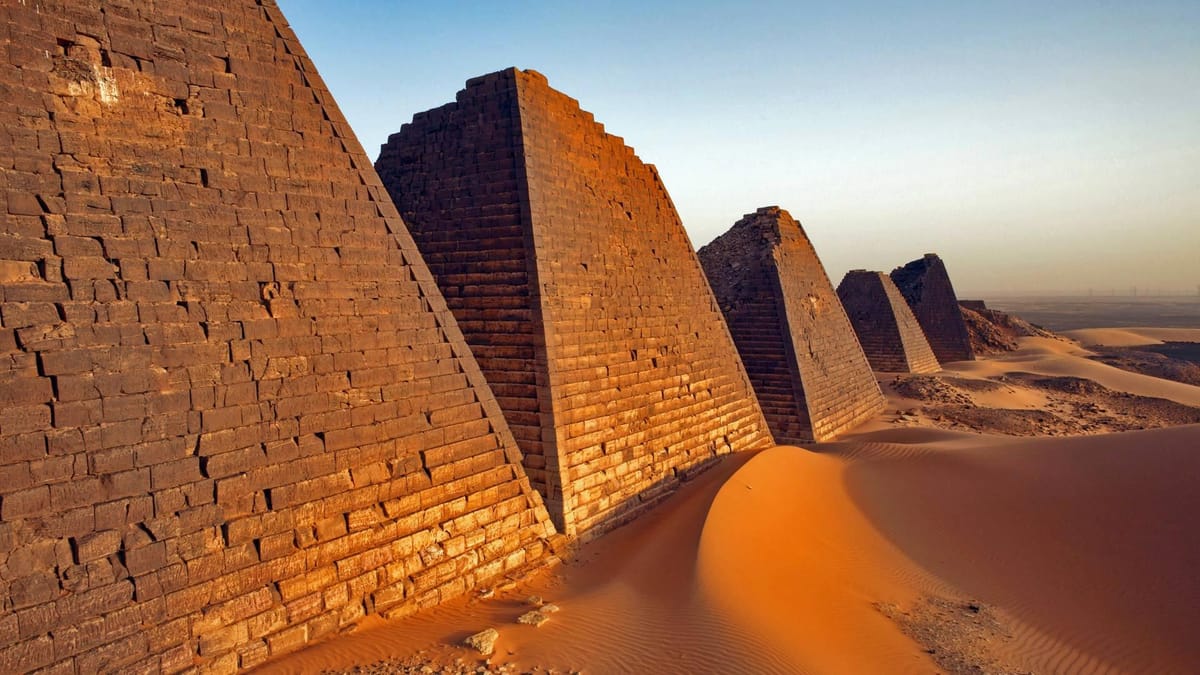
Rising from the desert on the east bank of the Nile, some 200 kilometres northeast of modern Khartoum, the pyramids of Meroë are the largest field of pyramids in the world by count — nearly 200 of them, more than in all of Egypt. They are the royal cemeteries of the Kingdom of Kush, a Nubian civilization centered on the city of Meroë from roughly the 3rd century BCE to the 4th century CE, and they were built to entomb Kushite kings, queens (several of whom, called Candaces, ruled in their own right), and high officials. Far smaller than Egypt’s Old Kingdom pyramids but far more numerous, Meroë’s pyramids are also visibly distinct: steep-sided, generally under 30 metres tall, faced in dressed sandstone, and fronted by a small decorated chapel rather than standing alone. Long overshadowed in popular imagination by Giza, the site was inscribed as a UNESCO World Heritage property in 2011 (as part of the “Archaeological Sites of the Island of Meroe,” alongside the temple sites of Naqa and Musawwarat es-Sufra) precisely because it represents, in the UNESCO’s own words, one of the best-preserved records of the Kushite civilization that “shaped the political, religious, social, artistic and technological scene of the Middle and Northern Nile Valley for more than 1,000 years.”
The Structure
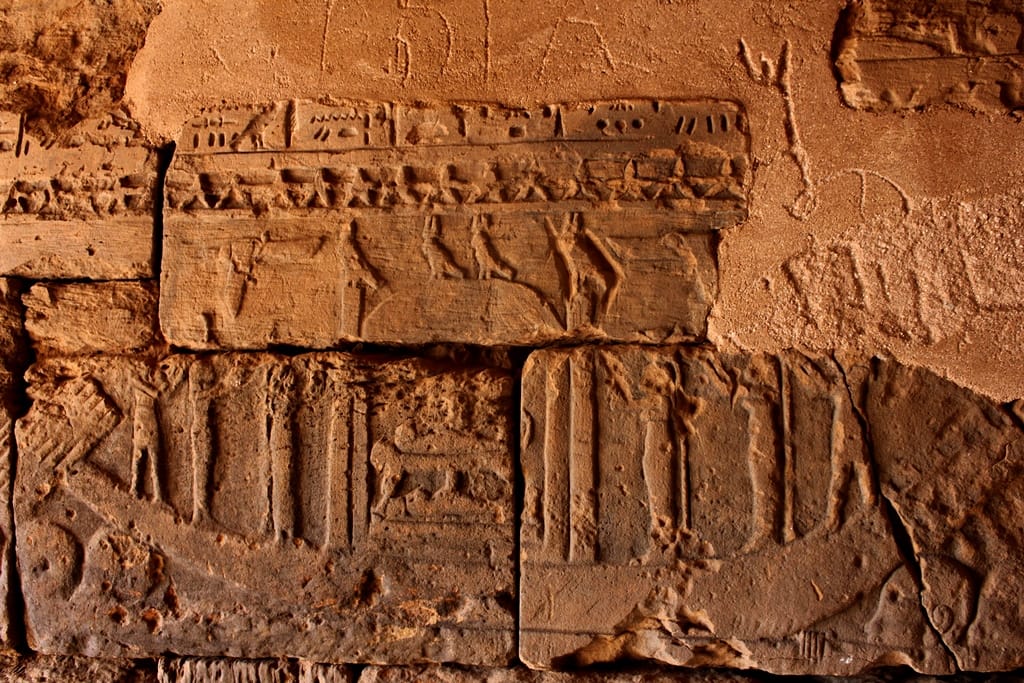
The Kingdom of Kush had deep, tangled roots with Egypt: Kushite kings conquered and ruled Egypt outright as its 25th Dynasty in the 8th-7th centuries BCE, and for centuries afterward Kushite royal culture borrowed heavily from Egyptian religion, iconography, and (initially) burial practice. The kingdom’s political center moved south over time — from Kerma, to Napata, and by around 270 BCE to Meroë itself, likely driven by shifts in trade routes, resources, and possibly a deteriorating environment further north. Meroë then flourished as the Kushite capital for some 600 years, built on a wealthy iron-smelting and trading economy that linked inland Africa to the Red Sea and, through it, to the wider ancient world; the kingdom was strong enough to fight and then negotiate a favorable peace treaty with the Roman Empire under Augustus after a war in the 20s BCE. Its rulers developed their own script, Meroitic, replacing Egyptian hieroglyphs for monumental inscriptions — a writing system whose signs can be sounded out but whose language is still only partly understood by modern scholars, which limits how much of Kushite history can be read directly from its own written record.
Royal and elite burials at Meroë form two main clusters, generally called the Northern and Southern cemeteries (plus a smaller Western cemetery used mostly for lesser royalty and officials), together comprising roughly 200 pyramids built between about 300 BCE and 350 CE, the earliest securely attributed to King Arkamaniqo (Ergamenes) around the late 3rd century BCE. Each pyramid complex follows a consistent plan: a steep-sided sandstone pyramid, its faces rising at roughly 70 degrees (much sharper than the low, broad angle of Egypt’s Giza pyramids) and usually cut off flat rather than coming to a sharp point; a small mortuary chapel attached to the pyramid’s east face, often decorated with painted or carved relief scenes of the deceased before Egyptian-derived funerary deities; and, beneath it all, one or more rock-cut burial chambers reached by a stairway or shaft, where the dead were interred with jewelry, pottery, furniture, and other grave goods. The pyramids’ relatively modest size compared to Egypt’s — rarely reaching 30 metres — reflects both a genuinely different aesthetic tradition and practical limits: Kushite masons built with smaller, more manageable dressed stone blocks rather than the Old Kingdom’s colossal cores.
How Was It Built?
Kushite builders worked with locally available sandstone, quarried and dressed into blocks that were laid up in courses around a core, typically of rubble and mortar-set masonry, faced with finer dressed stone or, in some later examples, brick finished with painted plaster. Their steep, narrow profile meant far less material and far less labor were needed than for an Egyptian pyramid of comparable base size — a practical reason a single royal workforce could raise dozens of these monuments across six centuries rather than a handful of enormous ones. Ramps and simple lifting devices, such as a shaduf-like lever arrangement, are the methods generally proposed for raising blocks into place, extrapolated from surviving construction traces and from broader Nile-valley building practice rather than from any surviving Kushite engineering text — the Kushites, unlike the Egyptians, left no detailed contemporary account of how their pyramids were built. What is well attested is the overall sequence: the underground burial chambers were cut and used first, the pyramid was built up above and around them afterward, and the offering chapel against its eastern face was finished last, ready to receive the ongoing funerary cult of the buried ruler.
The Mainstream View
Archaeologists and historians treat the pyramids of Meroë as, straightforwardly, the funerary monuments of the Kushite royal house — a conclusion resting on abundant, mutually reinforcing evidence rather than inference from silence. Excavated burial goods, Meroitic inscriptions naming specific kings and queens, chapel reliefs depicting Kushite rulers in recognizable royal regalia, and the clear architectural evolution of the pyramid form across the site’s 600-year span all tie the monuments firmly to the kingdom that is independently known, from Egyptian, Roman, and Kushite sources alike, to have ruled this stretch of the Middle Nile. Scholars read the pyramids’ design — steep, compact, chapel-fronted, built in sandstone rather than limestone or granite masses — as a distinctive Kushite adaptation of an Egyptian funerary tradition the kingdom had absorbed centuries earlier and then made its own, not a lesser copy of it. The kingdom’s decline in the 4th century CE, and the abandonment of Meroë not long after, is generally linked to some combination of environmental strain from long-term overgrazing, disruption of the trade networks the kingdom depended on, and military pressure culminating in a raid by the rival kingdom of Aksum around 330 CE — though, as with many ancient collapses, scholars still debate how these factors interacted.
The Open Case
Meroë’s genuine mysteries lie in what has been lost, not in who built it. The Meroitic script has been readable — its individual signs and their sounds are known — since the early 20th century, but the Meroitic language itself remains only partly deciphered, meaning huge amounts of the Kushites’ own testimony about their kings, their beliefs, and their building projects still cannot be fully read; this is an active field of ongoing linguistic research, not a closed book. The precise organization of the labor and engineering behind six centuries of pyramid-building — how work crews, quarrying, and design were coordinated across dozens of reigns — is reconstructed from architecture and comparative practice rather than from a surviving Kushite building record. And the site itself is a monument to loss as much as to achievement: in 1834 the Italian adventurer Giuseppe Ferlini, searching for gold, dismantled the tops of more than 40 pyramids, destroying or badly damaging monuments that had stood for close to two thousand years in order to strip the treasure of Queen Amanishakheto’s tomb (jewelry now split between museums in Berlin and Munich). None of this is evidence of impossible engineering or a vanished non-human hand — Kushite sandstone construction, ramps, and lever devices are well within the demonstrated capability of an Iron Age state with organized labor and centuries of Nile Valley building tradition to draw on. The real, unresolved wonder is more sobering and more human: how a civilization this rich, this literate, and this consequential — one that ruled Egypt itself and fought Rome to a standstill — came to be so overshadowed in the popular imagination by its northern neighbor, and how much of its own voice, recorded in a script we can still only partly read, remains to be recovered.
Sources
On screen
- The Pyramids You Command — In 0 A.D., you can build the pyramid field of Kush yourself, one monument at a time.
Gallery