Pyramid of the Sun
Who exactly were the Teotihuacanos who raised the third-largest pyramid on Earth over a sacred cave, and what did that cave, and the massive planned city built around it, actually mean to the people who never left a name we can read?
Why this rating?
- Construction difficulty
- 3/5
- Method uncertainty
- 2/5
- Capability gap
- 2/5
- Open questions
- 4/5
The pyramid's roughly one million cubic meters of adobe and rubble were raised with well-understood tamping-and-layering earthwork techniques requiring organized labor rather than exotic engineering, so how it was physically built is not seriously in doubt. What remains genuinely open is who the Teotihuacanos were, since no deciphered writing survives to identify their language or ethnicity, plus the meaning of the sacred cave beneath the pyramid and how the city's government actually functioned.
Overview
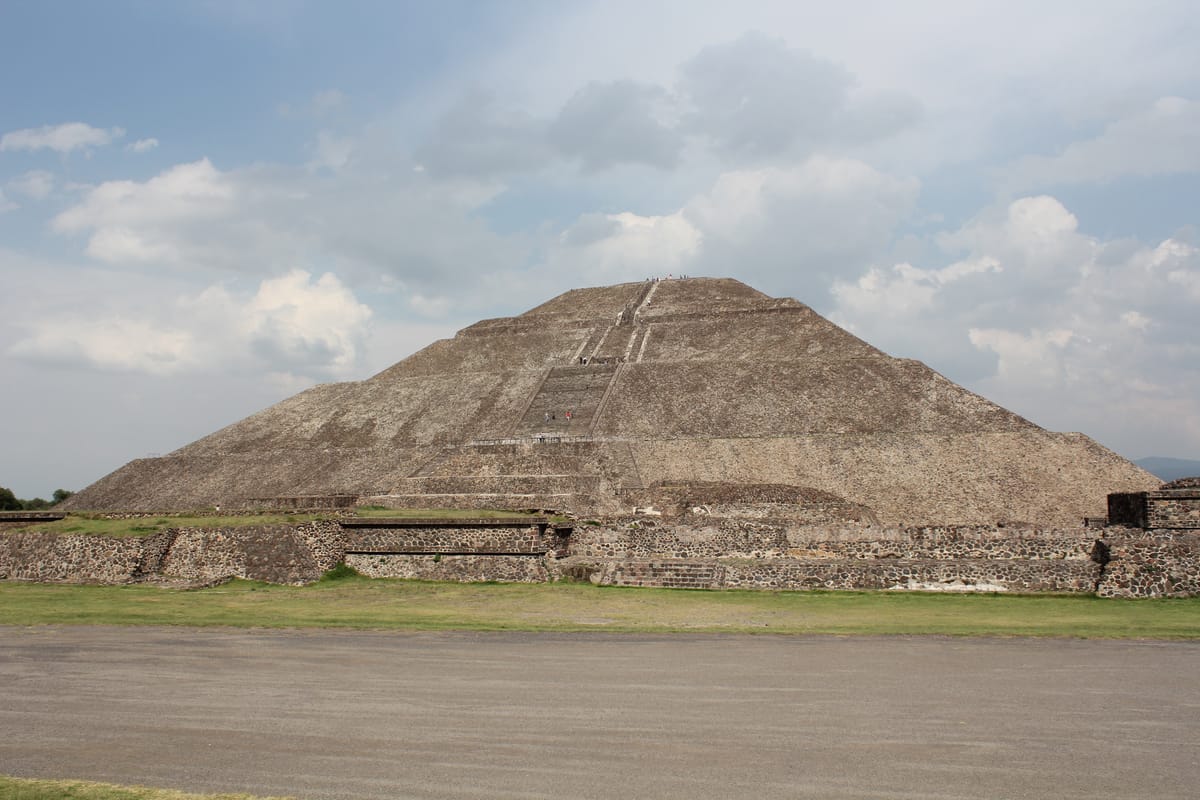
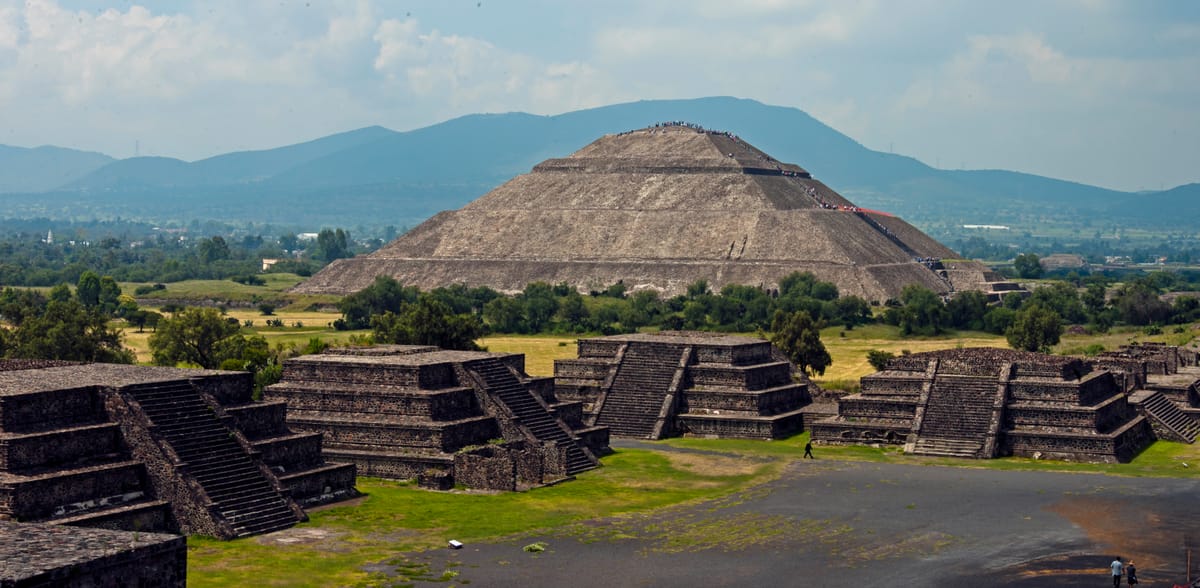
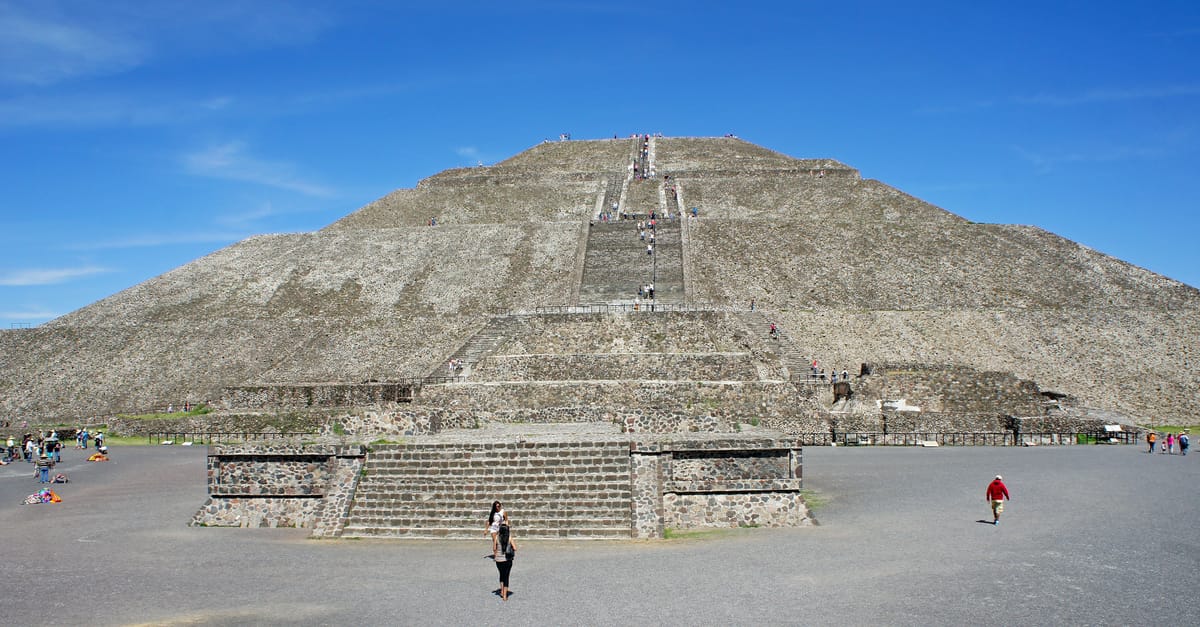
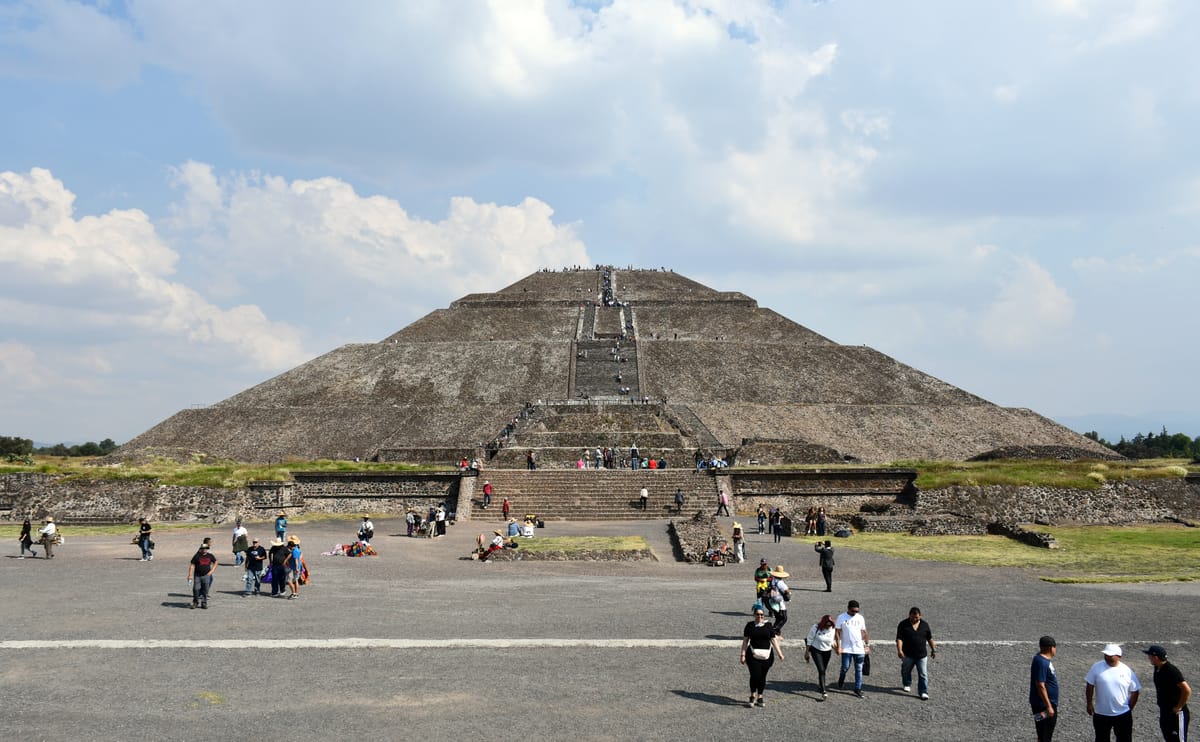
The Pyramid of the Sun is the largest structure at Teotihuacan, an ancient city in the Basin of Mexico roughly 40 kilometers northeast of modern Mexico City. Standing about 65 meters tall with a base measuring roughly 220 meters on each side, it is the third-largest pyramid on Earth by volume, behind only the Great Pyramid of Cholula and the Great Pyramid of Giza — and one of the largest buildings anywhere in the pre-Columbian Americas. It was raised mainly during the first two centuries CE, roughly 100-250 CE, by the civilization now known as the Teotihuacanos, at the heart of a planned metropolis that would eventually become one of the largest cities in the world. Neither “Pyramid of the Sun” nor “Teotihuacan” nor “Avenue of the Dead” are names the builders left behind: they were given centuries later by the Aztecs, who found the city already ancient and abandoned when they arrived, and who revered its ruins as sacred ground. Teotihuacan was inscribed by UNESCO as a World Heritage Site in 1987.
The Structure
The pyramid rises in a stepped, terraced profile along the Avenue of the Dead, the roughly 2-kilometer ceremonial axis that anchors the city’s grid, facing the smaller Pyramid of the Moon at one end and the sprawling Ciudadela complex at the other. Its core is built up from an estimated one million cubic meters of adobe (mud brick) and rubble fill, raised in at least two major construction stages and faced with cut stone that was originally covered in lime plaster and painted with murals in mineral pigments — almost none of which survives today, leaving the bare stone and adobe core exposed. A stairway of some 240-odd steps climbs the western face to what was once a temple platform at the summit, now gone. Most significantly, the pyramid was built directly over a natural cave, later extended by human tunneling into a passage roughly 100 meters long terminating in a multi-chambered cavity beneath the pyramid’s center — and the entire monument’s axis appears to have been oriented to align with this cave from the very beginning of construction, suggesting the cavern, not just the mountain-like mass above it, was the original reason this precise spot was chosen as sacred ground.
How Was It Built?
Archaeologists have a reasonably clear picture of the physical construction process, even where the social organization behind it remains debated. The pyramid’s builders quarried and hauled an estimated one million cubic meters of earth, sun-dried mudbrick, and rubble, tamping and layering it into a stable stepped core without the use of metal tools, wheeled vehicles, or draft animals — none of which were available in Mesoamerica at the time. This core was then faced with cut volcanic stone (largely tezontle and other local rock) set to hold the plaster and paint applied over the top, a technique that gave the finished pyramid a smooth, brilliantly colored exterior very different from the weathered stone visible today. Radiocarbon dating of construction fill and stratigraphic excavation, led by archaeologists including Rubén Cabrera Castro and Saburo Sugiyama, place the bulk of construction within the first two centuries CE, with the pyramid reaching close to its present size in an initial building phase before later modification. This was a mobilization of labor and material on an enormous scale, implying a society capable of organizing thousands of workers, and of provisioning and directing them over a sustained building program, even though no monumental inscriptions naming a ruler or dynasty, of the kind common in Egypt or among the later Maya, have ever been found at the site.
The Mainstream View
Mainstream Mesoamerican archaeology treats Teotihuacan as the deliberate creation of a large, sophisticated, and highly organized society — not a mystery civilization or a lost outside influence. The city was laid out on a rigid grid oriented to specific astronomical alignments, with the Pyramid of the Sun, the Pyramid of the Moon, and the Ciudadela positioned as fixed points along the Avenue of the Dead; this is the signature of centralized urban planning executed over generations, not an accident of organic growth. At its height, probably around 450-500 CE, Teotihuacan covered more than 20 square kilometers and may have housed 100,000 to 200,000 people, making it one of the largest cities in the world at the time, with a diverse population that included immigrants from the Oaxaca Valley, the Gulf Coast, and the Maya region, evident in distinct residential compounds and imported artifacts found across the city. Construction techniques, materials, and building sequences are well documented archaeologically, and the city’s enormous economic reach — Teotihuacan obsidian tools and its wares have turned up as far away as Maya centers hundreds of kilometers south — is not in question. What is genuinely unresolved, and openly debated among specialists, is the precise ethnic and linguistic identity of the Teotihuacanos, since the civilization predates and is distinct from the Aztecs who later named the site, and the exact structure of Teotihuacan’s government, which shows less evidence of a single all-powerful ruler than most other major Mesoamerican capitals.
The Open Case
Three questions remain genuinely open, and none of them require abandoning the mainstream picture of a real, technically accomplished Mesoamerican civilization. First is identity: no deciphered writing system survives from Teotihuacan, so scholars cannot say with confidence which language its people spoke or which single ethnic group, if any, dominated the city — proposals have included Nahua, Otomi, Totonac, Zapotec, and Mixtec-speaking populations, and the balance of evidence points toward a genuinely multi-ethnic metropolis rather than one people ruling over the rest. Second is the cave: its central role in the pyramid’s placement is well established archaeologically, but exactly what rites were performed there, and whether the man-made chamber discovered six meters below the pyramid’s core functioned as a royal tomb, a portal in a creation myth, a water-and-fertility shrine, or something else entirely, remains a matter of interpretation rather than settled fact. Third is governance and collapse: how a city this large — with no clear central palace or ruler’s tomb of the kind found at contemporary sites — organized labor, resources, and authority is still debated, and its eventual decline, marked by the burning of major civic buildings along the Avenue of the Dead around 550 CE and likely worsened by drought and climate disruption, is still being pieced together from excavation rather than text. These are the real open questions: not whether people built the Pyramid of the Sun, but which people, and what the mountain they raised over a sacred cave meant to them.
Sources
On screen
- The Pyramid You Can Drive To — In Forza Horizon 5's open-world Mexico, the third-largest pyramid on Earth is a place you can just pull up to.
Gallery