The Osirion at Abydos
Why did the builders of a delicate limestone temple raise, directly behind it, a stark megalithic hall of hundred-tonne granite sunk to the water table around a stone island — and does its archaic, 'cyclopean' style really mean it is older than the New Kingdom?
Why this rating?
- Construction difficulty
- 4/5
- Method uncertainty
- 3/5
- Capability gap
- 2/5
- Open questions
- 3/5
The Osirion is a genuine engineering feat: red granite members weighing many tens of tonnes — the largest estimated near a hundred — were quarried at Aswan, floated hundreds of kilometres downriver, and set into a pit cut below the water table, all while managing groundwater. That is harder than the ordinary limestone temple in front of it, hence the high construction score. But nothing here lies beyond attested New Kingdom capability (Egyptians moved far larger obelisks and colossi), so the capability gap is modest. The methods are broadly known yet the specifics — exactly how the biggest blocks were transported and lowered, and how the water table was managed during building — remain debated, and the deliberate archaizing 'cyclopean' style, together with a historically contested date, keeps a real cluster of open questions. It is not an out-of-place artifact; it is an unusually stark, ambitious, and puzzling monument.
Overview
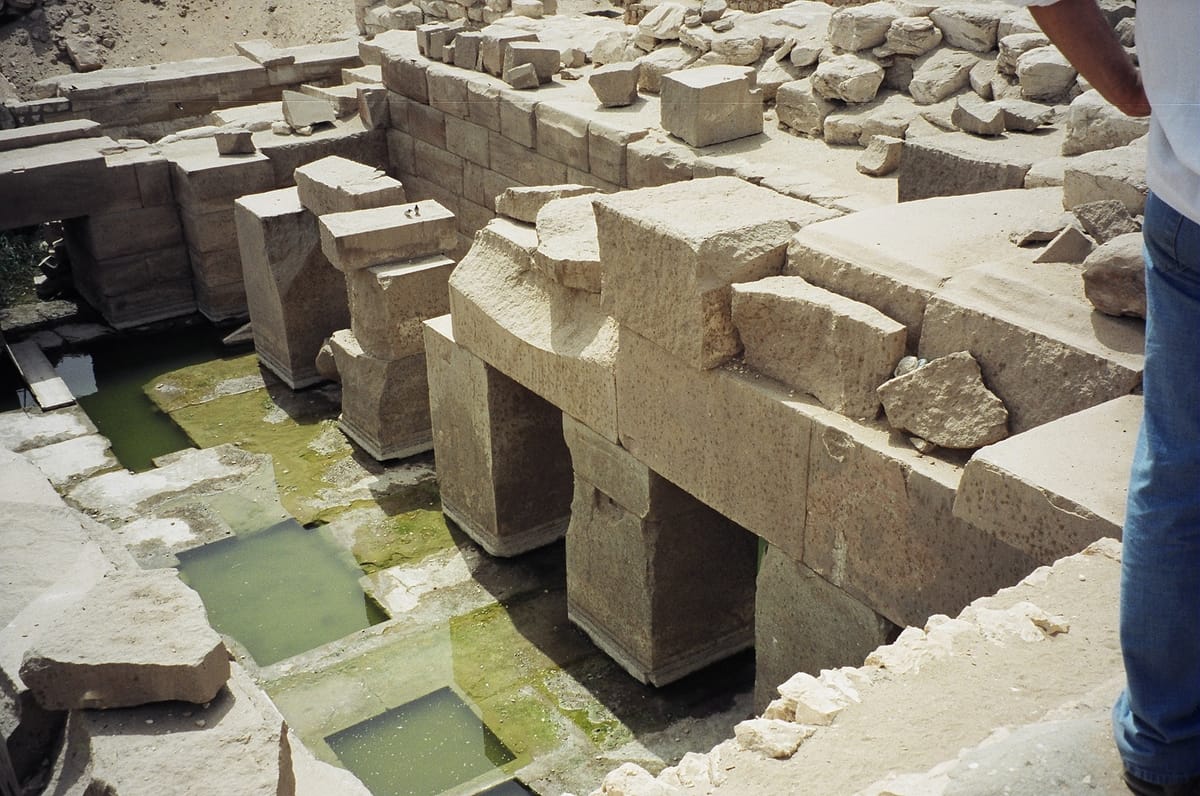
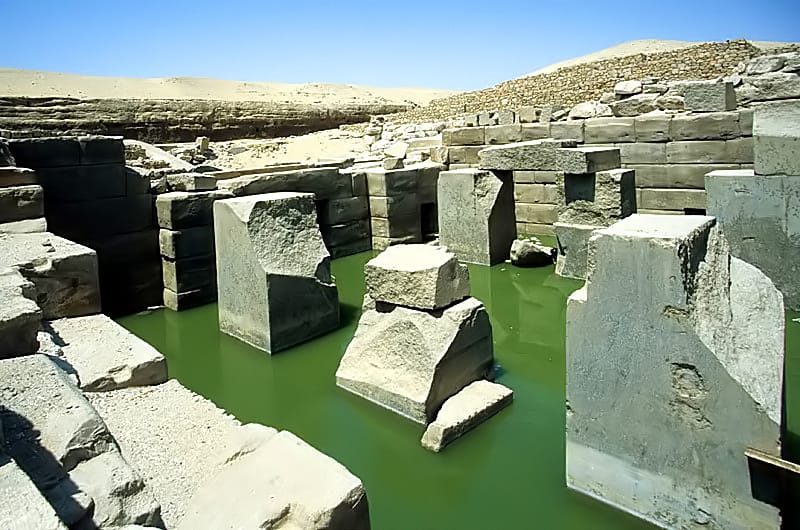
The Osirion — also spelled Osireion — is one of the strangest structures in all of Egypt, and it hides in plain sight. It lies immediately behind the celebrated Temple of Seti I at Abydos, in the desert margin west of the Nile in the modern Sohag Governorate of Upper Egypt. Where the temple in front of it is a masterpiece of delicate painted limestone relief, the Osirion is its opposite in almost every respect: a partly subterranean hall built of colossal, plain, austere blocks of red granite, sunk deep into the ground until it reached the water table, and today permanently half-flooded with green groundwater. A visitor who has just walked through the exquisite chapels of Seti’s temple steps out the back and finds something that looks like it belongs to a different, harsher world.
Abydos is the reason it is here. For most of ancient Egyptian history Abydos was the great cult center of Osiris, the god of death, resurrection, and the afterlife, and one of the holiest pilgrimage destinations in the country. The early kings of Egypt were buried in the desert nearby at Umm el-Qa’ab, and by the New Kingdom one of those First Dynasty tombs had come to be venerated as the very tomb of Osiris himself. Every pious Egyptian hoped to visit Abydos, or at least to be symbolically carried past it, on the journey to the west. In that intensely sacred landscape, the Osirion was conceived as a cenotaph — a symbolic “false tomb” — of Osiris, a monument that re-enacted in stone and water the myth of the god’s death and rebirth. The pharaoh Seti I, who built it, thereby bound his own name and afterlife to the resurrection of Osiris.
What makes the Osirion a genuine puzzle, rather than merely an unusual building, is its style. Its massive, unadorned masonry looks archaic — closer to the plain granite architecture of the Old Kingdom, a thousand years earlier, than to the ornate work of Seti’s own age. That archaism was striking enough that some of its earliest excavators wondered whether it might be far older than the New Kingdom, and in the twentieth century fringe writers seized on the idea to claim a lost civilization. The mainstream answer is now clear, and it is anchored in the pharaoh’s own inscriptions. But the answer only sharpens the real questions: why build in so deliberately archaic a manner, and how was a hall of hundred-tonne granite raised at the water table at all?
The Structure
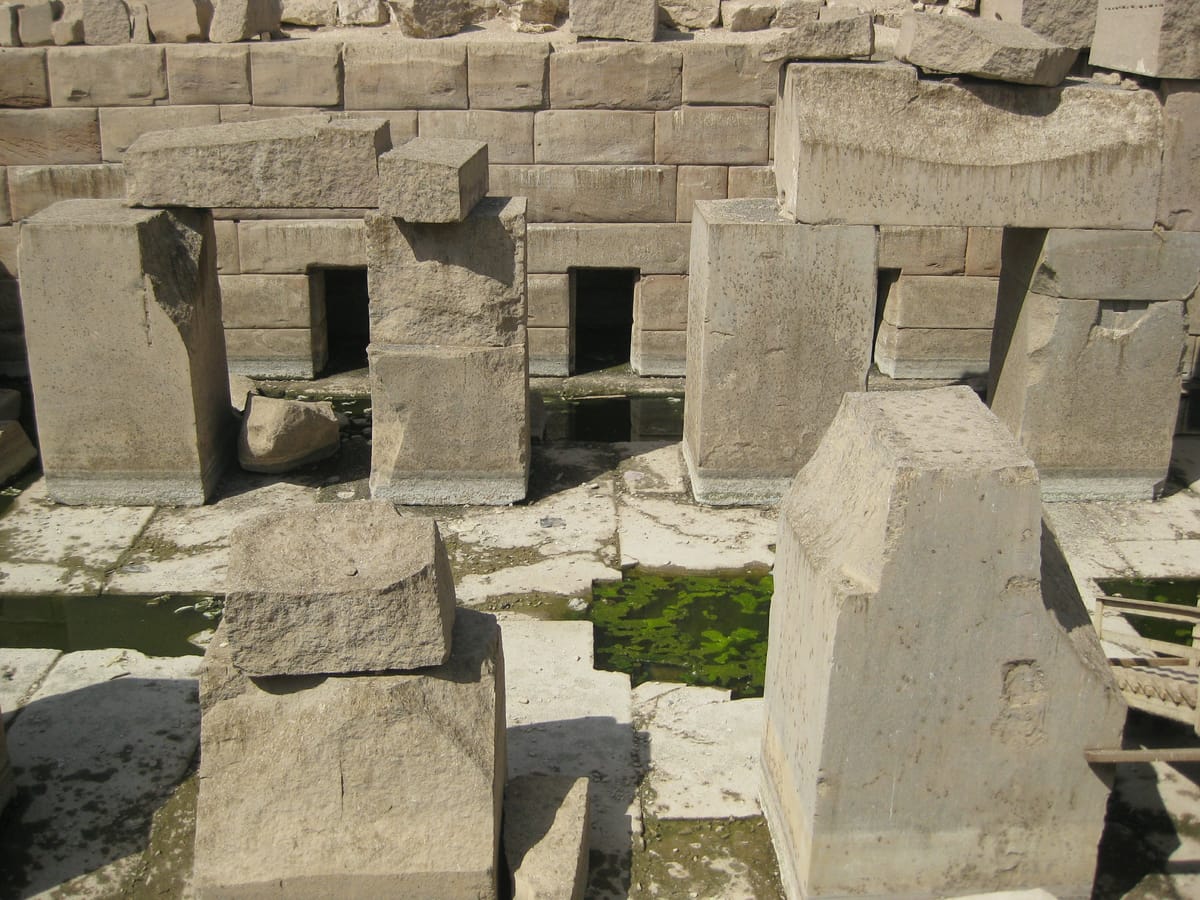
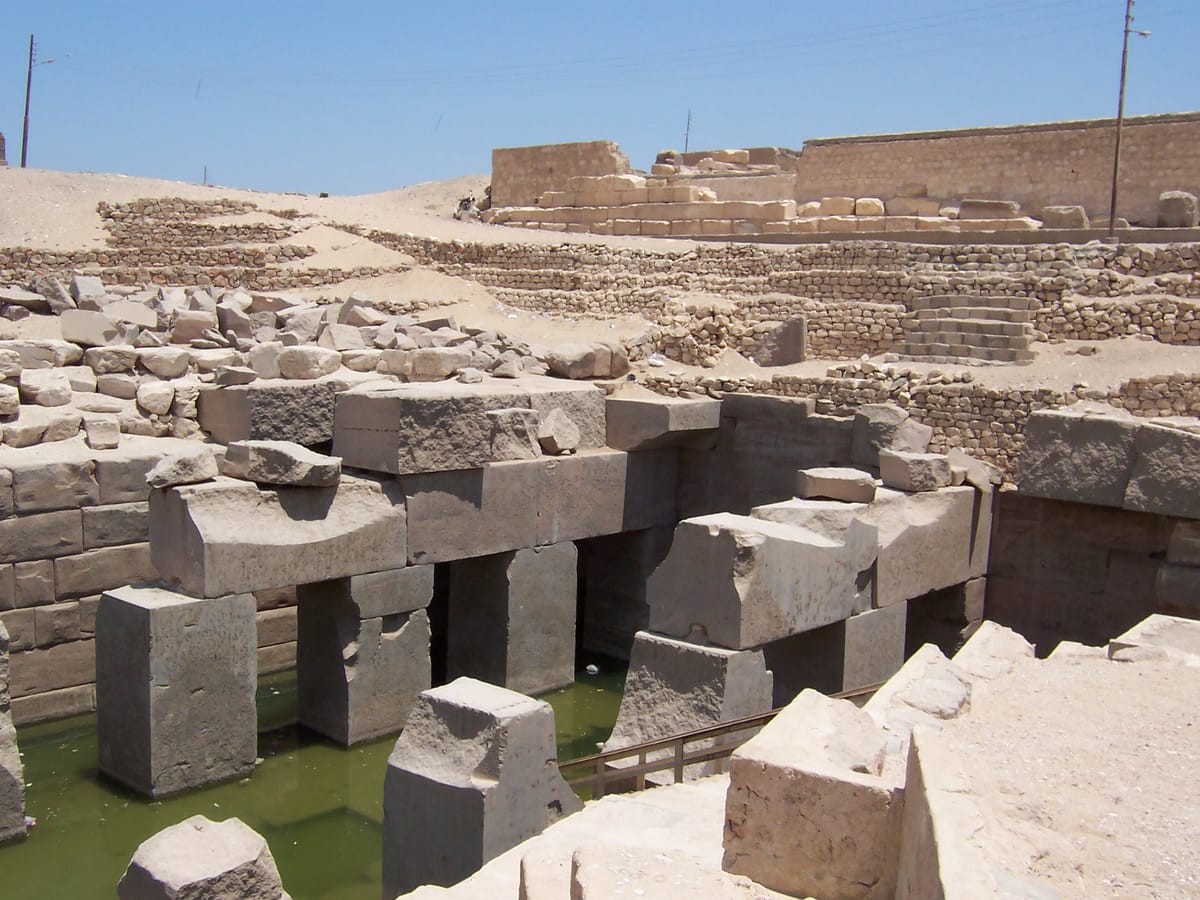
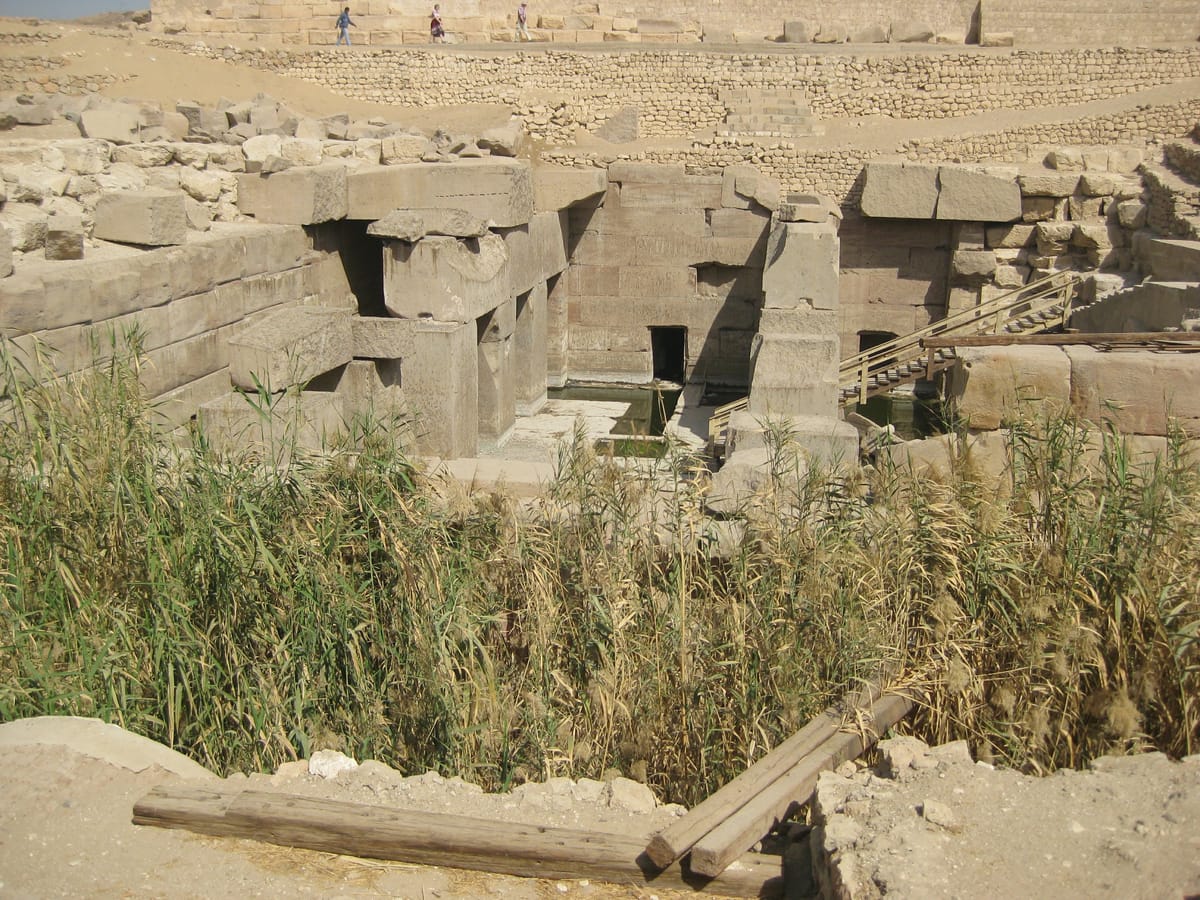
The Osirion is laid out as a great rectangular hall with a long entrance passage, the whole thing dug down well below the surrounding desert floor. The central hall measures roughly 30 metres long by about 12 metres wide. Its heart is a raised rectangular platform of sandstone masonry — the “island” — which once carried the roof on ten enormous red granite pillars, each on the order of 2.6 metres across, paired with equally massive granite lintels and roofing beams laid across them without mortar. The pillars and beams are the largest elements in the building; individual granite members weigh many tens of tonnes, and the largest blocks have been estimated at close to a hundred tonnes. The whole central ensemble is post-and-lintel construction of the plainest, heaviest kind, utterly without the carved columns, capitals, and painted scenes of a normal Egyptian temple.
The defining feature is water. The island is surrounded on all sides by a channel or moat, and the floor of that channel was cut down to the level of the local water table, so that the central platform sits like an island ringed by water — a deliberate evocation of the primeval mound, the first dry land that rose from the waters of chaos at the moment of creation in Egyptian cosmology, and the mythic setting of the resurrection of Osiris. Two symbolic staircases descend, one at each end of the island’s long axis, into the water. Around the outer walls of the hall runs a ring of seventeen small cells or chambers, cut doorless into the surrounding masonry, whose exact ritual purpose is uncertain. When the ancient Greek geographer Strabo visited in the first century BCE he already described a “fountain which lies at a great depth,” reached through “vaulted galleries made of monoliths of surprising size” — the structure was flooded even then, as it is now.
The hall was reached by a long, stone-lined entrance passage, running about 69 metres and entered from outside the northern wall of Seti’s temple, with a sharp turn partway along. Beyond the main hall, to the east, lies a transverse chamber that is among the best preserved parts of the monument. Its decoration matters, because it is where the building speaks. The entrance passage was carved with scenes from the Book of Gates, one of the great New Kingdom funerary “guidebooks” to the underworld; the transverse halls carry scenes from the Book of the Dead together with mythological and astronomical imagery, including a finely carved figure of the sky-goddess Nut arched and supported by the air-god Shu, with the decans — the star-groups that marked the hours of the night — set out beside her. This is the standard funerary literature of a royal tomb, transplanted into a cenotaph of Osiris.
How Was It Built?
The building of the Osirion divides into two very different problems: the ordinary limestone-and-sandstone shell, and the extraordinary granite core.
The granite is the hard part, in every sense. Red (Aswan) granite is far harder than the limestone and sandstone of most Egyptian temples, and it could only be quarried at Aswan, several hundred kilometres upstream. Detaching pillars and beams of this size, dressing them, and moving them meant the full apparatus of Egyptian heavy engineering: pounding and splitting the stone in the quarry with dolerite hammers and wedges, dragging the blocks on sledges to the river, floating them downstream by barge during or after the annual inundation, and then hauling them on ramps and sledges to the site to be levered into position without mortar. None of this was new — the Egyptians had been quarrying and raising Aswan granite for obelisks, sarcophagi, and colossal statues since the Old Kingdom, and would later raise single obelisks far heavier than any block in the Osirion — but assembling a whole roofed hall from such members was a major undertaking even by New Kingdom standards.
Then there is the water. The builders did not stumble onto groundwater by accident; they deliberately cut the structure down until they reached it, because the flooded channel around the island was the point — it is what turns a stone platform into the primeval mound. But building at the water table is awkward. The lower courses had to be laid, and the heavy granite set, in a pit that wanted to fill with water, which implies some management of the groundwater during construction and careful sequencing of the work. The masonry that survives shows real care: the enormous blocks are closely fitted and rely on their own weight rather than mortar. The overall impression is of a monument built downward, into the earth and the water, rather than upward into the light — the inverse of a normal temple, and appropriate for a tomb of the god of the dead.
The Mainstream View
Egyptologists attribute the Osirion to Seti I, the second pharaoh of the 19th Dynasty, who built the great temple in front of it around 1290–1279 BCE, with the decoration of the cenotaph completed a little later under his grandson Merenptah. The evidence for this is not a matter of style or inference but of the pharaohs’ own names in the stone. Excavation recovered numerous cartouches of Seti I within the building, including an inscription describing the monument with the phrase “Menmaatre [Seti I] is beneficial to Osiris” — Menmaatre being Seti’s throne name. The Egyptologist Peter Brand, in a detailed study of Seti’s monuments published in 2000, confirmed the attribution on the basis of these numerous cartouches, and the identification had already been formalized in the Egypt Exploration Society’s excavation report of 1933. Merenptah’s role is equally documented: he had the eastern wall carved with scenes of himself offering to the gods, and it is to his reign that much of the funerary decoration — the Book of Gates, the Book of the Dead, the astronomical ceiling — belongs.
The function, too, is well understood within Egyptian religion. The Osirion is a cenotaph of Osiris, built as an integral part of Seti’s larger project at the god’s cult center. Its island-in-water plan is a literal architectural staging of the primeval mound and the tomb of Osiris; its funerary texts are the same ones that lined contemporary royal tombs in the Valley of the Kings; and its position directly behind and below Seti’s mortuary temple ties the king’s own afterlife to the resurrection of the god. In later centuries priests and pilgrims clearly continued to read it this way: graffiti of the 21st–22nd Dynasties label it as a “hidden place” of the underworld and associate it with Isis. Nothing about the date, builder, or purpose is genuinely in dispute among Egyptologists.
That settled attribution is also the answer to the building’s most seductive false lead. Because the Osirion’s plain, massive, “cyclopean” granite is so unlike the refined art of Seti’s own age, some early observers — struck by its resemblance to the austere granite architecture of the Old Kingdom, such as the Valley Temple of Khafre at Giza — speculated that it might be a far older structure that Seti had merely discovered, reused, or imitated. In the twentieth century that speculation was amplified by “lost civilization” and ancient-astronaut writers into claims that the Osirion is thousands of years older than Egyptologists admit. The mainstream verdict is that this is simply wrong: Seti I’s cartouches are in the fabric of the building, its funerary texts are New Kingdom compositions, and its integration with the temple and the Osiris cult is complete. The archaism is a matter of chosen style, not of age — a deliberate reaching back toward the grave, primordial manner appropriate to a monument of creation and death.
The Open Case
The date is settled; the interesting questions are not. The first is simply why — why Seti I’s architects chose so deliberately archaic and austere a style for this one building, when everything else their workshops produced at Abydos was delicate, ornate, and thoroughly of its time. The best answer is that the archaism was meaningful: a stark, primordial, “timeless” manner suited a monument meant to represent the first mound of creation and the tomb of a god who died at the dawn of the world. But that is an interpretation of intent, reconstructed from the building itself, and reasonable scholars can weigh the religious symbolism, the possible conscious imitation of Old Kingdom granite architecture, and the sheer practical logic of heavy megalithic construction differently. Exactly what the builders were trying to say with this style remains a fair question of art history.
The second cluster of open questions is practical and concrete: how, in detail, was it built. Broadly the techniques are known — Egyptian quarrying, river transport, and lever-and-ramp handling of granite are well attested — but the specifics for the Osirion’s largest members are not fully worked out. How were the heaviest blocks, on the order of a hundred tonnes, transported the hundreds of kilometres from Aswan and then manoeuvred into a deep, water-prone pit and set with such close fit? How was the groundwater controlled during the years of construction, and how deep does the structure actually go? Parts of the surrounding channels were only cleared in the 1990s, and their full depth has never been excavated, in part because the persistent flooding that gives the monument its meaning also makes it extremely difficult to dig. These are ordinary, honest questions of engineering and archaeology, not evidence of anything beyond the reach of New Kingdom Egypt — but they are real, and they are unresolved.
It is worth being plain about what is not open. The Osirion is not an out-of-place artifact, not the relic of a vanished super-civilization, and not older than the pharaoh whose name is carved throughout it. The neighbouring Temple of Seti I is famous for a manufactured “mystery,” the eroded “helicopter” architrave, which dissolves on inspection into overlapping royal titles. The Osirion is the reverse: a structure whose mystery has been wrongly inflated by fringe writers, yet which, once the false claims are cleared away, still leaves behind a genuine and worthy sense of wonder. A New Kingdom pharaoh chose to dig down to the water of creation and raise there, in hundred-tonne granite, a deliberately ancient- looking tomb for a god. How he did it, and precisely what he meant by it, are the questions still worth asking.
Sources
- abydos
- osirion
- osireion
- osiris
- seti-i
- merenptah
- egypt
- new-kingdom
- megalithic
- red-granite
- cenotaph
- primeval-mound
- book-of-gates
- cyclopean
- water-table
Gallery