Newark Earthworks
How did the Hopewell lay out miles of near-perfect circles, squares, and an octagon to a shared unit of measure — and encode the moon's 18.6-year standstill cycle into that geometry — without writing, metal tools, the wheel, draft animals, or any known surveying instruments?
Why this rating?
- Construction difficulty
- 2/5
- Method uncertainty
- 3/5
- Capability gap
- 3/5
- Open questions
- 4/5
Moving roughly seven million cubic feet of earth in woven baskets was laborious but required no advanced technique, and the basket-load method is well attested, so the physical build is not what puzzles researchers. The genuine wonder is design and knowledge: the Hopewell laid out perfect circles, a square, and an octagon to a repeated standard unit, made the square and circle equal in area, and oriented the octagon so that its walls frame all eight extreme rising and setting points of the moon across the 18.6-year lunar standstill cycle — a level of geometric and astronomical precision achieved with no writing, metal tools, the wheel, or surveying instruments. How that knowledge was worked out, recorded, and reproduced identically at sites dozens of miles apart remains genuinely open.
Overview
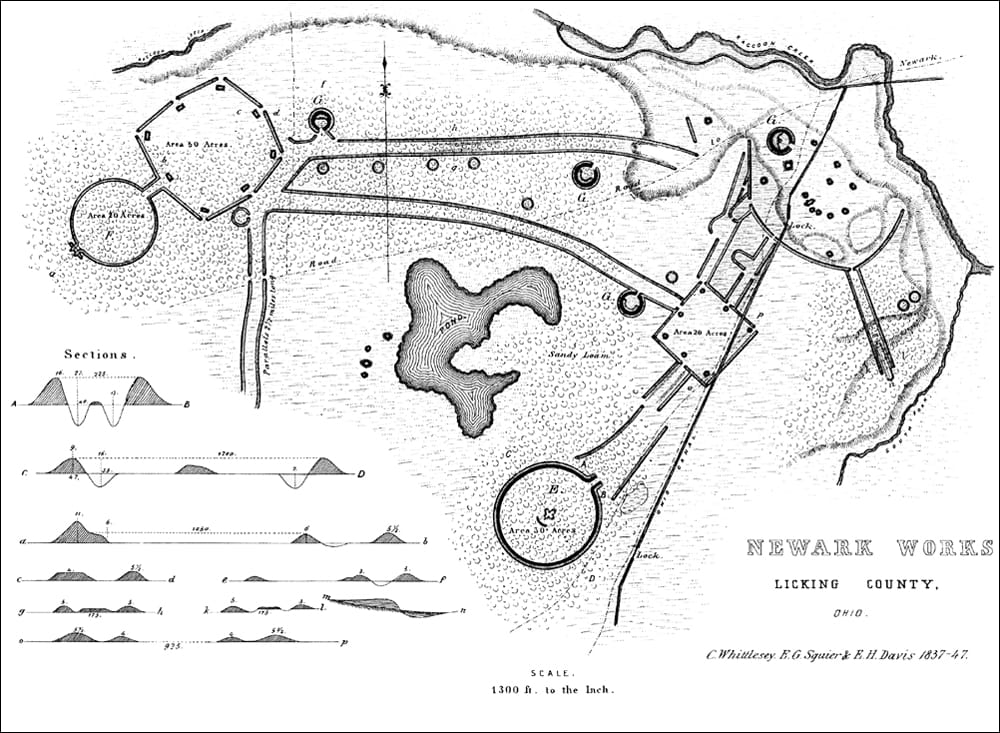
The Newark Earthworks are the surviving core of what was once the largest complex of geometric earthen enclosures ever built anywhere on Earth. Raised by the Hopewell culture between roughly 100 BCE and 500 CE in what is now Newark, Ohio, the original complex sprawled across more than four square miles — some 3,000 acres — of circles, a square, an octagon, an ellipse, and long parallel-walled avenues linking them together. The builders moved an estimated seven million cubic feet of earth, on the order of 70,000 tons, one woven basket at a time. Today less than a tenth of that survives the growth of the modern city, but the pieces that remain — the Great Circle Earthworks, the Octagon Earthworks with its attached Observatory Circle, and the fragment called Wright Earthworks — are still enough to make the site extraordinary. In September 2023, UNESCO inscribed the Newark Earthworks, together with seven other Ohio sites, on the World Heritage List as the “Hopewell Ceremonial Earthworks,” recognizing them as masterpieces of monumental Indigenous engineering, geometry, and astronomy.
The Structure
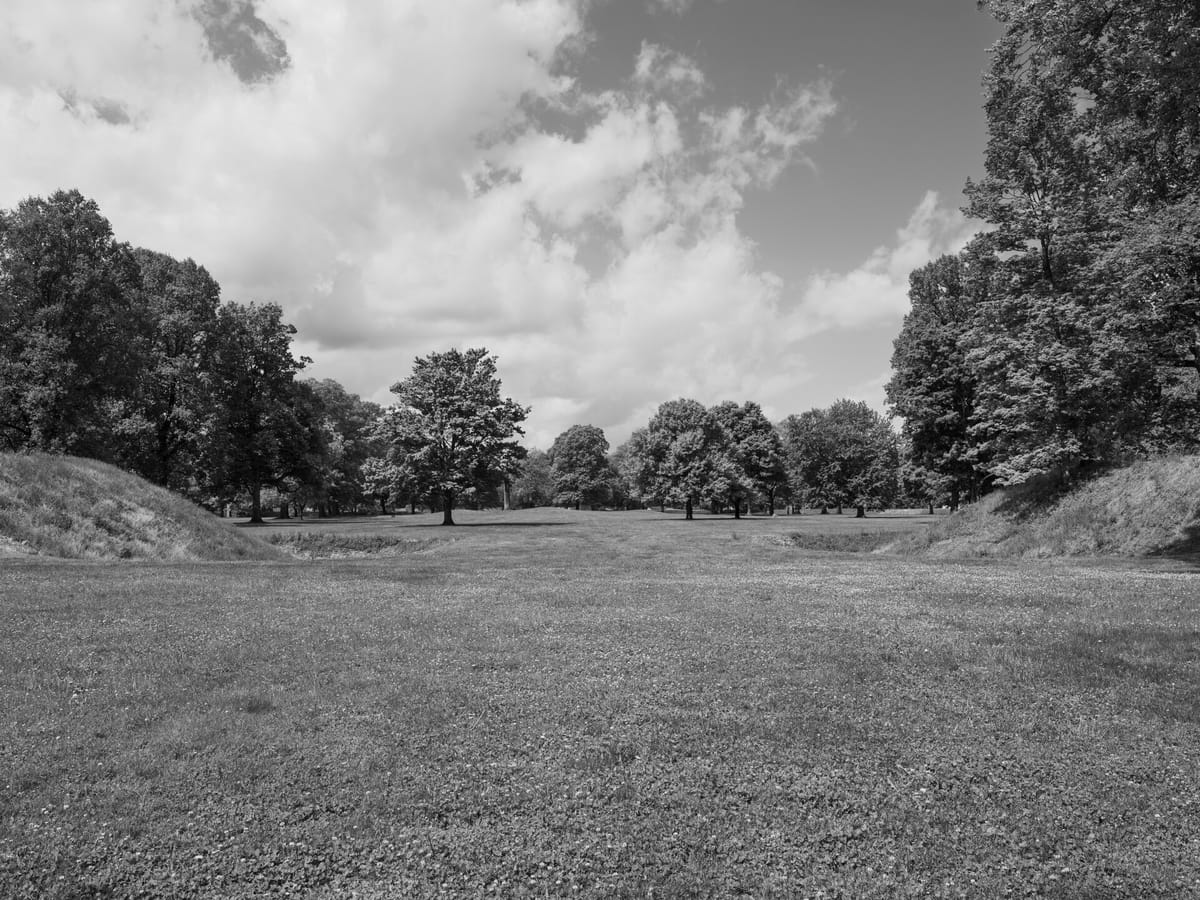
Two great enclosures anchor what remains. The Great Circle Earthworks is a nearly perfect ring about 1,200 feet across, its embankment rising as much as eight feet and backed by an interior ditch some five feet deep — a telling detail, because a defensive wall would put its ditch on the outside. Here the ditch lies within, marking the circle as sacred space rather than a fortress; at its center sits a low, bird-shaped mound known as Eagle Mound. A short distance away stands the Octagon Earthworks: eight straight embankment walls, each roughly 550 feet long, joined into a 50-acre octagon that opens through a narrow neck into the 20-acre Observatory Circle. What makes these forms remarkable is not their size alone but their exactness. The circles are round to a degree that is hard to achieve even with modern tools; the octagon’s walls are near-uniform in length; and the same base measurement — the roughly 1,050-foot diameter of the Observatory Circle — recurs as a kind of standard unit, laid out so that the (now-destroyed) great square enclosed essentially the same area as the great circle. These proportions repeat, to within small tolerances, at other Hopewell sites tens of miles away, implying a shared system of measurement carried across the landscape. A set of parallel walls once ran southwest from the octagon, and some archaeologists argue they were the start of a “Great Hopewell Road” pointed toward the earthworks at Chillicothe, some 60 miles distant.
How Was It Built?
The method itself is not the mystery. The Hopewell built by hand, carrying soil, sand, and clay in woven baskets holding perhaps 35 to 40 pounds each and heaping them up in deliberate layers — seven million cubic feet of fill representing something like twenty million basket-loads of patient, coordinated labor. No metal tools, wheeled carts, or draft animals were involved; the work was done with digging sticks, hoes of stone and shell, and human muscle, over a span of years or generations. What demands explanation is everything that had to happen before the first basket was emptied: the design. To make a circle 1,200 feet across come out truly round, to set eight walls at consistent lengths and angles, and to reproduce the same unit of measure at distant sites, the builders needed a working method of surveying — some way to stake, sight, and check large geometric figures on the ground — plus a shared standard of length and a body of practical geometry, all without writing to record any of it. And they folded the sky into that geometry. In 1982, Ray Hively and Robert Horn of Earlham College demonstrated that the Octagon and its circle are oriented to the moon: the walls and sightlines frame all eight of the extreme points where the moon rises and sets over its slow 18.6-year cycle of standstills, with the principal axis aimed at the northernmost moonrise. Tracking that cycle requires generations of careful naked-eye observation, because it is far longer and subtler than the yearly path of the sun.
The Mainstream View
Archaeologists are in firm agreement that the Newark Earthworks were designed and built by the Hopewell — Indigenous peoples of the Middle Woodland period, ancestors of historic Native American nations of the Eastern Woodlands. “Hopewell” is a modern archaeological name, borrowed from the family that once farmed a major site near Chillicothe; it does not correspond to a single tribe or to anything the builders called themselves, and the culture is better understood as a widely shared set of ceremonial practices, trade networks, and artistic styles than as one people. The consensus reads the enclosures not as houses or forts but as monumental ceremonial architecture: gathering places for ritual, burial, feasting, and pilgrimage, drawing people from across a vast region whose exotic trade goods — obsidian from the Rocky Mountains, mica from the Appalachians, copper from the Great Lakes, shark teeth and marine shell from the Gulf coast — turn up in Hopewell deposits. The geometry and the lunar alignments, once fringe claims, are now mainstream: Hively and Horn’s findings have been repeatedly re-examined and broadly upheld, and the same octagon-and-circle lunar design recurs at the High Bank Works near Chillicothe, making a coincidence vanishingly unlikely. UNESCO’s 2023 inscription rests explicitly on this reading — that the earthworks encode sophisticated mathematics and astronomy — and it stands in deliberate opposition to the discredited 19th-century “Mound Builder myth,” which once tried to credit these works to almost anyone but Native Americans.
The Open Case
Nothing at Newark calls for lost civilizations, forgotten technologies, or visitors from elsewhere; the builders were Native Americans working within their own long tradition of earthen construction, and the racist notion that they could not have done it has been dead in serious scholarship for a century. The real open questions are more interesting than any of that. How was the geometry actually laid out on the ground — what surveying technique let people without instruments or writing close a 1,200-foot circle, set an octagon’s angles, and hit the same unit of length at sites more than fifty miles apart? How was that standard of measurement recorded and transmitted across generations and distances, and does the “Great Hopewell Road” really connect Newark to Chillicothe? How many years of sky-watching stand behind the octagon’s lunar orientation, and how deliberate is every alignment versus a few that geometry produced by chance? And, most stubbornly, what did it all mean — how these spaces were used, what was performed inside the Great Circle, why the moon rather than the sun took precedence here, and what the whole four-square-mile composition was meant to say. Much of the answer was bulldozed as Newark grew, and one of the finest surviving pieces, the Octagon, spent over a century beneath a private golf course before the Ohio History Connection regained full control in 2025. What remains is a monument that we can measure with satellites and still not fully read — precise beyond easy explanation, and eloquent in a language we have only begun to recover.
Sources
Connected findings
- Patterns Too Big to See — In Ohio, the Hopewell laid out circles and an octagon so exact they frame the moon's 18.6-year cycle. In Peru, the Nazca drew animals the length of football fields. Neither people could ever stand back far enough to see the whole of what they made.
On screen
- The Observatory You Wait Inside — Exactly one game has ever recreated the Newark Earthworks — and it hands you the moon's 18.6-year cycle, then asks you to be standing in the right place when it peaks.
Gallery