Mount Nemrut (Nemrut Dağı)
Why did the king of a small buffer state pour a kingdom's resources into raising multi-tonne colossal statues and a 50-metre mound of crushed rock on a remote 2,100-metre peak — and where, beneath that unexcavated tumulus, is the tomb it was built to hide?
Why this rating?
- Construction difficulty
- 4/5
- Method uncertainty
- 2/5
- Capability gap
- 2/5
- Open questions
- 3/5
Hauling multi-tonne stone blocks up a remote 2,100-metre peak, carving and stacking 8–9-metre enthroned statues, and heaping a 50-metre mound of crushed rock was a demanding logistical feat in a marginal mountain setting, which keeps construction difficulty high; but the methods are ordinary well-understood Hellenistic quarrying, sculpture, and earth-moving, so both the uncertainty about how it was done and any gap versus known 1st-century-BCE capability stay modest. The genuinely open question is not technical but archaeological and human — the tomb the tumulus was built to protect has never been located or opened despite excavations since 1881, and the motive behind such lavish effort by a small buffer kingdom remains a matter of interpretation.
Overview
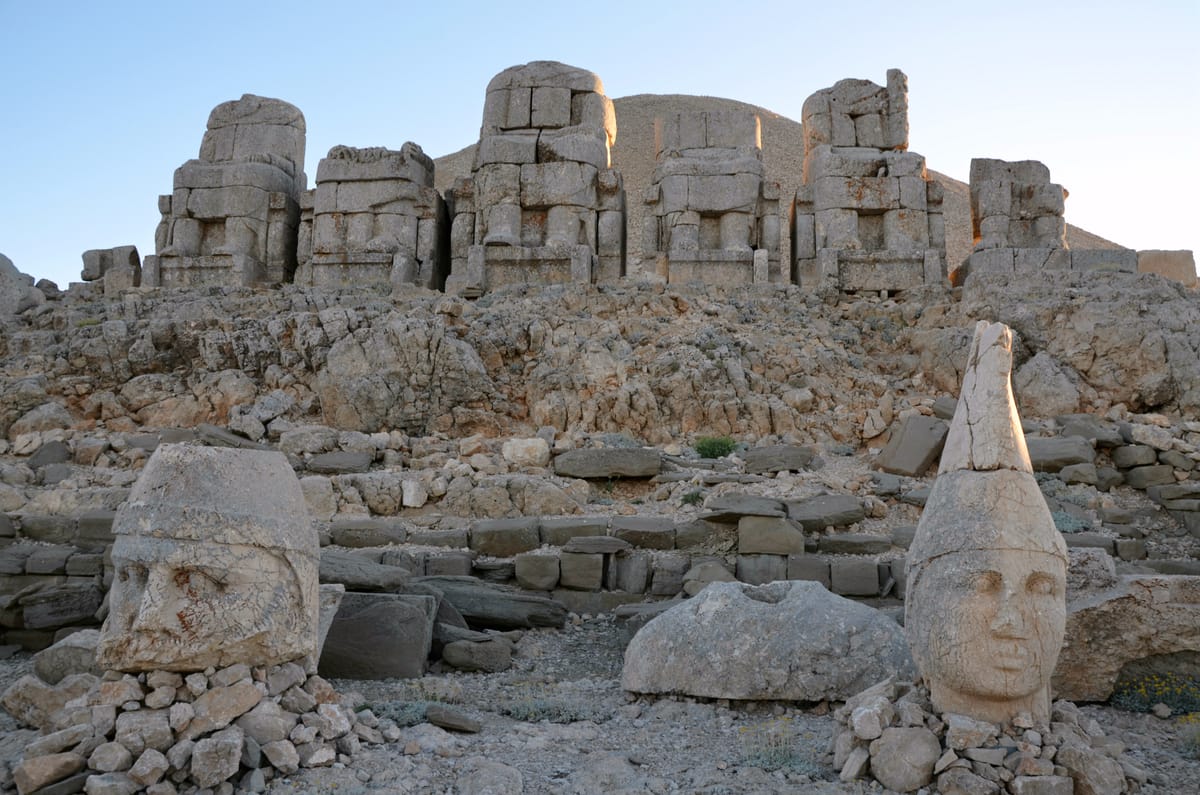
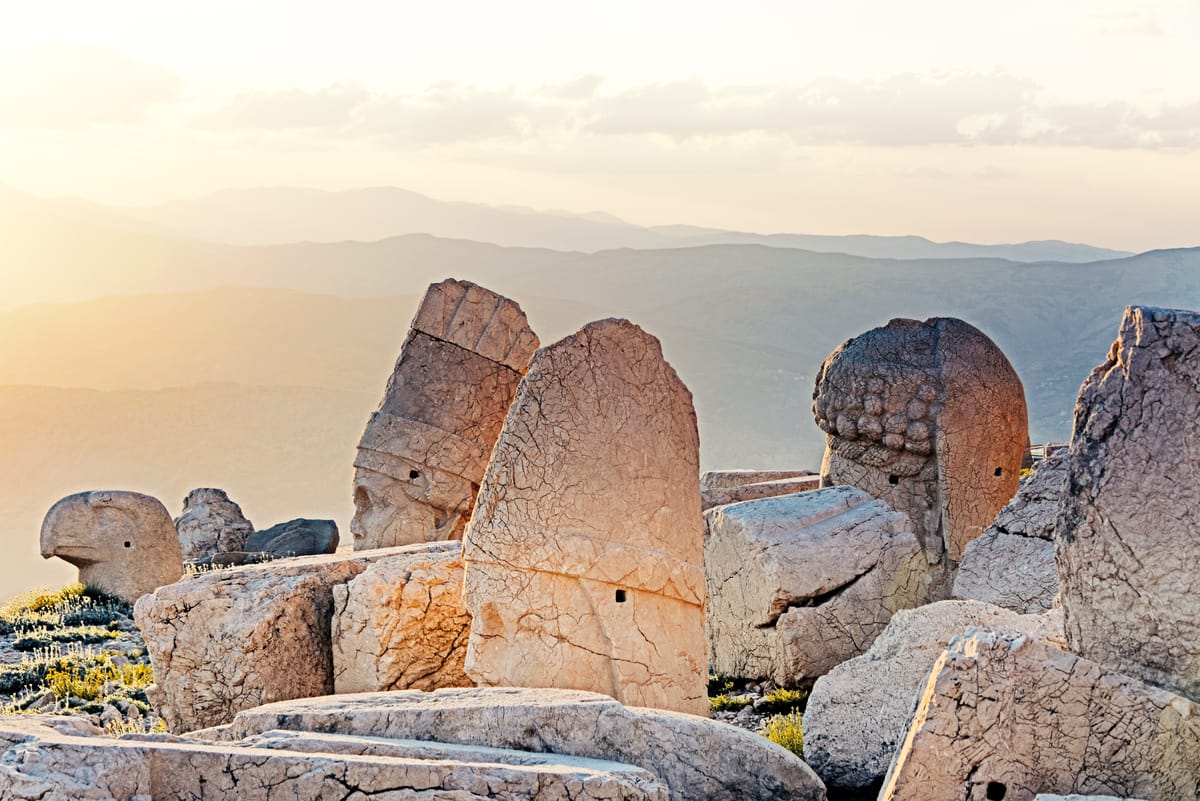
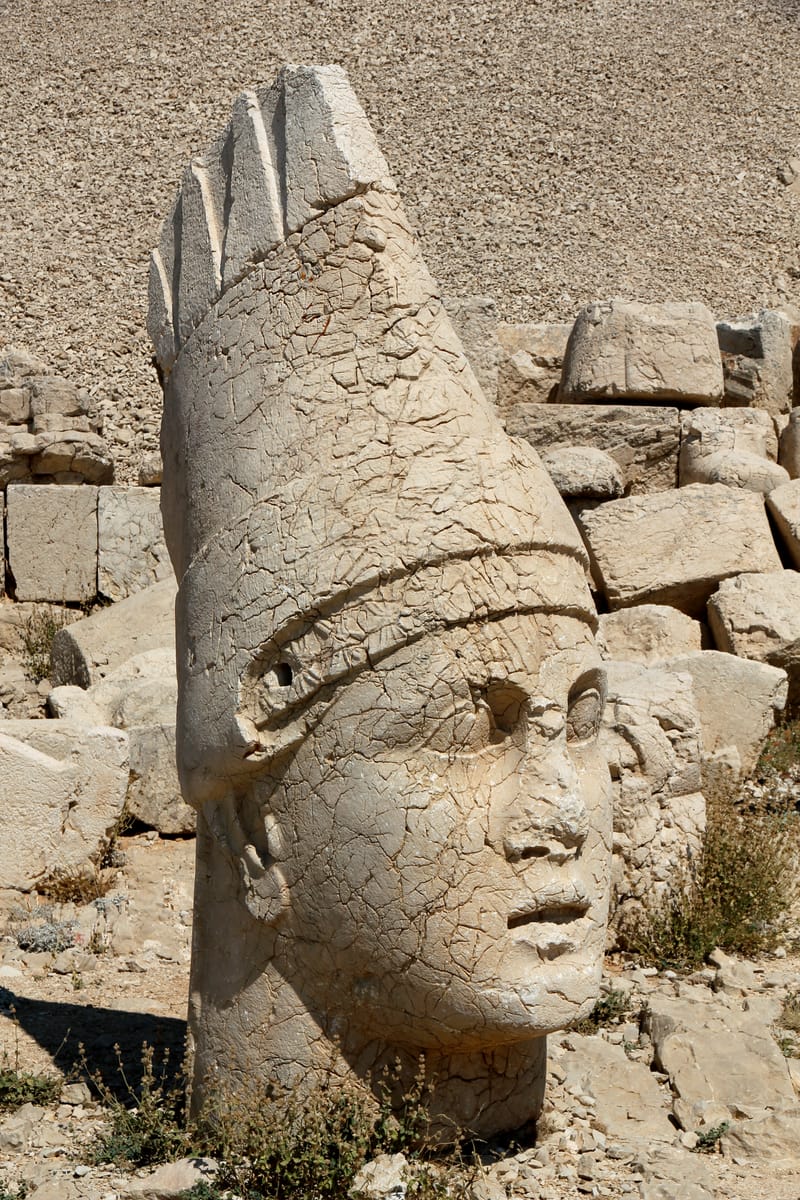
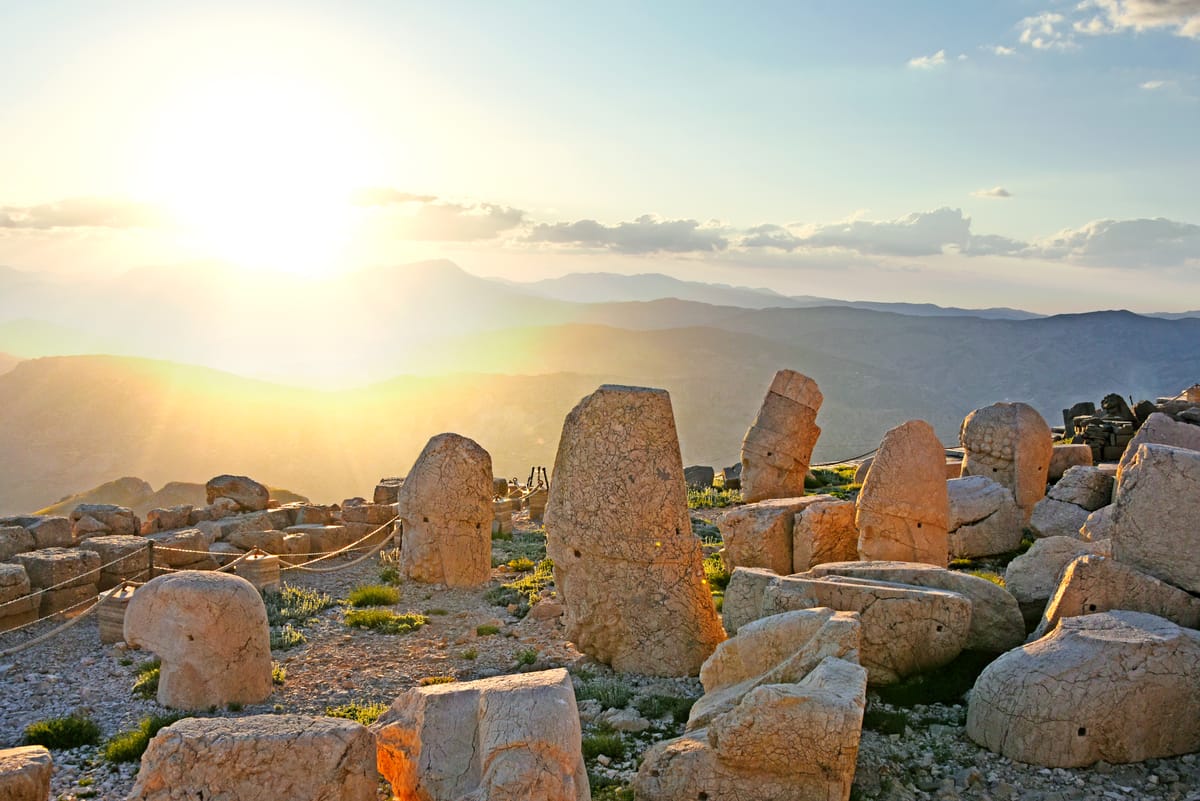
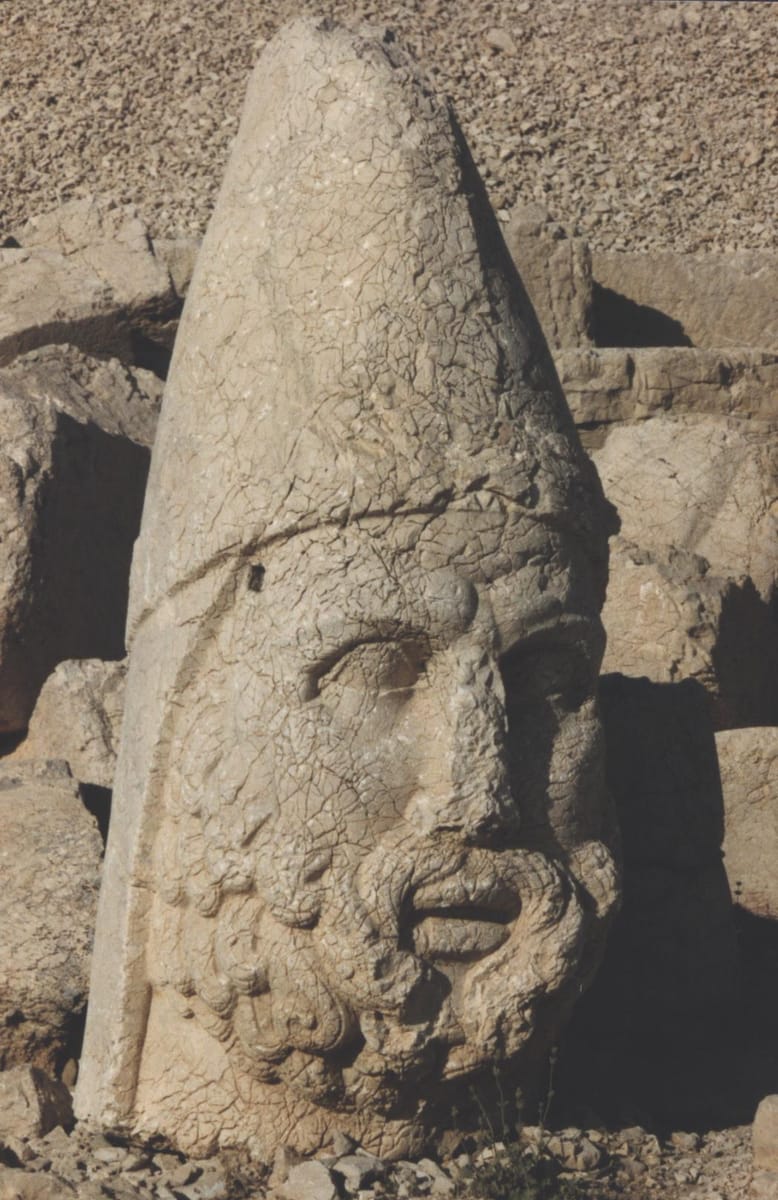
On the bare summit of Nemrut Dağı, a 2,134-metre peak in the Anti-Taurus range of southeastern Turkey, stands one of the strangest monuments of the ancient world: a mountaintop tomb-sanctuary built by a king most people have never heard of. Antiochus I Theos of Commagene ruled a small, mountainous kingdom wedged between the Roman Republic to the west and the Parthian Empire to the east, and around the middle of the 1st century BCE — his reign is usually placed at roughly 69 to 34 BCE — he commissioned what the Greeks called a hierothesion: a combined royal tomb and sanctuary of the gods. To crown it he had a conical mound of crushed rock, about 50 metres high and some 145 to 150 metres across, heaped over the very top of the mountain, and around it, on terraces cut into the slope, he set up a ring of colossal enthroned statues showing himself seated as an equal among the great gods. The heads of those statues — each a block weighing several tonnes — were later shaken from their bodies by earthquakes and now rest on the ground, staring out from the terraces in a scene that has become one of the iconic images of Anatolian archaeology. UNESCO inscribed the site, as “Nemrut Dağ,” on the World Heritage List in 1987, calling it one of the most ambitious constructions of the Hellenistic period. And yet its central purpose remains sealed: after more than a century of investigation, the tomb the whole mountain was built to hold has never been found.
The Structure
The hierothesion is arranged as three terraces — East, West, and North — set around the base of the summit tumulus. The tumulus itself is an artificial cone of fist-sized crushed limestone chips, sloped at roughly 30 to 35 degrees, rising about 50 metres above the natural peak and measuring around 145 to 150 metres in diameter; its loose, unstable fill was almost certainly meant to defeat grave robbers, since digging into it simply causes the rock to slump back into any hole. The East and West terraces each carried a nearly identical row of five colossal enthroned statues, originally on the order of 8 to 9 metres tall, flanked at either end by guardian figures of lions and eagles. The seated figures represent Antiochus himself alongside a deliberately blended Greek-Persian-Armenian pantheon: Zeus-Oromasdes (the Greek Zeus fused with the Persian Ahura Mazda / Oromasdes), Apollo-Mithras-Helios-Hermes, Herakles-Artagnes-Ares, and the enthroned goddess of the kingdom, Commagene, in the guise of Tyche. Their double and triple names are the point: they turn the row of statues into a visual diagram of Antiochus’s theology, in which a single divine order is expressed through two great cultural traditions, with his own royal house seated literally in the middle. The North Terrace, longer but seemingly unfinished, held a long sandstone wall and appears never to have received statues. Around the terraces run two additional programs in stone: rows of dexiosis reliefs, showing Antiochus clasping hands with each god as an equal, and lines of ancestor stelae tracing his descent — through his father back to the Persian king Darius and the Achaemenids, and through his mother back to Alexander and the Seleucids. On the West Terrace lies the so-called Lion Horoscope, a relief of a lion strewn with nineteen stars (the constellation Leo), a crescent, and three named planets — Mars, Jupiter, and Mercury — whose arrangement has been read as encoding a specific date, most often calculated to 7 July 62 BCE and interpreted as marking either Antiochus’s coronation or the founding of the sanctuary.
How Was It Built?
Physically, Nemrut is a Hellenistic building project carried out in an unusually difficult place. The colossal statues were assembled in horizontal courses: large blocks of the local limestone were quarried, dressed, carved into the seated bodies and separately worked heads, and then stacked one on another to build up each figure to its full 8-to-9-metre height, with some individual blocks reported in the range of several tonnes and up to roughly nine tonnes. The reliefs and inscriptions were cut into slabs of the same local stone. All of this happened at over 2,000 metres, on a summit with no water, no timber, and no easy road — so the real engineering story is one of logistics: organizing quarrying on or near the peak, moving heavy dressed blocks up the final slopes with levers, rollers, ramps, sledges, and muscle, and coordinating a seasonal workforce in a harsh mountain climate. The tumulus was raised by carrying and tipping an enormous volume of broken rock over the natural summit to build the 50-metre cone. None of these operations required tools or techniques beyond what the Greek and Near Eastern world of the 1st century BCE already used routinely for temples, statuary, and fortifications; what set Nemrut apart was the decision to do it all on an exposed, remote peak rather than in a city. A long Greek cult inscription, the nomos, was carved across the terraces (with a fuller version at the related site of Arsameia), laying down how the sanctuary was to be maintained, staffed by priests, and honored with monthly festivals — evidence that Antiochus planned not just a monument but a permanent, funded royal cult centered on his own divinity.
The Mainstream View
Among archaeologists and historians there is little serious dispute about what Nemrut is, who made it, or roughly when. The site is firmly attributed to Antiochus I of Commagene in the mid-1st century BCE, a dating anchored by the king’s own inscriptions, the dynastic and religious program of the sculpture, and the astronomical reading of the Lion Horoscope. The monument is understood as the supreme expression of the Commagene royal cult — a small kingdom’s bid for prestige and permanence, dramatizing through fused Greek and Persian gods and a doubled ancestry the ideology of a dynasty that wanted to stand as heir to both Alexander and the Persian kings while staying independent of Rome and Parthia alike. The construction methods are treated as well within the reach of Hellenistic engineering: quarrying, block-by-block statue assembly, relief carving, and the piling of a rubble tumulus are all ordinary techniques of the period, made notable here only by scale and by the punishing location. The site was rediscovered for the modern world in 1881 by the German engineer Karl Sester, documented soon after by the Ottoman scholar Osman Hamdi Bey and the sculptor Osgan Efendi, and investigated systematically from the 1950s onward, most famously by the American archaeologist Theresa Goell together with the German epigrapher Friedrich Karl Dörner. Their work, and later conservation and survey campaigns, produced the detailed picture of terraces, statues, inscriptions, and cult that scholarship still relies on today. The earthquake damage that toppled the heads, and the deliberate defacement some statues show, are read as the ordinary afterlife of an abandoned pagan sanctuary in a seismically active region.
The Open Case
The genuine puzzle at Nemrut sits underneath everything else, literally. The hierothesion was built around a royal tomb — Antiochus’s inscriptions speak of his body resting there, close to the gods — and the entire tumulus reads as an elaborate device to protect and conceal it. But no tomb has ever been located. Excavators from Goell and Dörner onward tried, over decades, to find the burial chamber; the loose crushed rock of the mound has defeated every attempt, slumping back into any shaft or tunnel driven into it, and geophysical surveys have so far failed to reveal a clear chamber. So the best current answer to the central question — where is the king buried? — is that he is very probably still there, exactly where he was laid more than two thousand years ago, in a chamber no one has managed to reach or even confirm. That leaves a rare thing in archaeology: a famous, thoroughly studied monument whose reason for existing has never actually been examined. Around that hard unknown sits a softer, more human one. Why did the ruler of a minor buffer state — not an empire — spend so lavishly to raise multi-tonne statues and a mountain of rubble on a peak so remote that almost no one would ever climb it, and then legislate a perpetual cult to worship himself as a god? The mainstream reading (dynastic propaganda, a genuine syncretic faith, a claim to divine kingship) is plausible and well argued, but it remains interpretation: the sanctuary itself never explains, in so many words, why it needed to be this big, this high, and this hidden. None of this calls for lost technology or outside help — Hellenistic engineers could clearly do all of it. What keeps Nemrut open is that its literal core is still sealed, and the extravagance of the whole gesture still invites the question of what, exactly, Antiochus was trying to guarantee for himself on top of that mountain.
Sources
- UNESCO World Heritage Centre — Nemrut Dağ (inscribed 1987)
- Encyclopædia Britannica — Nemrut Dağ
- National Geographic — The eighth wonder of the ancient world may have an untouched tomb
- World History Encyclopedia — Exploring Mount Nemrut: A Meeting Point Between East & West
- Wikipedia — Mount Nemrut
- Wikipedia — Antiochus I Theos of Commagene
- Commagene Nemrut Conservation and Development Programme — About Nemrut
- Güney & Öngü — An Iconological Study on the Lion Horoscope Relief of Nemrut Dağ Hierothesion (PDF)
- commagene
- hellenistic
- antiochus-i
- hierothesion
- tumulus
- colossal-statues
- syncretism
- unesco
- turkey
- unexcavated-tomb
Gallery