Monks Mound
How did a Native American society without draft animals, metal tools, or the wheel organize the labor to raise 22 million cubic feet of earth, basket by basket, into a stable 30-meter platform on soft floodplain soil — and why, at the height of its power, did the city built around it empty out?
Why this rating?
- Construction difficulty
- 3/5
- Method uncertainty
- 2/5
- Capability gap
- 2/5
- Open questions
- 4/5
Moving 22 million cubic feet of earth by basket without wheels or draft animals demanded serious sustained organization, and excavation has already explained the layered-soil engineering that kept the mound stable; what's genuinely unresolved is how labor was mobilized, how fast the mound rose, and why the city emptied out within a few centuries.
Overview
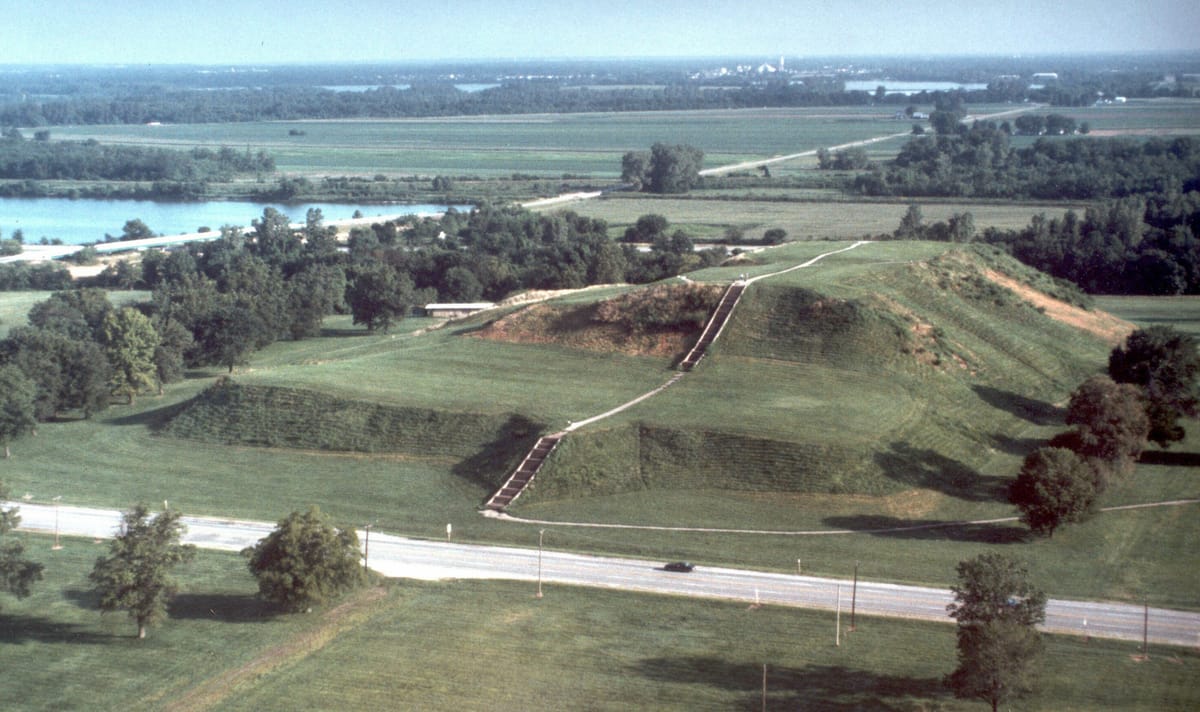
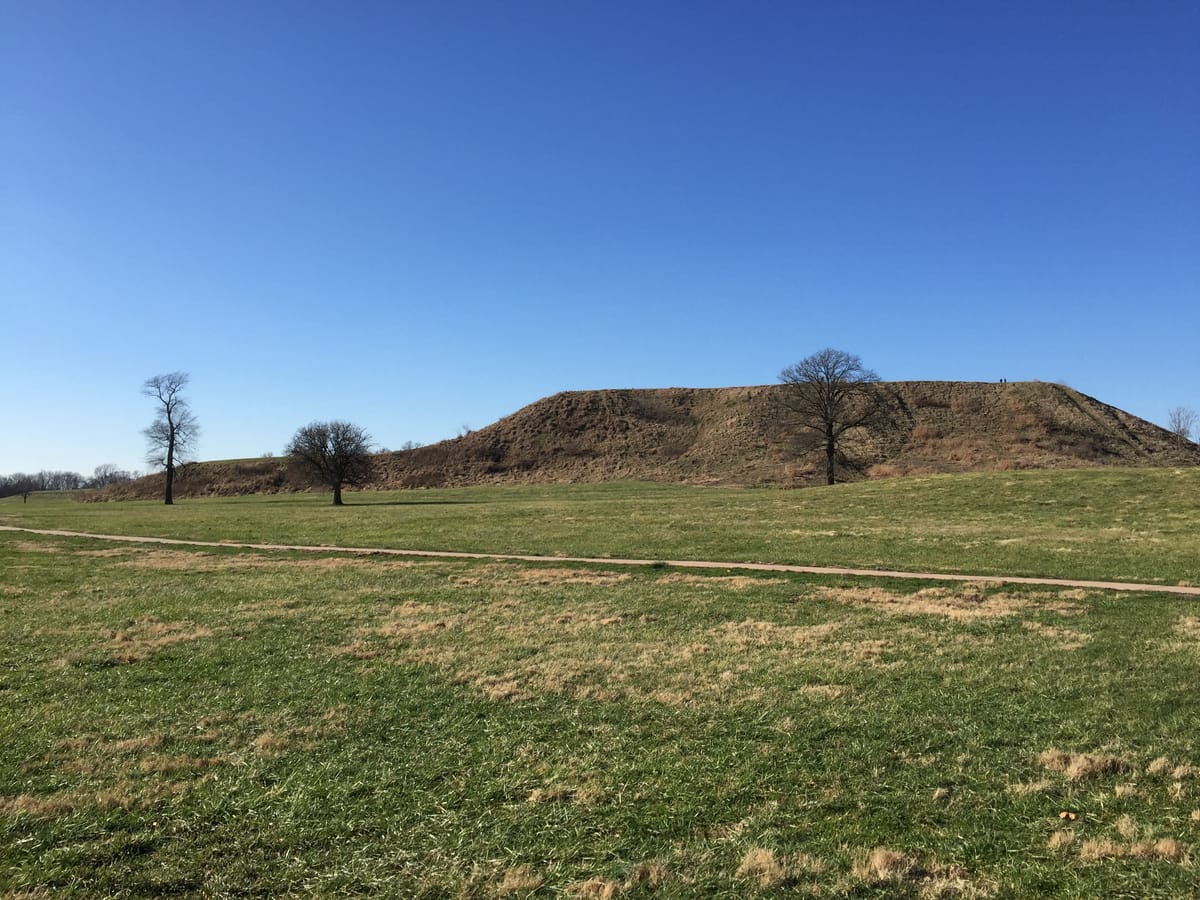
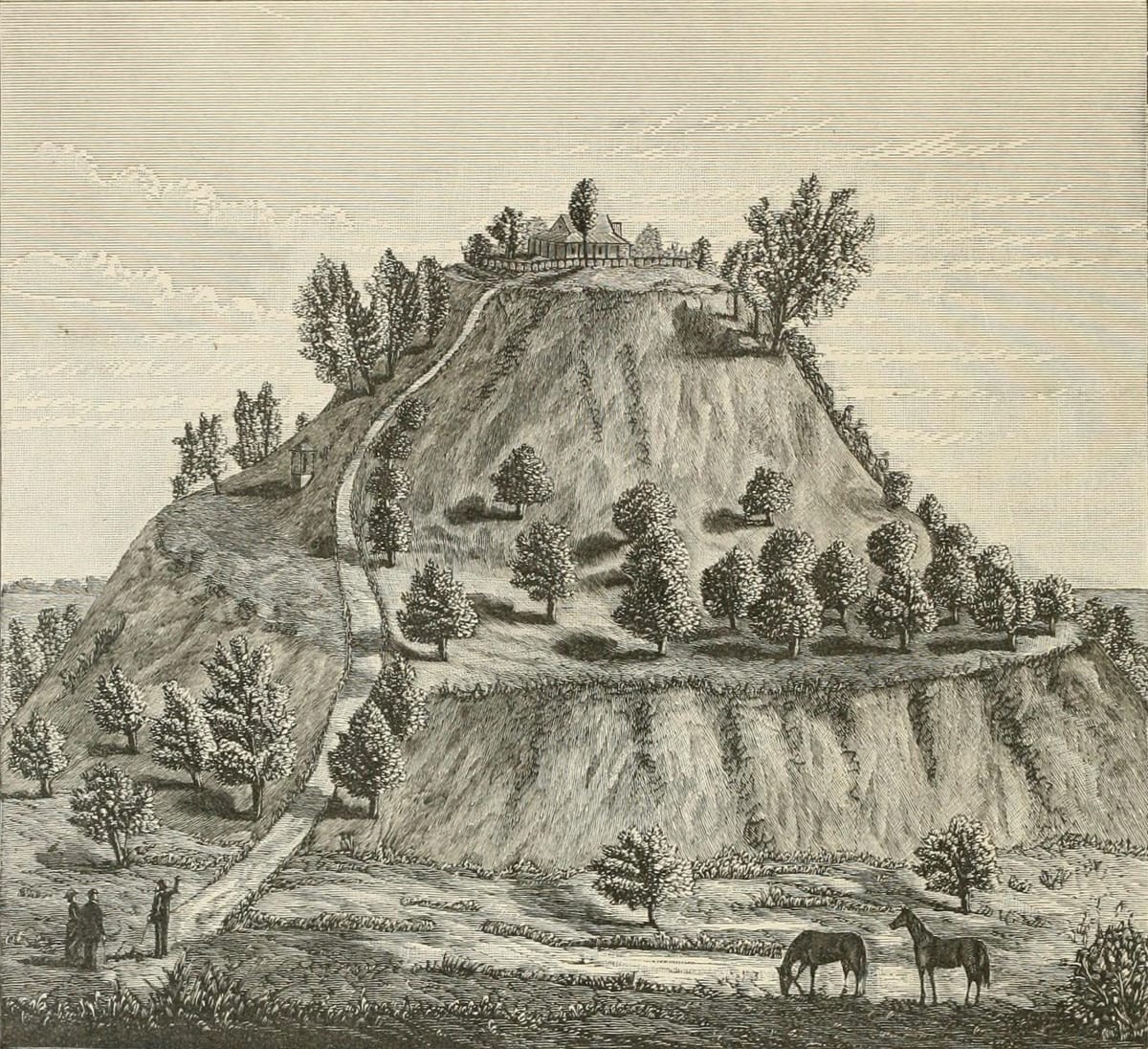
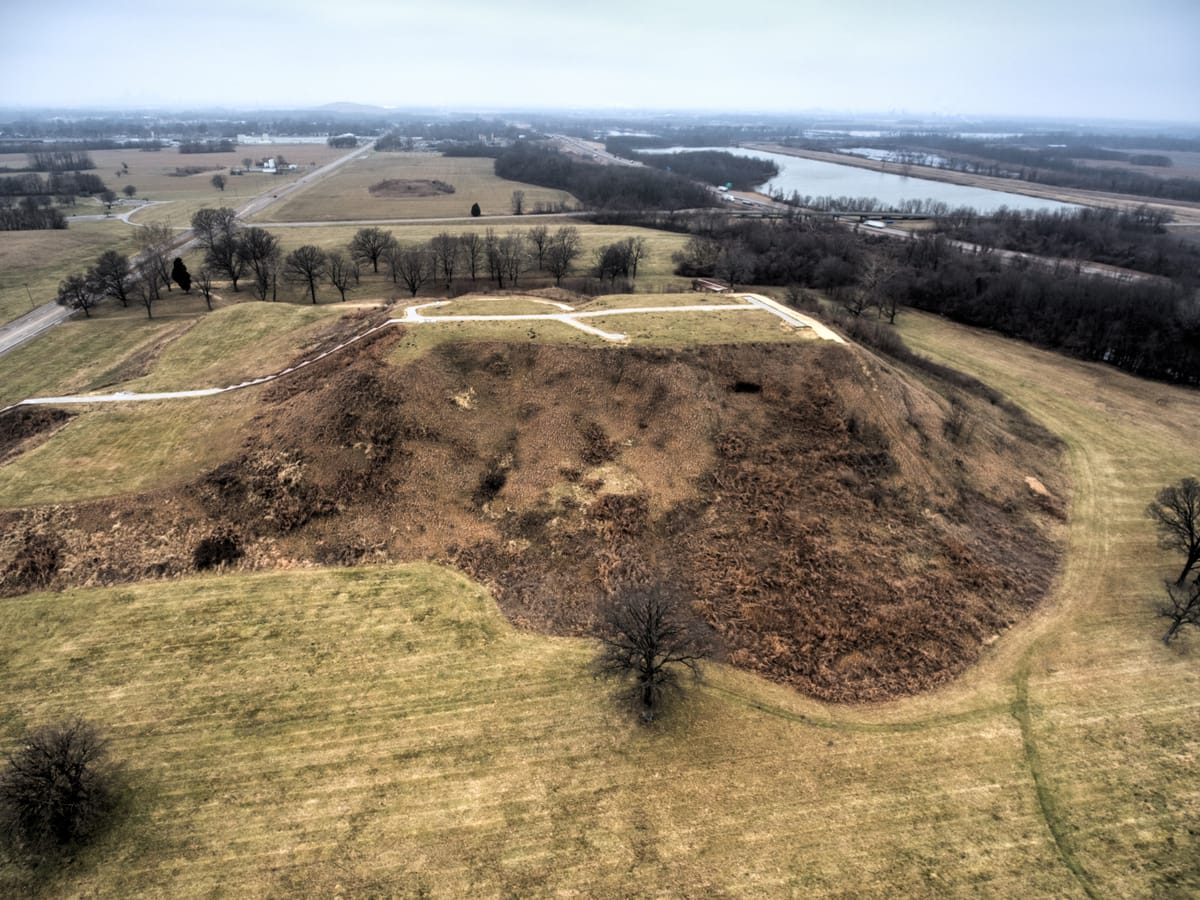
Monks Mound is the largest pre-Columbian earthwork in the Americas: a massive, four-terraced platform of packed earth rising about 30 meters (100 feet) above the Mississippi River floodplain and covering roughly 5.6 hectares (about 13 acres) at its base — a footprint comparable to the Great Pyramid of Giza. It stands at the ceremonial and political heart of Cahokia, near modern Collinsville, Illinois, which at its peak around 1050-1150 CE was one of the largest cities in the pre-Columbian Americas, home to an estimated 10,000-20,000 people or more spread across a metropolis of roughly 120 mounds, plazas, and neighborhoods. Monks Mound and the wider Cahokia site were built entirely by Native Americans of the Mississippian culture — a fact that is not in scholarly dispute, though it was denied for generations by white American writers who found it easier to imagine a vanished “lost race” than to credit Indigenous people with a monumental city. Today the site is preserved as Cahokia Mounds State Historic Site and inscribed as a UNESCO World Heritage Site (1982). The name “Monks Mound” is a later, incidental label: French Trappist monks briefly farmed its terraces from 1809 to 1813, centuries after the Mississippians who built it had already left.
The Structure
Monks Mound anchored the north side of Cahokia’s Grand Plaza, a vast level open space used for public gatherings, ceremonies, and games, with dozens of smaller mounds — burial mounds, other platform mounds that once supported elite residences or temples, and ridge-top mounds — arranged around it across the site. Excavations on Monks Mound’s summit uncovered the outline of a large building over 30 meters (100 feet) long, the largest structure yet found at Cahokia, thought to have served as a temple or the residence and headquarters of Cahokia’s paramount leadership; a massive circular post socket found nearby matches Cahokia’s several “Woodhenge” timber-post circles, evidently used to track solar events across the seasons. Cahokia’s builders raised the mound in at least a dozen distinct construction stages between roughly 900 and 1200 CE, with the bulk of its bulk added during the city’s height in the 11th and 12th centuries; a smaller, earlier mound buried within the northern end of the structure shows building began before the city’s full urban expansion. A final lower terrace was appended on the mound’s south side before 1200 CE, likely to shore up a structure already showing signs of slumping under its own weight. Cahokia’s decline followed in the century or two after, and by around 1350-1400 CE the city had been largely abandoned, for reasons that remain actively debated among archaeologists.
How Was It Built?
The scale of the undertaking is difficult to overstate: an estimated 22 million cubic feet (around 623,000 cubic meters) of earth were moved to build Monks Mound, all of it dug with stone, wood, and shell tools and hauled to the site in woven baskets carried on workers’ backs — without wheeled carts, draft animals, or metal implements of any kind. Excavations show the builders were far from careless about the engineering problem this posed: they layered different types of soil and clay, sourced from separate borrow pits around the city, in a deliberate sequence that helped the growing mound drain water and resist slumping on the soft, water-saturated floodplain soils beneath it — a genuine technical achievement, refined and repaired over successive building stages as engineers of the time learned what worked. Some analyses of construction stages suggest large portions of the mound may have gone up remarkably fast, conceivably within a matter of decades rather than centuries, implying that Cahokia’s leadership could mobilize, feed, and coordinate a large workforce for sustained, organized seasons of labor — evidence, in itself, of a complex and capable society rather than a simple one.
The Mainstream View
Modern archaeology holds, without serious dispute, that Monks Mound and the entire city of Cahokia were built by Native Americans — the Mississippian culture, ancestral to and connected with the historic and present-day Indigenous nations of the Midwest and Southeast. Radiocarbon dating, ceramic styles (notably shell-tempered Mississippian pottery), and the layout of house patterns and public architecture all place construction squarely within an Indigenous cultural tradition that spread across the eastern United States between roughly 800 and 1600 CE. That consensus stands in direct opposition to the 19th-century “Mound Builder myth,” which held that the region’s earthworks were too sophisticated to have been built by Native Americans and must instead be the work of a vanished non-Native race — Vikings, Phoenicians, a “Lost Tribe of Israel,” or refugees from Atlantis. The myth was not a neutral guess: it was promoted, consciously or not, to justify the dispossession and removal of Indigenous peoples by casting them as incapable of civilization, or even as having exterminated the “real” builders themselves. At Cahokia specifically, early American settlers and writers routinely credited the mounds to Vikings, Phoenicians, or other outsiders well into the 19th century; it was not until careful excavation accumulated through the late 1800s and into the 20th century — establishing clear material continuity between the mounds and Mississippian-era and historic Native American material culture — that the myth was abandoned by serious scholars, generally dated to around the 1890s. No reputable archaeologist today doubts that Monks Mound is a Native American achievement.
The Open Case
Nothing about Monks Mound calls Indigenous authorship into question, and this study takes no part in reviving 19th-century “lost race” or extraterrestrial speculation — that framing is a discredited artifact of racist historiography, named here only to be set aside. The real, still-open questions are about organization and history, not identity. Exactly how Cahokia’s leaders mobilized, fed, and directed the labor force needed to move 22 million cubic feet of earth — whether through kinship obligation, tribute, seasonal festival-labor, or some mix of voluntary and compelled work — is not directly recorded and remains inferred from the archaeology of construction stages and settlement patterns. The pace of construction is itself debated: some researchers argue much of the mound’s bulk went up in a few extraordinarily intensive decades around 1050-1100 CE, coinciding with a broader, rapid transformation of Cahokia from a large village into an urban center — a “big bang” moment of political and religious consolidation — while others favor a longer, more incremental building history. Most actively studied of all is Cahokia’s decline: the city’s population had fallen sharply by the 1300s and the site was essentially empty by 1400, and archaeologists continue to weigh competing explanations, including resource depletion (deforestation and soil exhaustion from feeding a dense population), episodes of Mississippi River flooding, political fragmentation or conflict, and climatic shifts associated with the onset of the Little Ice Age. These are genuine open questions about how a Native American city rose so quickly to such scale, and why it did not last — not doubts about who built it.
Sources
On screen
- The Mound You Build as Cahokia — Civilization VII hands you the Mississippians, a river tile and the largest earthwork in the Americas — and puts the builders' names on the completion screen.
Gallery