Longyou Caves
Who carved a million cubic meters of stone into two dozen precisely tooled underground halls, roughly when the Han dynasty ruled China, and left absolutely no written trace of doing it?
Why this rating?
- Construction difficulty
- 4/5
- Method uncertainty
- 3/5
- Capability gap
- 2/5
- Open questions
- 5/5
Removing roughly a million cubic meters of sandstone by hand with matching tool marks across 24 chambers implies a large, coordinated workforce, but the chiseling method itself is legible in the stone and requires no capability beyond what is otherwise known from the period; the real mystery is total historical silence — no record identifies the builders, the precise era, or the purpose, leaving identity, dating, and function all genuinely open.
Overview
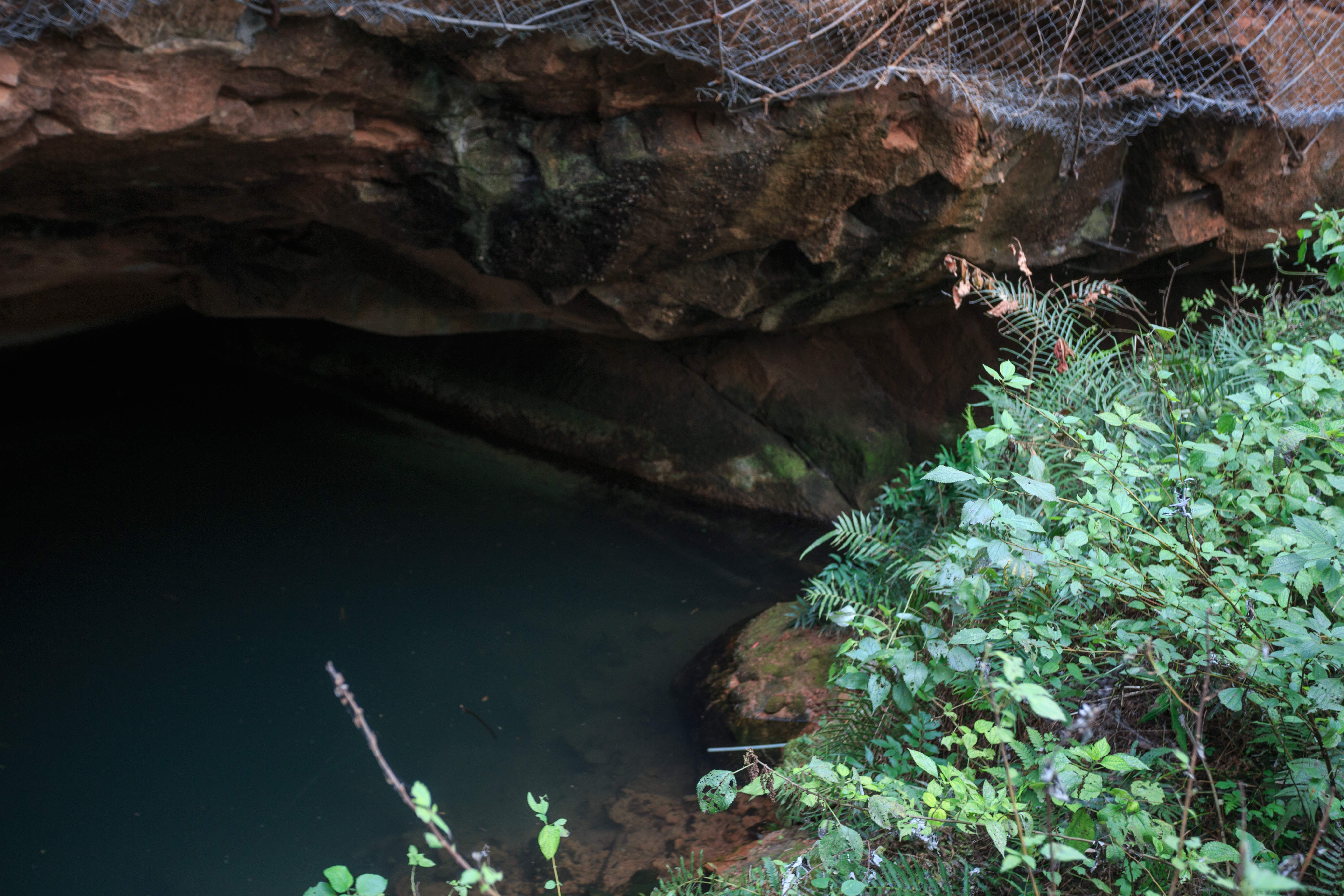
The Longyou Caves are a group of at least 24 large, entirely man-made sandstone caverns hidden beneath farmland near Shiyan Beicun village, on the Qu River in Longyou County, Zhejiang Province, China. They were unknown to the outside world until June 1992, when four local farmers pumping water out of what looked like ordinary fish ponds found the water level dropping into open, cavernous voids beneath the mud instead of hitting a lake bed. Draining and exploring the site revealed not one flooded pit but a whole complex: room after room of soaring underground halls, some with floor areas exceeding 1,000 square meters and ceilings rising as high as 30 meters, connected by narrow above-ground gaps but never by tunnels below. Every excavated surface — walls, ceilings, and the thick stone pillars left standing to hold the roofs up — is covered edge to edge in dense, remarkably even parallel chisel marks. The caves are unambiguously artificial: there is no debate about whether people made them. What is genuinely unresolved is who did it, when, and why, because no surviving book, inscription, map, or local legend says a word about the project. The site, now developed for tourism under the name Xiaonanhai Shishi (“Xiaonanhai Stone Chamber”), was designated a Major Historical and Cultural Site Protected at the National Level by the Chinese government in 2013.
The Structure
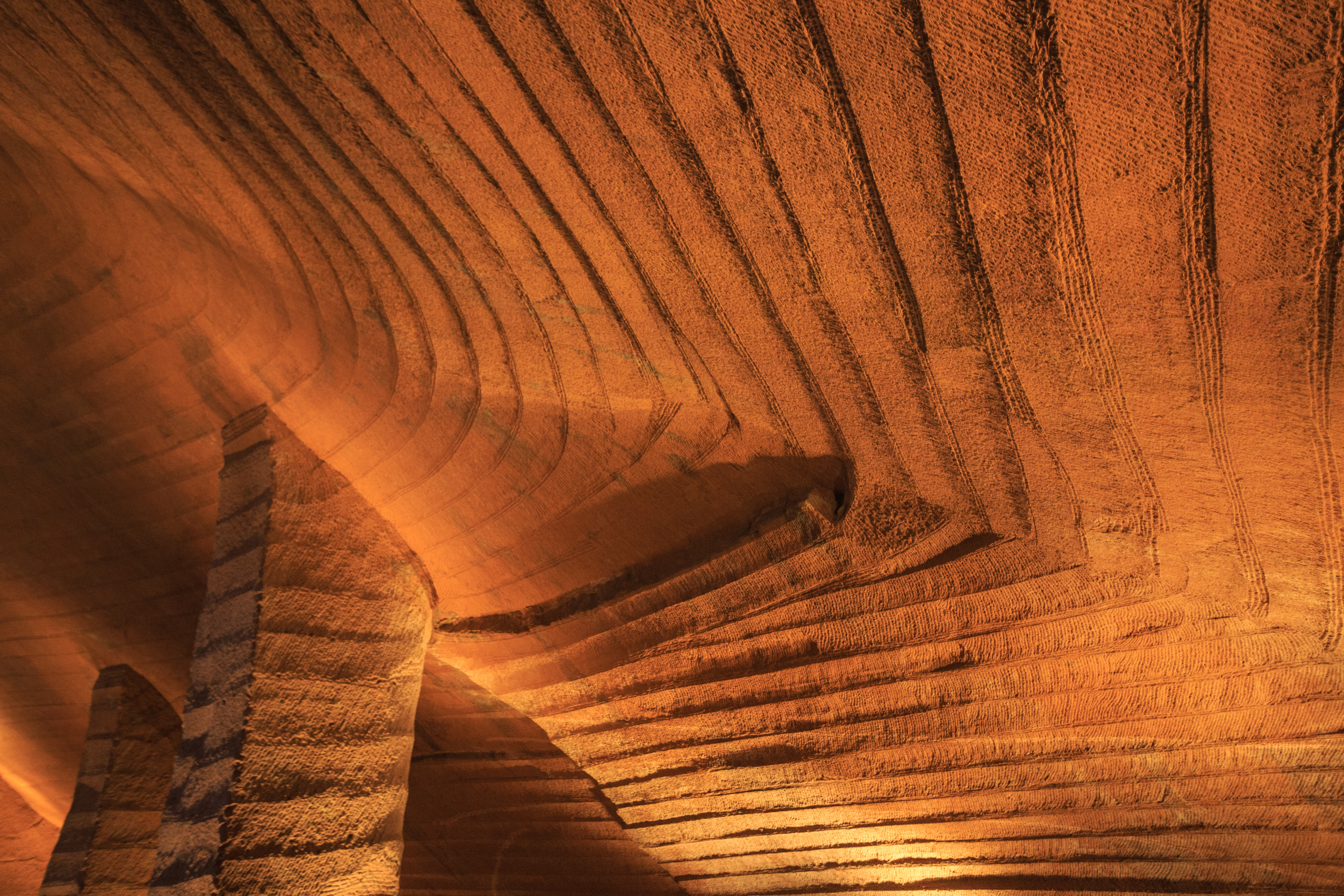
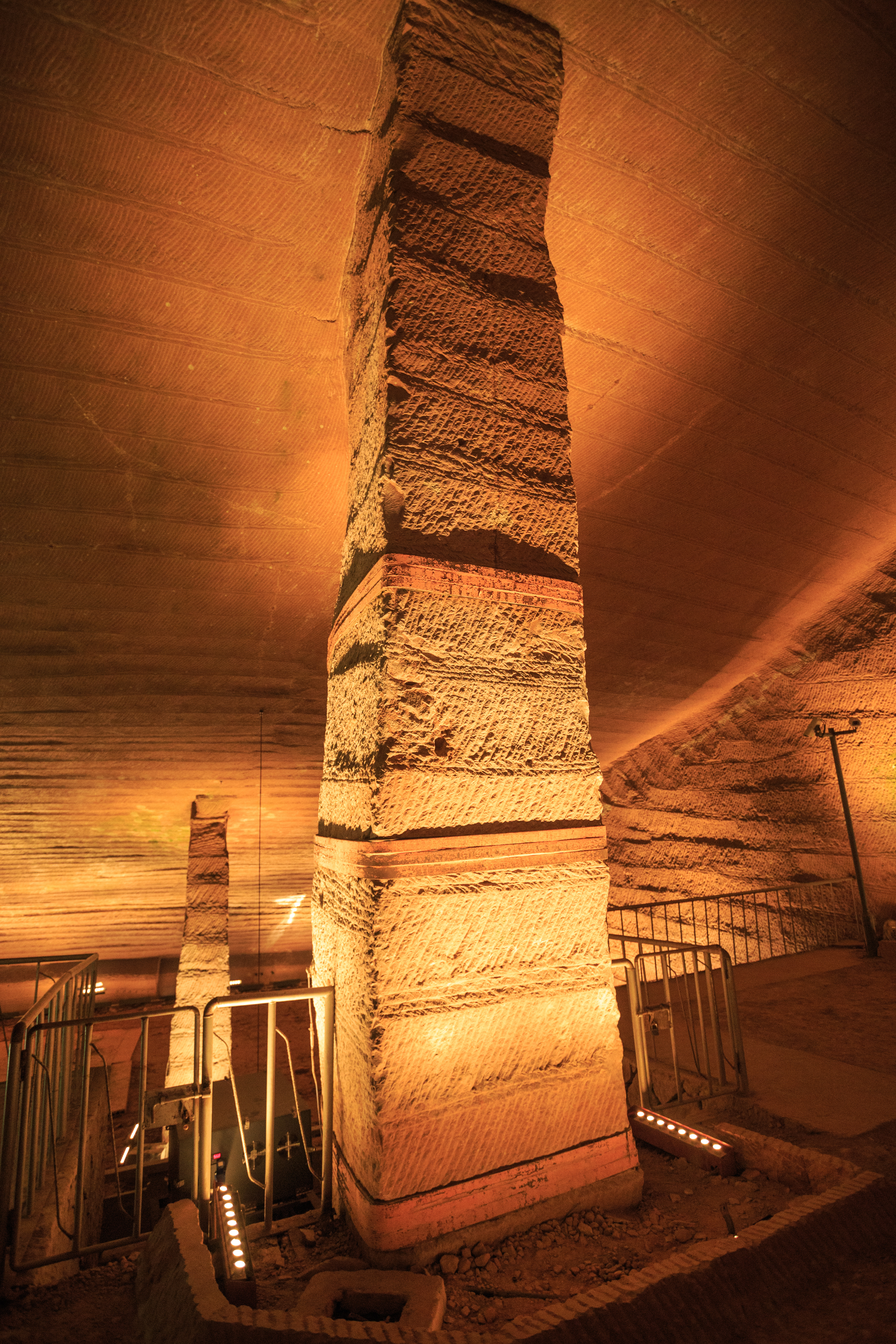
The 24 confirmed caverns sit in a cluster on Fenghuang Hill, cut into a fine-grained sandstone bedrock. Their sizes vary considerably: several are modest side-chambers, but the largest exceed 1,000 square meters of floor space each, and together the excavated caves cover more than 30,000 square meters. Ceilings arch upward in smooth, shallow curves rather than flat planes, in some caves reaching close to 30 meters — roughly the height of a ten-story building — and are typically supported by one or more massive stone pillars quarried from the same rock rather than built up separately, left standing as the surrounding material was removed around them. Some pillars and wall panels carry carved reliefs of animals, including a horse, a fish, and a bird, alongside the geometric tool-mark patterns, though these figurative carvings are comparatively sparse next to the overwhelming coverage of plain chiseling. Fragments of pottery recovered from the silt that had accumulated in the caves have been dated to the late Western Han period, and a few sources point to artifacts as specific as the reign of Emperor Xuan of Han (91–48 BCE), which is part of the basis for the commonly cited “roughly 2,000 years old” estimate. That dating rests on what was found sitting in the caves after they had already been abandoned and silted up, not on direct dating of the excavation itself, so it is best read as a plausible latest-use window rather than a secure construction date. A seventeenth-century poem by the scholar-official Yu Xun is sometimes cited as an early literary mention of caverns in the area, but even that reference does not describe their origin or purpose — it is evidence the caves (or something like them) already existed and already puzzled people long before 1992, not evidence of who built them.
How Was It Built?
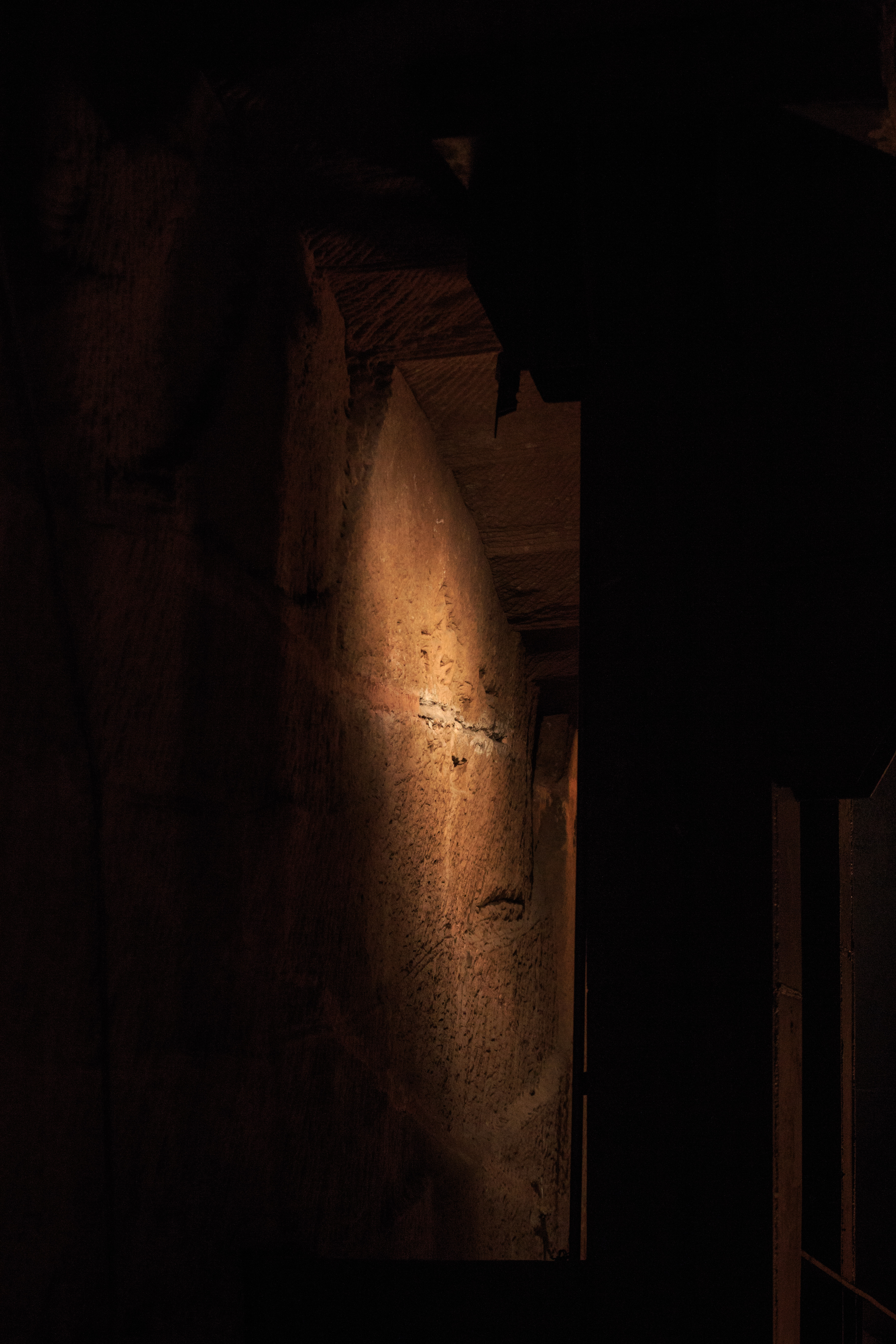
The evidence for method is written directly on the stone. Every worked surface bears “courses” of parallel, closely spaced chisel strokes, typically laid out in bands roughly 60 centimeters wide and angled at about 60 degrees to the run of the course, giving the ceilings in particular a distinctive fan- or scallop-like texture. The uniformity of the tooling across all 24 chambers — same spacing, same angle, same rhythm — is one of the site’s most striking features, and strongly suggests a standardized technique passed between crews or applied under some form of centralized direction, rather than ad hoc digging by unrelated groups over time. Engineers who have studied the site estimate that close to one million cubic meters of rock were removed in total. Cutting, shaping, and then hauling that volume of stone up and out of the caverns by hand — with no evidence of draft-animal ramps, wheeled equipment, or mechanical lifting gear from the period — would have required a very large, sustained, and organized labor force over a period of years; back-of-envelope estimates in the low thousands of workers over several years are commonly cited, though such figures are rough extrapolations rather than findings from a labor-cost study. Adding to the puzzle, no chisels, hammers, or other tools have ever been recovered from the site, so the physical toolkit itself has to be inferred entirely from the marks it left behind rather than examined directly.
The Mainstream View
The working consensus among the archaeologists and engineers who have examined the site is that the Longyou Caves are the product of a large-scale, organized excavation project, most likely for quarrying stone or creating usable enclosed space, undertaken sometime in the last two or three centuries BCE to the first couple of centuries CE — the era bracketed by the late Warring States/Qin period and the Han dynasty. Several specific functions have been proposed by researchers, including Chu Liangcai of Zhejiang University, none of which has become the settled answer: that the caverns were simply quarries whose stone was shipped out by river for construction elsewhere; that they served as a Han-dynasty imperial storage complex (a “Changping Granary”-type facility) for grain, goods, or war matériel in a border county; that they concealed troops or supplies during the Spring and Autumn-period rivalry between the states of Wu and Yue; or that they were intended as an elaborate tomb or mausoleum for a regional ruler. The pure-quarry theory struggles to explain why so much labor went into decorative reliefs and perfectly even, aesthetically deliberate tooling patterns that go beyond what raw stone extraction would require. The storage and military theories fit the region’s known history reasonably well but lack corroborating documentary evidence. The tomb theory lacks the burial goods, sarcophagi, or sacrificial remains that would normally accompany a mausoleum of this scale. In short, the mainstream position treats Longyou as a real but historically unrecorded engineering project of the ancient Chinese state or a regional power — not a mystery about whether humans built it, but an open case about which of several plausible human purposes actually motivated it.
The Open Case
What makes Longyou genuinely strange is not the caves themselves but the silence around them. This was not a small effort: shifting roughly a million cubic meters of rock by hand, with the coordination needed to keep 24 separate excavations tooled to matching specifications, implies an undertaking on the scale of a significant public work — comparable in ambition to canals, city walls, or major tombs that Han and pre-Han China documented extensively elsewhere. Yet no surviving chronicle, local gazetteer, tax record, or inscription mentions the project, its planners, its laborers, or its purpose. Nothing has surfaced to show where the excavated stone went, even though a river sat right at hand for transport. No tools were left behind to examine directly. And no cave connects underground to any other, despite sitting meters apart, which sits oddly with most proposed practical functions and has never been fully explained. None of this requires exotic engineering or capabilities beyond what is otherwise known from the period — the tool marks are entirely consistent with hand chiseling by a skilled, well-organized workforce. What is missing is not evidence of ability but evidence of memory: a documented ancient society built something enormous, coordinated, and skilled enough to leave a signature in the very texture of the stone, and then that knowledge simply vanished from the record for two thousand years. Longyou is less a case of “how could this be built” than “how could something this big be built and then completely forgotten” — a reminder that even well-documented civilizations lose entire chapters of their own history, and that what remains open here is a question about the past’s paper trail, not about ancient capability.
Sources
Connected findings
- One Kept the Stone, One Kept the Hole — A million cubic metres of Chinese sandstone went somewhere and nobody can find it. Fifty-tonne Peruvian blocks are still lying beside the road, exactly where the hauling stopped.
Gallery