La Danta, El Mirador
How does a society with no metal, no wheeled transport and no draft animals move roughly 2.8 million cubic metres of stone in a seasonal swamp with no rivers — and do it centuries before the Classic Maya were supposed to be capable of organising anything on that scale?
Why this rating?
- Construction difficulty
- 5/5
- Method uncertainty
- 3/5
- Capability gap
- 4/5
- Open questions
- 4/5
Moving on the order of 2.8 million cubic metres of stone and fill with no metal tools, no wheeled transport and no draft animals, in a basin with no permanent water, is among the largest construction efforts attempted anywhere in the ancient world — and it was done in the Preclassic, before the political complexity usually thought necessary for it. The building techniques themselves are reasonably well understood, but the labour organisation is inferred rather than documented, how much of the mass is an incorporated natural hill is explicitly unresolved even by the excavators, and whether the Mirador Basin constituted an early state remains contested.
Overview
In the far north of Guatemala’s Petén, close to the Mexican border, a basin of karst limestone and seasonal swamp holds the ruins of El Mirador — a Maya city that reached its height in the third century BCE, six hundred years before Tikal’s great temples went up, and was effectively finished before the Classic period began.
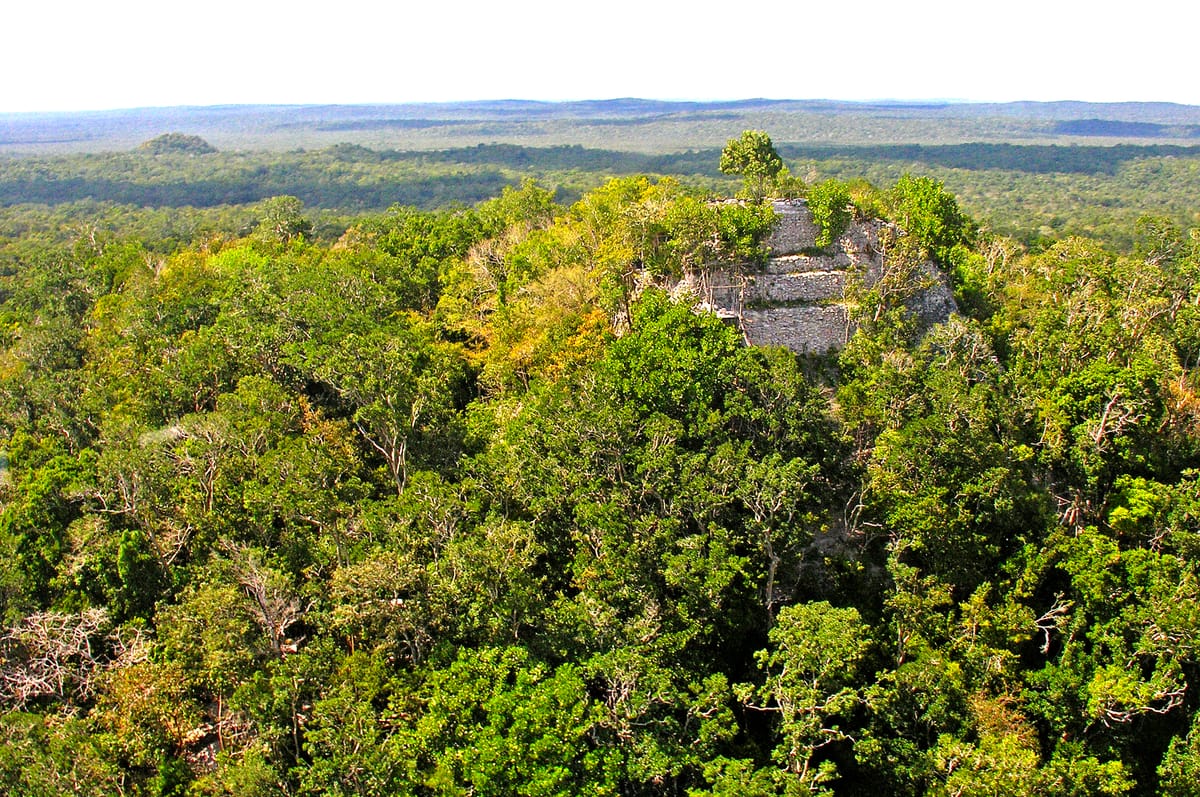
The largest thing in it is La Danta, “the tapir”. It measures roughly 600 by 320 metres at the base and stands about 72 metres from the forest floor to the top of the shrine on its summit. Its estimated volume — around 2.8 million cubic metres of cut stone and fill — exceeds that of the Great Pyramid of Giza. Guinness lists it as the largest Maya pyramid; by volume, among ancient pyramids worldwide, it is generally placed second only to the Great Pyramid of Cholula.
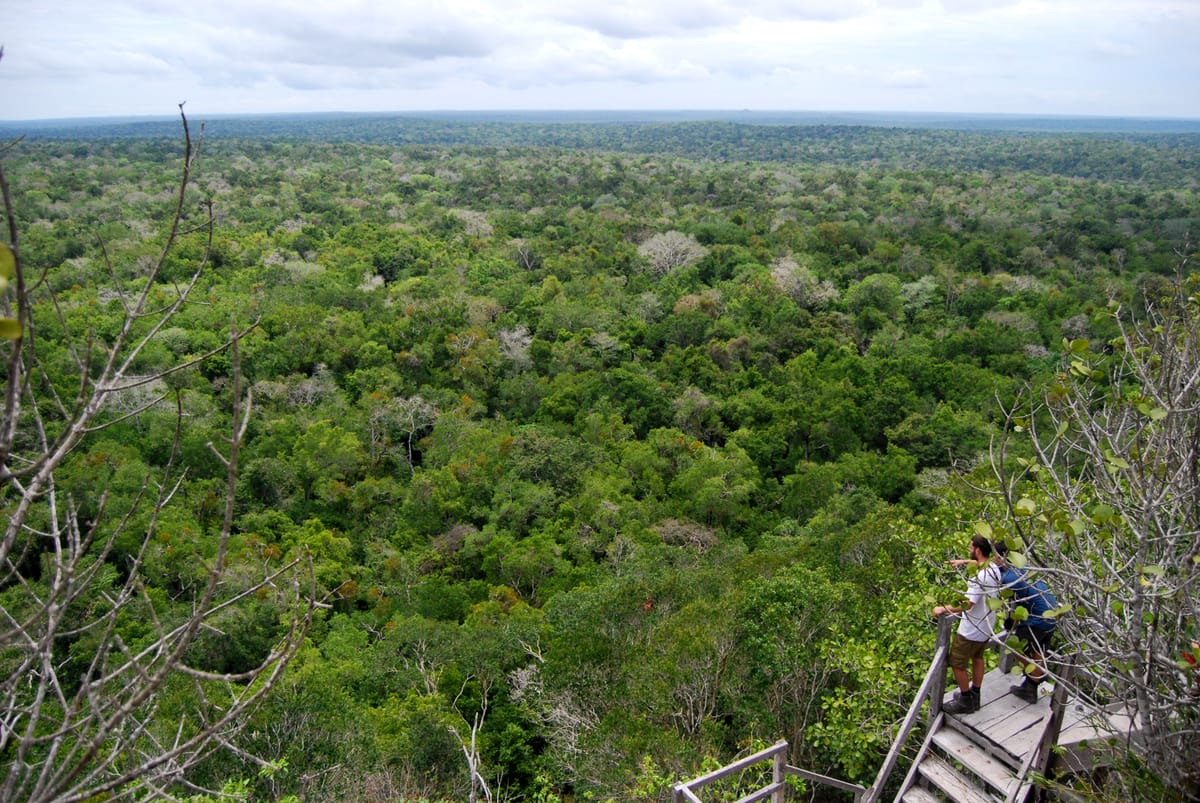
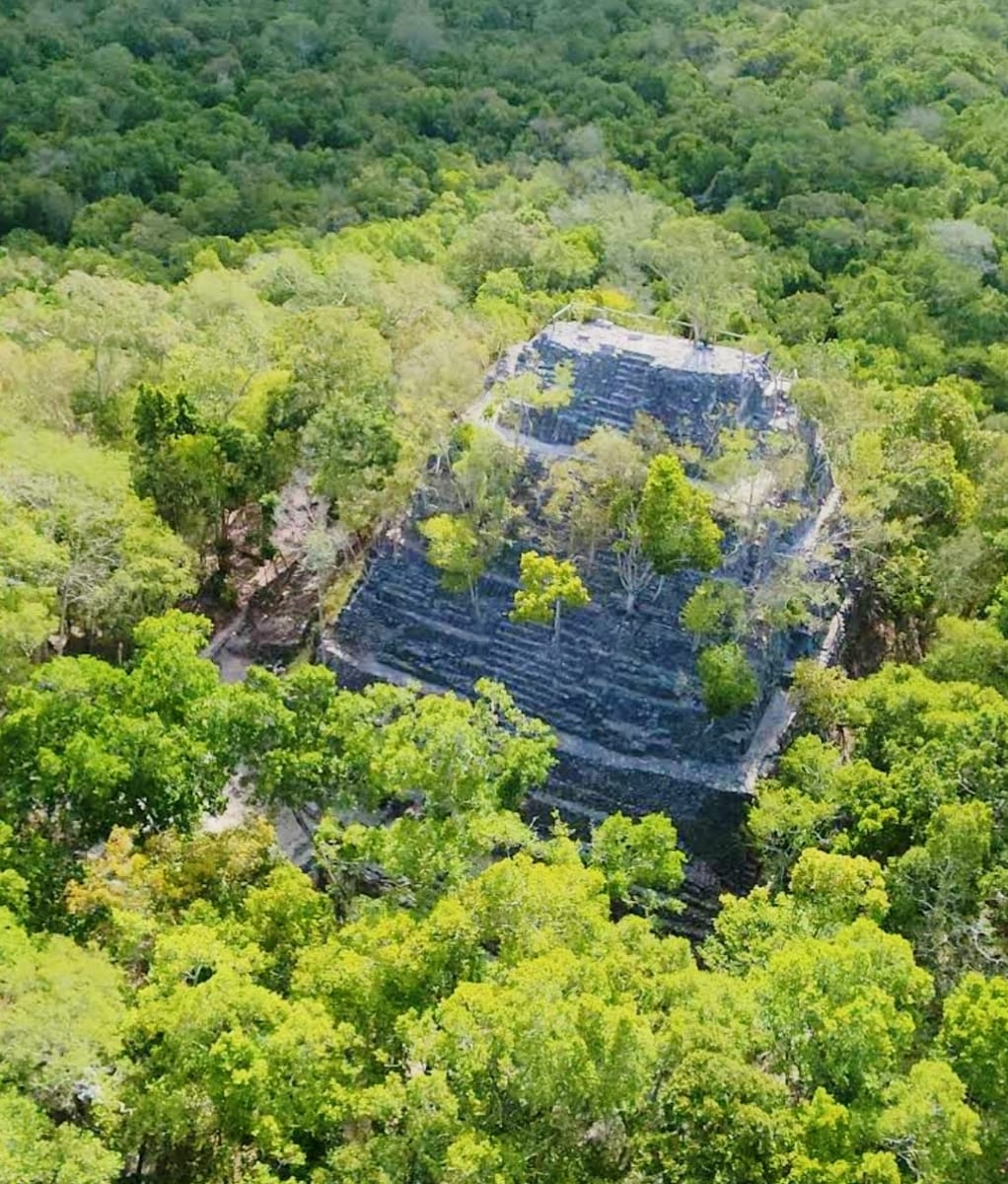
Almost none of that is visible. La Danta is not a pyramid standing in a clearing. It is a forested hill with trees growing out of it, and the only part that reads as architecture from the air is the cleared stonework at the very top. The basin around it is the same: hundreds of structures under unbroken canopy, invisible from a hundred metres away.
The Structure
La Danta is not one pyramid but a stack of three continuous platforms, each supporting the next.
The first tier is a vast artificial terrace of cut stone and rock fill, roughly 300 metres wide and 600 metres long — around 18 hectares, or some 45 acres, raised bodily above the forest floor. On top of that sits a second platform, and on top of that a third, about 26 metres high, which serves as the base for the structure that gives the whole thing its height: a triadic group, a dominant central pyramid flanked by two smaller ones facing inward across a shared summit court.
The triadic form is the signature of Preclassic Maya monumental architecture. It does not appear before about 300 BCE, and El Mirador has roughly 35 of them. The three-point arrangement is widely read as the three hearthstones of creation — a celestial hearth, rendered in limestone at the scale of a hill. La Danta is the largest example; El Tigre, elsewhere in the same city, reaches 55 metres, and Los Monos 48.
Binding the city together — and binding it to its neighbours — is a network of causeways, the sacbeob or “white roads”. These are not paths but engineered embankments: 2 to 6 metres high and 20 to 50 metres wide, surfaced in lime plaster, running dead straight through swamp and forest. Thirteen of them interconnect within the site. One runs about 12 km to Nakbé, another roughly 20 km to El Tintal. A LiDAR survey of the Mirador-Calakmul Karst Basin published in Ancient Mesoamerica in 2022 mapped more than 177 km of these elevated Preclassic causeways, along with over 775 settlements in the basin itself and 189 more on the surrounding karst ridge — condensed by the survey team into 417 cities, towns and villages arranged in at least six tiers by size and architectural configuration.
The city’s food came from the bajos, the seasonal swamps that fill the low ground. Thousands of tonnes of nutrient-rich swamp mud were carried out of them and spread on terraces, with lime added to raise the soil’s pH, to grow maize, squash, beans, cacao, cotton and palm. Depleted fields were regenerated by adding a fresh layer of mud.
At some point before the terminal Preclassic abandonment, a defensive wall between 3 and 8 metres high was thrown up around the northern, eastern and southern sides of the site. By about 150 CE El Mirador was essentially empty. Around 700 CE parts of it were reoccupied on a much smaller scale — Late Classic construction there scarcely exceeds 8 metres — and by about 900 CE the basin was abandoned again, this time for good.
How Was It Built?
The Preclassic Maya had no metal tools, no wheeled transport, no pulleys and no draft animals. Every cubic metre of La Danta was cut, carried and placed by people.
The raw material was underfoot. The Mirador Basin is karst: the limestone is the bedrock, and quarry scars are found immediately adjacent to the monumental groups. Freshly cut limestone is soft enough to shape with stone and hardwood tools and hardens on exposure to air, which is the single technical break the Maya were given. Facing stone was dressed; the interior was rubble and rock fill, retained by walls and revetments and built up in enormous cells. The whole surface was then finished in lime plaster — burnt limestone, slaked and applied — which is what made the causeways white and the platforms dazzling.
Richard Hansen, who has directed work in the basin since 2003, has estimated the labour at as much as 15 million person-days for La Danta alone. Even at ten thousand workers labouring every single day, that is over four years of continuous effort just for this one structure, in a city that contains dozens of others.
Two constraints make that harder than the raw numbers suggest.
The first is water. The Mirador Basin has no permanent rivers. Everything depends on capturing and holding the wet-season rain, and the survey work has identified water management and collection facilities as a defining feature of the Preclassic sites — reservoirs and channels that were part of the same construction programme as the pyramids, because without them there is no workforce to build the pyramids.
The second is fuel. Lime plaster is what makes Maya monumental architecture possible, and it is brutally expensive to produce: roughly five tonnes of limestone and five tonnes of wood are needed to make one tonne of lime. A city that plasters 177 kilometres of causeway and dozens of platforms is consuming forest at an industrial rate. That consumption has been linked directly to the basin’s collapse — deforestation drove catastrophic erosion, and a sterile clay layer two to three metres thick was washed into the bajos, burying the nutrient-rich muck that the entire agricultural system depended on. The thing that made the city buildable appears to have unmade the thing that made it feedable.
The Mainstream View
There is no serious dispute that La Danta is a Maya construction of the Late Preclassic, built by the people whose settlements and causeways surround it, using techniques visible in its own fabric and in dozens of comparable structures across the basin. Ian Graham produced the first map in 1962; Bruce Dahlin directed work from 1978 to 1983; Ray Matheny excavated the site centre; Hansen’s Mirador Basin Project has run since the early 2000s and has published extensively.
What the mainstream has genuinely revised is when the Maya became capable of this. El Mirador overturned a long-standing picture in which the Preclassic was a modest run-up to the real achievement of the Classic period. The basin shows monumental architecture, regional road networks, engineered water systems and intensive agriculture already in place by the third century BCE — and the largest structure the Maya ever built belonging to that early phase, not the later one. Hansen argues from this that the Mirador Basin represents the earliest well-defined political state in Mesoamerica.
The scale is also, in an ordinary way, a function of time. La Danta was not raised in a single campaign but accreted over generations, each phase enclosing the last, which is the standard Mesoamerican pattern and the reason volumes get so large.
The Open Case
Three things remain genuinely unsettled, and the first is the number everyone quotes.
Hansen’s own volume calculation — about 2,816,016 cubic metres — carries an explicit condition: unless there is a topographic anomaly, such as a natural hill inside. La Danta sits on a low natural rise, and under a hundred metres of vegetation, distinguishing built mass from the limestone knoll it was built around is genuinely hard. Nobody has excavated through the middle of a 600-by-320-metre platform to find out. So the headline figure — larger than Giza, largest structure in the Americas — rests on an assumption its own author flagged, and the labour estimates that follow from it inherit the same uncertainty. This is not a scandal; it is what an honest measurement of a jungle-covered hill looks like.
The second is what kind of society did it. The evidence for scale is overwhelming: 417 settlements, 177 km of causeways, water systems, a shared architectural grammar. What that adds up to politically — an early state with centralised authority, or a dense network of allied polities capable of mobilising labour without one — is argued about, and the 2022 LiDAR paper is careful to present it as an interpretation of labour investment rather than a settled fact. Nobody has found a Preclassic royal tomb at El Mirador on the scale of the later Classic burials, and the Preclassic Maya left very little writing.
The third is why it ended. A defensive wall went up. Then the basin emptied, around 150 CE, and the Maya centre of gravity moved south and east to cities like Tikal. Deforestation, erosion and the clay-buried bajos provide a mechanism, and it is a good one. Whether that was the cause, a symptom, or one pressure among several — drought, warfare, the collapse of trade — is not resolved.
What is not in doubt is the achievement, and it is worth stating plainly. Before the Classic Maya existed, in a swamp basin with no rivers, people with stone tools and baskets moved something close to three million cubic metres of rock into the sky, plastered it white, and connected it to a hundred and seventy kilometres of raised road. Then the forest took it back so completely that it took an airborne laser to find out how much of it there was.
Sources
Gallery