Codz Poop (Palace of the Masks), Kabah
How did Kabah's masons cut, sort and fit thousands of interchangeable limestone elements — with no metal tools, no wheel and no surviving plan — into rank upon rank of near-identical god-masks covering an entire 53-metre façade?
Why this rating?
- Construction difficulty
- 3/5
- Method uncertainty
- 3/5
- Capability gap
- 2/5
- Open questions
- 4/5
The Puuc core-and-veneer building method is well understood and entirely within documented Maya capability, but the organisation behind the façade is not: carving, sorting and fitting more than five thousand interchangeable mosaic elements with stone tools implies a standardised workshop system that leaves almost no direct archaeological trace. Who the masks actually depict — Chaac, Itzamnaaj or the Witz mountain being — and why Kabah alone pushed the motif to this extreme remain genuinely unsettled.
Overview
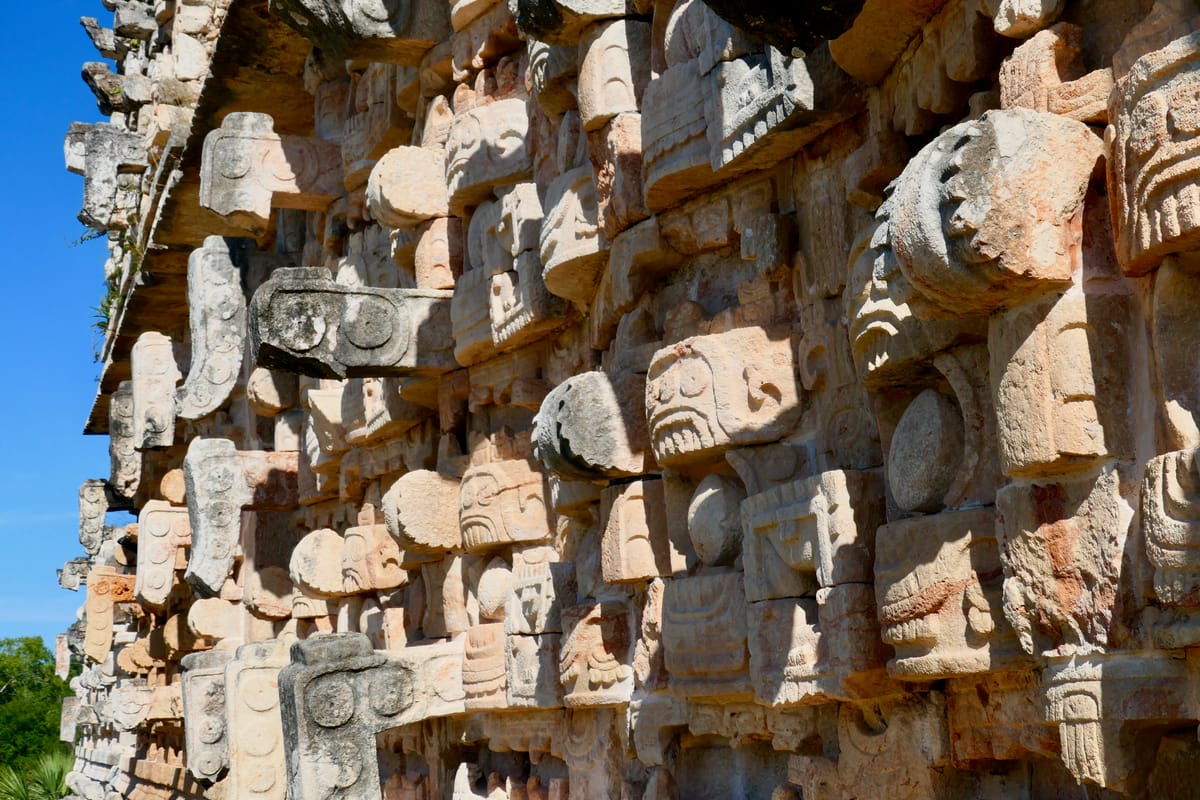
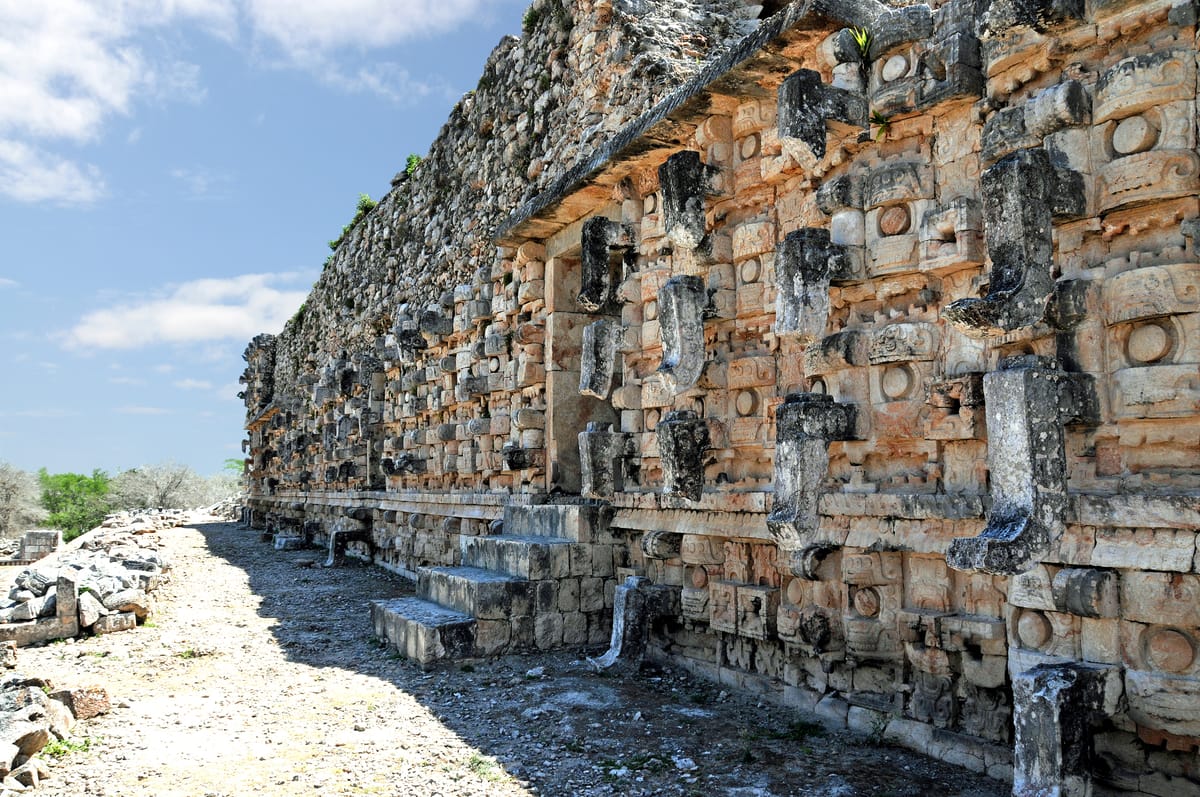
The Codz Poop — catalogued by archaeologists as Structure 2C6, and known in Spanish as the Palacio de los Mascarones, the Palace of the Masks — is the signature building of Kabah, an ancient Maya city in the Puuc hills of Yucatán, Mexico, about 140 kilometres south of Mérida. It is a long, low, two-tiered range building of pale limestone, and it is famous for one thing: its entire western front, from the base of the wall to the roofline, is covered in row upon row of the same sculpted deity face. Each face has goggle eyes, a squared brow, a fanged mouth and a heavy hooked snout that curls outward from the wall like a rolled-up trunk. There are no blank panels, no figural scenes breaking the rhythm, no restful stretches of plain masonry — just the same head, repeated across roughly 53 metres of wall.
Nothing else in Maya architecture looks quite like it. Long-snouted masks are a standard motif across the Puuc region and beyond, but they normally appear as accents: clustered at building corners, stacked over doorways, framing a stair. Only at Kabah does a single mask become the entire skin of a building. The name Codz Poop is usually translated from Yucatec Maya as “rolled mat” or “rolled matting” — a reference either to the mat-like weave of the mosaic or to the curled, rolled form of the masks’ snouts. Kabah was inscribed on the UNESCO World Heritage List in 1996 as part of the listing centred on the nearby city of Uxmal, which takes in the neighbouring Puuc towns of Kabah, Sayil and Labná as a single cultural landscape.
The Structure
Kabah was occupied from at least the middle of the last few centuries BCE, but the city that survives above ground is overwhelmingly a product of the Terminal Classic period, roughly the seventh to eleventh centuries CE, when the Puuc region reached its florescence and Kabah acquired more large monumental structures than any other site in the region. The Codz Poop belongs to the heart of that boom. Two hieroglyphic dates carved on the building’s own doorjambs anchor it firmly in time: a text on the eastern door, read by Nikolai Grube and Daniel Graña-Behrens, records 10.1.10.0.11, 2 Chuen 3 Muan — 14 October 859 CE — alongside a scene of a slain warrior and the phrase u kamiiy, “his death.” A second jamb date, found in INAH excavations in 2013 and published by David Stuart and Meghan Rubenstein, gives 10.2.3.11.6, 9 Cimi 8 Zotz — 9 March 873 CE — and appears to mark a later building phase, fourteen years on. Elsewhere at Kabah a date of 987 CE survives, among the very latest Classic-style Maya dates known anywhere in the lowlands; the city was largely abandoned in the eleventh or twelfth century.
The building itself is a palace-type range structure, often given as about 46 metres long, with ten vaulted chambers arranged as two tiers of five. Those chambers include some of the widest corbel-vaulted interior spaces the Maya ever achieved. The decorated west face, as measured during its recent conservation, runs 53 metres long and stands about 7 metres high. Mexico’s Instituto Nacional de Antropología e Historia counted 161 complete masks on the structure — 125 on the west façade itself, 26 on the north wing and 10 on the south — assembled from some 5,400 individually carved stones. Popular accounts often quote larger, rounder figures of 250, 300 or even 356 masks; those numbers include fragmentary, fallen and reconstructed elements, and no two counts agree, which is itself a measure of how much of the façade has had to be pieced back together.
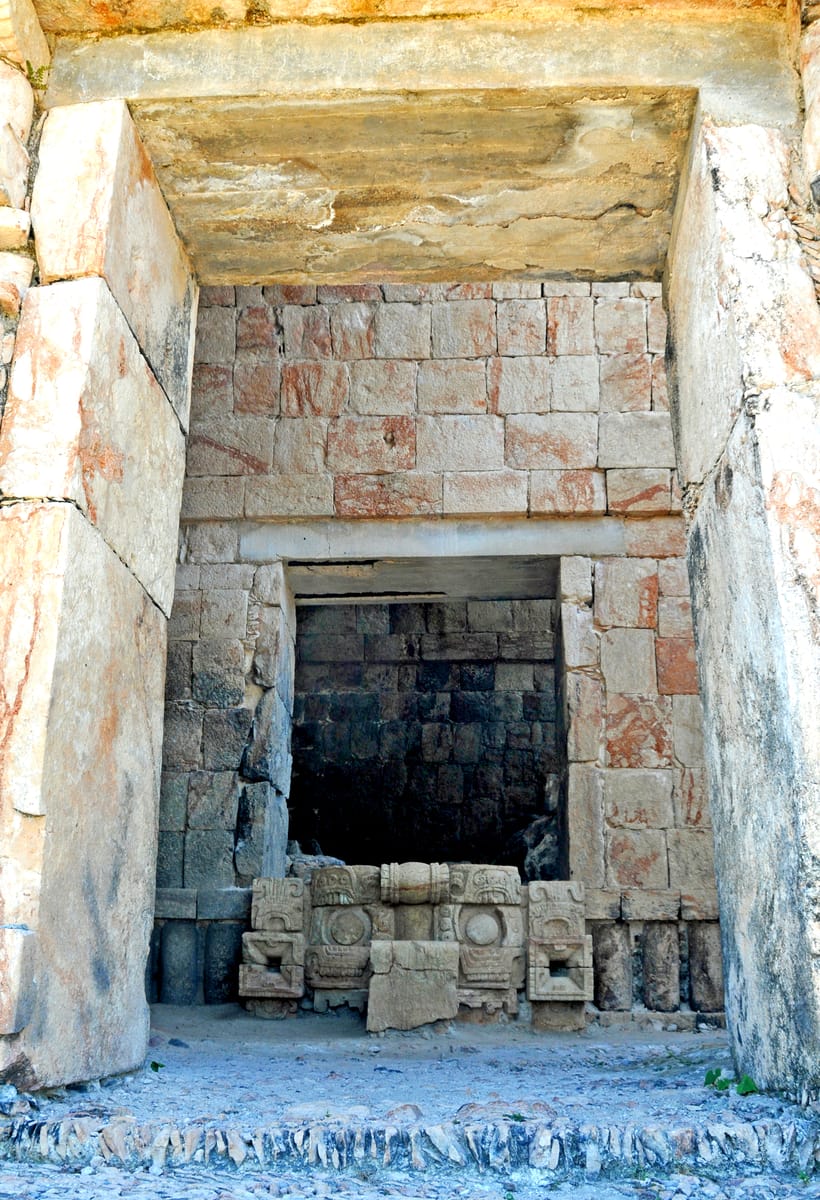
Every mask is a kit. A single face is built from roughly thirty separate carved blocks — brow plates, squared eye surrounds, circular eye discs, tooth rows, ear flares, and the several interlocking pieces that make up the great curling snout — each cut to slot into the wall as a tenoned veneer stone rather than carved from a monolith. Traces of the original polychromy in red, ochre and black survive in sheltered pockets, so the façade would once have read not as pale limestone but as a wall of painted faces. The masks were also functional architecture as well as ornament: inside the building, a set of mask snouts is laid on its side and used as the treads of a stairway leading up to the rear rooms, so that anyone entering the inner chambers literally climbed over the god’s face.
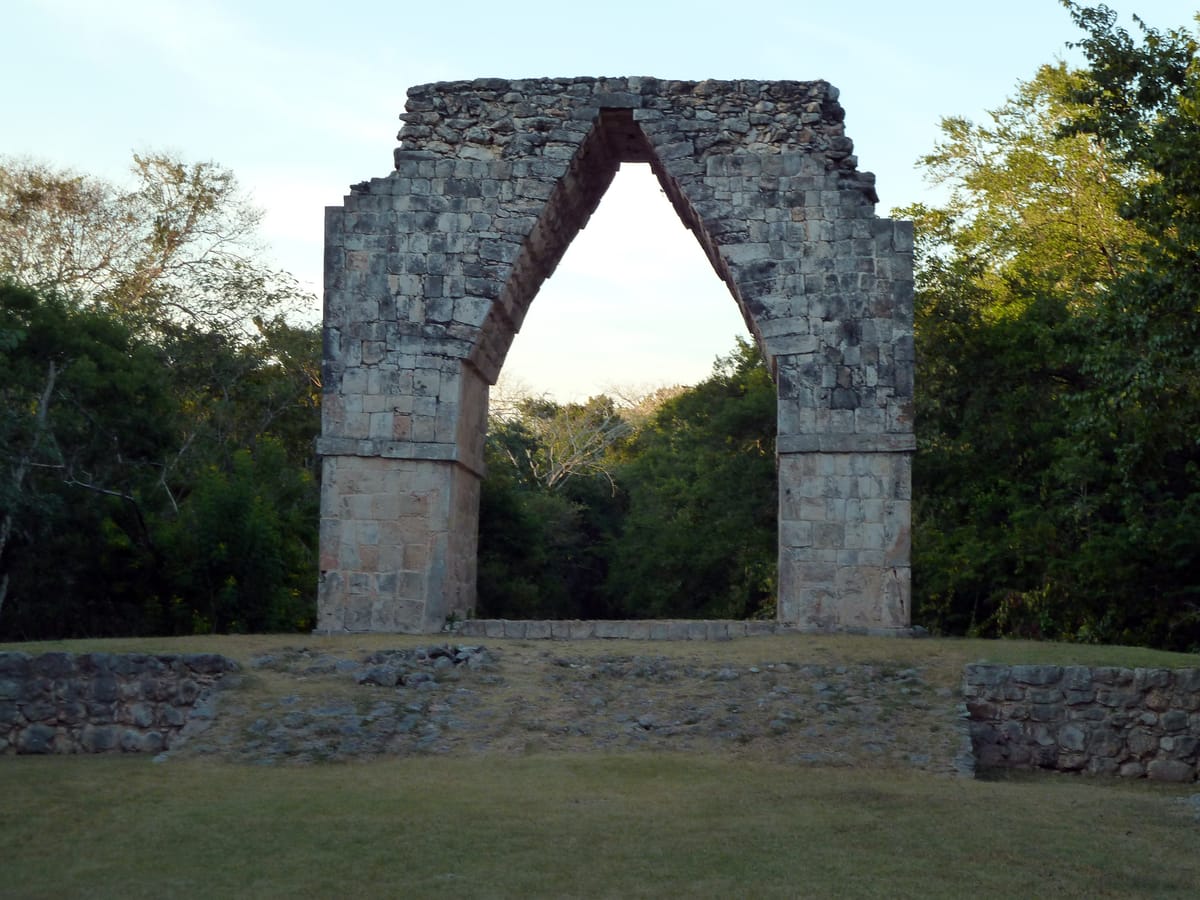
Kabah sits in a landscape with a specific problem. The Puuc region has no cenotes — the natural sinkholes that gave northern Yucatán’s other Maya cities year-round access to the water table. Here there was only rain, caught and stored in bottle-shaped cisterns called chultunes. That dependence shaped Puuc religious life, and it is one reason the long-snouted mask is so often identified with Chaac, the rain deity. Excavators have found copal incense packed inside the hollow stone snouts of masks at the site — offerings placed into the sculpture itself. Kabah was also physically tied to Uxmal, the dominant Puuc capital, by an 18-kilometre raised causeway or sacbe roughly five metres wide, with a monumental corbelled arch standing at each end; the Kabah arch still stands.
The site entered Western scholarship in 1843, when John Lloyd Stephens and Frederick Catherwood published the first detailed description and drawings of Kabah in Incidents of Travel in Yucatan. Much of the finest carved work — sculpted panels, lintels and doorjambs showing rulers, dancers and scenes of warfare — was subsequently removed to museums. Modern archaeology at the Codz Poop runs from H. E. D. Pollock’s mid-century survey of the Puuc through excavations from the early 1990s directed by Ramón Carrasco Vargas, with José Ligorred Perramón overseeing work on the building itself, to a major conservation campaign carried out between July 2022 and June 2023 under Promeza, the archaeological-zone programme attached to the Tren Maya project. That campaign — cleaning microflora, consolidating crumbling surfaces, rejoining fragments, stripping out the cement mortars of earlier interventions and replacing concrete lintels with timber — won INAH’s 2024 Paul Coremans Prize for conservation. In July 2026 the new Archaeological Museum of the Puuc opened at Kabah, displaying more than 250 pieces from the region.
How Was It Built?
The Codz Poop is a mature example of Puuc construction, and the method is well documented. Puuc builders worked in core-and-veneer: they raised a thick structural core of limestone rubble bound with lime mortar, essentially a rough concrete, and then faced it with thin, precisely dressed veneer stones that carried none of the load. Vaults were closed with specialised wedge-shaped, boot-shaped stones with bevelled faces, standardised enough to be produced in quantity, which is what allowed Puuc rooms to be wider and more stable than earlier Maya vaults built from large structural blocks. Lime for the mortar and plaster was burned from local limestone; the plaster was improved with bark extracts from chukum and similar trees, a traditional additive that gave Yucatecan renders their durability.
Crucially, the mosaic decoration is part of that veneer system rather than something applied to it. Each element of each mask was quarried, roughed out and finished as an individual block with a tenon at the back, then bedded into the mortar core as the wall went up. All of this was done with stone tools — chert and flint hammerstones, chisels and abraders — by a society with no metal implements, no draft animals and no wheel. The stone is a soft, workable limestone that hardens on exposure, which is precisely what makes such fine, repetitive carving practical at all.
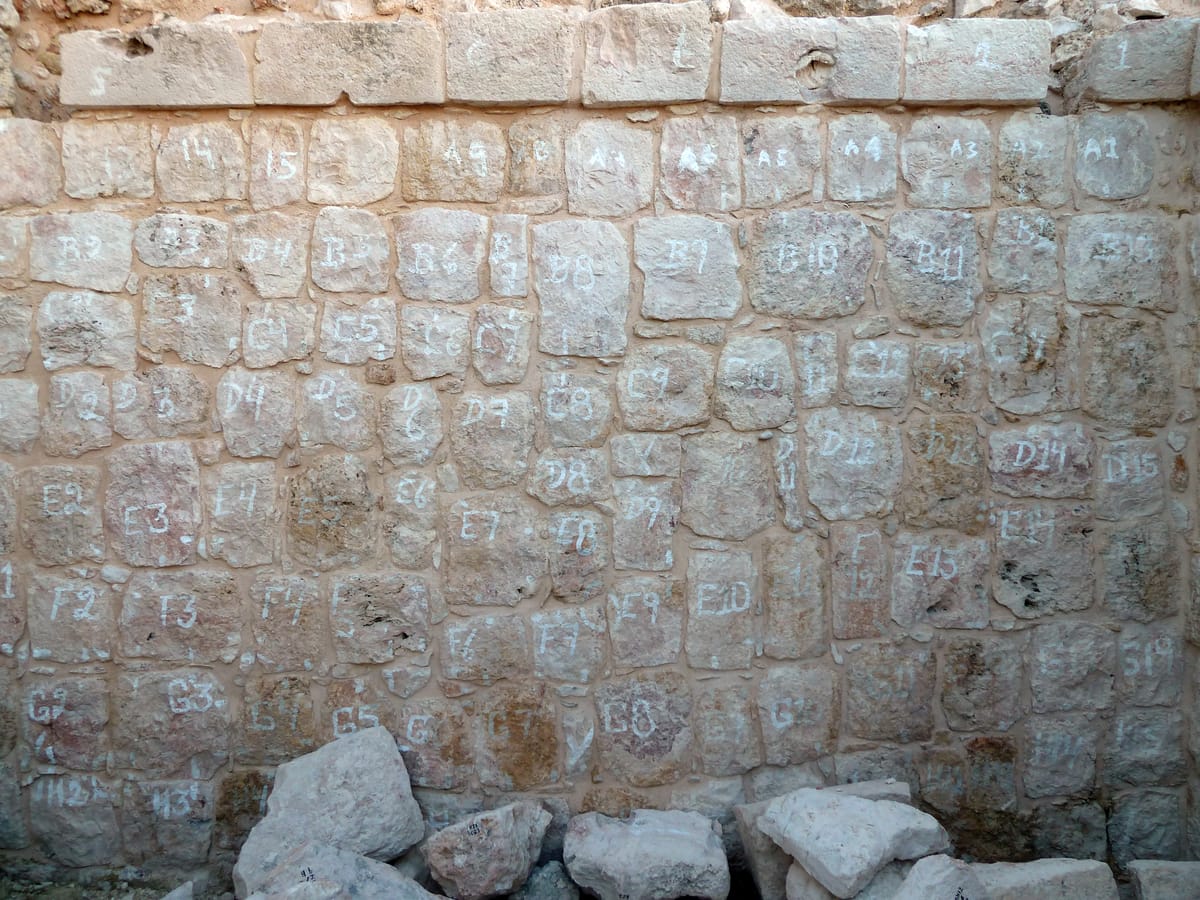
What the method does not by itself explain is the logistics. Building this façade meant producing thousands of small carved components that had to be interchangeable enough to be cut by many different hands, yet accurate enough that thirty of them would compose into a face, and that a hundred and sixty-odd such faces would line up into continuous horizontal registers across 53 metres of wall. That implies templates or gauges, a division of labour by element type, a system for sorting and staging finished pieces on site, and a supervising design — something much closer to a standardised workshop than to the freehand carving of a single sculptor. No templates, sketches or working plans have survived, and the workshops themselves have left little archaeological trace. The nearest modern echo of the problem is visible in the restoration itself: photographs from the site show fallen veneer stones chalked with grid codes — A1, B4, D12 — so that conservators could work out where each anonymous block belonged. Kabah’s builders faced the same sorting problem in reverse, a thousand years earlier, without chalk or a plan on paper.
The Mainstream View
There is no scholarly mystery about who built the Codz Poop or roughly when. It is a Puuc Maya palace of the Terminal Classic, raised by the rulers of Kabah in the second half of the ninth century, in a regional style shared with Uxmal, Sayil and Labná, and dated by hieroglyphic texts carved on the building’s own doorjambs. Nor is there any serious dispute about the technique: the core-and-veneer method, the boot-shaped vault stones and the tenoned mosaic veneer are all thoroughly documented across dozens of Puuc buildings, and every material and tool involved is attested in the Maya archaeological record. The scale of the labour is large but not extraordinary for a Terminal Classic city with an organised elite and a tributary hinterland.
The masks are read as ideology made visible. The dominant interpretation for most of the twentieth century identified the long-snouted face as Chaac, the rain god — an obvious fit for a region with no cenotes and total dependence on rainfall, and the reading behind the building’s popular name in English. Earlier scholars proposed other identifications: Eduard Seler saw Quetzalcoatl, and J. Eric S. Thompson argued for Itzamnaaj, the celestial creator deity. More recently the balance has shifted again toward reading the motif as witz, the animate zoomorphic form of a sacred mountain — which would make the whole building a stylised mountain, and its masked doorways the mouths of caves. INAH’s own conservation reporting now uses the Witz identification while explicitly noting that the masks have been associated with all three deities over the history of research. Meghan Rubenstein’s study of the building argues that Puuc mask iconography expressed a shared regional ideology which individual rulers then modified, turning a common motif into a statement of local authority — the Codz Poop being the most extreme case: a ruler who took the region’s standard architectural symbol and used it to clad an entire palace, saturating one building with a single sacred image.
The Open Case
What is genuinely unresolved at Kabah is not whether the Maya could build this — they plainly did, with tools and methods we can describe in detail — but what it cost, how it was organised, and what it was for.
The first open question is the production system. A façade of five thousand-plus interchangeable carved elements is, in effect, a pre-industrial assembly line executed in stone, and archaeology has recovered almost none of it: no workshop floors littered with half-finished eye discs, no templates, no marked-out blocks, no record of how the work was divided or how long it took. Whether Kabah’s masons worked from physical gauges, from a memorised canon of standard element types, or from a master mask copied down the wall, is unknown. So is the question of whether the crews were local and permanent or drawn in seasonally, and whether the same specialists moved between Kabah, Uxmal and Sayil — which would help explain the regional uniformity of Puuc mosaic work.
The second is identity. After more than a century of argument, scholars still cannot agree what the face on the wall actually is. Quetzalcoatl, Itzamnaaj, Chaac and Witz have each held the field in turn, and the current shift toward the mountain reading is a live reinterpretation, not a settled verdict — a striking situation for the single most reproduced image in northern Maya art. Even the count is contested: 161 complete masks by INAH’s conservation tally, but 250, 300 or 356 in widely circulated accounts, with the round number 356 sometimes floated as a calendrical near-match for the solar year. That last idea is attractive and entirely unproven; the counts vary because the façade is partly a reconstruction, and how many masks originally stood on the building is simply not known with confidence.
The third is why here, and only here. Every Puuc city had the motif; only Kabah tiled a palace with it. Whether that was a rain-crisis response, a ruler’s assertion of independence from Uxmal at the far end of the causeway, or a theological statement about the building as a living mountain, remains a matter of interpretation. And it happened late — within a century or so of the Codz Poop’s dated jambs, Kabah, along with most of the Puuc, was abandoned, in a collapse widely linked to drought in a landscape that had no groundwater to fall back on. There is nothing here that requires anything beyond Maya hands, Maya stone tools and Maya organisation. But standing in front of that wall, watching one face repeat until the eye loses count, the question that keeps returning is a very human one: what does a society have to believe, and how must it be organised, to carve the same god five thousand pieces at a time?
Sources
- UNESCO World Heritage Centre — Pre-Hispanic Town of Uxmal
- INAH — Reconocen proyecto de restauración de los mosaicos de piedra de la Zona Arqueológica de Kabah, con Premio INAH
- Maya Decipherment (David Stuart & Meghan Rubenstein) — The Reading of Two Dates from the Codz Pop at Kabah, Yucatan
- Meghan Rubenstein — Animate Architecture at Kabah: Terminal Classic Art and Politics in the Puuc Region of Yucatán, Mexico (PhD dissertation, UT Austin)
- Arqueología Mexicana — Kabah, Yucatán
- Wikipedia — Kabah (Maya site)
Gallery