El Fuerte de Samaipata
Why did successive cultures spend more than a thousand years carving a single sandstone hill into the largest sculptured rock on Earth — cutting channels, niches, and animal reliefs into the living stone — and what were all those figures actually for?
Why this rating?
- Construction difficulty
- 2/5
- Method uncertainty
- 2/5
- Capability gap
- 2/5
- Open questions
- 5/5
The carving technique itself is not especially mysterious — the figures were pecked and ground into soft, workable sandstone with stone and (later) metal tools over many centuries, and no block-moving or precision-fitting feat is involved. What is genuinely unresolved is the why: the meaning of the hundreds of niches, channels, and animal reliefs, whether the parallel grooves track astronomical events, and how the pre-Inca and Inca layers of belief relate. The wonder here is the scale and purpose of the sculpting, not the difficulty of cutting the stone.
Overview
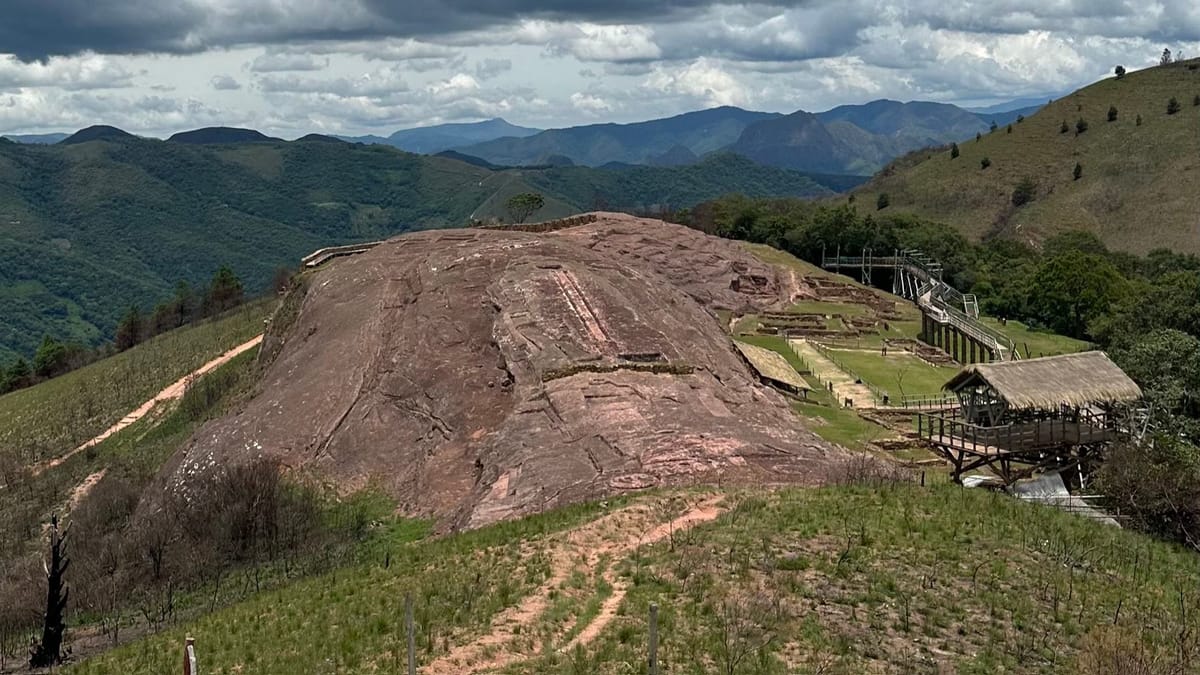
El Fuerte de Samaipata is an archaeological site in the eastern foothills of the Bolivian Andes, near the town of Samaipata in the Santa Cruz Department, roughly 120 kilometres southwest of the city of Santa Cruz de la Sierra and about 1,950 metres above sea level. Its name — Spanish El Fuerte, “the fort,” combined with the Quechua Samaipata, often glossed as “resting place in the heights” — is misleading: this was never a fortress. The site is built around a single enormous outcrop of red sandstone, roughly 220 metres long and 60 metres wide, whose entire crest was sculpted over more than a thousand years into a dense field of channels, basins, niches, terraces, and animal reliefs, all cut directly into the living bedrock rather than assembled from separate stones. UNESCO, which inscribed Samaipata on the World Heritage List in 1998, describes it as a “unique testimony to pre-Hispanic traditions and beliefs” with “no parallel anywhere in the Americas,” and the carved rock is widely cited as the largest sculptured stone with a ritual function anywhere on Earth. The carving was begun by lowland peoples around 300 CE, elaborated over the following centuries, and then absorbed into the Inca Empire in the late 15th century, when Samaipata became the ceremonial and administrative centre of a provincial capital guarding the empire’s eastern, Amazon-facing frontier.
The Structure
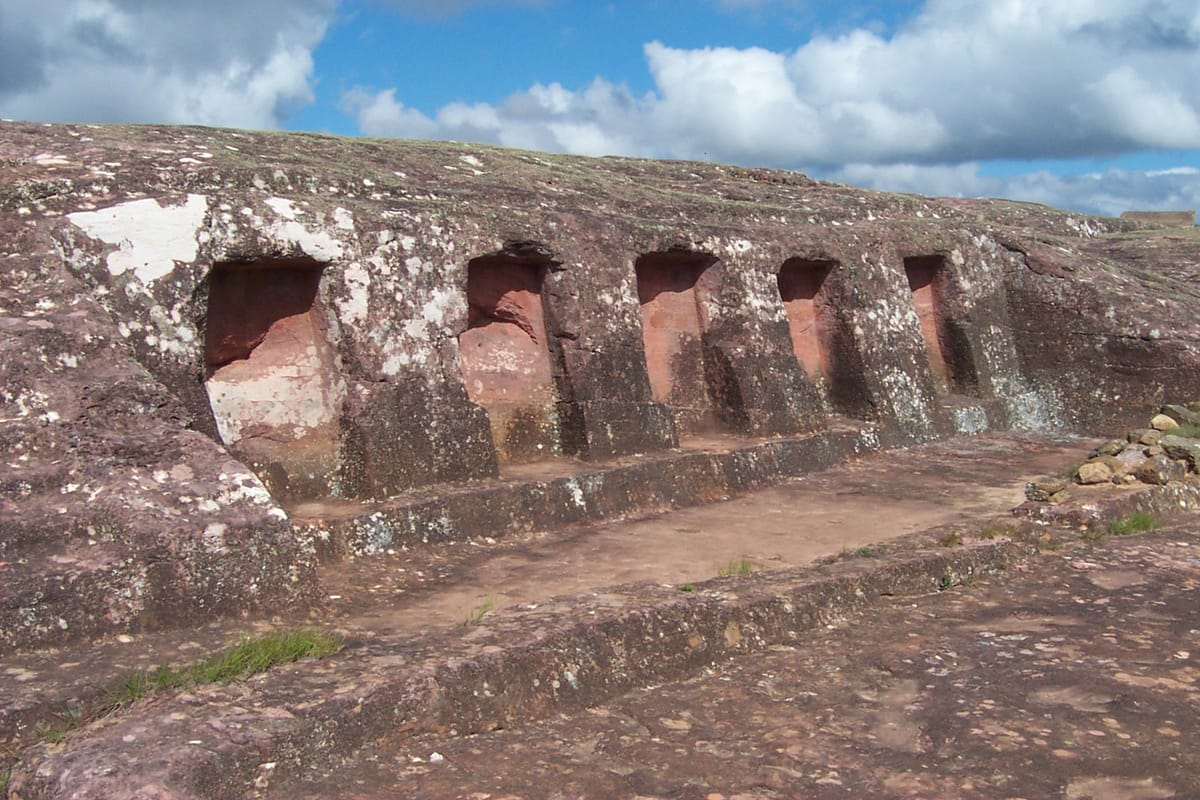
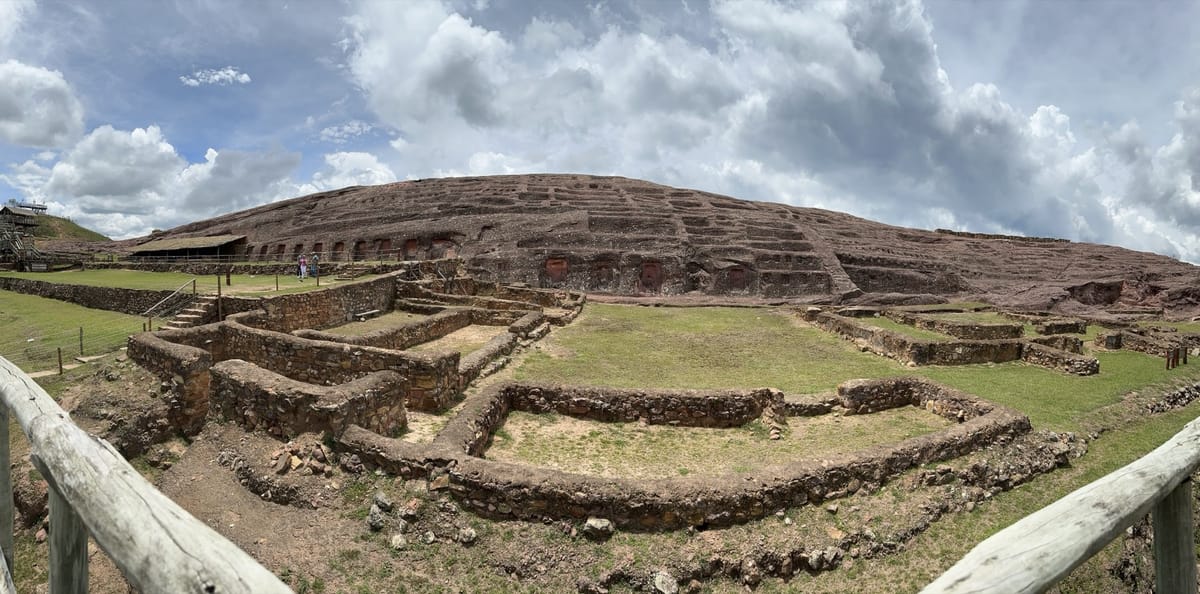
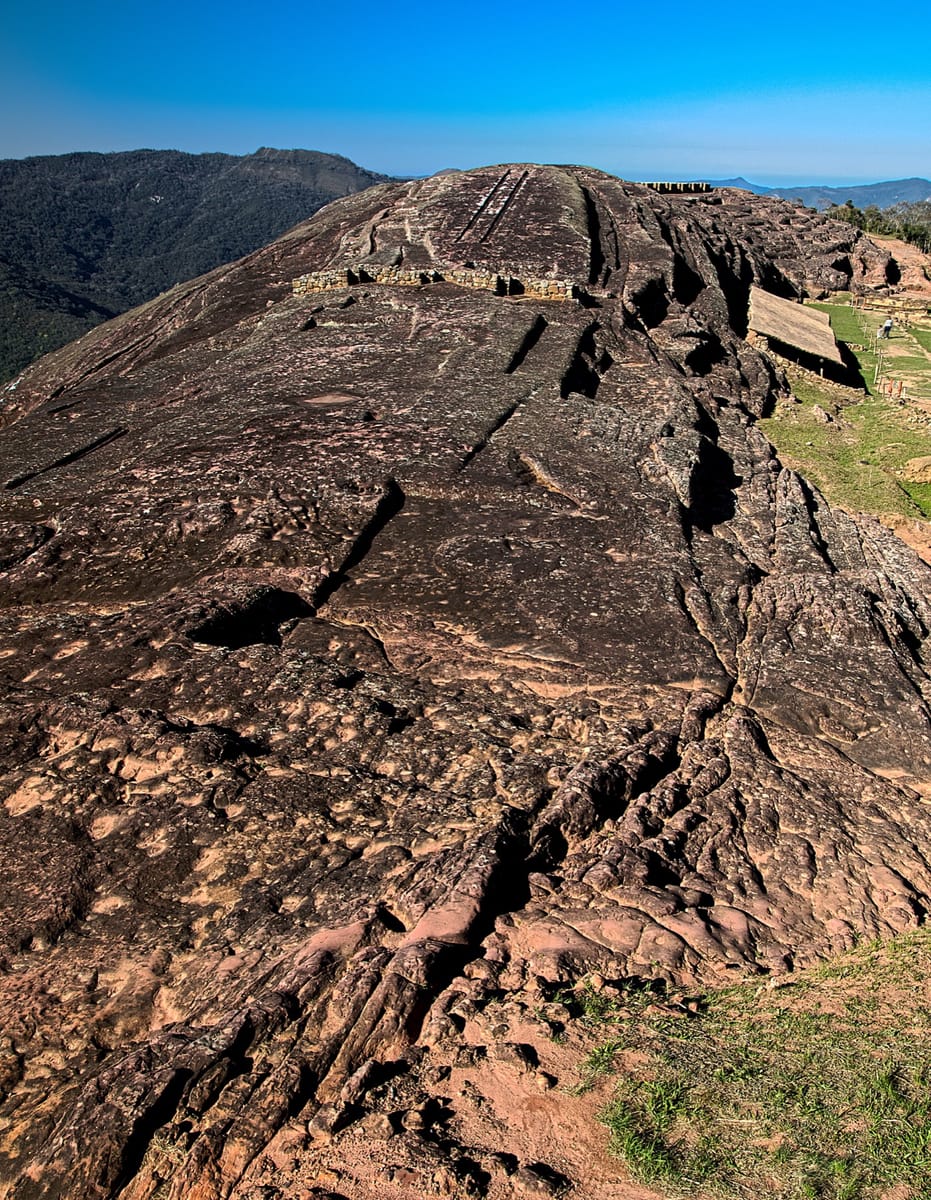
The site has two clearly distinct parts. The first is the sculpted hill itself — the ceremonial heart of the settlement — and the second is the area to its south, a lower zone of plazas and buildings that served as the administrative and residential district. The rock is oriented roughly east–west, and almost every accessible surface of its upper slope carries deliberate carving. Along the flanks run long, narrow parallel channels; the most prominent pair, cut close together and running down the back of the rock, are known locally as el cascabel (“the rattlesnake”) or the “spine of the serpent,” and there are also reliefs of felines, a large feline head, and circular puma or jaguar figures roughly a metre across. Hundreds of rectangular and triangular niches are cut into the rock and into carved terraces: one cluster of eighteen niches at the highest point is called the coro de los sacerdotes, the “choir of the priests,” and another set of carved niches lower down may have held offerings, idols, or served as seats. Interspersed among these are geometric shapes, tank-like basins, and vessel forms.
The successive cultures who worked the rock each left their mark. The earliest carvings are attributed to the Mojocoyas culture and later the Chané, Arawak-speaking lowland peoples who occupied the area from around 300 CE and treated the hill as a sacred ceremonial place. In the late 15th century the Inca, expanding under Topa Inca Yupanqui, annexed the region and overlaid it with their own imperial architecture: a large trapezoidal plaza about 100 metres on a side, and a kallanka — a great rectangular ceremonial hall roughly 70 metres long and 16 metres wide, among the largest such buildings known in Bolivia — along with structures interpreted as an acllawasi, a residence for chosen women dedicated to state religious duties. Samaipata sat on the empire’s turbulent southeastern edge, a buffer against the Chiriguano (Guaraní) peoples pressing in from the Chaco lowlands. After the Spanish conquest the old site was gradually abandoned; the colonial town of Samaipata was formally founded nearby in the early 17th century, and it was Spanish observers, struck by the walls and terraces, who gave the ruin the inaccurate name “the fort.”
How Was It Built?
Unlike the megalithic Inca sites of the Peruvian highlands, Samaipata involved no quarrying, hauling, or precision block-fitting. The entire monument is subtractive: it was made by removing stone from a hill that was already there. The medium is a relatively soft, workable red sandstone, and the figures, channels, and niches were produced by pecking, grinding, and abrading the surface — early carvers using harder hammerstones and abrasives, and the later Inca adding metal tools to the repertoire. Because sandstone is easily shaped but also easily weathered, the carving is at once impressively extensive and, after centuries of exposure to rain and sun, significantly eroded; many reliefs that were once crisp are now soft-edged, and conservation against ongoing weathering is a continuing concern at the site.
What is remarkable is less the technique than the sheer accumulated labour and continuity of intent. Generation after generation returned to the same outcrop and kept adding to it, cutting long straight channels, aligning niches, and shaping animal forms across a surface the length of two football pitches. No single culture designed the whole; the rock is a palimpsest, with pre-Inca zoomorphic and geometric carvings joined and partly overwritten by Inca-period work. The channels in particular show careful planning: they are graded to direct liquid — rainwater, or, many researchers suspect, chicha (maize beer) or other libations poured during ceremonies — along the rock and into carved basins, so that the sculpting is not merely decorative but functional, choreographing the movement of fluid across the stone.
The Mainstream View
Archaeologists are in broad agreement about the essentials. Samaipata was a sacred place — a carved ceremonial mountain — first developed by lowland Amazonian-Andean peoples from around 300 CE, and later appropriated by the Inca state as the religious and administrative capital of a frontier province. The rock’s carvings are understood as the material expression of pre- Hispanic cosmology: the feline and serpent imagery ties into a widespread Andean symbolic world in which pumas, jaguars, and snakes stand for power, the earth, and water, and the niches and basins are read as settings for offerings, libations, and the display of sacred objects or ancestral remains. The channels are interpreted as part of ritual involving the pouring of liquids, consistent with Andean practices centred on water and fertility. The Inca additions — the plaza, the great hall, the residence for chosen women — fit the standard template of an Inca provincial centre, confirming that the empire recognised the existing sanctuary’s importance and built its own ceremonial and political apparatus directly onto it. In this mainstream reading there is no technological puzzle: the site is a well-understood, if extraordinarily ambitious, product of stone tools, soft sandstone, religious devotion, and more than a thousand years of continuous human effort.
The Open Case
What remains genuinely open at Samaipata is not how the rock was cut but why — and what, in detail, all of it meant. The carvings have never been fully “read.” The precise significance of the hundreds of niches is uncertain: seats, shrines, offering-holders, tomb-like recesses, and sockets for now-vanished idols have all been proposed, and different clusters may have served different purposes. The two long parallel grooves that descend the back of the rock have drawn particular attention: some researchers argue they were designed to carry ritual liquids, while others have suggested that their orientation may track the rising or setting of certain stars or the sun at key moments of the year, giving the outcrop an astronomical dimension — though no such alignment has been firmly demonstrated, and the idea remains speculative. Nor is the full chronology settled: pinning down which figures belong to the Mojocoyas, the Chané, or the Inca, across a weathered surface reworked over more than a millennium, is genuinely difficult, and the “debated” label on its dates is honest rather than decorative.
That uncertainty is what makes Samaipata quietly astonishing. Here is the largest carved rock on the planet, worked continuously for over a thousand years by people who left no writing, into a landscape of serpents, felines, channels, and niches whose grammar we can partly translate but not fully speak. The wonder is not that anyone could cut soft sandstone — plainly they could — but that so many generations chose to pour that much effort into a single hill, and that the meaning they encoded there is still, in large part, a message we are only beginning to decode.
Sources
- UNESCO World Heritage Centre — Fuerte de Samaipata
- Wikipedia — El Fuerte de Samaipata
- Encyclopaedia Britannica — Samaipata
- Ancient Origins — Fuerte de Samaipata: A Site of Ceremonial Carvings
- LAC Geo — El Fuerte de Samaipata: Bolivia's Cultural Crossroads
- Bolivia Bella — Who carved El Fuerte de Samaipata?
- bolivia
- inca
- chane
- mojocoyas
- carved-rock
- sandstone
- ceremonial
- unesco
- santa-cruz
- largest-carved-rock
- pre-columbian
Gallery