Coral Castle
How did one small, self-taught immigrant single-handedly quarry, carve, and set roughly 1,100 tons of limestone — including a 9-ton gate balanced so finely a child could push it — with no witnesses and no modern machinery?
Why this rating?
- Construction difficulty
- 2/5
- Method uncertainty
- 1/5
- Capability gap
- 1/5
- Open questions
- 2/5
Leedskalnin's methods are documented by period photographs of tripods and block-and-tackle rigs, tools left on site, and the 1986 gate teardown that found a mundane iron shaft and truck bearing rather than any hidden mechanism; only the precise rigging sequence for individual stones and his personal motivations remain underdocumented, with no credible evidence for the anti-gravity legend the study itself debunks.
Overview
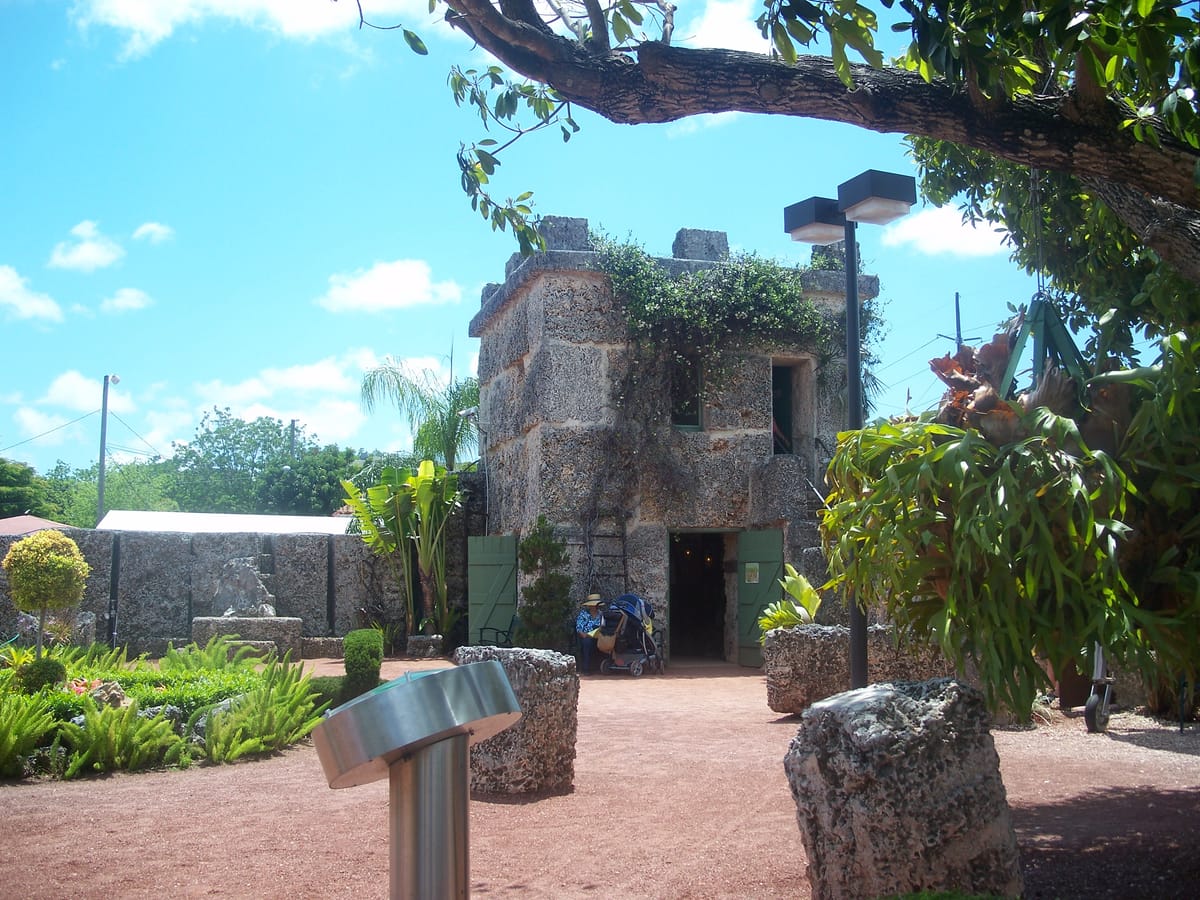
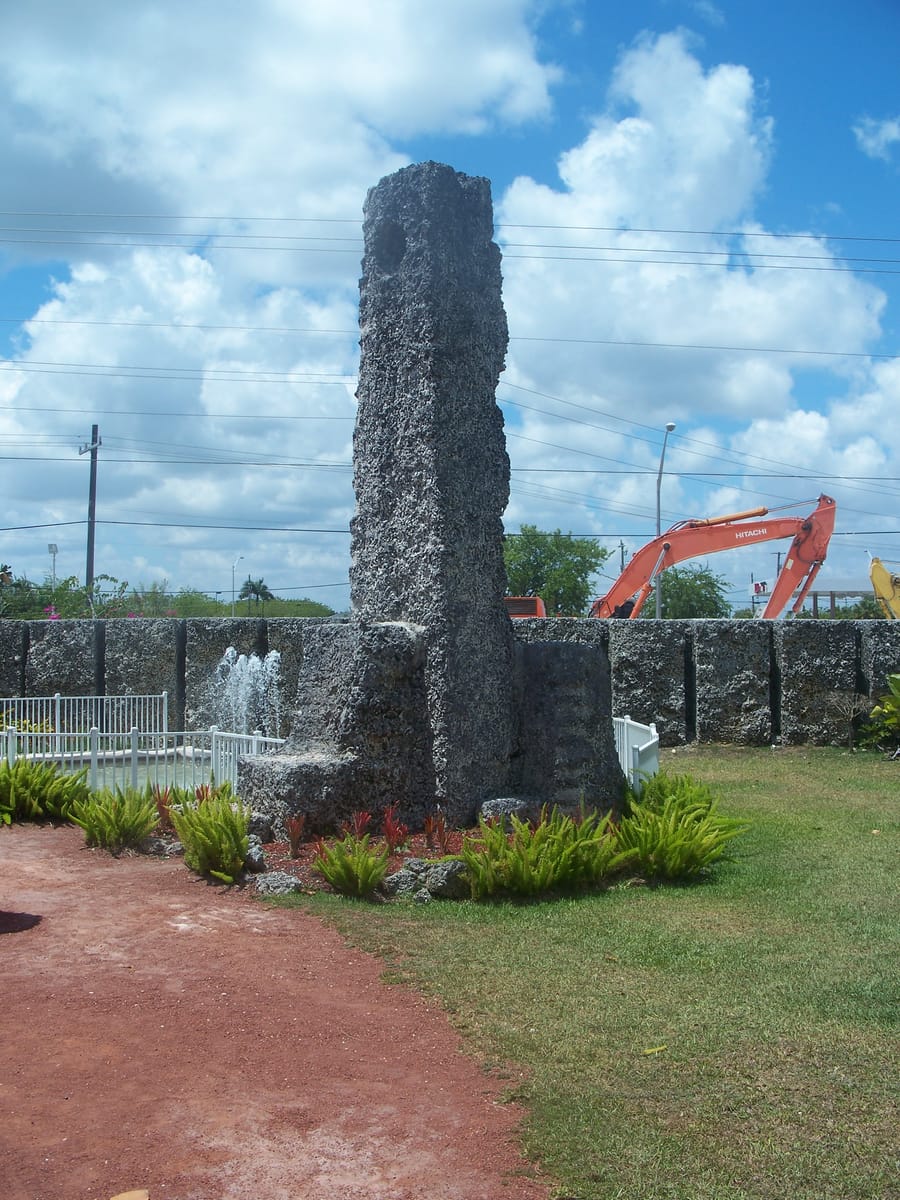
Coral Castle is an open-air sculpture garden of carved limestone in Homestead (within the Leisure City area of unincorporated Miami-Dade County), Florida. Despite its name, it is not made of coral: the material is oolitic limestone, a soft, porous sedimentary rock quarried directly from the shallow bedrock of South Florida, sometimes loosely called “coral rock” because of the fossil shell fragments embedded in it. Between roughly 1923 and 1951, the Latvian-American immigrant Edward Leedskalnin single-handedly quarried, carved, and set an estimated 1,100 short tons of this stone into walls, a two-story tower, carved furniture, a functioning sundial, a Polaris-aligned telescope, and an obelisk, culminating in a famous 9-ton revolving gate so precisely balanced that it could reportedly be pushed open with one finger. Leedskalnin worked almost entirely alone and largely at night, refusing to let anyone watch him move stone, which gave rise to a durable popular legend that he had discovered anti-gravity or the “lost secret of the pyramids.” Coral Castle is unambiguously a 20th-century creation — not an ancient or prehistoric site — and that is central to what makes it worth studying: it is a rare case where the “how was this built by one person with no witnesses” question can be checked against photographs, tools left on site, and living memory, rather than against millennia-old, evidence- poor ruins. It was listed on the National Register of Historic Places in 1984 (originally under the name “Rock Gate”) and today operates as a private museum and roadside attraction.
The Structure
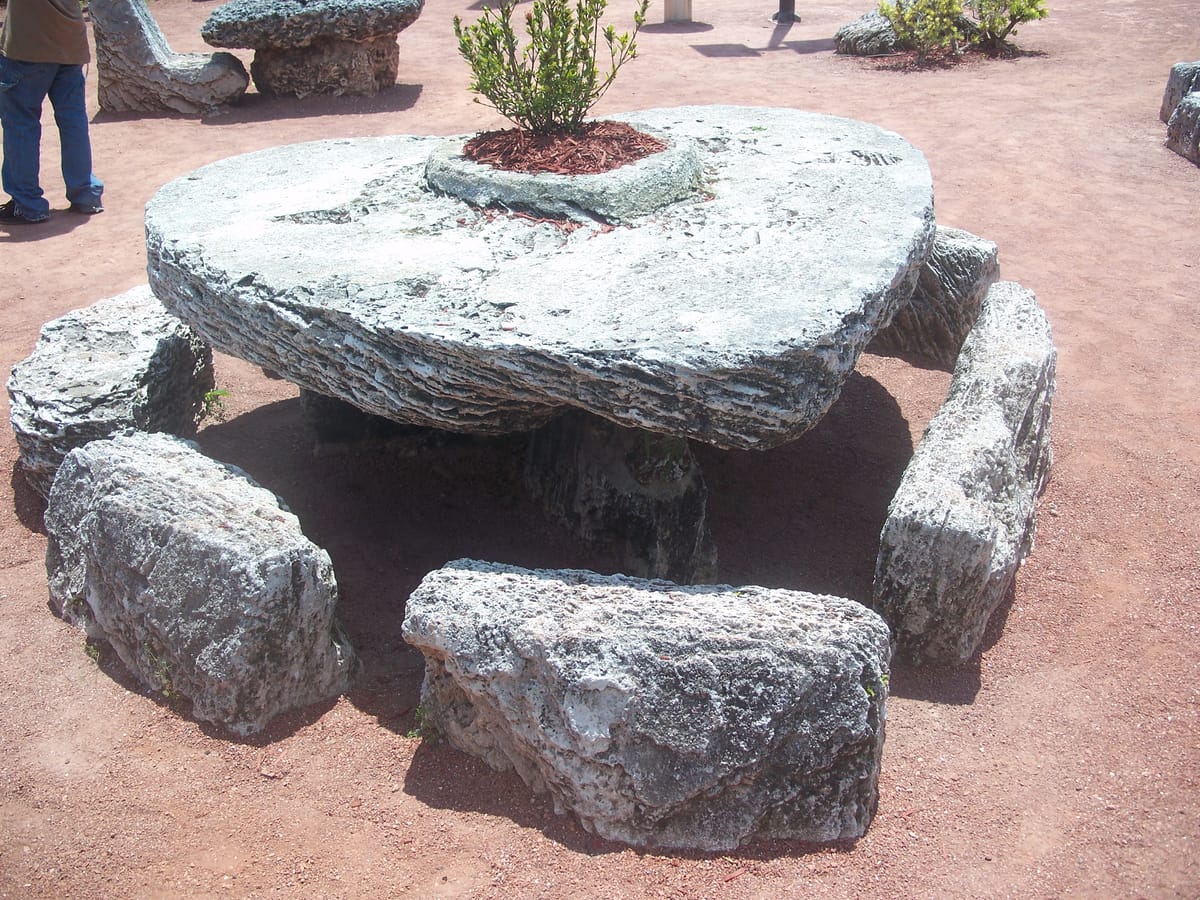
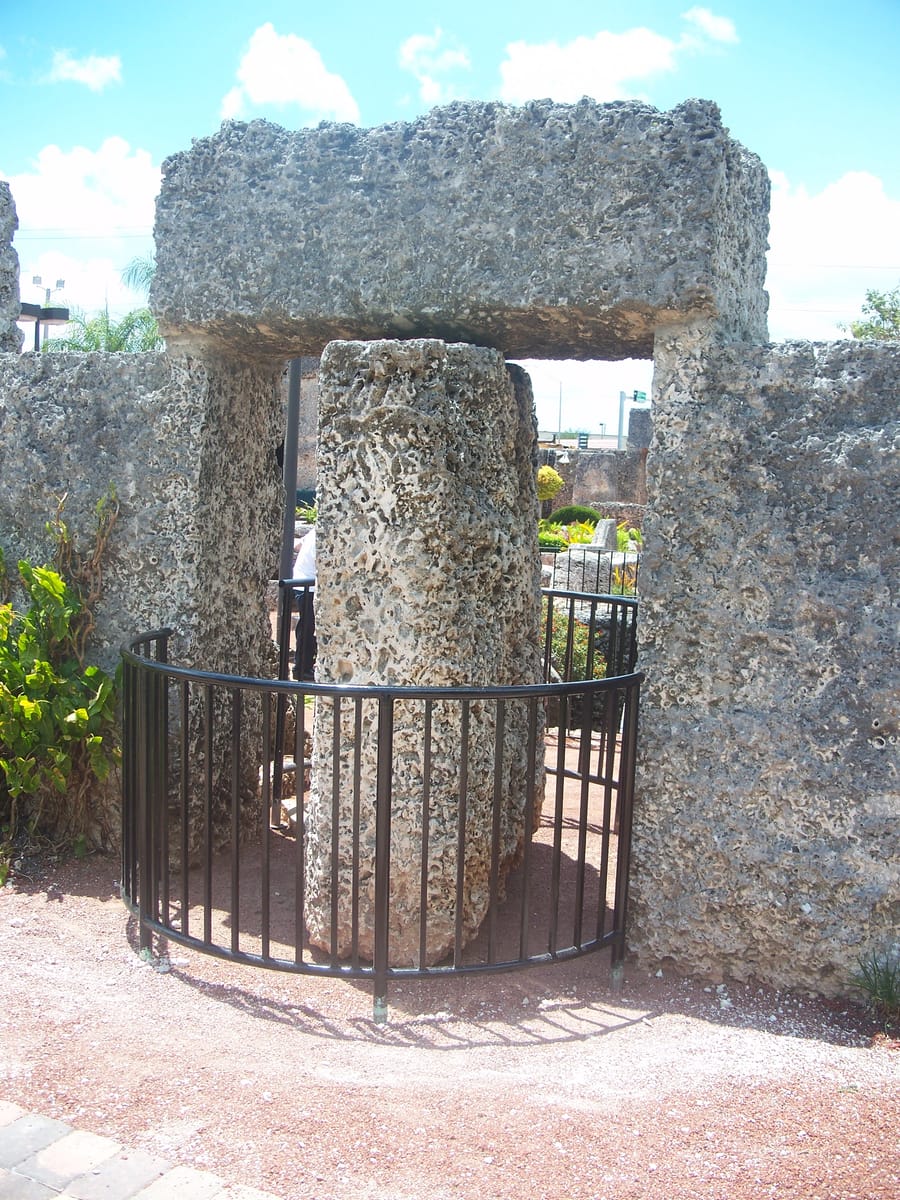
Leedskalnin began construction around 1923 on a plot in Florida City, a few miles south of the site’s current location, after settling in South Florida in the early 1920s reportedly following a bout of tuberculosis. Between roughly 1936 and 1939, concerned about encroaching development and wanting more privacy, he relocated the entire project — stone by stone — about 10 miles north to its present address on South Dixie Highway in Homestead, where he continued building until his death in 1951. The finished complex covers roughly 1,100 tons of stone across walls up to 8 feet high, a two-story tower that served as his living quarters and workshop, a walled courtyard of furniture-like carvings (a heart-shaped table, a Florida-shaped table, rocking chairs, a crescent-moon “bathtub” chair, and a barbecue pit), and a set of astronomically-minded features: an accurate sundial, a stone chair aligned to track the sun, and a telescope-like tower carved to sight Polaris, the North Star. Individual blocks average around 15 tons, with the largest single stone — a triangular megalith Leedskalnin called his “Georgia guidestone” precursor piece — estimated at close to 30 tons. The best-known single feature is the entrance gate: a roughly 9-ton, 8-foot slab of stone, cut into a rough crescent, that pivots on a vertical axis and — for decades — could be swung open by a light push. Leedskalnin was a small man, reportedly around 5 feet tall and 100 pounds, which sharpened the contrast between builder and material and did much to fuel the site’s mystique.
How Was It Built?
Leedskalnin left behind more evidence of his methods than the myth admits. Contemporary photographs — some taken by curious neighbors and passersby despite his efforts at secrecy — show large wooden tripods and derricks erected over the work site, along with block-and-tackle rigs, chain hoists, and winches. Tools recovered from the site and now on display include hand chisels, pry bars, wedges, and a variety of improvised implements Leedskalnin fashioned from Ford Model-T parts and other salvaged automobile and truck components, including a crude generator built around a car axle that he used to run limited electric lighting and power tools late at night. His working method, as reconstructed from these tools, the tripod photographs, and the tool marks on the stone itself, was to quarry blocks directly from the shallow bedrock a few feet from where they were used, split and dress them with hand tools, then hoist and walk them into position using compound pulleys, levers, and rope tackle anchored to the tripods — a slow, physically demanding process, but one built entirely from well-understood 19th- and early-20th-century mechanical principles, not exotic physics. Oolitic limestone is also considerably easier to work than it looks: freshly quarried, it is soft enough to cut with hand tools and, because it is highly porous, meaningfully lighter than an equivalent block of granite or marble, which narrows — without closing — the gap between “one small man” and “1,100 tons of stone.” The most direct confirmation came in 1986, when the rotating gate seized after its original bearing rusted. Repair crews had to bring in a crane and several workers just to lift the gate off its post, and in the process they found the mechanism Leedskalnin had used to achieve such fine balance: an iron shaft and a recycled truck bearing at the pivot point, precisely centered on the stone’s center of mass. Engineers replaced the corroded bearing and shaft with new ones and reset the gate, which — notably — never again turned quite as effortlessly as it had under Leedskalnin’s original setup, a detail that speaks to his skill at fitting and balancing rather than to any hidden force.
The Mainstream View
Historians, engineers, and folklorists who have studied Coral Castle agree that Leedskalnin built it using ordinary mechanical means: tripod derricks, block-and-tackle pulley systems, levers, wedges, rollers, and patient, incremental work, all applied over roughly 28 years to a stone that is relatively soft and light for its appearance. Leedskalnin’s own trade background — he had worked in logging and had practical carpentry and mechanical skills — is consistent with the tools and rigging documented in period photographs and preserved on site. His cryptic public remarks, most famously that he understood “the laws of weight and leverage” and “the secrets of the people who built the pyramids,” are read by mainstream analysts as showman’s mystique layered over a straightforward (if unusually disciplined and secretive) engineering practice, not as an admission of some undiscovered technology. His separate, published theories about “individual magnets” circulating within matter — the seed of the later anti-gravity legend — were his own idiosyncratic and scientifically unfounded ideas about magnetism in general; they describe no verified method and are not corroborated by any physical evidence at the site. The 1986 gate disassembly, which found a plain iron shaft on a truck bearing rather than any exotic mechanism, is treated by researchers as the closest thing to a controlled test of the anti-gravity claim, and it came back negative.
The Open Case
What actually remains open at Coral Castle is narrow and human-scale, not paranormal. Leedskalnin worked alone by choice and left no notes on his exact rigging for each individual stone, so the precise sequence of hoists, angles, and supports he used for the heaviest pieces — such as the roughly 30-ton triangular block — has to be inferred from tool marks, the tripod photographs, and analogy to his documented methods elsewhere on site, rather than read off a construction log. His deeper motivations are similarly underdocumented: the popular “Sweet Sixteen” story, that he built the entire castle as a monument to a 16-year-old fiancée named Agnes who broke their engagement in Latvia the day before their wedding, comes largely from his own vague public statements and from site tradition, and later research into Latvian records has raised questions about the story’s exact details even while it’s confirmed something like a broken engagement did prompt his emigration. What is not in serious doubt, and what should be stated plainly, is that there is no credible evidence of anti-gravity, magnetism-based levitation, or any lost or supernatural technology at work — the popular legend rests on Leedskalnin’s own showmanship, his refusal to let anyone watch him work, and the genuine cognitive surprise of seeing what one determined person can do with tripods, pulleys, and decades of nights. Strip the myth away and Coral Castle is still remarkable: a 20th-century monument to obsessive individual patience, self-taught mechanical skill, and the simple, verifiable fact that simple machines, correctly applied, can move astonishing amounts of stone.
Sources
Connected findings
- The Secret of the Pyramids Was a Truck Bearing — Imhotep froze a palace of reeds and matting into limestone for a dead king. Four and a half thousand years later a man in Florida carved himself a stone rocking chair, and told everyone he had worked out how the pyramids were done.
Gallery