Chan Chan
How did the Chimú raise the largest earthen city on Earth — roughly 20 square kilometers of adobe palaces, tapering earthquake-resistant walls, and marine friezes — and keep tens of thousands of people alive in one of the driest deserts on the planet, where it almost never rains?
Why this rating?
- Construction difficulty
- 3/5
- Method uncertainty
- 2/5
- Capability gap
- 2/5
- Open questions
- 3/5
Chan Chan's astonishment is one of scale and setting rather than of technique: building the largest earthen city in the Americas and feeding tens of thousands in a near-rainless desert took immense organized labor and sophisticated water management, but adobe brickwork and canal irrigation are well-understood methods with abundant surviving evidence. What stays genuinely open is why the water table and canals failed — including the huge, apparently non-functional intervalley canal — and the exact sequence and dating of the royal compounds.
Overview
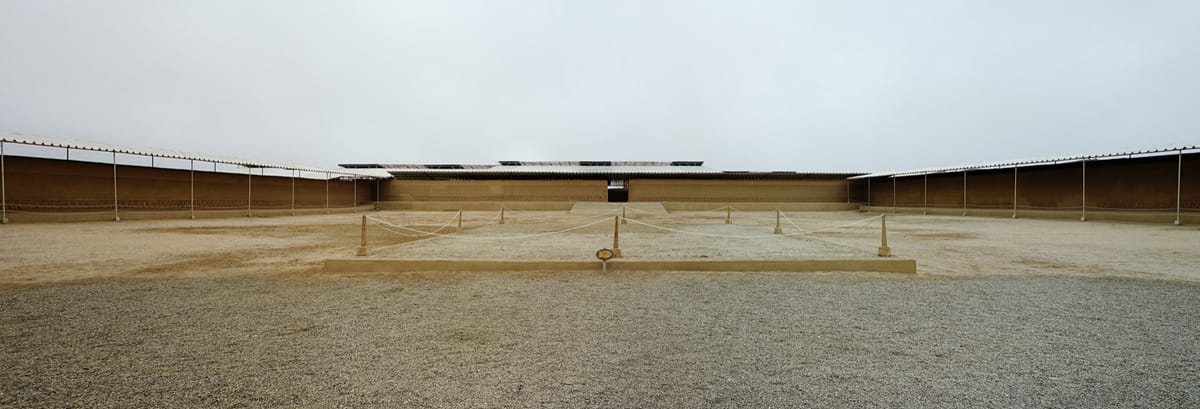
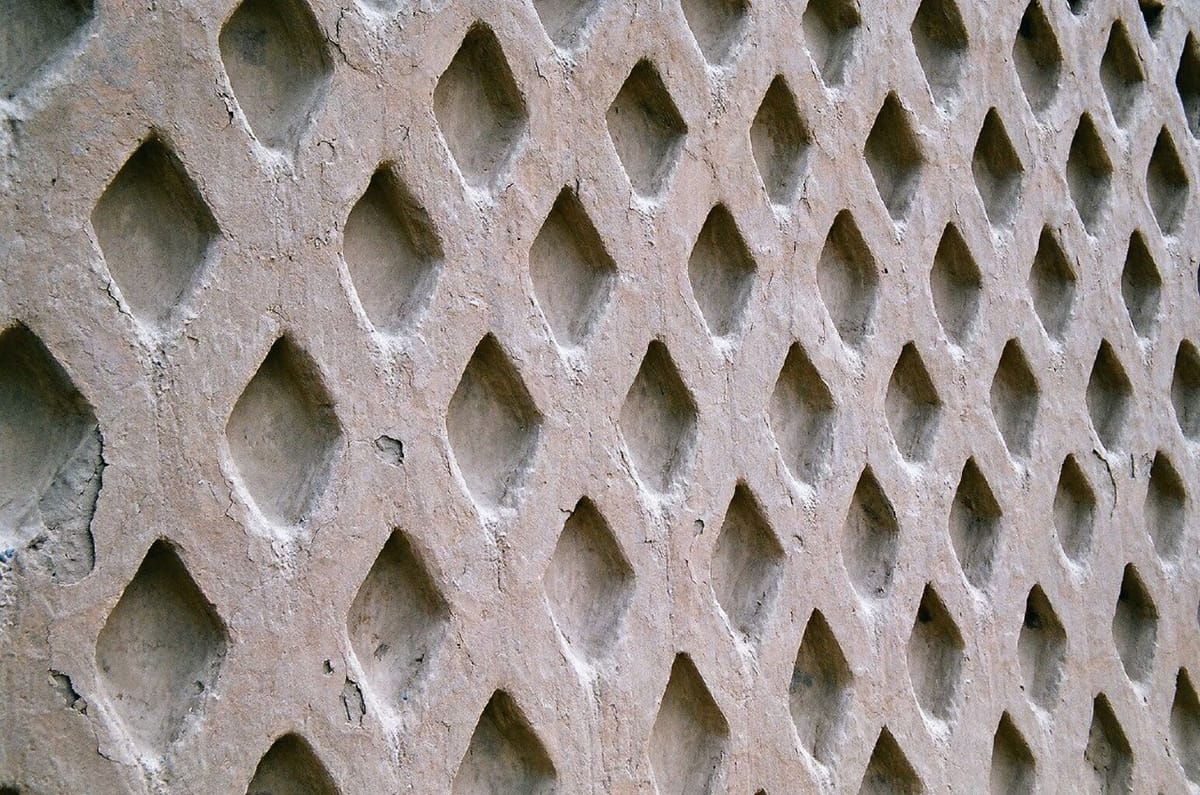
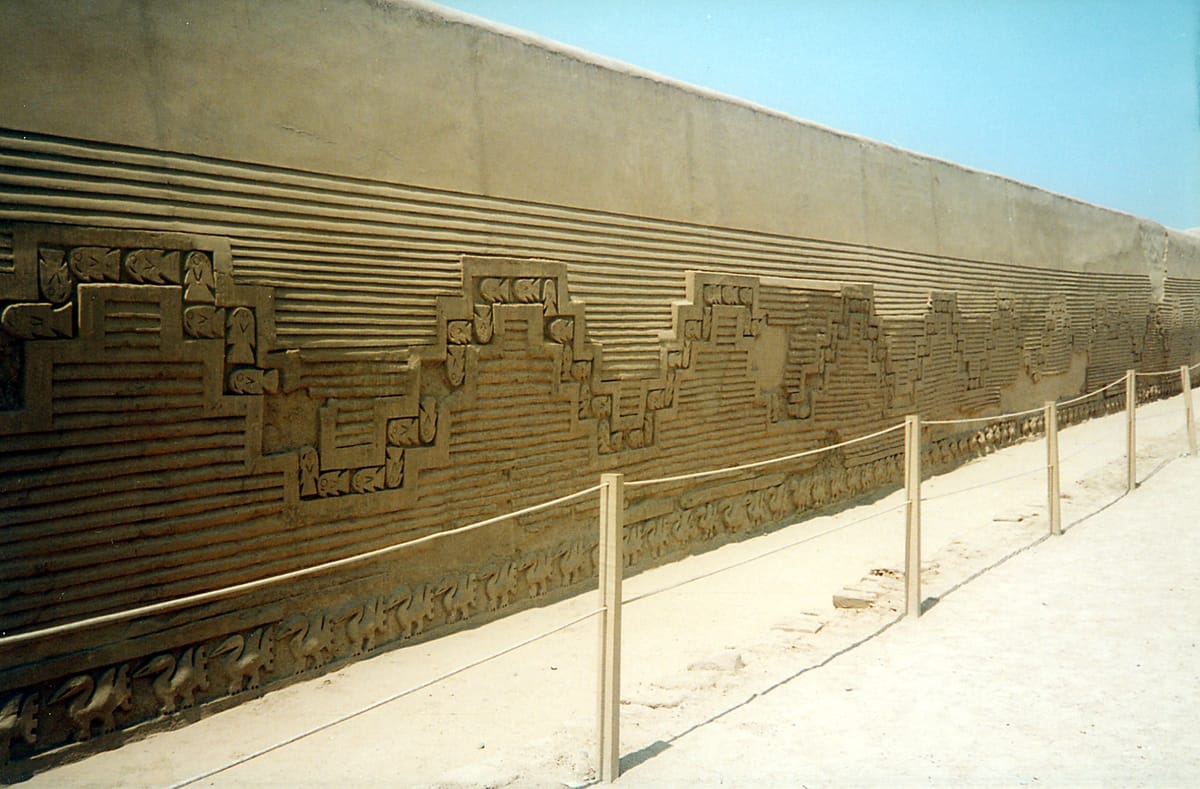
Chan Chan is the ruined capital of the Chimú kingdom, spread across the flat desert between the Pacific and the modern city of Trujillo, near the mouth of the Moche River on Peru’s north coast. Built and expanded from roughly the ninth century CE until the Inca conquest around 1470, it is the largest city ever raised from earth in the pre-Columbian Americas and one of the largest earthen cities anywhere in the world: at its height it covered some 20 square kilometers, with a dense monumental core of about 6 square kilometers, and is thought to have housed on the order of 30,000 to 60,000 people. Almost the entire city is made of adobe — sun-dried mud brick — plastered smooth and then carved, across acres of wall, with low reliefs of fish, seabirds, waves, and net-like lattices that announce a civilization built on the sea. Its heart is a cluster of nine or ten vast walled compounds known as ciudadelas, each a self-contained royal palace of plazas, storerooms, audience halls, and a burial platform, ringed by adobe walls that once rose as high as a three- or four-story building. What makes Chan Chan quietly astonishing is not a single impossible stone but the whole ambition of it: a metropolis of packed mud sustaining tens of thousands of people in a coastal desert where measurable rain can fail to fall for years.
The Structure
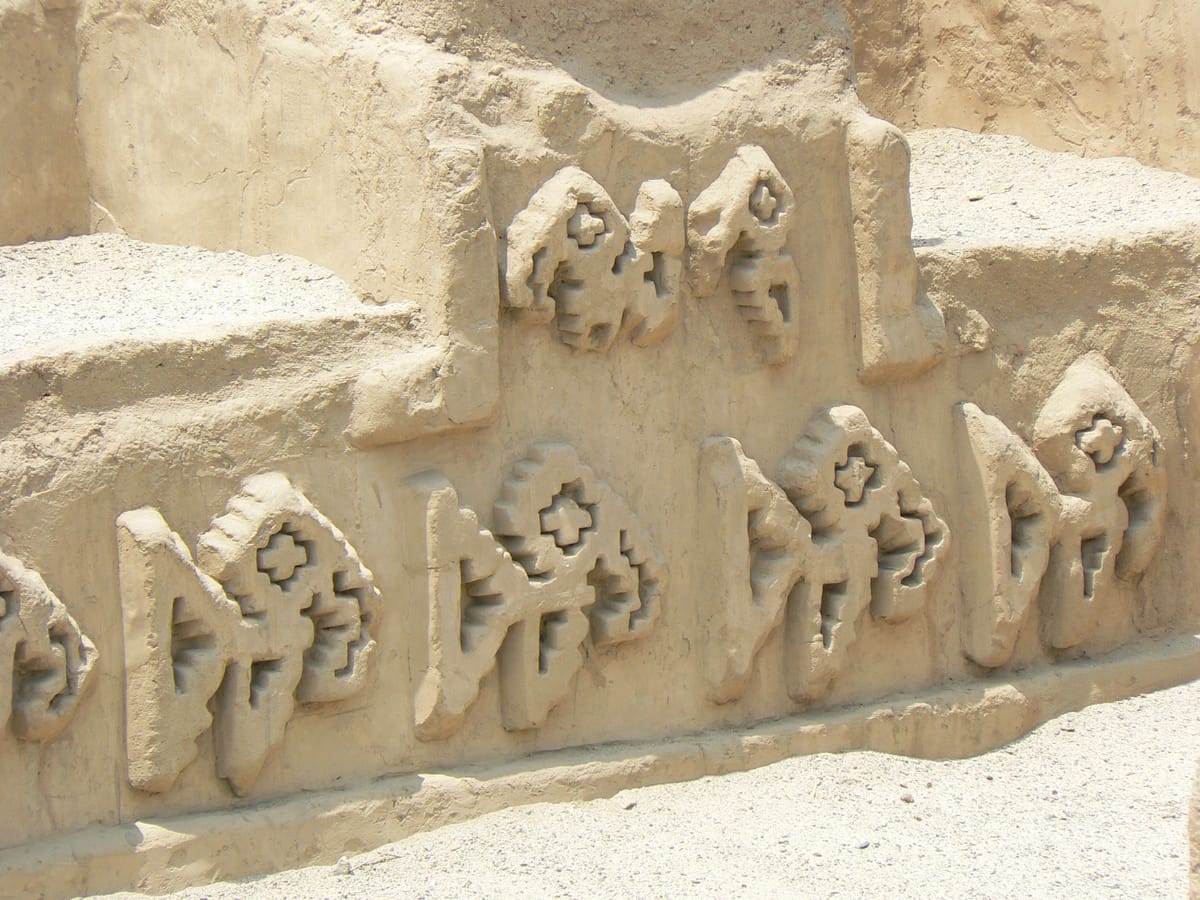
The Chimú, or kingdom of Chimor, emerged on the same north-coast valleys once ruled by the earlier Moche, and by their late florescence controlled a long ribbon of Peruvian coastline that the Inca would later absorb as one of their richest provinces. Chan Chan was their capital and, by the standards of the pre-Columbian Andes, a genuine city rather than a ceremonial center. Its defining monuments are the ciudadelas: enormous rectangular enclosures, each entered through a single guarded doorway and divided inside into ceremonial plazas, warrens of storerooms, U-shaped administrative niches that archaeologists call audiencias, walk-in wells, and a raised royal burial platform. Scholars link this repetition of near-identical palaces to a Chimú system of split inheritance: when a king died, his heir inherited the throne but not the wealth, which stayed with the dead ruler’s household. The old palace was sealed as the king’s mausoleum and shrine — his burial platform filled with offerings, fine textiles, ceramics, and the interred bodies of attendants — while the new king had to build his own compound and generate his own fortune, often by conquest. The result, over generations, was a city of successive royal palaces standing side by side. Around and between these compounds spread far humbler quarters: dense clusters of small irregular rooms where the artisans and laborers who made Chan Chan’s famous textiles, metalwork, and pottery lived and worked. Beyond the walls rose several huacas, solid adobe temple-platforms used for ritual and burial. The city’s marine reliefs — rows of fish that often alternate direction like a running tide, pelicans and cormorants, crashing waves, and diamond nets — turn the mud walls into a catalogue of the ocean that fed the kingdom.
How Was It Built?
Chan Chan was built almost entirely by hand from the ground it stands on. Workers mixed local clay-rich mud with sand and organic binder such as straw, shaped it in molds, and dried the bricks in the fierce coastal sun; laid in mud mortar, these adobes were then coated in a smooth mud plaster that could be carved while still workable. The great perimeter walls of the ciudadelas were raised in courses, built markedly thicker at the base — several meters across — and tapering inward toward the top, a profile that both saved material at height and helped the tall earthen walls shed load and resist the region’s earthquakes; some stood roughly nine to twelve meters high. The friezes that make the city famous were produced by carving or stamping repeating motifs into the plaster before it hardened, an efficient way to decorate enormous wall surfaces with marine imagery. Sustaining the population, though, was the harder engineering problem, because Chan Chan sits in one of the driest deserts on Earth. The Chimú solved it with water rather than stone: they drew on the Moche and neighboring river valleys through long irrigation canals, and inside the city they sank walk-in wells and excavated sunken gardens — pits dug down to the level of a shallow water table that was itself kept high by all the irrigation soaking into the plain. This let farmers and residents reach groundwater directly in a place where rain could not be relied upon. The most ambitious piece of this system was a massive intervalley canal, tens of kilometers long, engineered to carry water from the Chicama valley to the north into the Moche system that fed the capital.
The Mainstream View
Archaeologists see Chan Chan as the administrative and economic engine of a powerful, highly organized coastal state — not a mystery of technique but a triumph of scale, labor, and water management. Decades of fieldwork, beginning with the Chan Chan–Moche Valley Project led by Michael Moseley and Carol Mackey from 1969 onward, have mapped the compounds, excavated burial platforms and craft quarters, and traced the canals, giving a detailed and largely consistent account of how the city worked. Its construction is well understood: adobe brick is a modest, forgiving material, and the challenge at Chan Chan was organizing an enormous sustained workforce to make, move, and lay millions of bricks and to carve kilometers of relief — the kind of mobilization a centralized kingdom with tribute labor could readily command. The city’s survival in the desert is credited to sophisticated but conventional hydraulic engineering: gravity-fed canals from the rivers, a deliberately recharged water table, and wells and sunken fields that tapped it. The recurring marine motifs are read as expressions of an economy and cosmology centered on the sea and on the management of water. Chan Chan’s story ends in conquest rather than collapse: around 1470 the Inca, under Túpac Inca Yupanqui, defeated Chimor, took its last independent king to Cusco, and relocated many of its celebrated metalworkers, after which the capital declined. When the Spanish founded Trujillo nearby in the 1530s, colonial treasure-hunters mined the sealed burial platforms for gold, and centuries of looting and erosion followed.
The Open Case
What remains genuinely unresolved at Chan Chan is less how the walls were raised than how the city’s lifelines faltered — and why its builders kept betting everything on a fragile desert water supply. The great intervalley canal is the sharpest puzzle: this enormous work of engineering appears never to have delivered water successfully, and researchers still debate why, with candidate explanations ranging from tectonic uplift that warped the canal’s gentle gradient, to damage and silting from catastrophic El Niño floods, to the possibility that it was abandoned before completion for reasons now lost. More broadly, the same El Niño cycle that periodically devastates this coast — one flood around 1100 CE is thought to have wrecked northern canal systems and forced a reorganization of the Chimú economy — makes the long-term water history of Chan Chan a moving target, and the reasons the water table and field systems ultimately could not keep pace with the city are not fully settled. The exact sequence in which the ciudadelas were built, and therefore the precise dynastic chronology they encode, is still argued from architecture and limited dating. And the fine reading of the city — the function of the U-shaped audiencias, the full meaning of the alternating fish and wave friezes — remains interpretive. Chan Chan raises a genuine “how was this possible?” not because its mud walls defy explanation, but because it is a city of earth the size of a small modern town, built and fed for centuries in a place that should not have been able to support it — a monument to how far organized human ingenuity could push a rainless desert before the desert pushed back.
Sources
- UNESCO World Heritage Centre — Chan Chan Archaeological Zone
- Wikipedia — Chan Chan
- Encyclopaedia Britannica — Chan Chan
- Wikipedia — Chimú culture
- EBSCO Research Starters — Chan Chan
- Encyclopedia.com — Chan Chan
- Smithsonian Magazine — Endangered Site: Chan Chan, Peru
- Cambridge Core (American Antiquity) — Cultural Materialism, Split Inheritance, and the Expansion of Ancient Peruvian Empires
Gallery