Caral
How did a society with no pottery, no metal tools, no wheel, no draft animals, and no writing raise six stone-faced pyramids and sunken plazas on a desert terrace 5,000 years ago — building one of the world's first cities at the same moment as the pyramids of Egypt, and doing it, apparently, without an army?
Why this rating?
- Construction difficulty
- 3/5
- Method uncertainty
- 2/5
- Capability gap
- 3/5
- Open questions
- 4/5
The building method itself is unusually well evidenced — the shicra bags survive inside the platforms and show exactly how the fill was assembled — so the 'how' scores low. What is genuinely striking is the capability gap: a preceramic Late Archaic society with no pottery, metal, wheel, draft animals, or writing produced planned monumental urbanism as early as any in the world, and real debate remains over how its labor was organized without evident warfare, what the sunken circular plazas were for, and how the Norte Chico region's chronology and its inland-versus-coastal origins fit together.
Overview
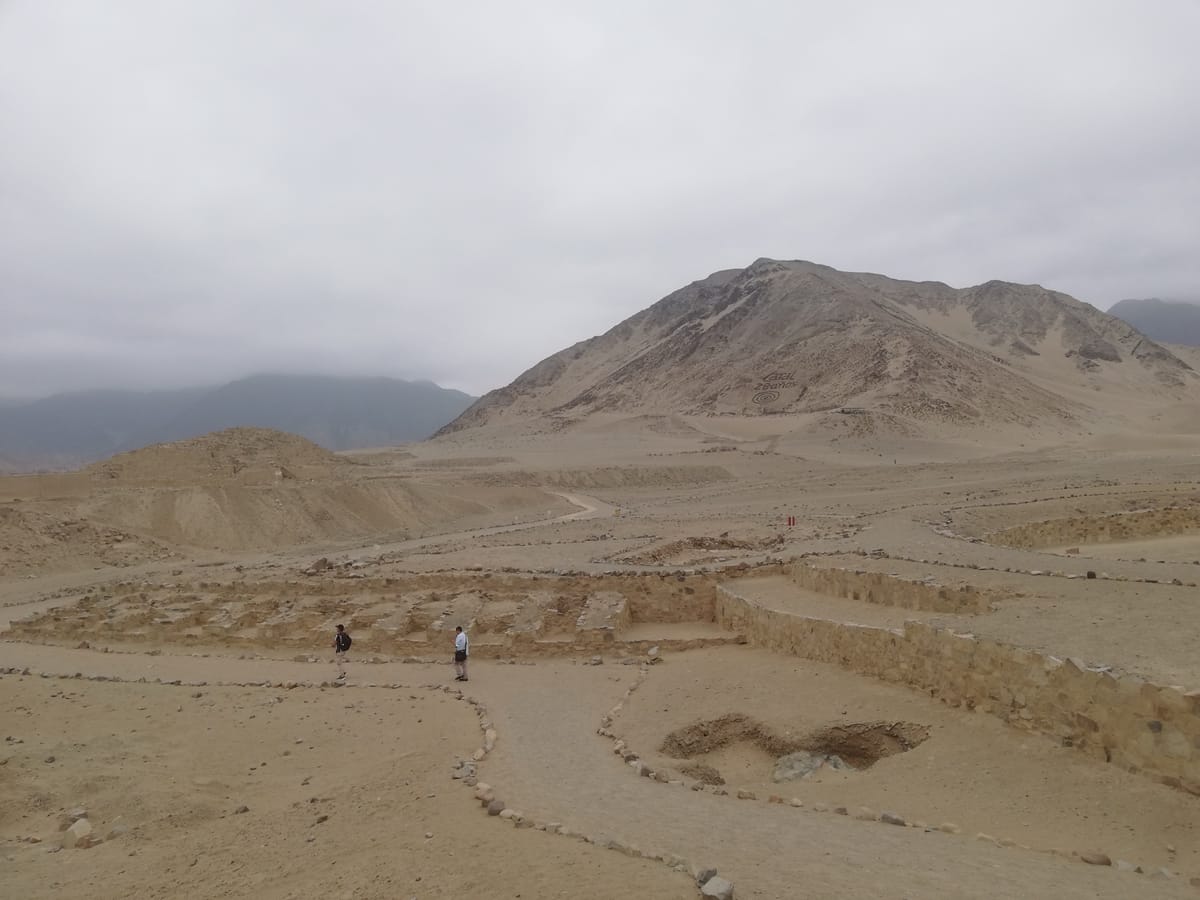
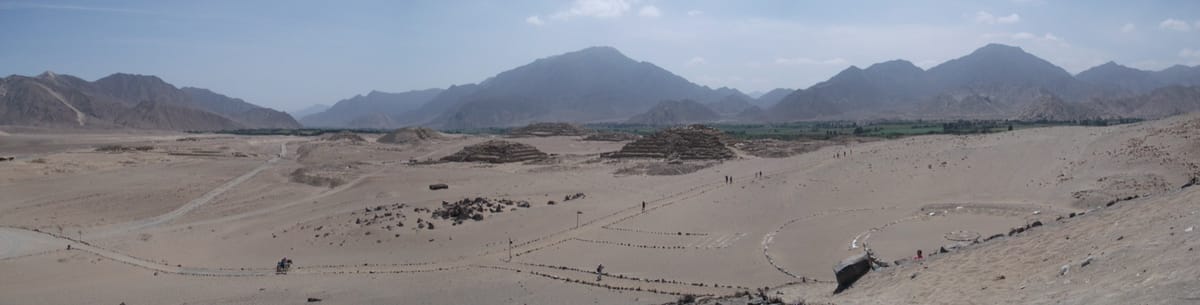
Caral is the largest and most fully studied settlement of the Norte Chico (also called Caral-Supe) civilization, the oldest known urban society in the Americas. It sits on a dry desert terrace overlooking the green floodplain of the Supe River, in Peru’s Lima Region, about 200 kilometers north of Lima and roughly 20 kilometers inland from the Pacific coast. Its monumental core was raised around 2600 BCE, during the Late Archaic Period of the Central Andes — making Caral a contemporary of the great pyramids of Egypt and the early cities of Sumer, and older than the Olmec of Mesoamerica by roughly two thousand years. The central zone, protected as the UNESCO World Heritage Site “Sacred City of Caral-Supe” and covering about 626 hectares, contains six large stepped platform mounds — often called pyramids — together with two sunken circular plazas, ceremonial platforms, residential sectors, and plazas laid out across the terrace. What makes Caral so consequential is not just its age but its combination of features: a genuine planned city, with monumental public architecture and clear social hierarchy, built by a society that had no pottery, no metal tools, no wheel, no draft animals, and no writing. Its discovery, and the radiocarbon dates that confirmed its antiquity, pushed the origins of complex civilization in the New World back by more than a thousand years and overturned long-held assumptions about how, and how early, cities began.
The Structure
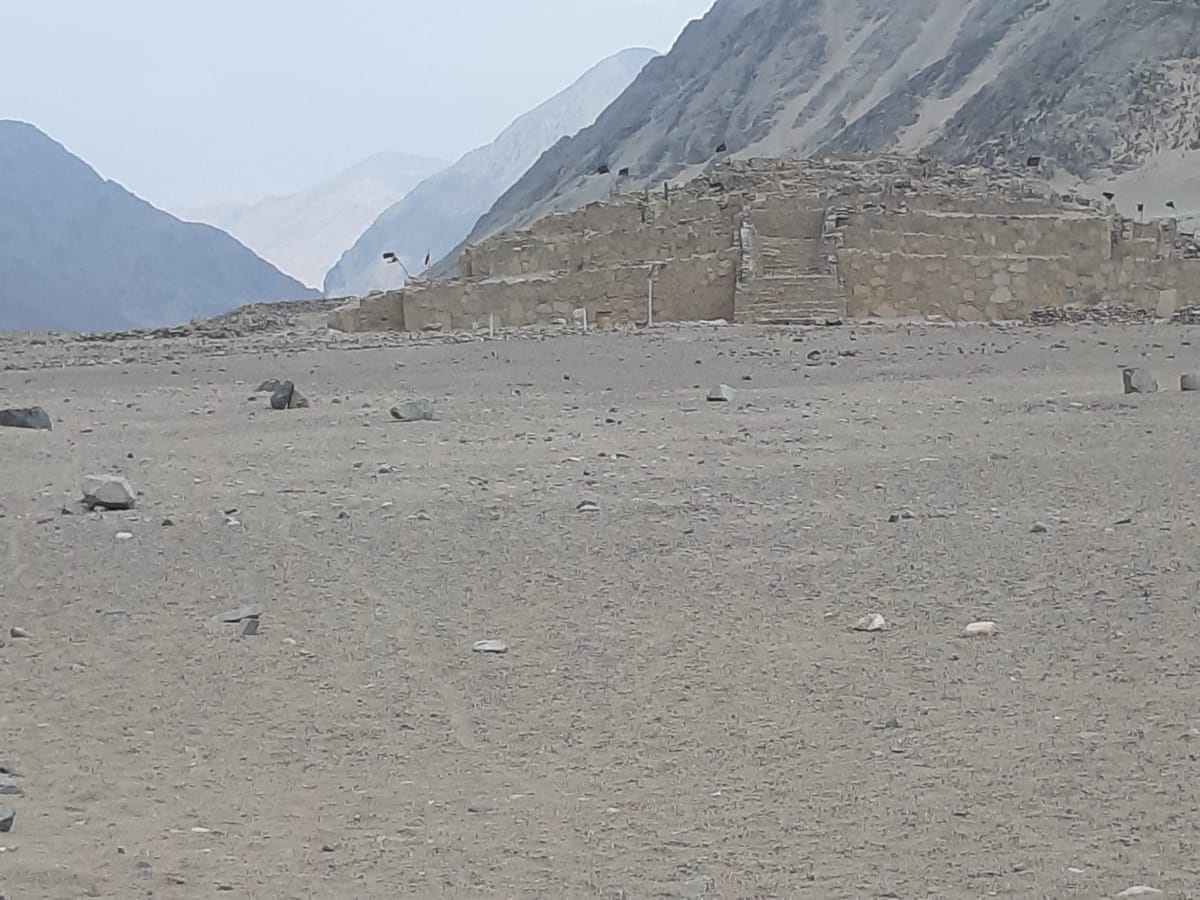
The Supe Valley held not one site but a cluster: Caral is the flagship of some nineteen related settlements strung along the valley, and archaeologists estimate the wider Norte Chico society may have supported on the order of 20,000 people, with roughly 3,000 living at Caral itself. The city’s plan divides broadly into an upper half, dominated by the largest monuments, and a lower half with smaller mounds and residences — a layout many read as reflecting social rank. Its centerpiece is the Pirámide Mayor (Great Pyramid), whose base measures about 150 meters by 110 meters and which rises some 28 meters (about 92 feet) high — a footprint close to four football fields. A staircase climbs from a sunken circular plaza at its foot, over terraced levels, to a summit complex of rooms and an atrium. The sunken circular plazas — ceremonial spaces dug below the ground surface and ringed by low walls — are among Caral’s signature forms, and were evidently arenas for communal gathering and ritual.
The building materials were humble and local: river cobbles and quarried stone, cut reeds and plant fiber, adobe-like clay mortar, and cane and wood. The monuments were faced with stone retaining walls and their interiors packed with fill; the residential and ceremonial rooms were plastered and, in places, painted. Among the finds that flesh out daily and ritual life are a set of 32 flutes made from condor and pelican bones and 37 cornetts of deer and llama bone, evidence of a rich musical culture; finely worked cotton textiles (cotton, not clay, was the society’s defining craft material); and a knotted-cord object interpreted as an early quipu, the recording device later Andean cultures used in place of writing. Buried offerings, shell ornaments traded from as far as coastal Ecuador, and Amazonian plant remains show Caral sat at the center of long-distance exchange, trading cotton and other goods with fishing communities on the coast and with peoples across the Andes. Strikingly, excavators have found no city walls, no weapons, and no clear signs of warfare or violent destruction — one reason Caral is often described as a society organized around shared ritual, trade, and labor rather than conquest.
How Was It Built?
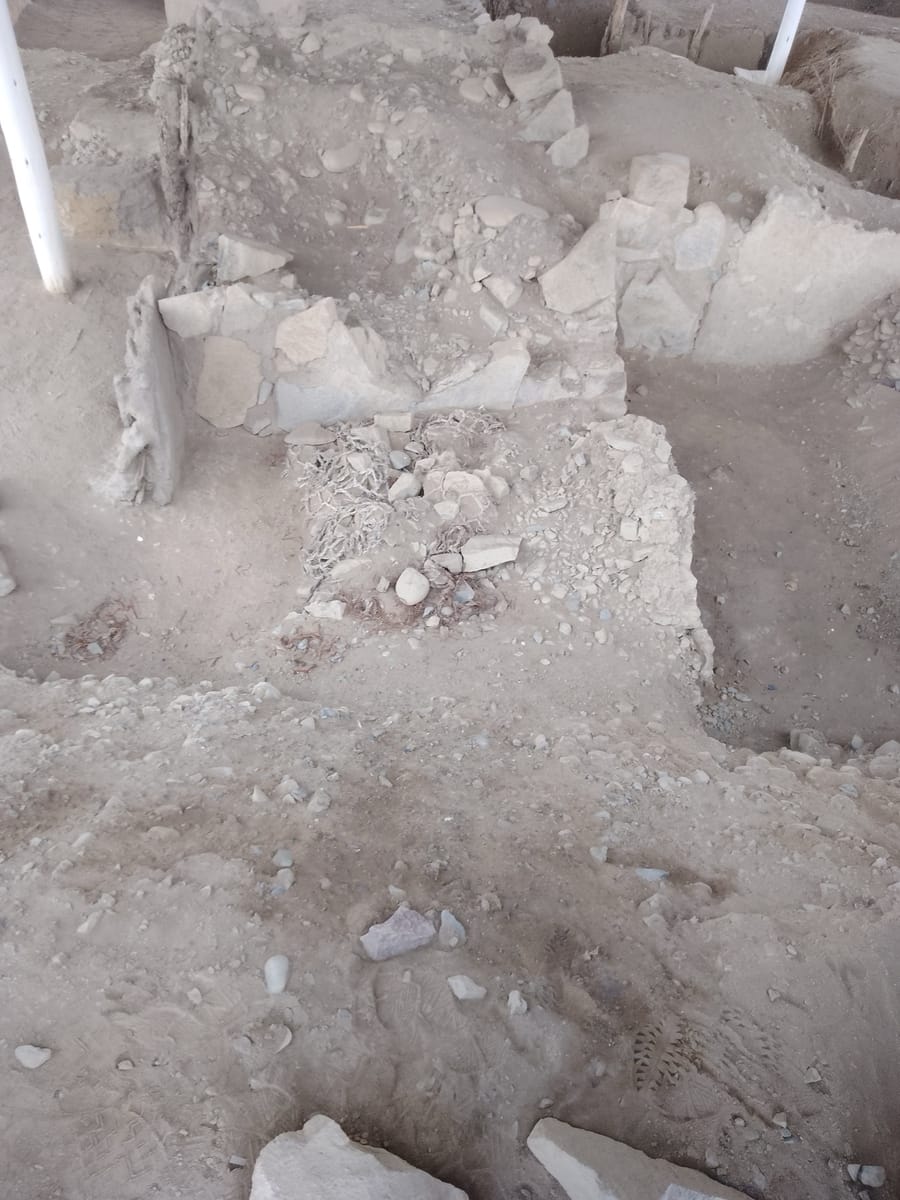
The pyramids were not solid masonry but stepped platform mounds: stone-faced retaining walls built up in stages, with the volume behind each wall packed with fill. The key to that fill — and one of Caral’s most remarkable engineering signatures — is the shicra. Workers gathered a tough highland grass and reed, wove it into loose, open-mesh carrying bags, filled each bag with quarried rock, and stacked the stone-laden bags in the spaces behind the retaining walls, layer on layer, to raise the platform. Thousands upon thousands of these bags went into the mounds. Because they could be woven, filled, and carried by ordinary laborers without any specialized masonry skill, the shicra bags let a large workforce build in parallel, each person contributing a modular unit of construction.
The technique also solved a structural problem. The Peruvian coast is seismically active, and loose rubble fill behind a wall is exactly the kind of mass that shifts and slumps during an earthquake. Bagging the stone in flexible fiber mesh let the fill settle and flex without catastrophically spreading — the bags contain and interlock the rubble, damping seismic movement and helping the platforms survive repeated quakes over millennia. In effect, the builders of Caral engineered a five-thousand-year-old earthquake-resistant foundation out of grass and stone. All of this was accomplished without metal tools (stone and wooden implements did the quarrying and shaping), without the wheel or draft animals (everything was carried by human muscle), and without pottery (liquids and goods were moved and stored in gourds, baskets, and woven containers rather than fired ceramics). The labor was organized, sustained, and evidently willing: the scale of the monuments implies a society able to mobilize and feed large numbers of workers over long periods.
The Mainstream View
Scholars regard Caral as a genuine early instance of state-level social complexity, and its construction as the product of organized communal labor rather than any lost or exotic technique. The site was first noted by Max Uhle in 1905 and studied by Paul Kosok in the 1940s, but its true antiquity was established only through the work of Peruvian archaeologist Ruth Shady, who began systematic excavation in the mid-1990s. Finding no ceramics anywhere at the site, Shady suspected it predated the spread of pottery in the region. In 1999 she collected samples of the reed and plant fiber from shicra bags built into the monuments and, with Jonathan Haas of Chicago’s Field Museum and Winifred Creamer of Northern Illinois University, had them radiocarbon dated. The results, published in Science in 2001, returned dates around 2627 BCE for the monumental architecture — confirming Caral as substantially older than any other known urban center in the Americas and firmly within the preceramic Late Archaic.
That single line of evidence — datable organic bags embedded directly in the fabric of the pyramids — is why the “how” of Caral is comparatively well understood. The shicras are not an inference; they survive, in place, showing exactly how the platforms were built up. Mainstream scholarship holds that the monuments were raised in stages by rotating communal work parties, using local stone and fiber, over generations, and that the society’s cohesion rested on shared religion, feasting, and a trade economy linking the fertile Supe Valley farms, the fishery of the nearby coast, and distant highland and Amazonian sources — an integration sometimes framed by the “maritime foundations” hypothesis, which argues that abundant coastal fish protein helped underwrite the whole system. Caral, in this view, is not a mystery of method but a landmark of timing: proof that urbanism, monumental architecture, and complex social organization arose in the Andes independently, and astonishingly early.
The Open Case
What keeps Caral genuinely open is less how its stones were stacked than how its society worked, and how it fits the story of civilization’s origins. A city on this scale, this early, built without the usual scaffolding of pottery, metal, the wheel, or writing, sits uneasily against old models that treated those technologies as prerequisites for complexity — and Caral shows they were not. That forces harder questions. How was the labor to raise six pyramids organized and sustained in a society that has left no evidence of armies, weapons, fortifications, or violent coercion? Was it commanded, negotiated, or drawn together by religion and reciprocal obligation — and what does the near-total absence of warfare really mean? The sunken circular plazas are plainly central to the city’s life, yet exactly what happened in them — which rites, which gatherings, what the architecture was tuned to do — remains interpretive. The knotted quipu hints that the Norte Chico were recording something two thousand years before the Inca, but what, and how, is unreadable. And the region’s deeper chronology is still contested: precisely how Caral’s dates relate to its neighboring valley sites, whether inland farming towns or coastal fishing settlements came first, and what tipped this desert valley into urban life around 3000 to 2600 BCE are all actively debated. Caral offers no lost technology and needs none — its builders were unmistakably human, working with grass, stone, and coordinated effort. The wonder is that they did it at all, and did it so early: one of the first cities on Earth, raised by people who had barely any of the tools we assume a city requires.
Sources
- UNESCO World Heritage Centre — Sacred City of Caral-Supe
- Wikipedia — Caral
- Wikipedia — Norte Chico civilization
- Shady Solís, Haas & Creamer — Dating Caral, a Preceramic Site in the Supe Valley (Science, 2001)
- Smithsonian Magazine — First City in the New World?
- History.com — This Peruvian Civilization Built Pyramids as Old as Egypt's
- Field Museum / ScienceDaily — Anthropologists Establish Date and Importance of the Americas' Oldest City
- Wikipedia — Ruth Shady
Gallery