The Behistun Inscription
Why carve the founding document of an empire — 1,200 lines in three languages, the size of a house — a hundred metres up a sheer cliff, and then cut away the only ledge that could reach it, leaving a text meant to be read that essentially nobody could read for 2,300 years?
Why this rating?
- Construction difficulty
- 4/5
- Method uncertainty
- 3/5
- Capability gap
- 2/5
- Open questions
- 5/5
Dressing and carving a 15-by-25-metre field of relief and fine cuneiform on a vertical limestone face roughly 100 m above the road, in two or three years, while the composition kept being revised mid-job, was a serious feat of organised rock-cutting — but it is squarely within demonstrated Achaemenid capability, and the working sequence has been reconstructed from the cuts themselves. What is genuinely unresolved is everything around the mechanics: whether Darius's account of his own coup is true, whether he really invented a writing system for it, and why the only access to the finished monument was deliberately destroyed.
Overview
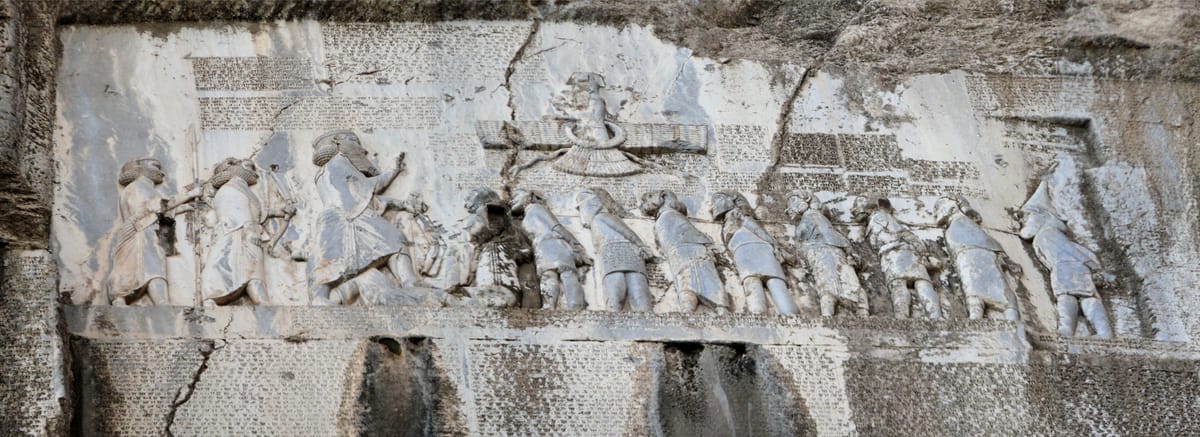
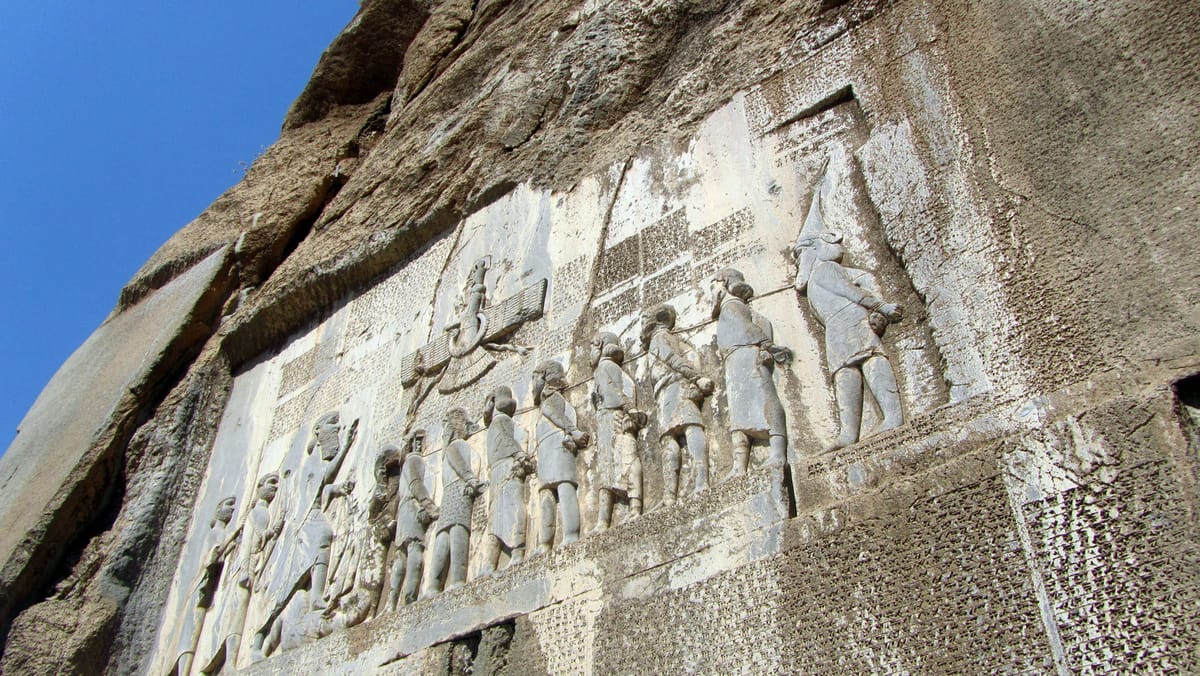
The old road from Babylon to Ecbatana runs beneath a limestone mountain the Persians called Bagastana — “place where the gods dwell.” Around a hundred metres above that road, on a face too steep to stand on, there is a panel of carved rock roughly 15 metres high and 25 metres wide. In the middle of it a king stands with a bow in his hand and his left foot planted on the chest of a man lying on his back. Nine more men shuffle towards him in a line, wrists bound behind them, a single rope running from neck to neck. Above and below and all around them, filling every dressed surface, are about 1,200 lines of cuneiform in three different languages.
This is the Behistun Inscription, cut for Darius I of Persia around 520 BCE, and it is the longest and most important royal inscription of the Achaemenid Empire. It is Darius’s own account of how he came to the throne — a year of civil war, nineteen battles, nine defeated pretenders — told in Old Persian, Elamite and Babylonian so that the empire’s three administrative languages could all receive it.
And then, when the carving was done, the ledge the workmen had been standing on was cut away.
That single decision is what makes Behistun strange. Everything about the monument screams read me: the position over the imperial highway, the three parallel translations, the closing passage in which Darius insists the text be circulated to every province. And everything about its execution made reading it impossible. For roughly 2,300 years the most eloquent document in Persian history sat on a cliff where no one could get close enough to make out a single wedge — which is precisely why, when someone finally did, it turned out to be intact enough to crack cuneiform wide open.
The Structure
Mount Behistun stands about 30 km northeast of Kermanshah in western Iran, at the point where the route from Mesopotamia climbs into the Zagros toward the Iranian plateau. There is a spring at its foot. Armies, caravans and kings passed under it for millennia, and the site accumulated monuments accordingly: a Parthian relief of Mithridates II, a reclining stone Hercules dated by its own inscription to 148 BCE, the vast smoothed rock face known as the Farhad Tarash left unfinished by the Sasanians, a Safavid caravanserai. UNESCO inscribed the whole complex as a World Heritage Site in 2006 under criteria (ii) and (iii). But the reason anyone knows the name is Darius’s panel.
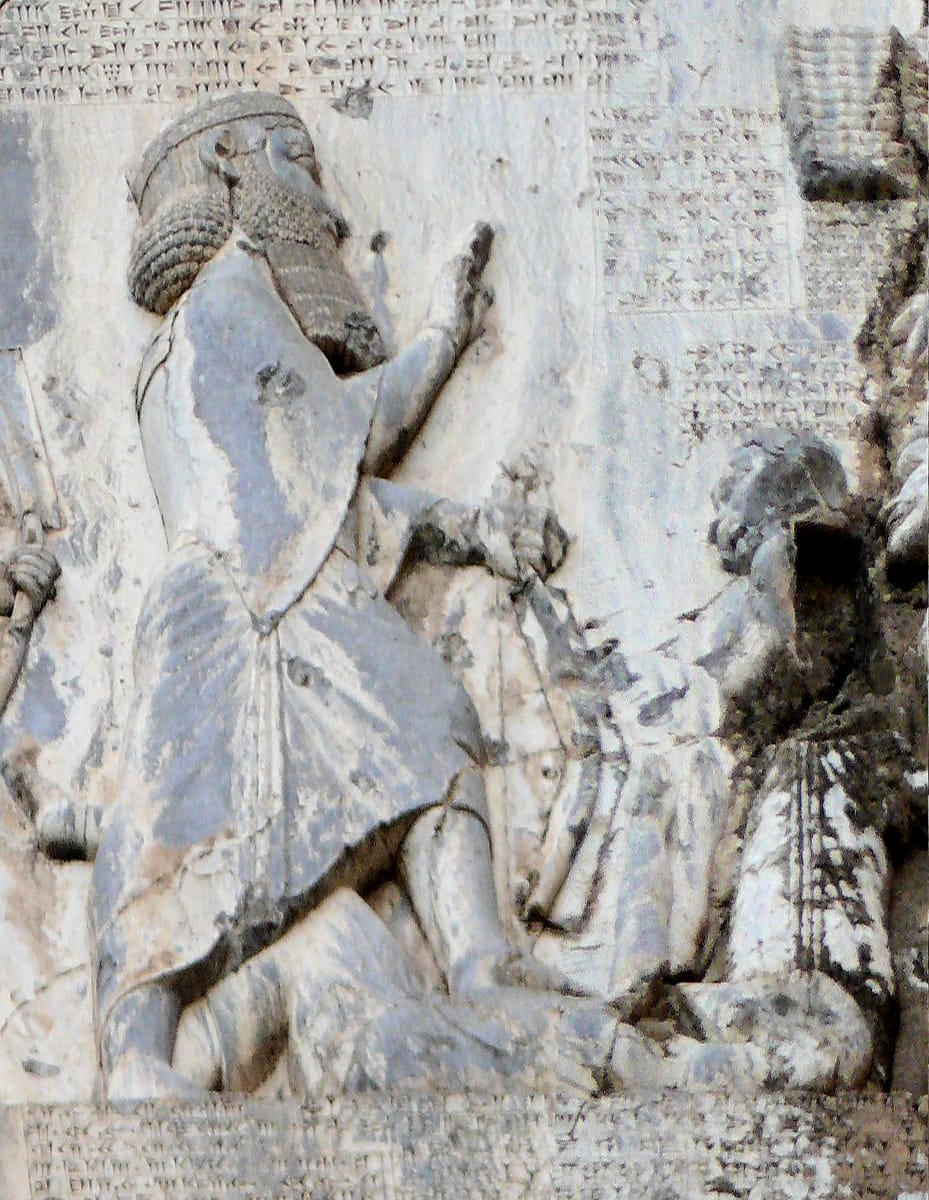
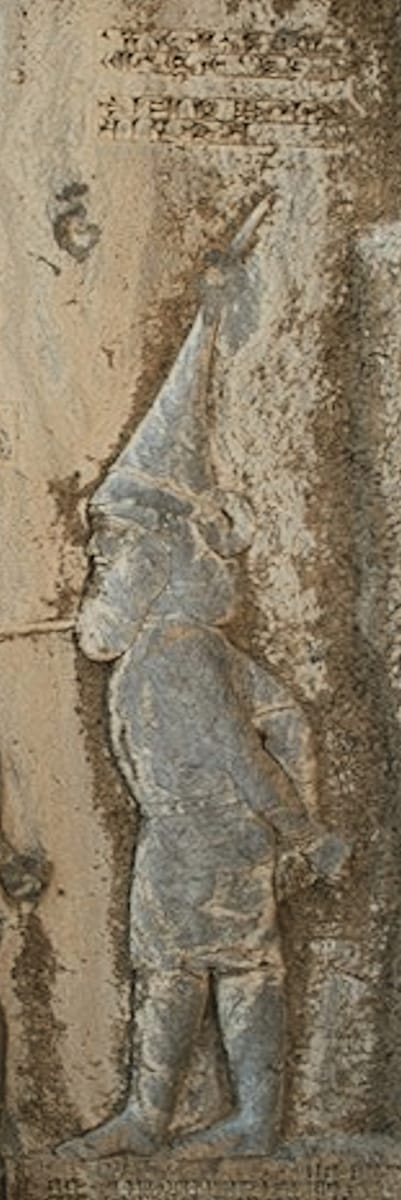
The relief itself is modest in size — about 3 metres high and 5.5 metres wide — and it is the text that dominates the cliff. Darius is carved life-size, 1.72 m, in the Persian court robe, holding a bow. Behind him are two attendants, a bow-bearer and a spear-bearer. Under his foot is Gaumata, the magus whom Darius says impersonated the dead Cambyses II’s brother Bardiya and seized the throne. Ahead of him, at a pointedly smaller 1.17 m, come the rebel kings he put down across 521–520 BCE, each labelled with a small caption inscription naming him and his lie: Āçina the Elamite, Nidintu-Bêl of Babylon, Fravartiš the Mede, Martiya, Çiçantakhma, Vahyazdāta, Arakha, Frāda. Above the line a winged figure hovers in a disc, usually read as the god Ahura Mazda, though some scholars prefer the king’s khvarnah, his divine good fortune.
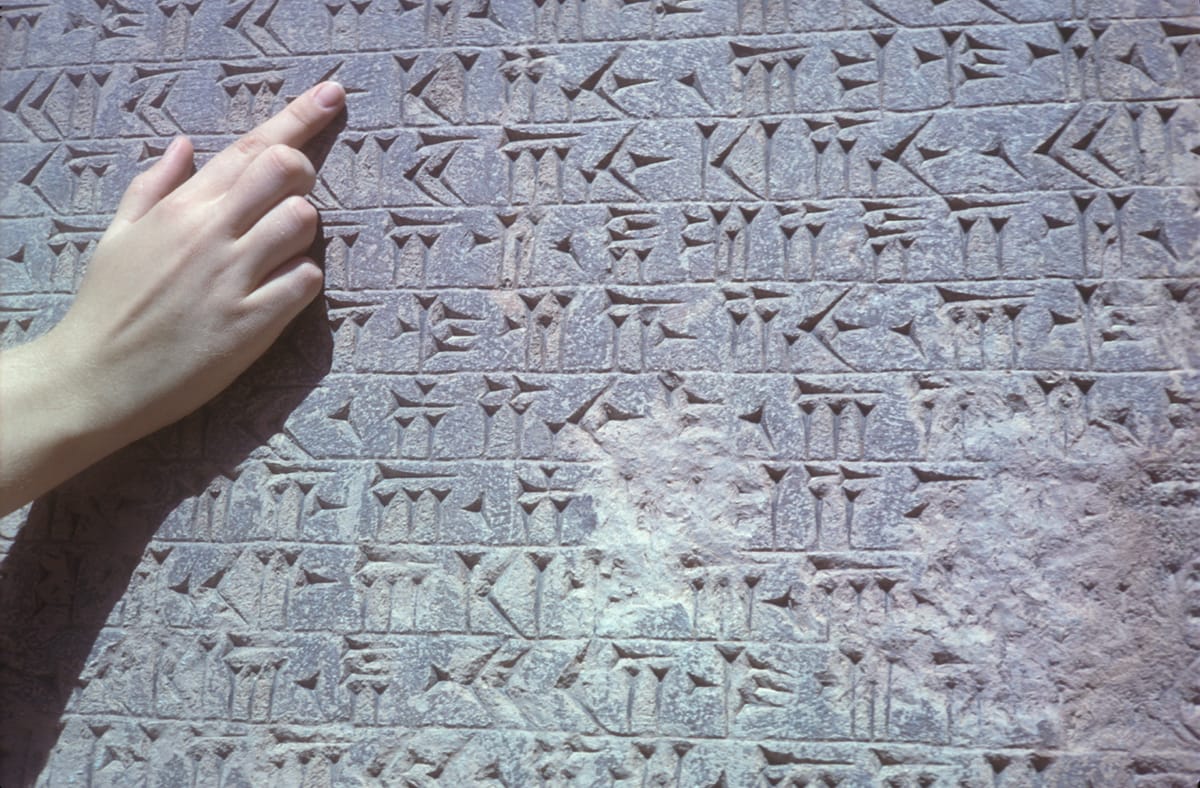
The three texts are not equal. The Elamite runs to roughly 590–650 lines in eight columns; the Old Persian to 414 lines in five columns; the Babylonian, squeezed onto a projecting mass of rock at the left, to 112 densely packed lines. A fifth Old Persian column was tacked on later, recording the campaigns of Darius’s second and third years — and, tellingly, it was never translated into the other two languages.
One detail gives away how physically demanding this was. Darius’s beard does not belong to the mountain. It is a separate block of stone, carved apart and fixed to the cliff with iron pins and lead, presumably because the projection needed for a proper Persian beard could not be won from the rock face where it had to sit.
How Was It Built?
There is no contemporary account of the work, and the scaffolding is 2,500 years gone. What we have instead is the cliff, and the cliff is legible, because the sculptors kept changing their minds and the changes are still visible.
The general method is not in doubt: a natural limestone face was cut back and dressed flat into a prepared panel, then worked with iron points, chisels and mallets by men on suspended platforms or a cut working ledge, from the top down. Rawlinson, the first modern person to get his hands on it, noted that the finished surface had been given a coating of a hard siliceous varnish to sharpen the letters and protect them from weather; traces of lead survive on the stone as well. This is the same toolkit and the same discipline that produced Persepolis and the royal tombs at Naqsh-e Rostam, at the same moment, for the same court.
What is remarkable is the sequencing, which scholars (Luschey, Trümpelmann, Hinz and others) have reconstructed from the carving itself. The Elamite version was cut first. The Babylonian went onto the projecting rock at the left. The Old Persian — the king’s own language — was added last, beneath the relief. Meanwhile the picture kept needing updating: Darius went on winning. When he defeated the Saka under Skunkha in his third year, Skunkha had to join the queue of captives, and there was no blank rock left to put him in. So a strip of the already finished Elamite text was chiselled off the cliff to make room for him — and the entire Elamite version was then meticulously copied out again on a freshly dressed surface to the left of the Old Persian. Two full Elamite recensions, one of them mutilated, because a Scythian needed a spot in a picture.
That is the real character of Behistun as a construction project. It was not carved; it was assembled, over roughly 520–518 BCE, in phases, with a client who kept revising the brief while his masons hung off a cliff a hundred metres in the air.
And at the end of it, the access was destroyed. The stairway or working ledge below the panel was sheared away, so that — in the standard reading — nobody could deface, amend or forge the record. From that day until the nineteenth century, reaching the text required a dangerous free climb.
The Mainstream View
Nothing about Behistun requires an exotic explanation. The Achaemenid Empire in 520 BCE commanded the labour, the ironwork, the rope, the trained relief sculptors and the trilingual scribal bureaucracy that this job needed, and it demonstrably used all of them elsewhere. Rock-cut royal monuments on cliffs were an established regional habit: Behistun’s composition — victorious king, foot on a prostrate enemy, line of bound captives, divinity above — is widely accepted to be modelled on the far older Anubanini relief at Sar-e Pol-e Zahab, barely a hundred kilometres away, carved for a Lullubi king some fifteen centuries earlier. Darius was not inventing a genre. He was claiming one.
The purpose is equally well understood, and it is political. Behistun is royal apologia: the argument that Darius, who was not Cyrus’s son, was nonetheless the rightful king, restorer of order against a usurping impostor, and chosen by Ahura Mazda. Historians treat it accordingly. As Pierre Briant put it, the Behistun inscription is not a textbook of Persian history.
The inaccessibility is likewise explained without mystery. The monument’s audience was never meant to be a reader at arm’s length; it was the road, the sight of it, and the reputation of it. Darius says so himself. In paragraph 70 he states that he had the text sent out across the provinces — and he was telling the truth. Fragments of a Babylonian copy have been excavated at Babylon, and an Aramaic translation on papyrus turned up among the Elephantine papyri in Egypt (Papyrus Berlin 13447), recopied roughly a century after the events it describes. The cliff was the master copy — monumental, permanent, deliberately tamper-proof. The empire read the duplicates.
Then the accident of history. Carsten Niebuhr copied part of the inscription around 1764. Georg Friedrich Grotefend worked out ten of the 37 Old Persian signs by 1802. And from 1835 Henry Creswicke Rawlinson, a British officer in Iran, climbed the cliff again and again: the Old Persian by 1837, the Elamite reached by laying planks across a chasm, the Babylonian not until 1847, and then only by hiring a Kurdish boy to scramble the face, rig a sling, and press wet paper squeezes against text Rawlinson could otherwise only read through a telescope. Because Behistun said the same thing three times, and because one of those languages could be worked out from Persian, it functioned exactly as the Rosetta Stone did for hieroglyphs. Assyriology as a discipline starts here.
The Open Case
The mechanics of Behistun are the least mysterious thing about it. What stays open is stranger, and it is open in a way that may never close.
Is the story true? Darius’s account has one obvious weak point: it is the only account, written by the man with the most to gain. He says the king he killed was Gaumata, a magus wearing the face of a dead prince. An alternative reading — argued seriously and never settled — is that the man on the throne was Bardiya, the genuine son of Cyrus, and that Darius murdered a legitimate king and then carved a very large, very permanent cover story onto a mountain. Herodotus, writing generations later and partly from Persian sources, transmits essentially Darius’s version. There is no independent contemporary witness. The monument is simultaneously our best evidence for the crisis of 522 BCE and an interested party’s testimony about it.
Did Darius invent a writing system to say it in? In paragraph 70 of the Old Persian text, Darius appears to claim that he created a new form of writing, “in Aryan,” that had not existed before. If read straight, that means Old Persian cuneiform — an elegant, semi-alphabetic script quite unlike the sprawling syllabaries beside it — was made to order for this inscription, which would be one of the very few scripts in history with a named commissioning client and a birthdate. Whether that is what the passage says is one of the most contested questions in Old Iranian studies: some scholars date the script to Cyrus’s reign, some think Darius’s scribes devised it while he took the credit, and a 2024 re-reading argues he claimed only to have added a version in his own language. The cruellest part is physical. Rainwater has dissolved the limestone precisely there. The words that would settle it are now illegible on the rock.
And why the ledge? Cutting away your own scaffolding is not a neutral act. It protects the text and it also seals it. There is no Achaemenid statement explaining the decision; “so it could not be tampered with” is a modern inference, reasonable but unverified. Whatever the reasoning, the result was a monument built with enormous effort to communicate, and then sealed beyond the reach of anyone it was communicating with — a king shouting from a height, in three languages, at a road full of people who could see that something enormous had been said and could not make out a word of it.
The cliff is still losing the argument with the weather. Rainwater keeps dissolving some passages and crusting new limestone over others; the twentieth century added bullet damage from soldiers during the Second World War. Iranian teams began systematic photogrammetric damage assessment in 1999, and an international project re-examined the inscription from 2012. Every year a little more of Darius’s version of events becomes something we have to reconstruct rather than read.
Sources
- UNESCO World Heritage Centre — Bisotun (ref. 1222)
- Wikipedia — Behistun Inscription
- Livius — Behistun
- Livius — Behistun (2): Rawlinson and the decipherment
- Achaemenica — The Behistun Inscription (DB)
- Encyclopaedia Iranica — BISOTUN iii. Darius's Inscriptions
- World History Encyclopedia — Behistun Inscription
- Wikipedia — Behistun papyrus (Papyrus Berlin 13447, DB Aram)
- Wikipedia — Anubanini rock relief
- CDLI Bulletin — A New Reading of the 70th Paragraph of the Behistun Inscription
Gallery