The Baalbek Trilithon
How did Roman builders quarry, move, and set three roughly 800-tonne stone blocks into a temple podium wall with such precision, and why did they cut blocks so far beyond what the structure needed?
Why this rating?
- Construction difficulty
- 5/5
- Method uncertainty
- 4/5
- Capability gap
- 4/5
- Open questions
- 4/5
No Roman text or physical trace documents how the roughly 800-tonne (and abandoned 1,650-tonne) blocks were actually hauled and set, and the scale genuinely outstrips the few-hundred-tonne moves Rome is documented to have achieved elsewhere. Dating and Roman authorship are secure, but the mechanics of the final haul and the motive for pushing stone-moving this far remain live, unresolved questions.
Overview
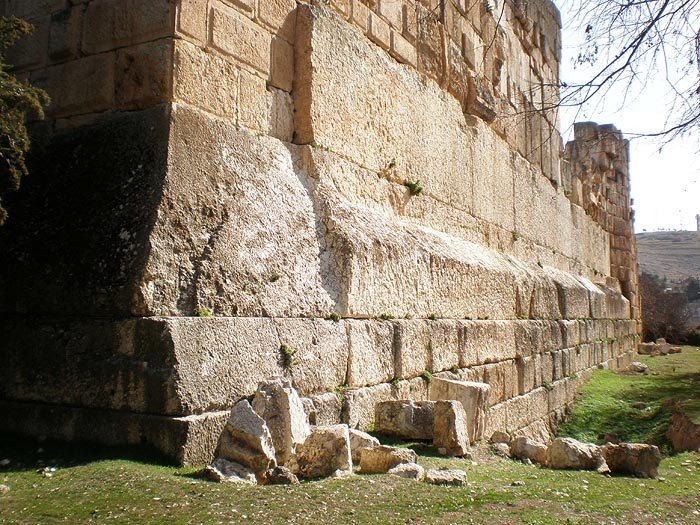
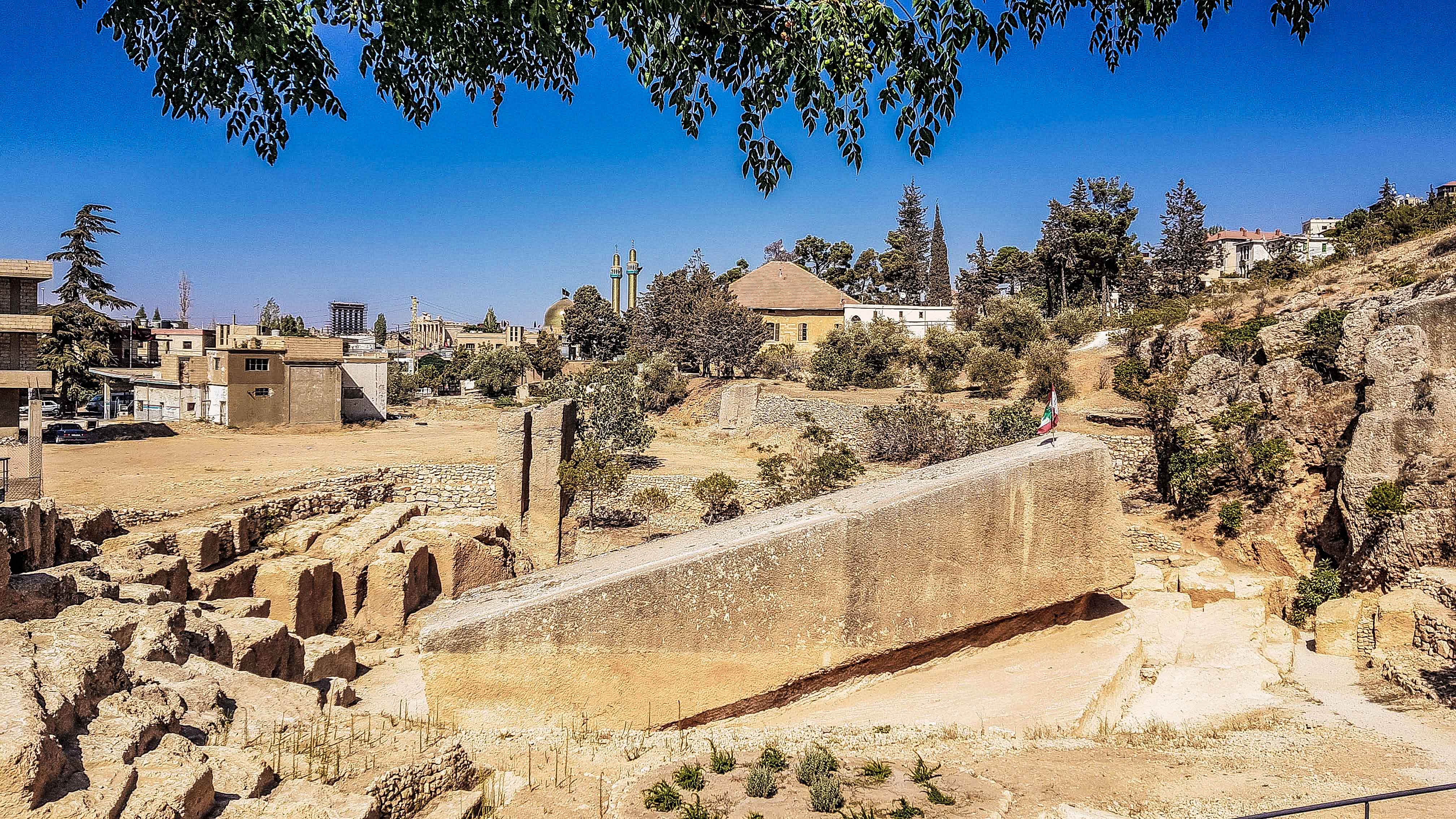
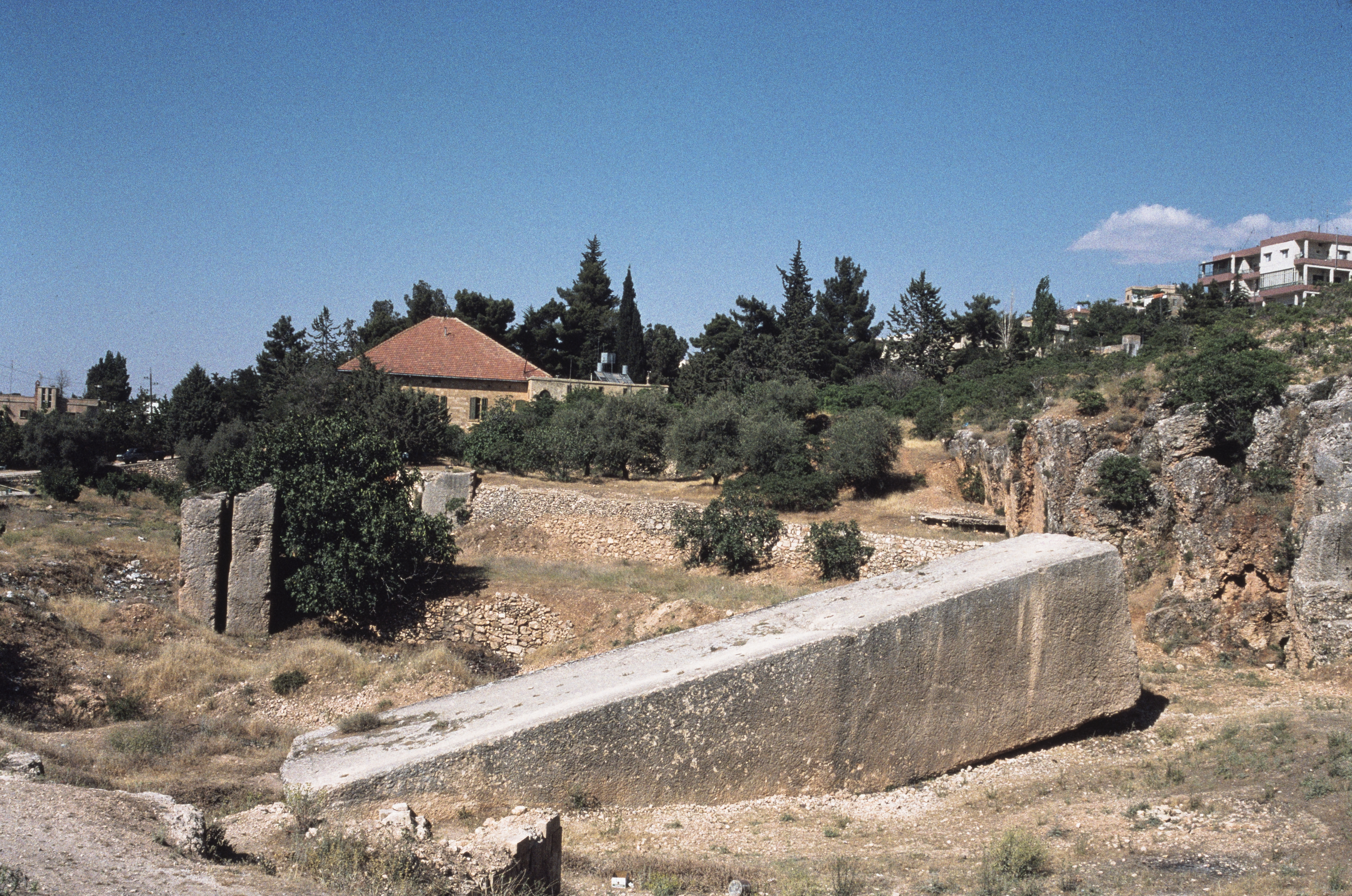
In the Bekaa Valley of eastern Lebanon, on the site of ancient Heliopolis, the Roman sanctuary of Baalbek holds some of the largest dressed stone blocks ever incorporated into a building. Three of them, set side by side in the western retaining wall of the podium beneath the Temple of Jupiter, are known as the Trilithon (Greek for “three stones”): each is roughly 19 to 20 meters long, about 4.3 meters high, 3.6 meters thick, and is estimated to weigh around 800 tonnes. They sit atop a lower course of still-massive blocks weighing an estimated 350 tonnes apiece, all raised some 7 meters above ground level as part of the temple’s foundation platform. A few hundred meters from the temple, in the quarry that supplied this stone, lies a block that never made the journey at all: the so-called “Stone of the Pregnant Woman” (Hajjar al-Hibla), around 1,000 tonnes and still attached to the bedrock on one side. In 2014, a German-Lebanese excavation team working under the Deutsches Archäologisches Institut (DAI) and the Lebanese University uncovered a third, even larger block nearby, estimated at roughly 1,650 tonnes — among the largest stones humans are known to have ever quarried. Baalbek, inscribed as a UNESCO World Heritage Site in 1984, is best known for the scale of its Roman-era temple complex, and the Trilithon is the single clearest expression of just how far that ambition was pushed.
The Structure
The Temple of Jupiter Heliopolitanus was the centerpiece of a temple complex built over roughly the 1st to 3rd centuries CE, when Baalbek — refounded as the Roman colony Colonia Julia Augusta Felix Heliopolitana around 15 BCE — became host to the largest temple dedicated to Jupiter Optimus Maximus anywhere in the Roman Empire. Construction most likely began under Augustus or shortly after, with the main temple substantially complete by around 60 CE (attested by graffiti left by workers on column drums), while other elements of the sanctuary, including the Temple of Bacchus and the great forecourts, continued to be built and embellished into the 3rd century under emperors such as Trajan, Antoninus Pius, and Caracalla. The site did not start as a Roman project, however: archaeological and textual evidence points to a long history of cultic activity on the same raised tell before the Romans arrived, with the Jupiter temple likely replacing an earlier sanctuary and possibly reusing part of its foundation.
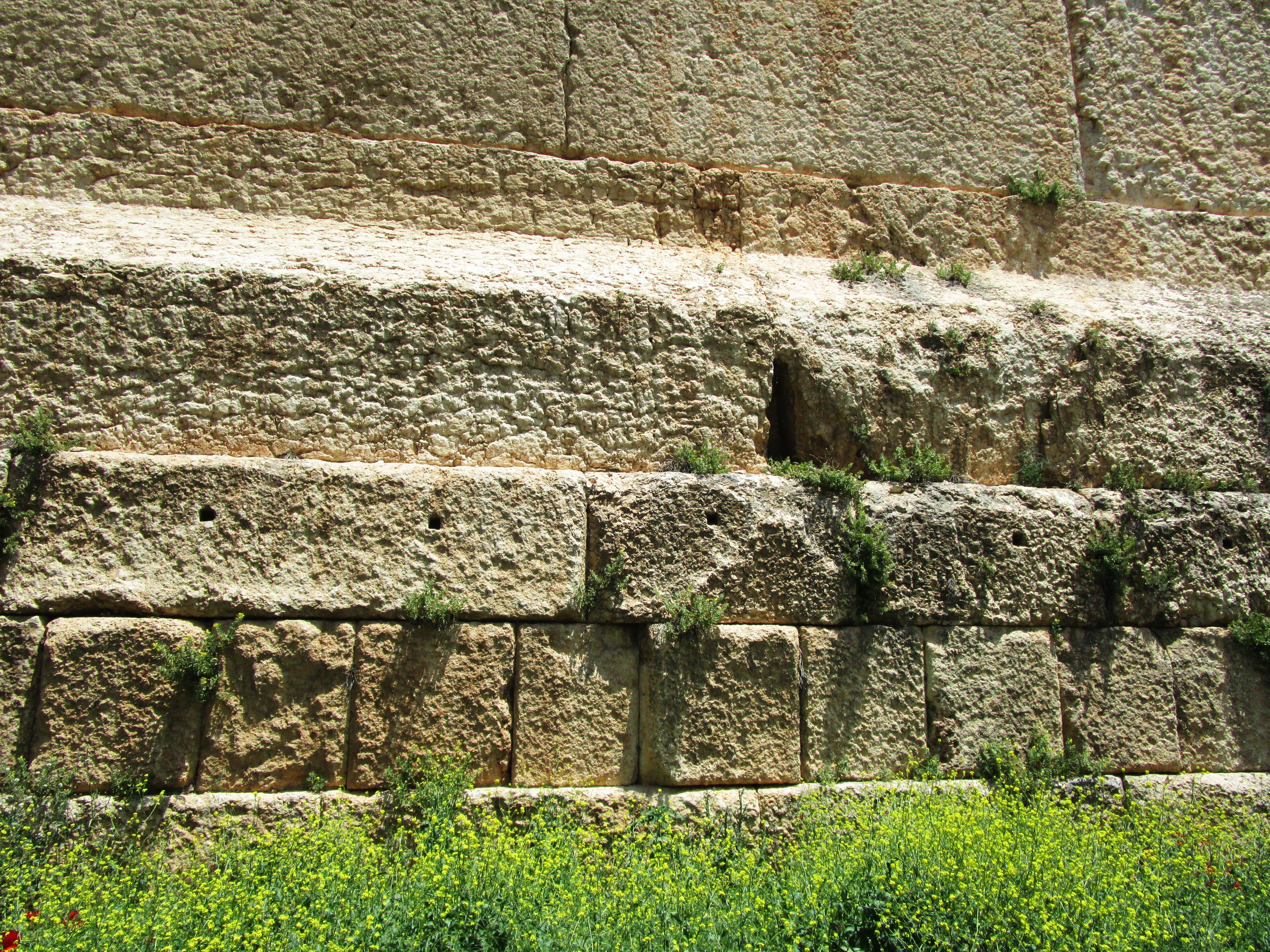
The Trilithon forms part of the massive podium — an artificially raised platform, faced in precisely fitted ashlar masonry, on which the temple’s colonnade once stood (six of an original 54 columns, each about 20 meters tall, still stand today). The lower courses of the podium’s western wall use blocks of around 300 to 350 tonnes; the Trilithon course above them steps this up further, with three single blocks each in the neighborhood of 800 tonnes making up a continuous run of wall roughly 19 meters long. Though the term “Trilithon” strictly describes a different kind of monument in archaeology (a pair of uprights topped by a lintel, as at Stonehenge), the name has been attached to these three stones since at least the early Byzantine period, when Baalbek’s temple was already regarded as an ancient wonder. Ancient writers and medieval travelers alike marveled at the podium, and it remains, by any measure, one of the largest assemblages of dressed monolithic stone in classical architecture.
How Was It Built?
The quarry that supplied the Trilithon lies roughly 800 meters from the temple, on ground slightly higher than the temple platform — a detail archaeologists consider significant, since it meant the blocks could in principle be moved downhill or on the level rather than lifted. Studies of the quarry, including the DAI-Lebanese University survey launched in 2004 and the 2014 excavation that uncovered the 1,650-tonne block, have reconstructed the general process: workers outlined a block’s shape on the natural limestone shelf, then cut galleries and channels around and beneath it, gradually separating it from the surrounding rock while leaving it resting on a thin shelf or a series of narrow stone “feet” until it was ready to be freed and moved. The unfinished blocks left behind, including the Stone of the Pregnant Woman and the 2014 discovery, still show this process partway through, with the underside not yet fully detached.
How the finished blocks were then hauled the several hundred meters from quarry to podium, and maneuvered into a wall many meters above ground level, is not directly recorded in any surviving Roman text. Reconstructions proposed by archaeologists and engineers include dragging the blocks on wooden sledges or rollers along temporary earthen embankments built up to the height of the podium, using large timber capstans, pulleys, and levers to inch the stones along, and packing and repacking supports beneath the block as it advanced — a slow, labor-intensive process requiring very large coordinated workforces but using techniques (rollers, ramps, capstans, massed levering) that are well attested elsewhere in Roman construction, including the moving of obelisks and large columns.
The Mainstream View
Archaeologists and classicists overwhelmingly attribute the Trilithon, and the wider Baalbek sanctuary, to conventional (if exceptionally well-resourced) Roman engineering: skilled quarry crews, large enslaved and free labor forces, imperial patronage able to fund a decades- to centuries-long building program, and construction methods — ramps, rollers, capstans, levers — documented at other major Roman sites. The scale of the Trilithon is understood as a deliberate statement of imperial and civic power rather than a structural necessity; a podium of this height did not require single 800-tonne blocks, but building it from a handful of colossal stones rather than many smaller ones would have visibly displayed the resources, organization, and audacity of the emperor and city that could pull it off. This view is well supported: the temple’s construction phases are dated fairly precisely through architectural inscriptions, brick stamps, and building style; the quarry sits close enough to have supplied the stone by straightforward overland haulage; and comparable feats of Roman stone-moving (multi-hundred-tonne columns and obelisks moved across the empire) show the underlying techniques were within Roman capability, even if applied here at an unusually extreme scale.
The Open Case
What keeps Baalbek genuinely puzzling is not whether Romans built it — the dating and attribution are secure — but the specific mechanics and motivation behind pushing stone-moving this far. No Roman text describes how the Trilithon blocks were actually transported, and no tool marks, sledge tracks, or construction debris directly documenting the final haul from quarry to podium have been recovered; every reconstruction of the method is an informed inference from the finished result, the quarry evidence, and comparable (but always smaller) known Roman feats. The scale gap is real: the largest obelisks and columns the Romans are documented to have moved elsewhere in the empire generally weighed in the range of a few hundred tonnes, well under the Trilithon’s roughly 800 tonnes, and nowhere close to the abandoned quarry block estimated at 1,650 tonnes — a stone so large that its own quarrymen apparently judged it too risky to move and left it in place. That raises an open question about why the builders repeatedly attempted, and in one case clearly gave up on, blocks so far beyond what any structural requirement demanded. Precision of fit, the logistics of leveraging multi-hundred-tonne stones up onto a 7-meter platform without modern lifting equipment, and the sheer organizational feat of coordinating the labor involved remain difficult to fully reconstruct in physical detail, even though no serious archaeologist doubts they were achieved by human hands. Baalbek’s scale has long made it a magnet for fringe claims involving lost civilizations or non-human builders; the evidence does not support those ideas, and the site is securely Roman (atop an older sanctuary). But setting fringe speculation aside still leaves a legitimate, unresolved engineering question: exactly how far Roman logistics could be, and were, pushed at Baalbek, and why the builders chose to make that point with stone rather than any easier alternative.
Sources
Connected findings
- The Stones Too Big to Move — Three civilizations, twenty-nine centuries apart, each pushed stone-moving to its exact breaking point — and left the proof lying exactly where it failed.
Gallery