Stelae of Aksum
How did Aksumite workers quarry, carve, transport, and raise single granite-like monoliths of up to 500-plus tonnes — including the Great Stele, the largest single stone humans are known to have ever attempted to stand upright — using only muscle, timber, and rope?
Why this rating?
- Construction difficulty
- 5/5
- Method uncertainty
- 4/5
- Capability gap
- 2/5
- Open questions
- 4/5
The Great Stele, at roughly 33 m and about 520 tonnes as a single carved block, is very likely the largest monolith humans ever attempted to stand upright, which puts construction difficulty at the ceiling. How Aksumite crews quarried, dressed, moved, and raised 500-plus-tonne stones with only timber, rope, earth ramps, and organized muscle is genuinely reconstructed rather than documented, so method uncertainty and open questions stay high. But the capability gap is deliberately moderate: the very fact that the biggest stele cracked and fell — apparently during or just after erection, too heavy for its base — shows the Aksumites were pushing at the edge of what their methods could do, not wielding some lost technology. Smaller stelae up to King Ezana's ~21 m monolith were raised successfully and still stand, so the achievement sits within, not beyond, a well-attested tradition of large-scale stone engineering.
Overview
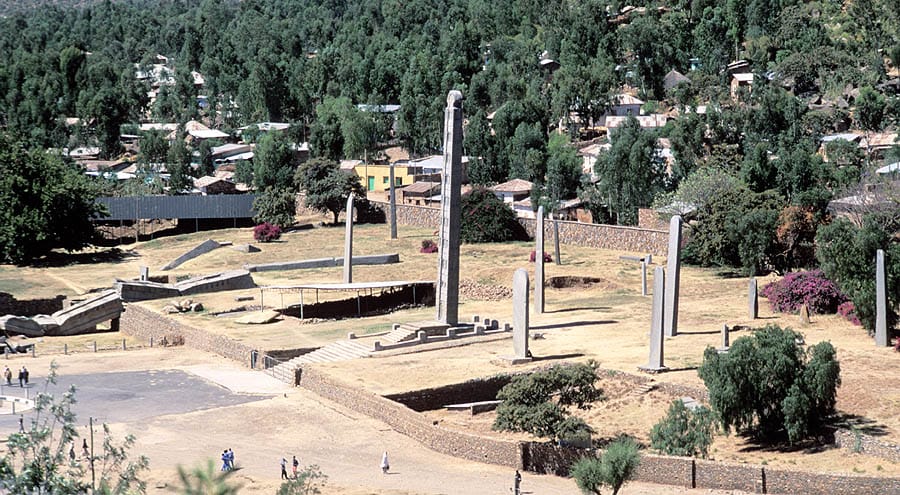
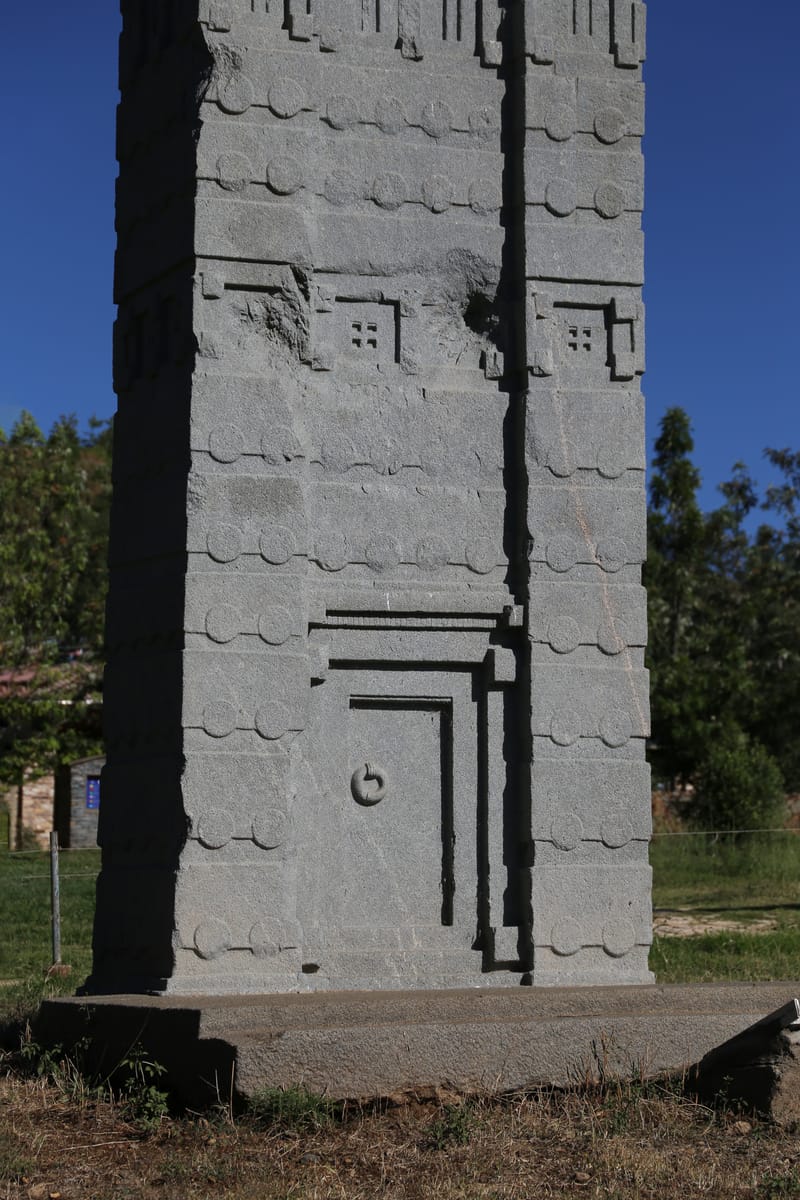
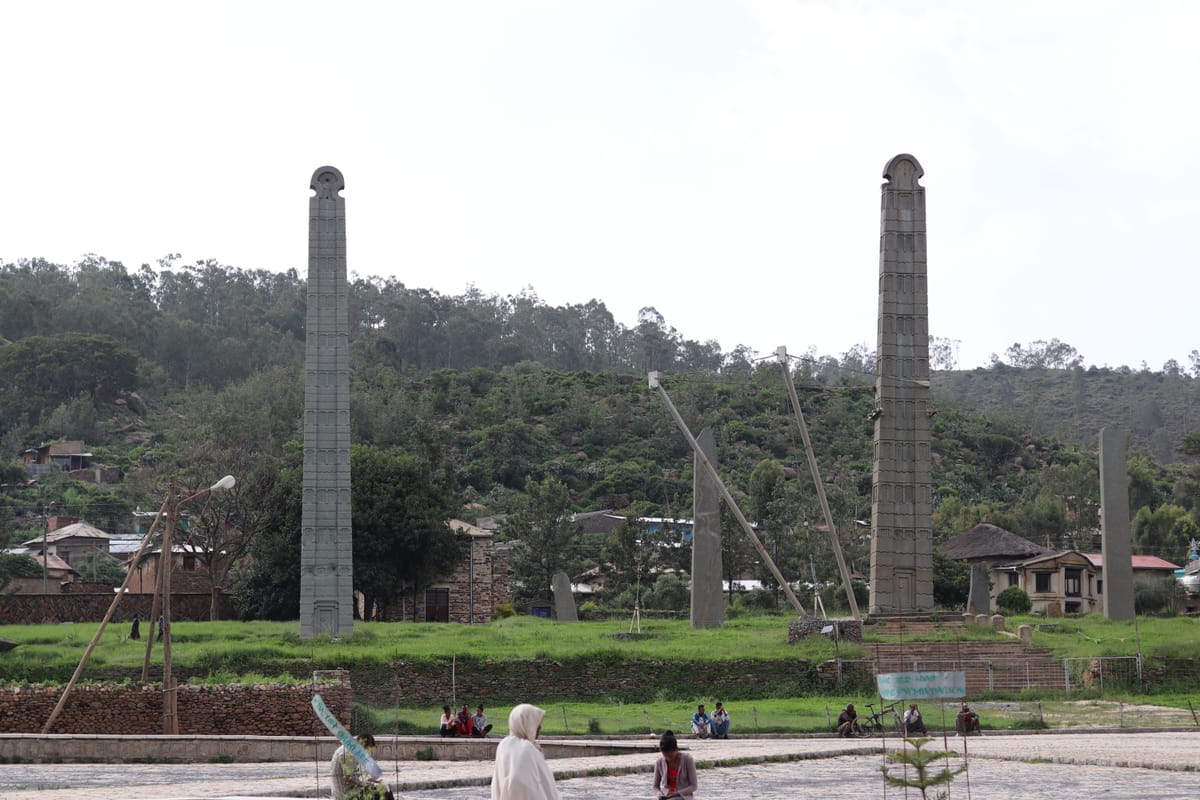
On the northern edge of the Ethiopian city of Aksum lies a field of the most audacious single stones the ancient world ever raised. The Northern Stelae Field holds scores of carved granite-like monoliths — around 120 in all, counting the plainest — set up as grave markers over the tombs of the kings and elite of the Kingdom of Aksum during the 3rd and 4th centuries CE. Most are modest, but a handful are colossal, and the largest were carved to imitate tall, storeyed tower houses, their flat stone faces cut with rows of false windows, projecting false beam-ends, and false doors set at the base — imagery of a dwelling for the dead, worked at monumental scale into solid rock. Aksum in this period was one of the great powers of the ancient world: a trading empire that, roughly between the 1st and 8th centuries CE, linked the Roman Mediterranean with Arabia, India, and the African interior, minted its own gold, silver, and bronze coinage from the 3rd century, and under King Ezana became, in the mid-4th century, one of the earliest states anywhere to adopt Christianity. The stelae belong to the last generations before that conversion, and they represent the peak — and, in one spectacular case, the breaking point — of Aksumite stone engineering. The whole city, stelae included, was inscribed as a UNESCO World Heritage Site in 1980.
The Structure
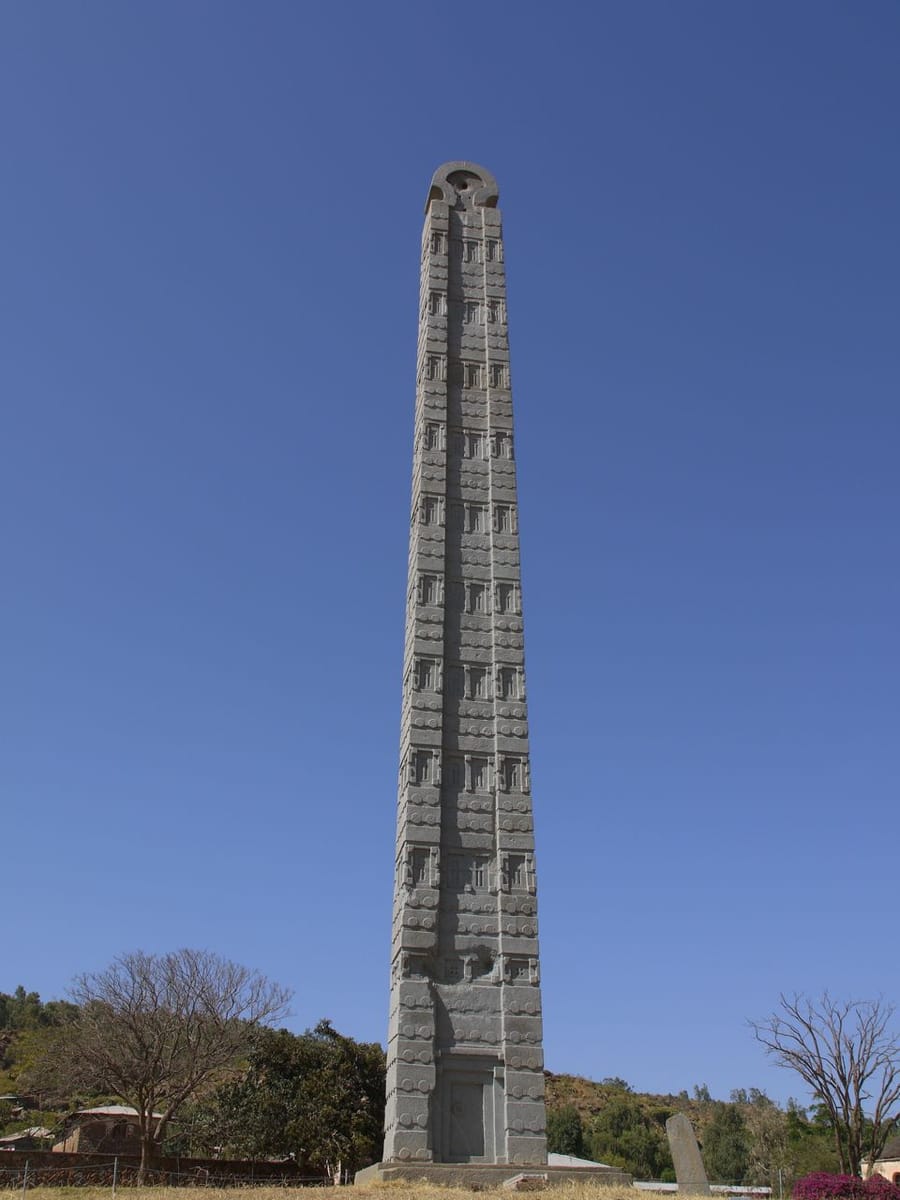
The giant stelae are single, upright slabs of nepheline syenite — a hard, coarse-grained igneous rock closely related to granite — quarried, carved, and stood on end above rock-cut tombs. Three dominate the field. King Ezana’s Stele, about 21 metres tall, is the largest that still stands intact on its original base, and is usually taken to be the last of the giants successfully raised. The second, known today as the Obelisk of Axum (Stele 2, or the “Rome Stele”), stands roughly 24 metres tall and weighs on the order of 160 tonnes; it is carved on every side to represent a nine-storey building, with rows of false windows and, at its foot, two false doors detailed down to carved door handles and false locks. And then there is the Great Stele (Stele 1): the most ambitious of all, a single block that would have risen some 33 metres and weighed around 520 tonnes — very likely the largest monolith any human society is known to have tried to erect. It never stood for long. It lies today broken across the field, and the evidence suggests it fell during or immediately after its attempted erection, early in the 4th century, apparently too massive for the base and foundation prepared for it. As it toppled, it crashed onto the nearby tomb of Nefas Mawcha, whose roof was itself a single stone of some 360 tonnes, shattering the upper part of the stele and, according to UNESCO, collapsing the tomb chamber and scattering its huge roof supports.
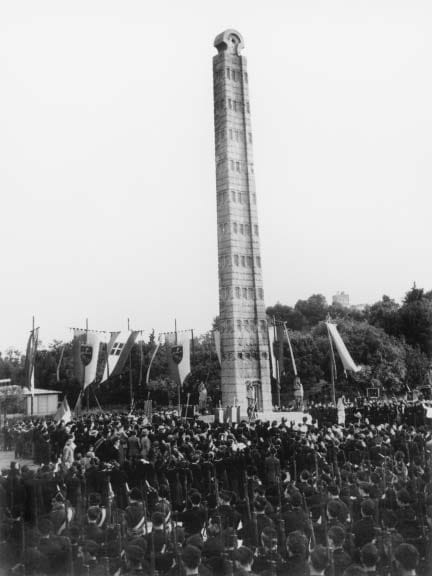
The Obelisk of Axum carries the field’s most turbulent modern history. In 1937, after Fascist Italy’s invasion and occupation of Ethiopia, the monument — by then already fallen and in pieces — was cut into sections and hauled off to Rome as war booty on Mussolini’s orders. It was re-erected in the Porta Capena square and unveiled on 28 October 1937, timed to the 15th anniversary of the Fascist March on Rome. Although Italy had formally agreed to return looted Ethiopian heritage as early as the 1947 peace treaty, the obelisk stayed in Rome for decades; a lightning strike in 2002 that damaged its top helped force the issue. Only in April 2005 was it finally flown home, its three main blocks carried one at a time by an Antonov An-124 heavy-lift aircraft, and only in 2008, under UNESCO supervision, was it reassembled and stood upright again on its original site — this time reinforced internally with aramid-fibre bars rather than steel, and unveiled anew that September.
How Was It Built?
Building an Aksumite giant began about five kilometres west of the city, at the quarries of Gobo Dura, where the nepheline syenite outcrops. There, workers detached enormous blocks from the living rock and roughed them out — likely in a partly unfinished state to save weight — before the far harder problem began: getting a block weighing tens or hundreds of tonnes across five kilometres of terrain to the stelae field. The mainstream reconstruction has crews dragging the stones on the ground, using organised manpower, timber rollers or sledges, ropes, and probably animal power and levers, exactly the toolkit attested for moving monumental stone in other pre-industrial societies. No inscription or drawing survives to record the method, so the details are inferred rather than documented.
Once at the site, the stone was carved — the false doors, windows, and beam-ends dressed into its faces — and then the decisive act came: raising it upright over its tomb. Here Aksumite engineering met its limit. The generally accepted picture is that the stelae were tilted up out of a prepared pit and against a counterweighted earth embankment or ramp, hauled into the vertical with ropes and levers, and finally seated on a foundation of massive base plates and support stones. For monoliths up to Ezana’s 21-metre, and even for the ~160-tonne Obelisk of Axum, this worked: they stood. For the 520-tonne Great Stele it did not. The scale of that failure is itself the clearest evidence of the method’s edge — the block was simply too heavy for the base beneath it, and it came down before it could ever be properly set.
The Mainstream View
Archaeologists and historians treat the stelae as a well-understood, if technically extraordinary, funerary tradition of the Aksumite state. Their date — chiefly the 3rd and 4th centuries CE — is anchored by the wider archaeology of Aksum and by the kingdom’s own coinage, which begins in the 3rd century and lets individual reigns be placed in sequence; the giant stelae belong to the pagan generations just before Ezana’s mid-4th-century conversion to Christianity, after which such monuments ceased to be built. Their purpose is not in serious doubt either: they stood as markers over elite and royal rock-cut tombs, their tower-house carvings understood as images of a dwelling for the afterlife. The material (Gobo Dura nepheline syenite), the quarry, and the general engineering — quarrying by hand, overland dragging, and raising by ramp, lever, and rope — all sit comfortably within the documented capabilities of a wealthy, well-organised ancient empire commanding large labour forces. The collapse of the Great Stele is read as a straightforward, if dramatic, engineering overreach: an attempt to exceed a size that the available foundation technology could support, which failed for ordinary mechanical reasons. Some scholars have even suggested the shock of that very public failure may have nudged Aksum toward its religious change. Nothing in the mainstream account requires anything beyond human muscle, timber, rope, and organisation.
The Open Case
What stays genuinely open is the how, in detail — not the who, the why, or the when. No Aksumite text, relief, or plan describes how these specific stones were quarried, carried, and raised, so every step of the operation is a modern reconstruction built from the physical remains and from comparison with other stone-moving cultures. The transport of a 500-plus-tonne block across five kilometres of uneven highland ground is asserted more than it is demonstrated: the exact combination of sledges, rollers, ramps, draught animals, and human teams, and how the load was controlled on slopes, remains inference. The raising is harder still. Standing the ~160-tonne Obelisk of Axum was already a feat at the far edge of pre-modern engineering — a fact underlined by how much effort it took UNESCO, with modern cranes and analysis, to re-erect it safely in 2008 — and how the Aksumites managed it without any such tools is reconstructed rather than known. The Great Stele sharpens the puzzle from the other side: its failure tells us they were operating right at the boundary of what their foundations could bear, but it does not tell us precisely what technique they used, how close it came to working, or what they had learned from the successful giants that came before. Precise dating within the 3rd–4th century span, too, rests on indirect evidence rather than firm inscriptions tied to individual stelae. None of this points to lost knowledge or outside help — the successfully raised stelae still standing at Aksum prove the ability was real — but the exact engineering of the largest stones humans ever tried to stand upright remains, fittingly, an unsolved problem of ancient craft.
Sources
- UNESCO World Heritage Centre — Aksum
- The Metropolitan Museum of Art — The Monumental Stelae of Aksum (3rd–4th Century)
- The Metropolitan Museum of Art — Foundations of Aksumite Civilization and Its Christian Legacy (1st–8th Century)
- Wikipedia — Obelisk of Axum
- Wikipedia — King Ezana's Stele
- Wikipedia — Kingdom of Aksum
- UNESCO World Heritage Centre — News: Aksum Obelisk return and reinstallation
- History Workshop — Radical Objects: The Obelisk of Axum and the Complexities of Restitution
- aksum
- ethiopia
- stelae
- obelisk
- kingdom-of-aksum
- funerary-monument
- megalith
- granite
- nepheline-syenite
- unesco-world-heritage
- looted-heritage
- tigray
Gallery