The Whisper You Can't Hear Yet
A note left on the statue tells you to listen at dawn. In the year the game is set, there is nothing to hear — the earthquake that gave the Colossus a voice is still seven years away.
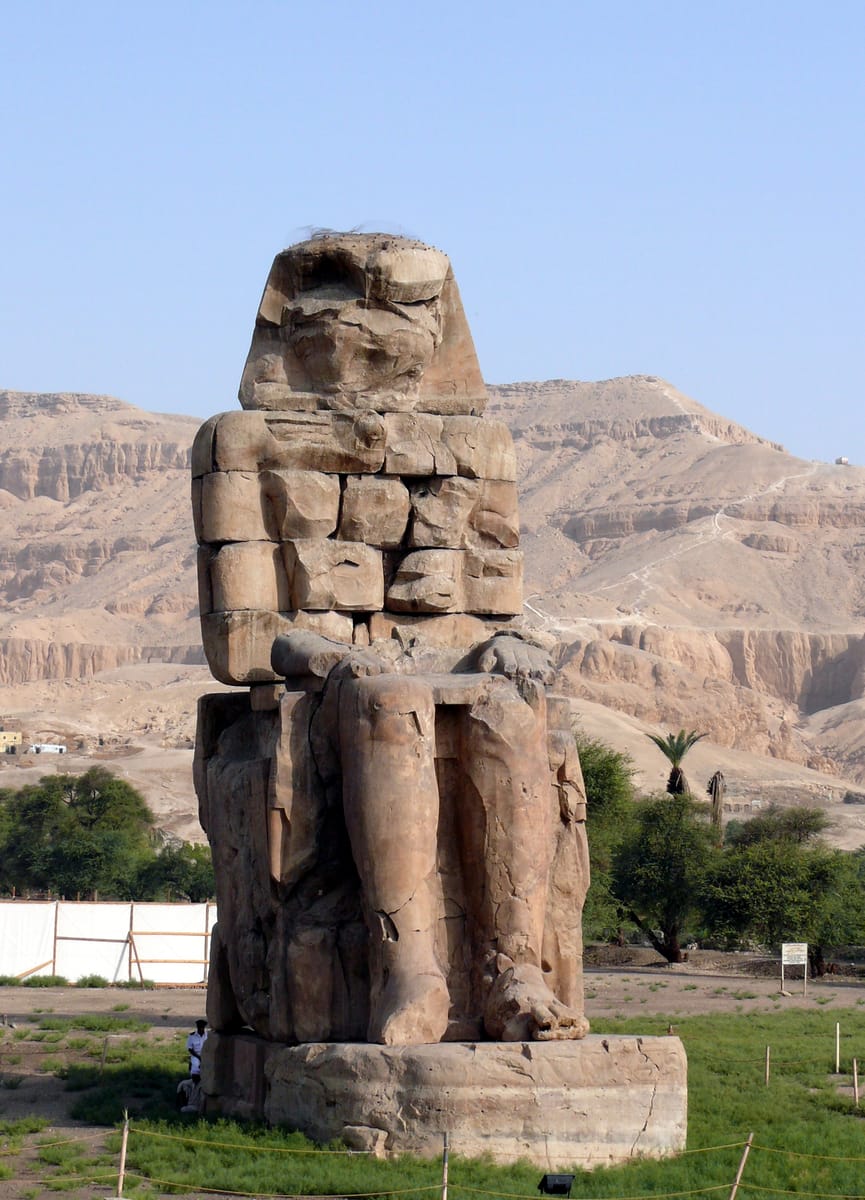
Everything the Colossi are famous for is a sound. Two seated figures of Amenhotep III, each cut from a single block of quartzite and dragged most of the length of Egypt — and what made them the most visited attraction in the ancient world was that one of them, after an earthquake split it in 27 BCE, started making a noise at sunrise. Greeks and Romans sailed up the Nile to stand in the dark and wait for it. More than a hundred of them scratched their names into the legs afterwards to prove they had heard it. Then a Roman repair job around 199 CE filled the cracks, and it never made the noise again.
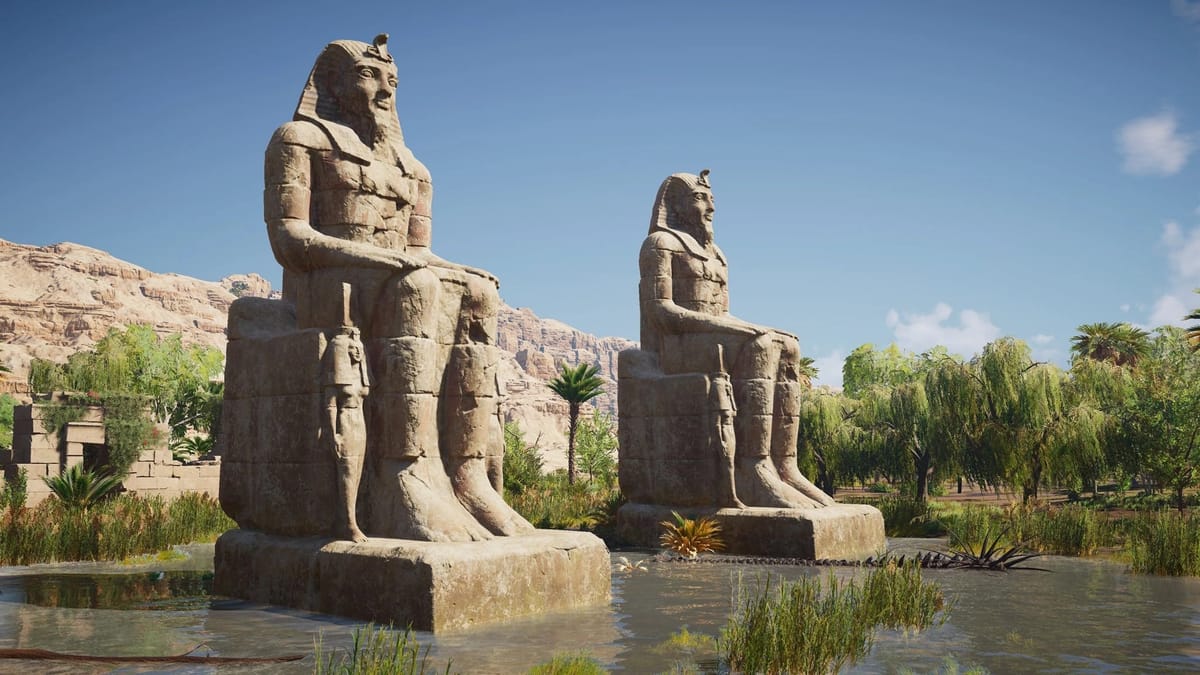
Assassin’s Creed Origins puts you at the foot of the statues in the wrong decade for that. The Curse of the Pharaohs, the expansion Ubisoft Sofia released in March 2018, opens up Thebes and the west bank, and the Colossi are a marked landmark out in the Theban Necropolis — sunk to the ankles in standing floodwater, with crocodiles nesting between the plinths. The side quest there is called Idol Hands, and it is a small comedy: a priest named Sab, sent out to bring Amun’s light to curse-blighted farmland, has been chased up one of the statues by the crocodiles and is stranded on top of it, shouting at the children of Sobek to return to the chaos waters. You climb up, kill the crocodiles, and talk him down. What Ubisoft gets exactly right is the water. The mortuary temple these two were built to guard is gone precisely because it was raised too near the floodplain, and the game leaves you wading through the mechanism of its destruction.
The statues themselves are whole — both of them, faces on, no seams. That is correct for the date, and it is easy to miss how unusual it is to see. Every photograph of the real northern colossus shows an upper body assembled from stacked courses of smaller blocks, a Roman reconstruction over the ruin the earthquake left. In the game’s Egypt that earthquake has not happened yet, so the game shows you something no living person has ever seen: the pair intact, as monoliths. And then, on one of them, there is a note. It reads: “At dawn listen, listen on the wind for the whispers of the Colossi, for they bring all who hear them good fortune.” Ubisoft dates this quest to 34 BCE. The crack that gave the northern statue anything to whisper with is seven years in the future. The name on the map marker — Memnon, the Trojan hero the Greeks decided was greeting his mother the dawn — is a name that only exists because of a sound that has not started. The game hands you the legend, in full, before its cause.
Total War: Pharaoh reaches back further and takes even less. Creative Assembly’s 2023 strategy game is set in the Bronze Age collapse, around 1200 BCE, when the Colossi are roughly a hundred and fifty years old and thoroughly silent, and it files them as a unique Monument Outpost in Upper Egypt: 100 gold and 500 stone, +5 Legitimacy, +2 Influence in the province, and a Pay Homage button that buys your army a few turns of morale. Play as Tausret and you begin the campaign already holding them. The flavour text says Amenhotep III “doubled himself in massive stone to safeguard his mortal remains and immortal glory” — half right, since the colossi fronted a temple for his cult while the king went into the ground across the ridge in the Valley of the Kings. The English build also spells them the Collosi of Memnon, which is its own kind of honesty: a Greek name, a millennium early, misspelled.
Neither game can give you the thing itself, and neither is being careless — the window was only about two hundred years wide, bracketed by an earthquake at one end and a Roman mason at the other, and both games sit outside it. What survives the translation is stranger than a sound effect would have been. Ubisoft left a note on a statue telling you to be there at dawn and listen. It is, as instructions go, entirely correct. You are just standing in front of it seven years too soon.
Read the full study: Colossi of Memnon
Sources
- Assassin's Creed Wiki — Colossi of Memnon
- Assassin's Creed Wiki — Idol Hands
- Assassin's Creed Wiki — The Curse of the Pharaohs (expansion)
- Ubisoft News — Curse of the Pharaohs Lets You Explore a New World, Fight Undead Royalty
- Neoseeker — Idol Hands (The Curse of the Pharaohs walkthrough)
- Total War Wiki — Monument Outposts (Total War: Pharaoh)
- Total War Wiki — Tausret
- Total War Wiki — Total War: Pharaoh
- Wikipedia — Colossi of Memnon