The Mistake You Collect
Partway up, Sneferu's builders changed the angle to save the pyramid from itself. Games rebuild that correction faithfully — the interesting part is which of them will admit what it is.
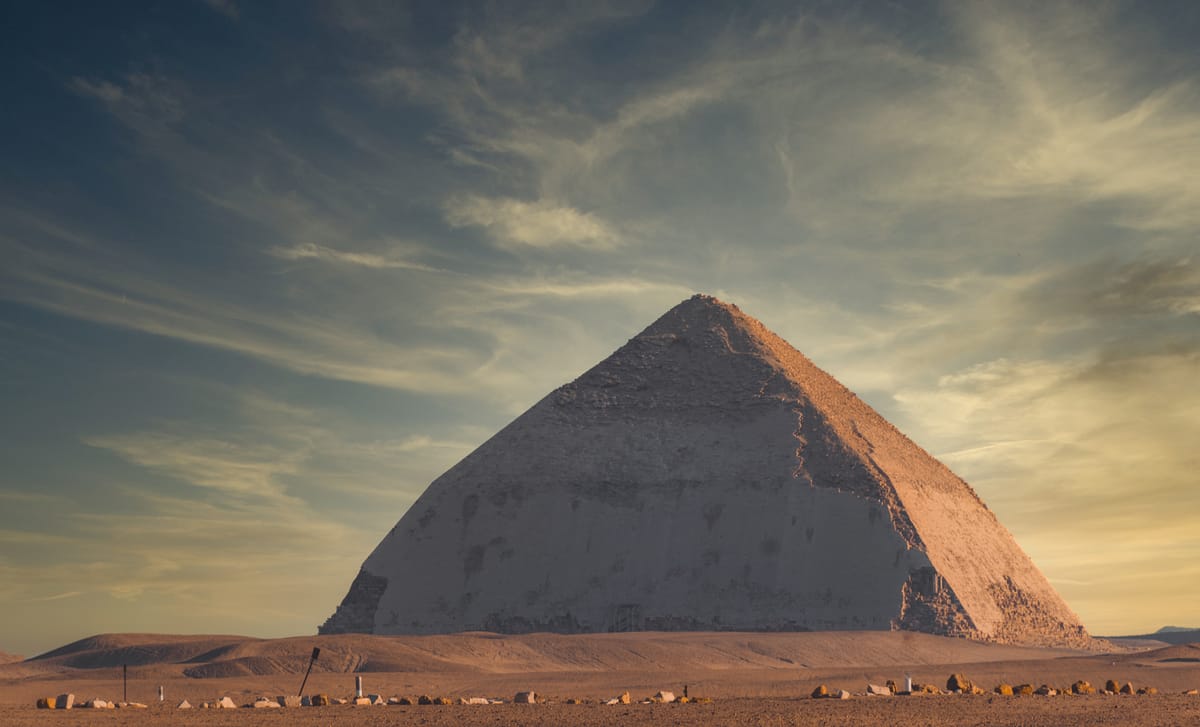
About forty-seven metres up, the builders stopped and changed their minds. Sneferu’s pyramid at Dahshur climbs out of the sand at roughly 54 degrees, and then, at that line, it leans back to 43 and finishes that way. Behind the change is a bad season on site — cracking, settling, a mass of stone accumulating faster than soft ground could carry it — and the fix was to shed weight and get the thing closed. Forty-six centuries later the decision is still legible from kilometres off, an engineering emergency preserved at monumental scale. So the question about a game that puts this pyramid on screen is not whether the model is right. It is whether the game knows what it is modelling.
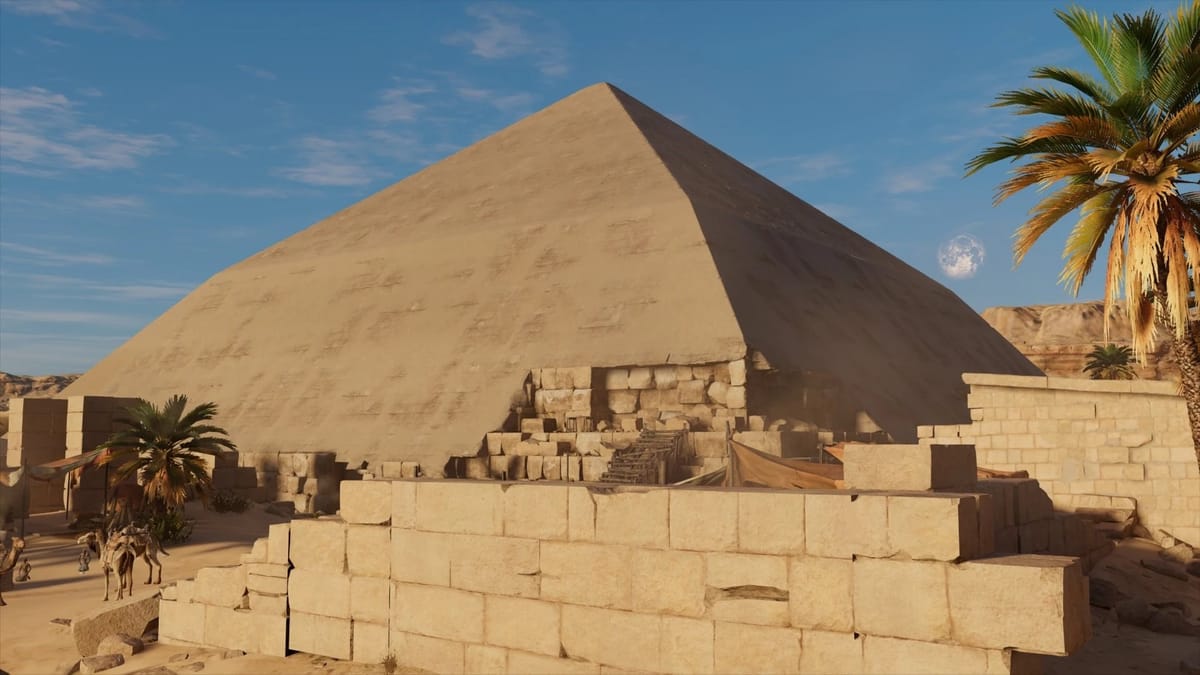
Assassin’s Creed Origins renders it, first, accurately. Its Bent Pyramid stands in the Saqqara Nome with the satellite pyramid off its south-west corner, the ruined mortuary temple along the eastern face and the wrecked causeway trailing off toward the river — and with the break in the slope carried straight through the geometry. From the ground it is easy to miss, and the screenshot above is a fair test: extend the line of the upper face downward and the actual flank falls away outside it, steeper below the kink than above. Ubisoft also gets to show what no photograph can. The Dahshur chapters play out in 48 BCE, so the casing is still on: the Bent Pyramid keeps more of its polished Tura limestone than any pyramid in Egypt, and here it keeps all of it, a sealed and gleaming monument that is nonetheless visibly kinked. The casing does not soften the mistake. It sharpens it.
The game also explains itself, which is the surprising part. Its in-game database entry turns on the shift in inclination from 54 degrees to 43 degrees partway to the apex, and a scholar called Merkes — whom Bayek rescues from bandits out in the desert — lays out the whole sequence unprompted: Meidum was “his first, and failed, pyramid,” and the Bent is the one whose shape “is due to an alteration that saved it from suffering the same fate as its brother.” That is, near enough, the mainstream Egyptological reading, delivered as optional side-quest chatter — and not even chatter everyone got, since Secrets of the First Pyramids shipped only with the game’s special editions before going on sale separately for forty Ubisoft Club units. The odd thing is that Discovery Tour — the free, classroom-facing mode, built with historians — is the one that flinches. Its four stations on the Bent Pyramid are titled “Sneferu’s Second Pyramid,” “A Design Transition,” “Too Small for a Human” and “Experimental Construction,” and between them they cover Meidum’s failure, the two entrances, the chamber too small for a burial, the new horizontal coring, and the verdict that the precautions “did not prevent sagging or cracks in the interior rooms.” Every consequence is there. The cause never is. The station actually called “A Design Transition” means the shift from step pyramid to smooth-sided pyramid — a transition between monuments — and the tour will tell you the Bent is “the only one of its shape in Egypt” without once saying what that shape is, or that the shape was a decision taken mid-build. The action game is more honest than the lesson attached to it.
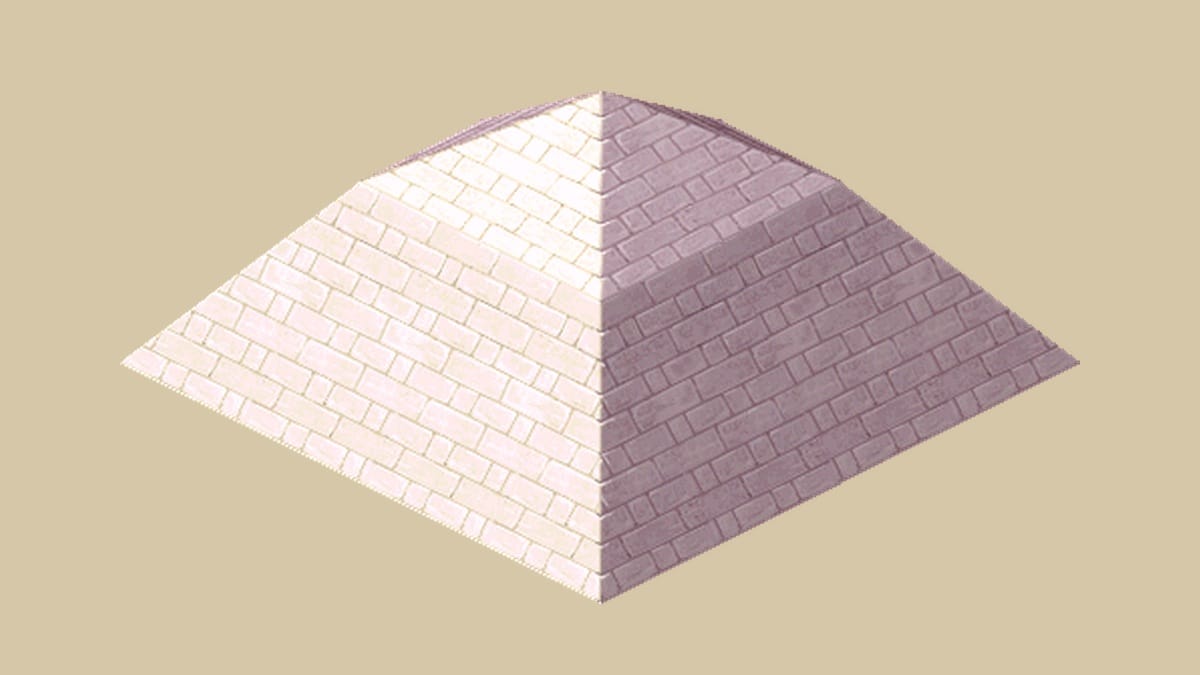
Pharaoh had already gone one better, eighteen years earlier, by making you do it. In Impressions Games’ 1999 city-builder the Bent Pyramid is its own monument type, distinct from the stepped pyramid and the true pyramid, and it appears in exactly one mission: South Dahshur, where Sneferu wants a tomb “even more spectacular” than his predecessor’s and you must deliver, per the goal screen, twenty-one points of Monument Rating in the form of one medium Bent Pyramid. The briefing even gets the surface right — a plain stone core “faced with fine white limestone, that it may forever shine under the desert sun” — and the build reflects it: the limestone ratio climbs as the courses rise, and your stonemasons polish the outer skin smooth once the last block is set. Then the campaign moves you north to build a proper one. You play Meidum, then the Bent Pyramid, then the true pyramid at North Dahshur, in that order, on that schedule. Sneferu’s learning curve is the mission list. The 2023 remake kept the monument on the menu.
Which brings back the best joke in Origins. That side quest has you gather three artefacts, and the artefacts turn out to be scale replicas of Meidum, the Bent Pyramid and the Red Pyramid — the collapse, the correction, and the one that finally worked. You carry all three to the top of the Red Pyramid and push them into slots in its capstone, where they lock together into a map. The masterpiece alone won’t open Sneferu’s vault. The game makes you bring the mistakes. Only one detail is off, and it is the Discovery Tour’s: it says the Bent Pyramid was abandoned. Sneferu abandoned it as a tomb and went north for a better one, but the pyramid itself was finished, all the way to a point. The bend is not where the thing was given up on. It is where it was saved.
Read the full study: Bent Pyramid of Sneferu
Sources
- Assassin's Creed Wiki — Bent Pyramid (in-game codex description)
- Assassin's Creed Wiki — Secrets of the First Pyramids (quest transcript)
- Assassin's Creed Wiki — Tours: The Bent Pyramid of Dahshur (Discovery Tour station text)
- Ubisoft — Discovery Tour by Assassin's Creed: Ancient Egypt
- Gamers Heroes — How to get into the Bent Pyramid of Sneferu in Assassin's Creed Origins
- Impressions Games Wiki — Bent Pyramid (Pharaoh monument type)
- Impressions Games Wiki — South Dahshur (mission briefing and goals)
- Pharaoh Heaven — South Dahshur walkthrough
- Steam — Pharaoh: A New Era
- Wikipedia — Bent Pyramid